
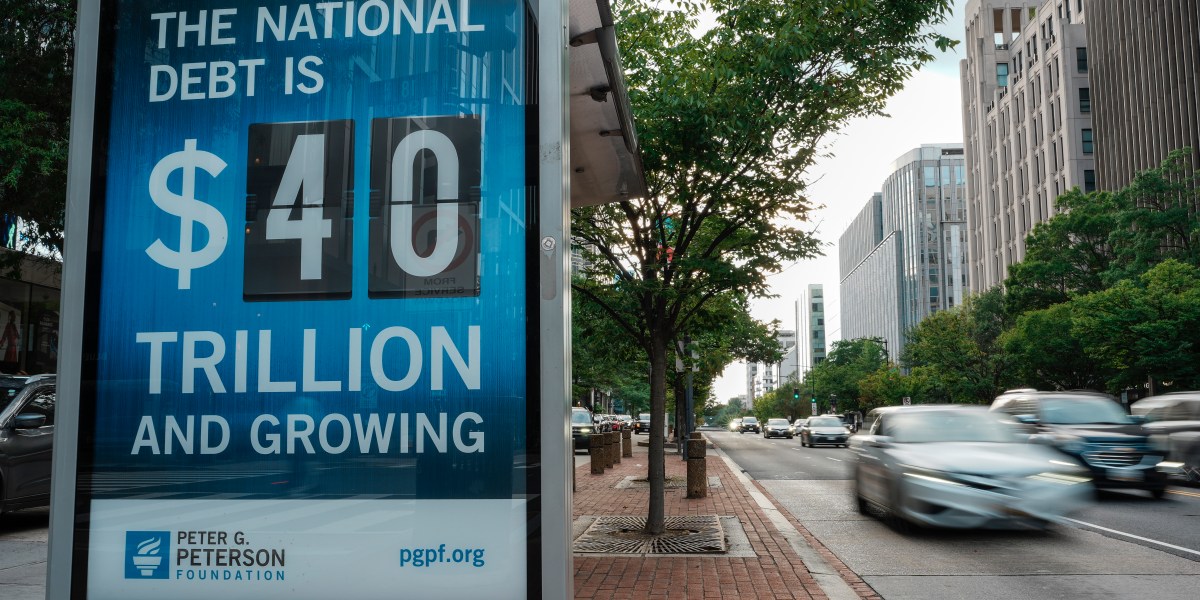
Policy optimists have long waved off concerns about a fiscal crisis in the U.S.: the moment at which the debt burden would grow so large that it would be either impossible to finance repayments or would require economic consequences. The national debt burden now stands at more than $40 trillion, but the U.S. remains the largest economy on the planet—why worry?Borrowing advocates also suggest that interest rates are elevated across many markets; the U.S. isn’t alone in relatively higher rates and therefore does not stand out as a cause for concern.But Moody’s top economist, Mark Zandi, believes he is seeing the first signs of discomfort in the Treasury market. He also says that while many nations will have to wrangle with their borrowing burdens, the scale of the U.S. economy means its situation is “far and away the most important one.”
Zandi isn’t an outlier in his outlook. For many years, debt hawks (those concerned about the eye-watering levels of government borrowing) have warned that just because no crisis has happened yet, it doesn’t mean it won’t happen at all. Their concern is not necessarily the value of public debt, but rather the country’s debt-to-GDP ratio.
This reveals the extent to which the government is borrowing to sustain necessary spending on services and operations, relative to its economic growth and, therefore, how comfortably it can repay its debts. At the time of writing, the U.S. ratio stands at 126%.
The potential form of a fiscal crisis varies depending on which policymaker or economist you ask: Bridgewater Associates founder Ray Dalio believes America will suffer an economic “heart attack,” while Kent Smetters, professor of business economics and public policy at the University of Pennsylvania’s Wharton School, previously told Fortune he believes the U.S. will inflate its way out of a crisis.
Zandi wrote in a note late Sunday night that he is seeing the early signs of a spiral. His warning comes as the U.S. Treasury confirmed a $2 trillion deficit for the fiscal year ending in October, more than half of which was on interest payments alone.
“But arguably most significant is that global investors see all this and appear to be demanding a higher rate to compensate for the mounting risk,” Zandi wrote. “The 10-year Treasury yield is up about a percentage point this year, among the biggest increases of any major economy, and the countries with the heaviest interest burdens have generally seen the biggest increases.
“A vicious cycle threatens to take hold, with higher rates adding to the interest payments and debt load, which in turn pushes rates up even more.”
Further afield
The U.S. isn’t alone in its wrangling over the burden of higher repayment rates. The IMF said in a note last week that long-term sovereign yields have “increased sharply” for a number of major advanced economies. Between February and September of 2026, it noted, the G7’s average 10-year government bond yield increased by over one percentage point, reaching its highest level in nearly two decades.
Treasury Secretary Scott Bessent has noted this, suggesting higher U.S. yields would be a cause for concern if they were “idiosyncratic” rather than matching a global trend.
But Zandi suggests the magnitude of the U.S. economy makes it notable despite the context, writing: “The U.S. isn’t the only country approaching a fiscal reckoning, but given that Treasuries are the global benchmark, it is far and away the most important one.”
This story was originally featured on Fortune.com
Hence then, the article about the u s national debt is approaching the point where bond traders see mounting risk of a vicious cycle moody s top economist says was published today ( ) and is available on Fortune ( Middle East ) The editorial team at PressBee has edited and verified it, and it may have been modified, fully republished, or quoted. You can read and follow the updates of this news or article from its original source.
Read More Details
Finally We wish PressBee provided you with enough information of ( The U.S. national debt is approaching the point where bond traders see ‘mounting risk’ of a ‘vicious cycle,’ Moody’s top economist says )


Also on site :
- New species of sperm whale identified from fossils found in Gunma
- ‘Barry Loser’ Animated Series, Based on Bestselling U.K. Children’s Books, Finds Italian Partners Ahead of Rome’s MIA Market (EXCLUSIVE)
- Wayfair’s ‘Soft and Silky’ Embroidered Farmhouse Comforter Set Is Perfect for a Fall Refresh, Now $50