
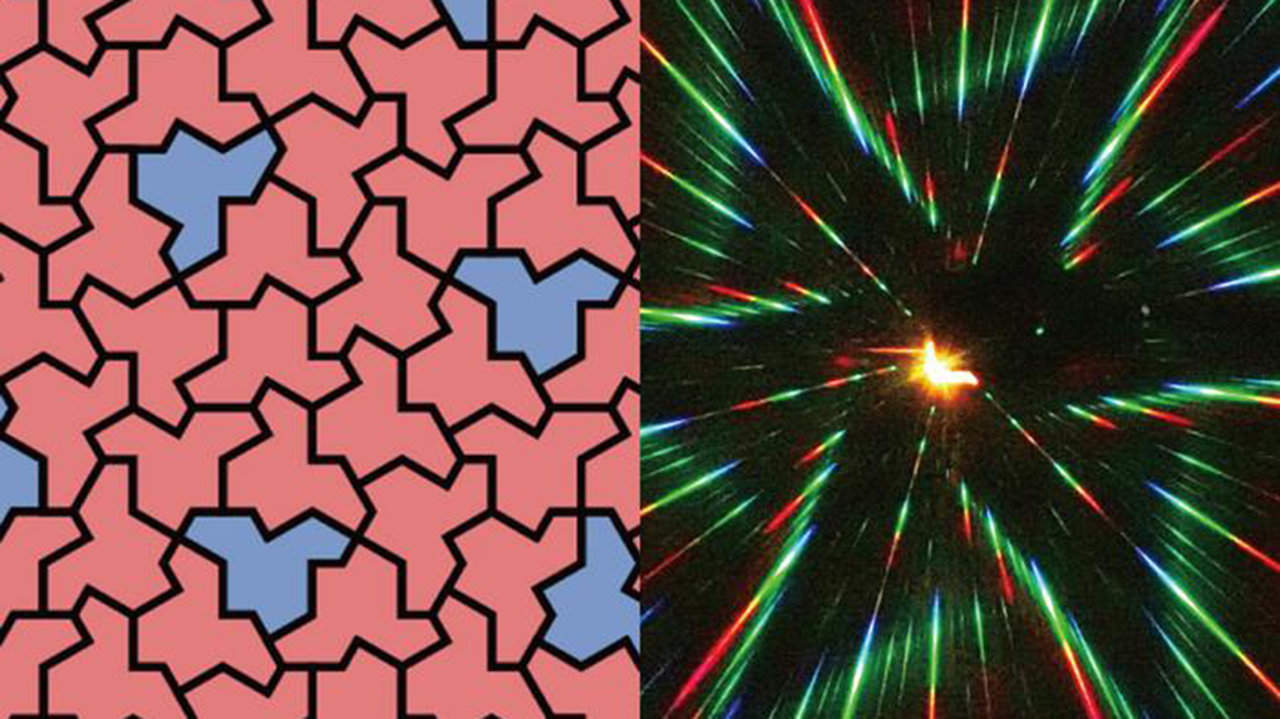
Physicists have built a crystal out of an "einstein" tile — an elusive shape mathematicians spent years searching for — and found that it bends light in a way no ordinary crystal can.
In the new study, published July 29 in the journal Nature Communications, researchers arranged this never-repeating tile shape into a pattern of nanoscale holes. This structure, known as a photonic crystal, is designed to control the way light moves through it. When the team shined a laser at it, the crystal produced a swirling, pinwheel-shaped scattering pattern that responded differently depending on which direction the incoming light was spinning.
The tile solves what mathematicians call the "einstein problem," a decades-old puzzle asking whether a single shape could cover a flat surface endlessly without ever repeating its pattern. (The name is a pun on "ein stein," German for "one stone," not a reference to Albert Einstein).
In the 1970s, mathematician Roger Penrose showed that two different shapes, used together like floor tiles, could cover a surface without the pattern ever repeating. Then, in 2023, geometry enthusiast David Smith and collaborators finally found one: a 13-sided shape that they nicknamed the "Smith hat"
Yuto Moritake, an experimental physicist at the University of Tokyo, first came across the hat tile in a popular science book in 2024. Moritake specializes in photonic crystals — materials patterned with repeating structures (often much thinner than a human hair) that bend and steer light for uses like lasers and optical sensors. Almost all photonic crystals rely on patterns that repeat in a regular grid. Moritake wondered what would happen if he swapped that repetition for the hat tile's never-repeating arrangement.
"I decided to include it in our photonic crystal structure," Moritake told Live Science, describing it as the starting point for the project.
To build the structure, Moritake and his colleagues used two precision manufacturing techniques, called electron beam lithography and etching, to punch hundreds of thousands of tiny holes — each just 100 nanometers in radius, or roughly 500 times thinner than a human hair — into a thin film of silicon nitride. This ceramic material is commonly used in computer chips. The holes were arranged according to the hat tile's pattern, covering a chip roughly half a millimeter across — about the width of a pencil tip.
When the team shined a laser at the finished chip, the light scattered, or diffracted, into a pinwheel-shaped pattern that appeared on a screen. Moritake first photographed the colorful pattern using his iPhone's long-exposure mode. The setting captured faint light over several seconds. Then, he switched to specialized cameras for more precise measurements.
The pattern was made up of well-defined bright spots, called Bragg peaks, that stayed in the same positions no matter where on the chip the laser hit. That consistency confirmed that the structure had the kind of long-range, predictable order found in a quasicrystal — a class of material whose atoms (or, in this case, holes) follow an orderly pattern that never repeats, unlike the repeating grids found in ordinary crystals such as table salt or diamonds.
Related stories'Crystals' of space-time could be the origins of certain rare black holes, theoretical study hints Scientists unveil new type of 'time crystal' that defies our traditional understanding of time and motion Distorted crystals use 'pseudogravity' to bend light like black holes do
Because the hat tile itself has no mirror symmetry — meaning it doesn't look the same as its own reflection, similar to how a left hand differs from a right hand — the scattering pattern it produced was also asymmetrical in this way. Scientists call this property chirality.
That chirality led to the study's biggest surprise. Light can be circularly polarized, meaning it spins either clockwise or counterclockwise as it travels, like a corkscrew. When Moritake tested the structure with both types of spinning light, he found a subtle difference in how each direction scattered off the crystal. Ordinary quasicrystals, which do have mirror symmetry, cannot produce this kind of effect.
"This structure can have some kind of circular polarization dependence," Moritake said, adding that the effect — made only possible by the tile’s asymmetry — was not something he initially expected to find .
Now, Moritake wants to apply this never-repeating pattern to control light traveling inside a photonic chip, rather than light that simply bounces off its surface. This could lead to future uses in optical communications and optical computing — technologies that use light instead of electricity to transmit or process information, Moritake said.
See how much you know about Albert Einstein with our Albert Einstein quiz!
Hence then, the article about crystal made from 13 sided einstein shape bends light in ways nobody imagined was published today ( ) and is available on Live Science ( Middle East ) The editorial team at PressBee has edited and verified it, and it may have been modified, fully republished, or quoted. You can read and follow the updates of this news or article from its original source.
Read More Details
Finally We wish PressBee provided you with enough information of ( Crystal made from 13-sided 'einstein' shape bends light in ways nobody imagined )


Also on site :
- Humanoid robot sales hit 7,000 worldwide last year
- Adam Sandler and His Wife Go Incognito in NYC; 60-Year-Old Comedian Is Nearly Unrecognizable Rocking a Bright Purple Hoodie
- Tributes Pour In for Music Legend John Farnham After 55-Year Career