
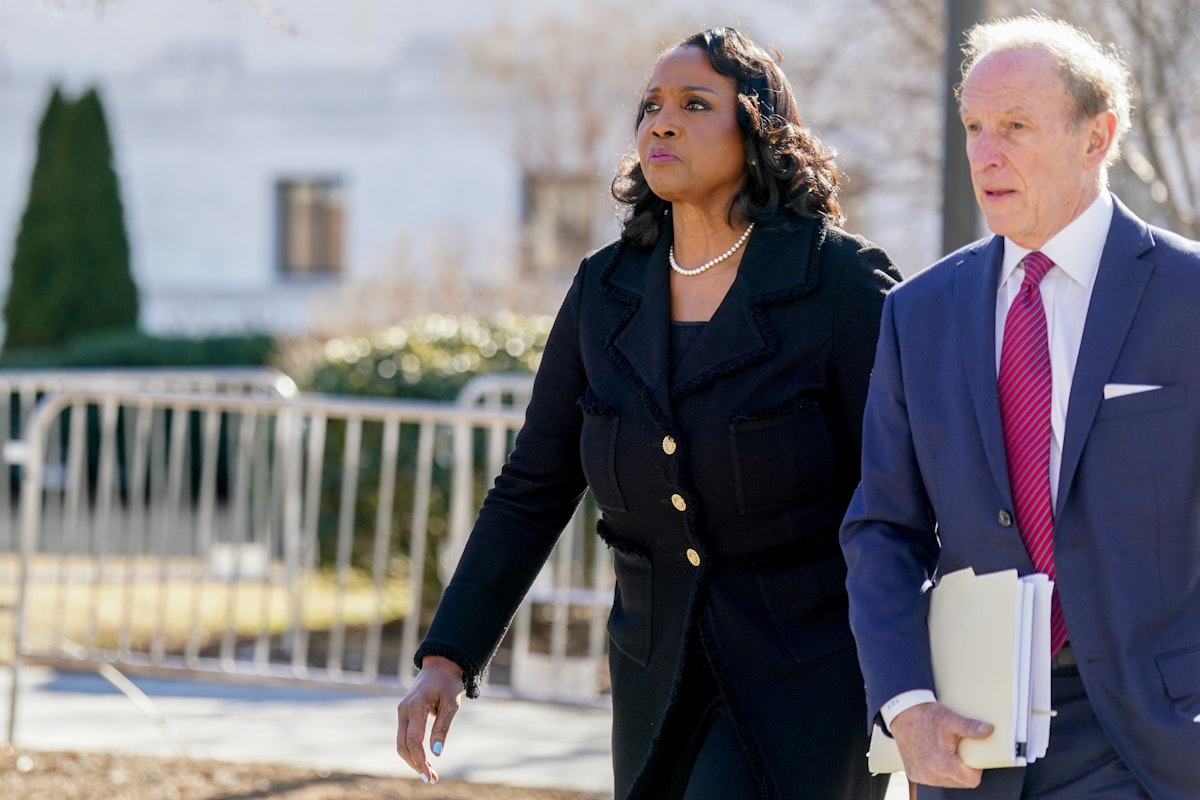
The Supreme Court appeared likely to reject President Donald Trump’s bid to fire Federal Reserve Governor Lisa Cook during oral arguments on Wednesday, finally marking an outer limit of what the court’s conservative members would stomach from Trump’s authoritarian second term.
There did not appear to be five votes among the justices to embrace Trump’s radical assertion of executive power over the nation’s central bank. The Fed’s political independence has been a cornerstone of American economic stability and foreign confidence in U.S. markets over the past century.
Even conservative justices who are normally inclined to side with Trump on presidential power appeared reluctant to do so on Wednesday. In an exchange with Solicitor General D. John Sauer, Justice Brett Kavanaugh warned that the Trump administration’s position could set a precedent for bad-faith efforts to purge the Fed.
“It incentivizes a president to come up with what, as the Federal Reserve former governors say, [are] trivial or inconsequential or old allegations that are very difficult to disprove,” he told Sauer, referring to a friend-of-the-court brief filed by past Federal Reserve chairs. “It incentivizes kind of the search and destroy [to] find something and just put that on a piece of paper—no judicial review, no process, nothing, you’re done.”
Though he did not frame it as such, Kavanaugh’s description is apt because it describes exactly what is happening right now. The case, Trump v. Cook, arose entirely out of the president’s frustration with the central bank and its independence—and has had destructive effects beyond a simple policy dispute.
Since his first term, Trump has frequently pushed the Fed to adopt a looser monetary policy with lower interest rates. At one point in 2019, Trump publicly suggested that Jerome Powell, the chairman of the Fed whom Trump had appointed two years earlier, might be a greater enemy of the United States than Chinese President Xi Jinping.
Trump’s hostility to Powell cooled in 2020 when the Fed slashed rates in response to the COVID-19 pandemic and the president’s attention turned elsewhere. Once Trump returned to power in 2024, however, he began to seek ways to exert greater control over the Federal Reserve. The president’s approach was likely emboldened by his ability to dismiss and influence other structurally independent agencies like the Federal Trade Commission and the Federal Communications Commission.
The Supreme Court, for its part, helped Trump seize control of those agencies through its embrace of the unitary executive theory, which generally holds that the president has untrammeled authority over the executive branch. To that end, the court has allowed Trump and his subordinates to make sweeping changes to federal agencies like USAID and the Department of Education. It also allowed him to overcome provisions in federal law that only allow certain officials to be removed for cause.
At the same time, the high court also signaled that there were limits to what it would stomach. In a May shadow-docket ruling, the justices allowed Trump to remove Democratic members of the National Labor Relations Board without cause, effectively nullifying the court’s 1935 decision in Humphrey’s Executor v. United States that had allowed Congress to provide for-cause removal protections for certain regulatory officials. (The Supreme Court now appears set to formally overturn Humphrey’s Executor in a ruling in Trump v. Slaughter later this year.)
The NLRB plaintiffs warned the court in their briefs that ruling against them could imperil the Fed’s independence as well. “We disagree,” the court wrote in its unsigned order allowing the dismissals to take effect. “The Federal Reserve is a uniquely structured, quasi-private entity that follows in the distinct historical tradition of the First and Second Banks of the United States.” In other words, the court had signaled that it would not be as deferential if Trump targeted the Fed.
That did not deter Trump for long. Bill Pulte, a Trump loyalist appointed to lead the Federal Housing Finance Agency, publicly announced in August that he had found evidence of mortgage fraud by Cook, a Biden appointee, as well as other prominent Democrats. Trump latched onto the allegations and demanded that Cook resign in a Truth Social post a few days later. Cook declined, prompting Trump to purportedly order her dismissal.
“In light of your deceitful and potentially criminal conduct in a financial matter, [the American people] cannot and I do not have such confidence in your integrity,” Trump said in his letter to Cook. “At a minimum, the conduct at issue exhibits the sort of gross negligence in financial transactions that calls into question your competence and trustworthiness as a financial regulator.”
Cook declined to leave her post and the Federal Reserve did not recognize her dismissal. She denied any allegations of misconduct or criminal wrongdoing. In response to Trump’s efforts, she filed a lawsuit to challenge the legality of Trump’s maneuver. The Supreme Court said last fall that Cook could remain in her post while it considered the case.
There is good reason to believe that the allegations against Cook are pretextual. In addition to the obvious nature of Trump’s attacks, news outlets have reported that other bank documents contradict Trump’s allegations of fraud. Federal prosecutors brought criminal charges against Cook last fall, but a federal judge dismissed them after ruling that Lindsey Halligan, the acting U.S. attorney for eastern Virginia who was handpicked to pursue the case, had been unlawfully appointed.
In recent weeks, the Justice Department has also opened what appears to be a pretextual criminal investigation into Powell over claims he lied to Congress about renovations to the Federal Reserve building. Powell issued a rare public statement earlier this month to reveal that he had been subpoenaed, asserting that the inquiry was an effort to influence the Fed’s policymaking judgment.
Chief Justice John Roberts, who is normally a proponent of the unitary executive, tried to throw Sauer a lifeline of sorts in the first few minutes of Wednesday’s argument. “You began by talking about deceit,” he told the solicitor general. “Does what you said after that apply in the case of an inadvertent mistake contradicted by other documents in the record?” That would give the court an opening to rule in Cook’s favor without addressing the scope of executive power more directly.
But Sauer didn’t budge. “It’s the sort of inadvertent notation that people could be indicted for, or at least the federal regulators would force you to buy back your loan,” he told Roberts, who made sure that the administration’s position was clear. “So it doesn’t make a difference whether this was an inadvertent mistake or whether it was a devious way to get a better interest rate,” he asked. “It doesn’t matter for you, right?” Sauer affirmed it was a core presidential power.
Even Justice Samuel Alito, who otherwise seemed to lean towards the administration’s view, seemed to take issue with how it had handled the matter. “No court has ever explored those facts,” he told Sauer. “Are the mortgage applications even in the record in this case?” Sauer replied that the “text of the [Trump] social media post that screenshots the mortgage applications is in the record.” In response, Alito observed that the purported investigation into wrongdoing by Cook had been done in a “very cursory manner.”
Since the court is hearing the case as an appeal of a preliminary injunction, Justice Amy Coney Barrett asked whether the court should give greater deference to the economic damage that could be wrought by a Trump victory. “Justice Sotomayor brought up the public interest here, and we have amicus briefs from economists who tell us that if we grant you your stay, that it could trigger a recession,” she asked. “How should we think about the public interest in a case like this?”
“I think the Court has to weigh that risk against the risk that there will be a permanent damage to the Federal Reserve’s credibility from allowing an officer, a governor, to remain in office who’s engaged in this kind of behavior before she came in office,” Sauer eventually replied. But that only led Barrett to question whether the seriousness of the alleged offense should play a role as well. “If she were accused of murder or something like that,” she asked, “if we’re talking about something that was really an infamous crime, should we take the nature of the crime into account?”
Other justices took issue with the procedural way in which the Trump administration handled the case. Trump is not technically challenging the for-cause removal provisions for Fed governors in this case. Instead, he argued that Cook’s actions met the for-cause threshold to justify her removal.
Some justices questioned whether Cook had been afforded proper due process to respond to the allegations. “Was Ms. Cook given the opportunity in some sort of formal proceeding to contest that evidence or explain it?” Justice Ketanji Brown Jackson asked Sauer.
“Not a formal proceeding,” he replied. “She was given an opportunity in public because she was notified.”
“Like, she was supposed to post about it and that was the oppourntiy to be heard?” Jackson asked. “Yeah,” Sauer confirmed, indicating that the legal mechanism for removing a central-bank governor was meant to be satisfied by a Twitter post.
Paul Clement, the lawyer arguing on Cook’s behalf, said that the Trump administration’s ramshackle procedure could not possibly be what Congress had envisioned. “There’s no rational reason to go through all the trouble of creating this unique quasi-private entity that is exempt from everything from the appropriations process to the civil service laws just to give it a removal restriction that is as toothless as the president imagines,” he told the justices.
By the end of Wednesday’s oral arguments, the court appeared to coalesce around rejecting Trump’s bid to remove Cook. It’s unclear how far the ruling will go to enshrine the Fed’s independence or what conditions it will require before removing one of its governors for cause in the future. For now, however, it appears that the court will deliver a significant blow to Trump’s campaign to seize control of the nation’s monetary policy—and with it, the basic health of the American economy.
Hence then, the article about the supreme court isn t joining trump s war on the fed was published today ( ) and is available on The New Republic ( Middle East ) The editorial team at PressBee has edited and verified it, and it may have been modified, fully republished, or quoted. You can read and follow the updates of this news or article from its original source.
Read More Details
Finally We wish PressBee provided you with enough information of ( The Supreme Court Isn’t Joining Trump’s War on the Fed )


Also on site :
- This Airline Just Upgraded Premium Economy With Full Privacy Screens, Electric Recline, and Wireless Charging
- France Launches Global Initiatives to Support Independent Cinema and Establish Framework for Alliance of State Film Commissions: Lumiere Summit
- Arsenal vs Chelsea: Gunners stamp authority, but Blues are contenders too