
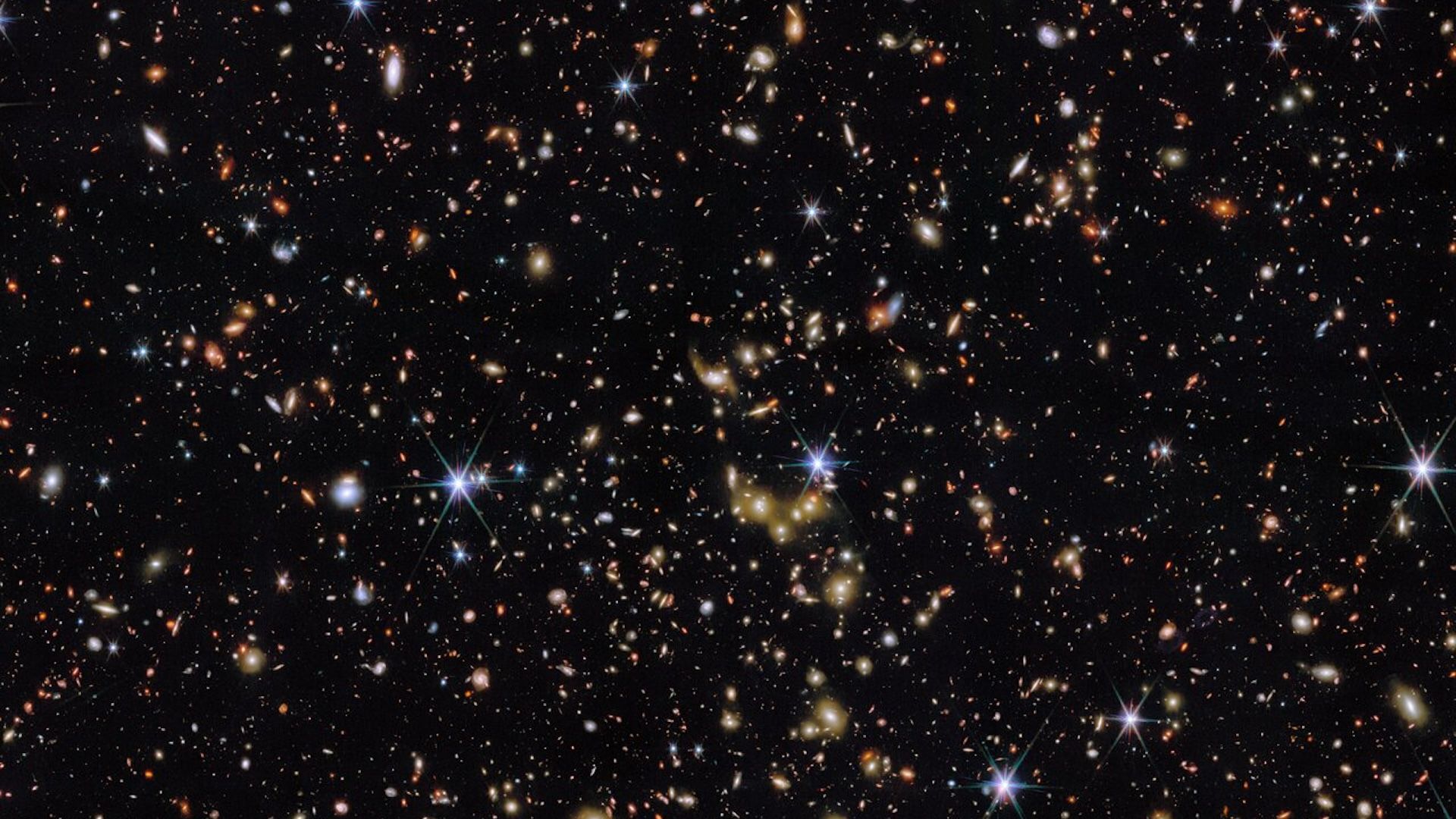
The mysterious force that cleared the cosmic fog at the dawn of the universe may not be what we thought, a new study suggests. The results hint that astronomers may need to rethink a major aspect of cosmological evolution, which led to the universe we clearly see today.
Around 400,000 years after the Big Bang, the fledgling universe finally cooled enough to form atoms — mostly hydrogen. But these neutral, non-electrically charged hydrogen atoms shrouded the cosmos in a fog that made it opaque to ultraviolet (UV) light.
Then, after the first stars flickered to life and gathered into galaxies, bursts of radiation ionized the neutral hydrogen. This turned the impenetrable fog of atoms into electrically charged protons and electrons, allowing light to pass through interstellar space unimpeded and, eventually, reach our observatories. This cosmic curtain parting is known as the Epoch of Reionization, or what a team of researchers studying it call the "last major phase transition in the universe."
A chart showing the evolution of the universe, from the Big Bang to today. The first stars started to appear from the hydrogen fog a few hundred million years after the Big Bang. (Image credit: (NASA/Wikimedia Commons))"We don't know exactly what objects caused reionization or how it evolved," Cody Carr, an astronomer who focuses on galaxy evolution at the University of Michigan and first author of a new study of the epoch, said in a statement. "We know that it took place, but we don't have complete answers to those questions."
Astrophysicists previously thought that this fog-clearing effect depended on supernovas, the violently explosive deaths of stars around eight to 50 times the mass of the sun.
But in the new study, published Oct. 15 in the journal Nature Astronomy, Carr and colleagues presented evidence that supernovas exerted the opposite effect, trapping the so-called Lyman continuum (LyC) photons of ionizing UV radiation that dispelled the celestial fog instead of scattering them.
"The most interesting thing about our paper is the observation that the strongest LyC emitters do not have fast galactic winds," Carr told Live Science via email. "This challenges the notion that galaxies require fast supernova-driven winds to enable LyC escape."
Which way the winds blow
The researchers used the Hubble Space Telescope to observe an analogue of the ancient universe in the local cosmos: six star-forming, wind-launching galaxies around 3.5 billion light-years away.
These compact starburst galaxies are generally smaller than 6,500 light-years in diameter and form around 10 solar masses' worth of stars per year. That star-birthing rate is several times higher than that of the Milky Way, which is up to 20 times larger.
The galaxies' spectra, or light-based fingerprints, revealed the origin, chemical composition, speed and direction of their stellar winds, which were whipped up by the radiation from their newly formed stars.
The researchers also described how these processes changed as the massive young stars evolved and died in energetic supernovas several billion years later, with the resultant galactic winds overpowering the stellar winds.
These nearby galaxies highlighted a counterintuitive two-phase process.
In the initial phase, which occurred during the first 3 million years of star formation, the newly formed massive stars' stellar winds carved through their galaxies' neutral gas and dust at nearly 2,000 miles per second (3,000 kilometers per second). This allowed LyC light to escape the galaxy and ionize the neutral gas and dust in intergalactic space.
The second phase, which emerged around 3 million years after star formation, seemed to reverse this process. As O-type stars — the hottest, bluest and most massive stars in the cosmos — lived fast and died young, their expelled stellar guts added to the opaque galactic gas and dust, churning it and loading it with mass, which created a trap for LyC light.
Astronomers close in on ancient signal from 'one of the most unexplored periods in our universe'New simulation of the universe shows the first 2 billion years after the Big Bang play out in stunning detailJames Webb telescope discovers ultra-rare ring galaxy just 2 billion years after the Big Bang
The oldest galaxies in this study — and, therefore, the ones with the fastest supernova-generated galactic winds — allowed the least amount of ionizing radiation to escape their environs.
"In general, our results are in disagreement with most cosmological simulations, which typically show the LyC escape fraction peaking after the launch of supernova-driven winds," Carr explained via email. In other words, supernovas didn't drive the Epoch of Reionization, but they may have dampened it. The intense light of newborn stars now seems like the most viable source of reionization.
Future research could aim to obtain additional galactic samples and higher-resolution observations across other wavelengths.
Hence then, the article about astronomers may have been wrong about what ended the cosmic dark age was published today ( ) and is available on Live Science ( Middle East ) The editorial team at PressBee has edited and verified it, and it may have been modified, fully republished, or quoted. You can read and follow the updates of this news or article from its original source.
Read More Details
Finally We wish PressBee provided you with enough information of ( Astronomers may have been wrong about what ended the 'Cosmic Dark Age' )


Also on site :
- How to Watch Levante vs Atletico Madrid Live: Full Match Details
- Ozu Shapes Mishima Yukiko’s Tokyo Competition Title ‘Two Cigarettes, Three Nights’
- Welcome to the school where Gen Z learns philanthropy as billionaire wealth explodes—with a 100% job placement rate