
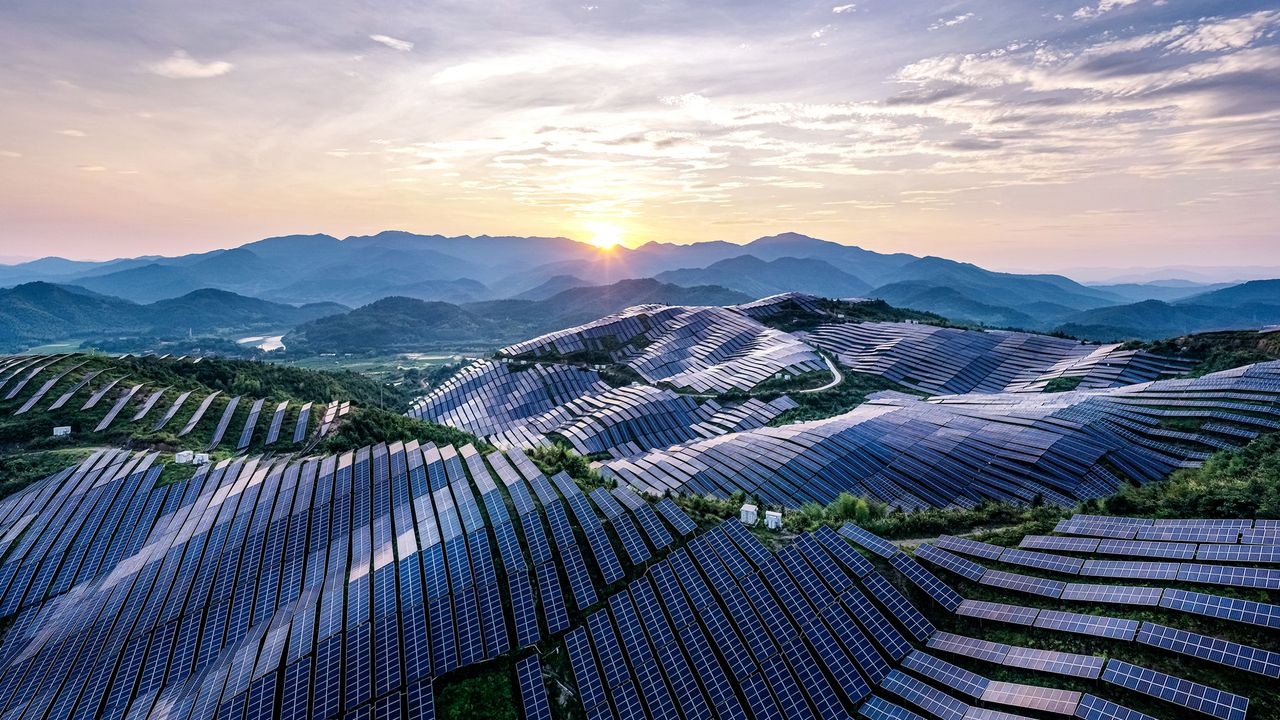
China's solar power capacity has overtaken coal for the first time, marking a major milestone in the country's rapid expansion of renewable energy.
China had about 1,288 gigawatts (GW) of installed solar capacity at the end of July, compared with 1,285 GW of coal-fired capacity, according to figures from the country's energy administration reported by the South China Morning Post.
The milestone could have major implications for global efforts to tackle climate change: China is the world's largest annual greenhouse gas emitter, accounting for around 30% of global planet-warming emissions. If its rapid expansion of renewable energy begins to displace coal-fired power — one of the country's primary sources of greenhouse gas emissions — the impact could extend well beyond Chinese borders.
"China reaching around 1,288 GW of installed solar capacity, marginally overtaking coal, is a major milestone," Matthew Davies, UNESCO chair in sustainable energy technologies and a professor of chemical engineering at Swansea University in the U.K., told Live Science.
However, installed capacity doesn't necessarily equate to actual electricity generation. "Solar only generates when sunlight is available, whereas coal plants can run for much longer periods, so solar still supplies a much smaller share of China's electricity than coal," Davies said.
In other words, China has more solar capacity than coal capacity, but coal remains far more important when it comes to the amount of electricity actually delivered to the grid.
Between January and July this year, Chinese solar power output rose 15.5% compared to the same time period in 2025. Over those seven months, it reached 802.4 TWh, which is around 13% of the country's total electricity consumption.
"I would see this as a structural turning point, not the point at which solar has replaced coal," Davies said. "The key question is whether renewable generation can grow fast enough not only to meet rising electricity demand but to push coal generation down in absolute terms. Given the scale of China's power system, sustained reductions in coal use could have a major impact on global CO₂ emissions."
To do that, China will need to do more than build solar farms. One of the biggest challenges will be integrating all of the new renewable power into the electricity system.
"Installing solar is only part of the transition; grids, transmission, storage and demand flexibility all need to keep pace so that renewable electricity can actually be used," Davies said.
This transition toward solar panels will also make renewable energy more accessible around the world, as China's enormous manufacturing capacity will help drive down the global cost of solar panels. However, Davies said the next phase of the transition is to ensure the whole solar production process is sustainable. "We need to think about where technologies are made, where materials come from, how long they last, and how they are reused or recycled," he said.
Related stories66 billion trees have been planted in China's Great Green Wall — and they appear to be growing faster than natural forests'If there's any country that will do it, it's China': Why is China diverting some of the world's mightiest rivers thousands of miles?China installs world's largest floating wind turbine in deep water test — it generates enough energy to power 4,200 homes annually
Solar panel manufacturing involves raw material extraction, processing, manufacture, transport and installation, so it has an initial carbon footprint. High energy requirement for polysilicon production is a considerable factor as it uses coal-fired power plants. But, this is offset by the electricity they generate.
There is also a case for expanding local and regional manufacturing, Davies noted. Doing so could strengthen supply chains, create local skills and economic value, and make the global energy transition more resilient and equitable. That could be particularly important for expanding access to electricity in parts of the world where reliable power remains limited.
"The global energy transition is not only about replacing fossil fuels in existing electricity systems; it is also about enabling people who still lack reliable electricity to gain access to clean, affordable power," Davies said. "Ultimately, success is not simply about installing more solar panels. It is about building a clean-energy system that is affordable, sustainable, resilient and accessible globally."
Hence then, the article about china reaches solar energy milestone what does this mean for the world s largest greenhouse gas emitter was published today ( ) and is available on Live Science ( Middle East ) The editorial team at PressBee has edited and verified it, and it may have been modified, fully republished, or quoted. You can read and follow the updates of this news or article from its original source.
Read More Details
Finally We wish PressBee provided you with enough information of ( China reaches solar energy milestone — what does this mean for the world's largest greenhouse gas emitter? )


Also on site :
- Walmart’s Farmhouse Baker’s Rack Makes a ‘Cute Coffee Station’ and Offers Extra Storage for Small Kitchens
- This Popular Children’s Show Ended 24 Years Ago, and a Child Psychologist Says It’s Still One of the Best Ways To Teach Kids About Feelings
- Outdoor gear retailer Patagonia sues Trump for shrinking beloved Utah national monument managed by tribes