
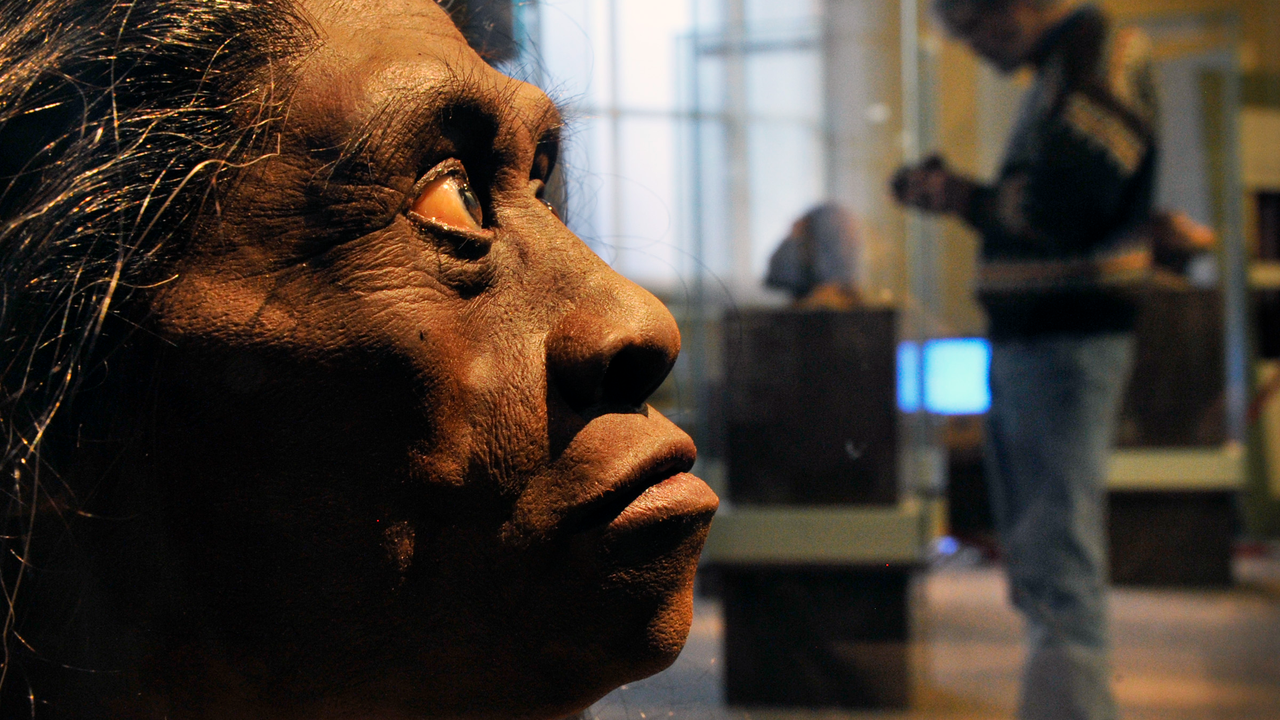
The diminutive, now-extinct humans known as the "hobbits" were scavengers who dined on dwarf elephants after Komodo dragons took the best cuts, archaeologists have discovered. The finding upends the assumption that Homo floresiensis, a human species that arrived on the Indonesian island of Flores at least 700,000 years ago, hunted big game.
First discovered in 2003, H. floresiensis has been nicknamed the hobbit because of its small size, averaging around 3 feet, 6 inches (106 centimeters) tall, along with its small brain, large teeth and big feet. But archaeologists also found stone tools, animal bones with cut marks, and charred bones that seemed to add up to sophisticated behavior common within our genus, Homo. The hobbits disappeared around 50,000 years ago as Homo sapiens began spreading around Southeast Asia.
But in a study published Friday (July 3) in the journal Science Advances, an international team of researchers questions whether the behavior of H. floresiensis was really as advanced as previously assumed.
The researchers looked at fossil bones of Stegodon florensis insularis, an extinct dwarf species of elephant relative discovered at Liang Bua cave, where bones from H. floresiensis and stone tools have also been found, to determine whether the cut marks were from hunting Stegodon meat or from scavenging the remains of the feasts of the only other carnivore on the island: the Komodo dragons (Varanus komodensis).
To distinguish the hobbit cut marks from Komodo dragon tooth marks, the researchers first conducted an experiment, feeding a goat carcass to a captive Komodo dragon at Zoo Atlanta. Then, they recovered the goat skeleton and painstakingly documented all of the marks, pits, notches and furrows the Komodo dragon's teeth made in the bones. The tooth marks were concentrated in areas with substantial amounts of goat flesh, the researchers wrote in the study, suggesting the Komodo dragon had a preference for meaty areas.
An extinct species of dwarf elephant called Stegodon florensis insularis inhabited the Indonesian island of Flores. (Image credit: Alamy)The researchers then investigated the ancient Stegodon bones for evidence of cut marks made by H. floresiensis' stone tools and tooth marks from Komodo dragons. They found 54 cut marks on the Stegodon bones and nearly twice as many Komodo dragon tooth marks. More importantly, they discovered that the Komodo dragon marks were focused on meaty areas, while the human cut marks were made primarily in areas without a lot of meat, suggesting H. floresiensis did not hunt and kill the Stegodon.
The overall patterns of cut marks and tooth marks suggest "a combination of mostly primary access by Komodo dragons and secondary access by H. floresiensis where both predators consumed Stegodon," the researchers wrote. And the hobbits likely ate this meat raw, according to the researchers, as they found no evidence on the Stegodon bones that they had been cooked. Nor did they find any evidence of burning on over 4,000 mouse bones from the site, suggesting the previous evidence of charring was actually natural manganese staining.
A lack of hunting and fire-making technology suggests that the hobbits were not as behaviorally sophisticated as previously thought and raises questions about their ancestry, the researchers said.
The Komodo dragon (Varanus komodoensis) lived on the island of Flores and was the only other carnivore along with Homo floresiensis. (Image credit: Alamy)It's possible that the ancestor of H. floresiensis branched from the Homo genus before humans accomplished the control of fire and hunting, study first author E. Grace Veatch, a paleoanthropologist at the University of Tübingen in Germany, told Live Science in an email.
One hypothesis for the origin of the hobbits is island dwarfism, which occurs when a large species' average body size evolves to be smaller over generations due to the limited availability of natural resources. Another theory is that hobbits descended from an earlier Homo species that was already small-bodied.
"I think our study highlights the importance of considering behavior in these debates," Veatch said. "Our study suggests that H. floresiensis evolved from a hominin population that did not require these dietary strategies [of hunting and cooking], such as a form of early Homo."
But the new study has not entirely settled the debate about the hobbits' ancestry, because very little is known about the behavior of early hominins in Southeast Asia, such as Homo erectus on Java and other areas of Sunda or Sundaland, a landmass between the South China Sea and the Indian Ocean that has been exposed off and on over the past 2.6 million years.
If H. floresiensis really did branch off from H. erectus, that would suggest many evolutionary changes occurred.
RELATED STORIESThe 'hobbits' may have died out when drought forced them to compete with modern humans, new research suggestsStrange pits on 'hobbit' teeth and other archaic humans could reveal hidden links in our family treeHobbits and other early humans not 'destructive agents' of extinction, scientists find
"Taking place on an island that was cut off from contact with the Sunda mainland, this evolution from Homo erectus to Homo floresiensis may have involved not just profound anatomical transformations, such as reduced body size and brain volume, but also behavioural adaptations," Adam Brumm, an archaeologist at Griffith University in Australia who was not involved in the study, told Live Science in an email.
"Flores was clearly a wild card in the story of early human evolution, the sort of place where almost anything could have happened — including, potentially, the loss of deeply-rooted hominin behaviours, such as hunting and fire use," Brumm added.
Where H. floresiensis fits in with the rest of the Homo genus is still an open question, Veatch said. "Importantly, this study highlights the contribution of taphonomy [the study of what happens to organic remains after death] to speak to these larger questions about ancestry."
What do you know about early humans? Test your knowledge with our human origins quiz!
Hence then, the article about diminutive species the hobbit did not hunt or control fire deepening the mystery of its ancestry dwarf elephant bones reveal was published today ( ) and is available on Live Science ( Middle East ) The editorial team at PressBee has edited and verified it, and it may have been modified, fully republished, or quoted. You can read and follow the updates of this news or article from its original source.
Read More Details
Finally We wish PressBee provided you with enough information of ( Diminutive species 'the Hobbit' did not hunt or control fire, deepening the mystery of its ancestry, dwarf elephant bones reveal )


Also on site :
- Witney Carson Claps Back at ‘DWTS’ Judge Carrie Ann Inaba, Joining Uproar Over Comments on Guillermo Rodriguez: ‘I Said What I Said’
- Tom DeLonge Was in the Crowd When 43,000 Fans Serenaded Him With His Own Song: ‘He Was Definitely in His Feels’
- Disney Cruise Line Offers First Look Inside Disney Believe with New Frozen Dining, Encanto Show, and Themed Lounges