
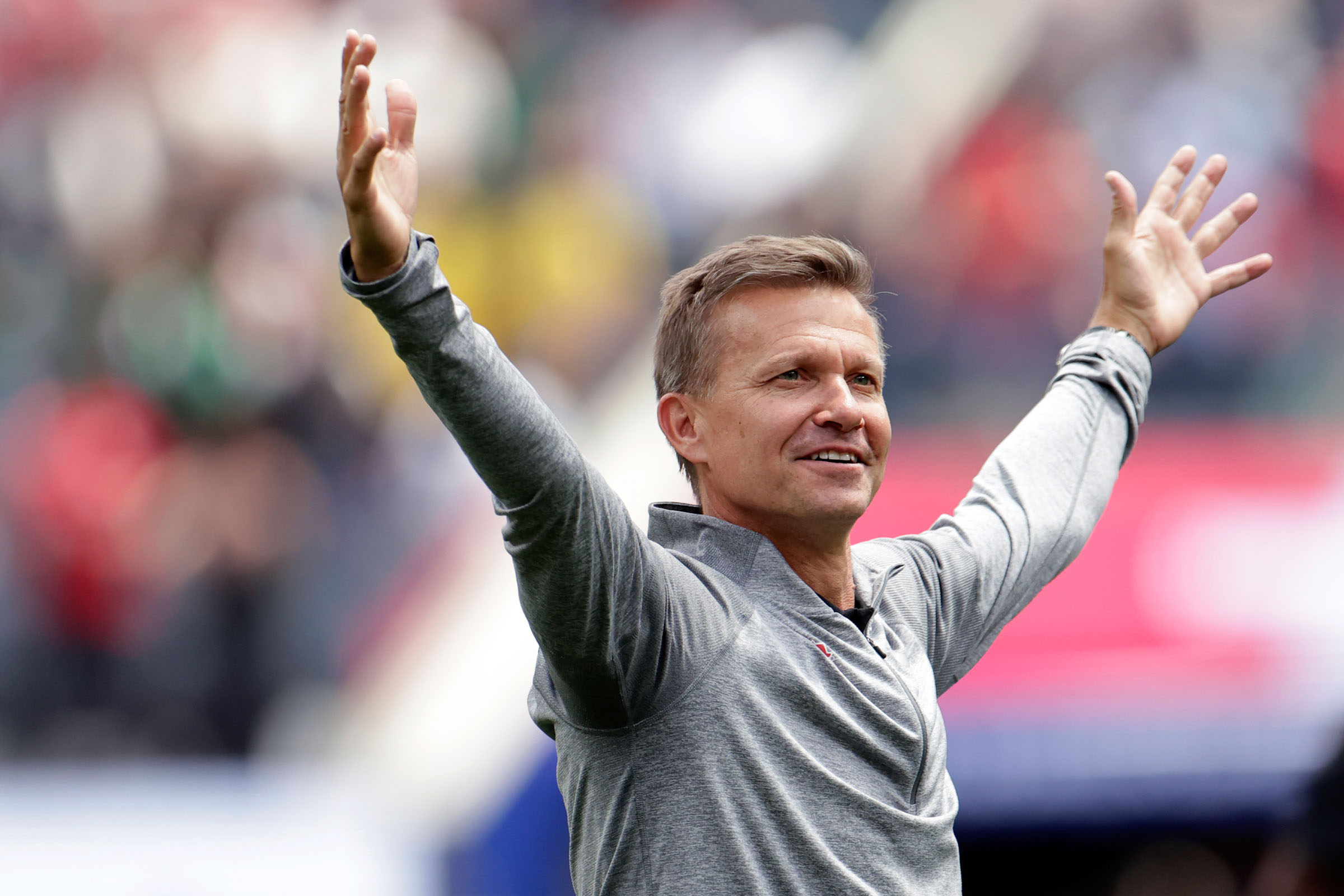
Jesse Marsch, the American who led Canada to its first World Cup knockout stage win ever, has stirred emotions in North America and beyond. Marsch’s fans, which include the likes of Canadian icons Wayne “The Great One” Gretzky and, apparently now, Michael Bublé (more on that below), credit him for turning around the Canadian soccer program and inspiring a fervor around a sport that’s on the upswing up north. At the same time, his comments about Canadians being more enthusiastic singers of their national anthem than Americans and his insistence he “doesn’t give a sh-t” about critics who knocked his on-field postgame speech to his team after Canada’s dramatic 1-0 round-of-32 win over South Africa on Sunday as “performative” have rankled more than a few.
World Cup fans and pundits all suddenly have their take on Canada’s animated soccer coach, who’s now responsible for the country’s only two World Cup victories in its history. TIME caught up with Marsch this week by phone – he’s in Houston, where his team is preparing to face Morocco in the round of 16 on July 4 – to talk about the uproar and more.
(Disclosure: Marsch, who played soccer at Princeton in the 1990s, and I attended college at same time; we have many mutual friends and have spent time together socially in recent years.)
This interview has been edited and condensed for length and clarity.
After your team beat South Africa, you told your players they were “Canadian heroes” during a passionate postgame speech on the field. Why, in your mind, are they heroes?
Look, people have been wanting to share their opinions, and often ill-informed opinions, about how I behaved in different moments on the bench. Why I do a circle after the game. Why I celebrated with the fans when we won six-nil. But this is the World Cup. Everybody watches and everybody gets excited about it. And I do too.
This project, for me, is so much more than just the first team. It's about trying to build the sport in the country and take a lot of the raw talent, from both a player perspective and the coaching perspective, and see if we can align the spheres of influence in a way that we can create a real Canadian identity to the way we play football. A Canadian DNA.
I've seen the passion that people have for the sport in the country. In this World Cup specifically, we've needed moments. That's why I celebrated the six-nil so heavily, and that's why I chose to talk to them about being Canadian heroes. And by the way, I do believe that. It just came to my head because when I hugged Steph before we got in the huddle, I said, "You're a hero, man, you're a Canadian hero.” And then I kind of expanded on it, that they all are.
You’ve been a head coach for clubs in Major League Soccer, Austria, and the English Premier League. This is your first national-team head coaching job. What have you found to be the biggest difference between coaching a country versus a club?
Well, it's hard to get your behaviors ingrained into the players the way that you want. When the weight of the games and the attention around the world is bigger than a lot of what our players are used to, instead of falling back on all the behaviors that I've tried to build with them, they fall back to behaviors they learn with their club teams or what they learned growing up. It's important that I stay on top of the details with them so that when we are in tough moments, we stick to what we want.
The opponents can't do that either. That's why a lot of national-team coaches choose to play with a very basic structure that just allows their best players to be at their best. But I know with our team, as much as we have some talented players, that we need to have a way. If we can stick to the plan, when the games are of more magnitude, that's our best chance as a group to be successful, instead of just relying on the pure talent of the team. That's been an effective strategy for us.
Can you tell us what your scouting is revealing about Morocco, which made the semis at the last World Cup?
It's a really talented team that is playing with a ton of confidence. They've had so much success over the last five, six years, that their self-belief combined with their overall talent means that they don't necessarily do anything overly complicated. But they want to be on the ball, they want to be in the game, they believe they can beat great teams. When they start getting on the ball and creating combinations and using some one-v-one ability, with some passing quality, with some athleticism, they wind up being a very difficult team for anyone to play against in international football. I think the coach has done a good job of creating a structure for them, and then giving his players the freedom to go out and play. They do that well. They're really good. They're fun to watch.
If your players were heroes after reaching the round of 16, if you guys beat Morocco to reach a quarterfinal, what would they be then? Gods? What's the next level?
I don't know. I’d like to get to that point, then I’ll tell you. [Laughs.] Because it's also so much about how the game goes. That we won the way we won, where we had to be patient, we had to be disciplined, we didn't give much away. We didn't capitalize on our moments, attacking wise, as much as we would have liked, but the fact that we scored a goal in extra time that electrifies the country, it's a part of why it feels after the game like they're heroes. It's not just that we won. It's the way we won. If you told me right now, OK, in three days you're going to beat Morocco, I would say that's awesome. But it's the manner in which the game plays out that winds up dictating the emotion.
Switching gears for a moment, I wanted to talk to you about Grant Wahl, the great American soccer journalist who died at the World Cup in Qatar. He is greatly missed at this home World Cup. He covered you in college and the two of you grew close. What do you think he would be writing about this World Cup?
Grant's known me since we were at Princeton. He followed me when I played there, he followed my playing career, we've been friends for a long time. Whenever he would write stories about me, I think he was able to capture who I am and the motivation behind how I do things.
So I think that Grant would probably invest a little bit more into what he's known about me for years, and how it dictates how I lead, how I coach, who I am. And by the way, in the end, I don't even really care. People can have an opinion about me however they want. I'm not banging away on keyboards. I've never written a restaurant review, let alone a f-cking tweet about somebody's professional career. The people that write a lot of these things have too much time on their hands. They're not the man in the arena. How would they know what people go through in general anyways?
You grew up in Racine, Wisc., and are coaching in the World Cup on July 4, in Houston, for another country. That's a very unique experience. What might you be thinking on the sidelines as this huge game kicks off?
I'm proud to be an American. But I'm an expat. I live in Italy, I live in Mexico. I haven't celebrated the Fourth of July in I don't even know how long. We used to go to the parade when I was young every year. There used to be barbecues.
People like to say, “Oh, he wishes he coached the national team.” Let me make it really clear: I never will coach the U.S. national team. Ever. And that's no problem. There was the possibility of me at one point, but I'm done with it. I don't even care anymore. I don't wish ill will against the U.S. I want the U.S. to do well. I like Pochettino, and I like a bunch of the players. But people need to stop making a deal out of me in the U.S.
So what will I be thinking on July 4? I will be thinking, I hope I've done everything I can to give my team the best chance to win this match. There's nothing else to it. Even if people want to talk about why do I talk in the middle [of the field], or why do I get emotional on the bench, or whatever, it’s because this is who I am. This is what I care about. That's it. That’s it.
Everyone's talking about hydration breaks. How do you feel about them?
I like them because it gives me an extra chance to try to impact certain things that are happening in the games. We've actually, post-water break, been better in almost every half. There's either something where I can kind of get the players' mentality right, or there's a couple of tactical changes that we can make.
If you know our sport, people struggle with change in football. And so I don't waste my time going, “Is it good? Is it bad?” I'm solution-based. So whatever VAR presents, or this or that, or rules, then I'm like, “OK, how do we take advantage of a situation like that and get the best out of it?”
OK, I surveyed some of your old college teammates for a few questions. Here’s one: would Princeton have won the national title in 1993 if you hadn't missed that season, for academic reasons, due to prioritizing Sega hockey and your social calendar?
[Laughs.] The answer is no. Because there was nothing that I could have done more to beat the Virginia team that we lost to in the Final Four.
Someone did mention that you got a text from Wayne Gretzky after the South Africa game. What did it say?
Wayne’s my boy. Wayne’s my boy. He's just always checking in. He loves Canada, he loves our team. I've gotten to know Wayne, and he's an awesome guy. Canadians are just really generous, really good people. After the third time hanging out with him, I said to him, “Wayne, you are like the nicest person I've ever met. How the hell were you the best to ever play?” And he goes, “Jesse, when I was on the ice, I was a different person. I had a totally different mindset and personality.” And I've used that with our guys. This is the thing about Canadian hockey. The guys are no different than our guys, but they're built to be fighters, to never back down. This is the DNA of Canada hockey, and so we're trying to build our own DNA in Canada. We're trying to also inherit that kind of mentality.
Any other Canadian legends you’ve heard from? Mike Myers, Ryan Reynolds?
I would love to meet Mike Myers. Boi-1da is a friend of mine. Steve Nash is a big soccer guy. Michael Bublé just started following me on Instagram. I’m hoping to hang out with the Bubs. We haven't had Ryan Reynolds here, because he's been busy. We had Shawn Mendes around. It was kind of my idea to build this celebrity support group around the team, and they started calling it Iconic XI. Alessia Cara, Nelly Furtado, really cool artists and musicians. They're all way cooler than me.
One pundit, former English soccer player John Cundy, was surprised that you kissed the Canadian crest on your shirt after the knockout stage victory in Los Angeles. "Kiss the badge?! I can't imagine [Thomas] Tuchel kissing the England badge," Cundy said. [Tuchel is German.] "He's American in America!" Any response?
I love representing the country. It's important that, as a foreigner, people know that I'm all in. I'm American, I'm not trying to say I'm Canadian, but as long as I'm here working with this and building something, yeah, I'm all in, man.
On the criticism that the postgame speech was performative — were you aware the broadcast cameras were there?
There was one camera down low in our group. I thought that was our [documentary team]. We have a documentary team, right, that follows us. So people act like this [is] performative bullsh-t; everywhere we go, we have cameras. If people aren't familiar with modern sports, get a life. And then the next part is, the reason you meet on the pitch is because after the game, you can't all be together between doping and media responsibilities. There’s not another chance to have the whole group together until an hour and a half after, back at the hotel. And by the way, if you listen to the speech I gave, the first thing I do is I ask Alphonso [Davies] if he wants to say anything. I'm not trying to hog the spotlight. I know I'm the leader, but this is about our team. If people don't get that, then they've never played.
You were an assistant coach for the U.S. national team in 2010 and 2011 and said before Canada’s first game at this World Cup, "Every one of these boys is incredibly Canadian. And the pride that they have in putting on the jersey, representing the country, hearing the national anthem… In the U.S., sometimes we had to beg players to sing the national anthem. These guys sing the national anthem, belt it out to the top of their lungs, because they want to show the country how proud they are to be here, to be Canadians and to represent what Canada is." Former U.S. star Clint Dempsey, a member of the 2010 U.S. World Cup team, took exception—he said he put his hand over his heart and prayed right before the game. “I can’t take this guy too seriously,” Dempsey said. “Stay in your own lane.” Any response?
When I said that, by the way, I wasn't trying to implicate specifically the U.S guys. I was talking more about how proud the Canadian players are to play for the national team. When we sing the national anthem, or anything we do that's nationalistic, even though most of them are first- and second-generation, or even dual nationals, they have so much pride for playing for Canada. So that was the whole point of discussion. Clint’s a friend of mine. He shoots from the hip. That’s who he is, and I really like Clint.
In May you signed an extension to remain as coach of the Canadian team through the 2030 World Cup? Why did you want to stay?
It was mostly about continuing the project with [Canada Soccer CEO and General Secretary] Kevin Blue and everything that we're building here. I know that my job is to coach the first team, but what we're trying to really do is build a future for the sport in the country, through fundraising, then through building an infrastructure. We don't really have a youth national team program. We're building a training center, we're building a residency, there's more to be done than just what we're doing with the first team.
Any message for Canada fans going into this game?
We love their support. It's been an amazing experience for our team and our players to see the passion and love of the team back home. We're sorry that we're not playing this game back in Canada. But keep the passion and try to get as many people down here to Houston as possible.
Any message to Jesse Marsch fans?
I don’t know if there are any. [Laughs.] I don't think we need to waste our time. You’re like one of a few.
I don’t think that’s true. But alas – do you have any message to the haters?
I don't. Honestly, I do not waste a whole lot of time with people that know anything about me. There's nothing worse than stubborn, strong opinions from people that don't know anything about what they're talking about. That’s a terrible combination.
Hence then, the article about canada coach jesse marsch does not care what you think of him was published today ( ) and is available on Time ( Middle East ) The editorial team at PressBee has edited and verified it, and it may have been modified, fully republished, or quoted. You can read and follow the updates of this news or article from its original source.
Read More Details
Finally We wish PressBee provided you with enough information of ( Canada Coach Jesse Marsch Does Not Care What You Think of Him )


Also on site :
- On Air Today: Local Musician Jesse Fox on 97.9 The Hill Presents Tabitha Meeks and Jesse Fox at Cat’s Cradle Back Room
- Could Texas Elect a Democratic Governor for the First Time in More Than 30 Years? Polls Show a Tight Race
- This Compact Sony Soundbar Is Under $100 for October Prime Day