
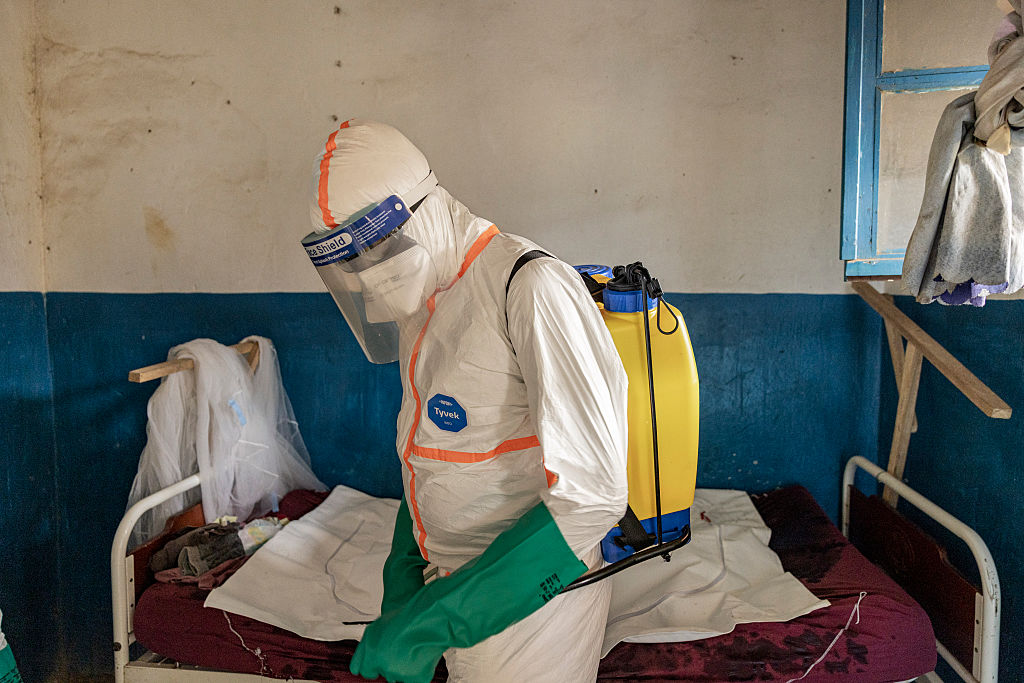
Ebola, which is currently spreading in the Democratic Republic of the Congo (DRC), is a nightmare disease. The virus floods the immune system, eventually shredding our vasculature. There’s a roughly 50-50 shot at survival, and the unlucky half will die in agony, bleeding profusely as their organs begin to fail.
I’ve seen this story before. For nearly a decade, I worked for the U.S. Centers for Disease Control and Prevention, fighting epidemics around the world. In 2014, I deployed to Liberia for the largest-ever outbreak of Ebola, then five years later to DRC for the second-largest Ebola outbreak ever. In these resource-limited settings, infection control is tough. The virus spreads through bodily fluids, yet I witnessed local health workers forced to reuse their disposable masks and gloves because of limited supply. Faced with such inequities, it’s no wonder that thousands of people died between those two outbreaks.
This latest Ebola outbreak is unfolding alongside a frightening hantavirus outbreak that erupted on a cruise ship. To be sure, Ebola and hantavirus are different viruses spreading under different circumstances, but both come from animals. This is a public health pattern we keep re-learning and failing to act on. Infectious disease professionals like myself predict that until we break this cycle of inaction, such outbreaks will arise with growing frequency.
Ebola, for example, is a disease tied to deforestation. The 2014 outbreak in West Africa likely began with an axe. In rural Guinea, starving communities cleared forests to make way for new farms. Those forests were previously home to bats, a natural reservoir for all kinds of nasty viruses. The bats, in turn, found new homes among local villagers. Some researchers believe patient zero was a two-year-old boy who acquired the virus from bats living inside a hollowed-out tree where he played.
In my field, we refer to this phenomenon, where diseases jump from species to species, as “spillover.” To some, this term may imply that these diseases are rare accidents. However, Ebola and hantaviruses are only two examples of many. The majority of emerging infectious diseases in humans, including most, if not all, pandemics since 1918, originated in animals. There are thousands of other viruses circulating in wildlife that could also make the leap. What’s worse, we have created conditions that make this scenario more likely with each passing day.
Health workers in orange hazmat suits board the Dutch cruise ship, MV Hondius following a deadly Andes hantavirus outbreak, in the Netherlands on May 20, 2026. —Nicolas Economou—NurPhoto/Getty ImagesFirst, there’s the issue of habitat destruction. Our ceaseless extraction of resources has destroyed ecosystems around the world, erasing boundaries between humans and wildlife, and increasing the opportunity for spillovers. Industrial farming facilities, wherein thousands of inbred animals routinely sit in their own feces while waiting to die, can also function as factory-sized petri dishes. Finally, the commercial wildlife trade, catering to growing demand for exciting foods and exotic pets, has been known to export dangerous pathogens around the world and, often, into urban centers.
In the backdrop is climate change, which continues to alter transmission dynamics; half of known infectious diseases have already been aggravated at some point by climatic hazards. Because of our choices as a society, there’s a one-in-five chance that another pandemic will occur in the next decade that will kill at least 25 million people.
This is not a hypothetical risk. It is a well-documented, incredibly deadly phenomenon that does not respect borders. Still, it's a blind spot for the public health sector. In 2020, the World Health Organization convened an expert panel charged with figuring out how to make COVID-19 the last pandemic. Their 86-page report used the word "wildlife" twice, and the words "deforestation" and "climate" once, all crammed into one small paragraph. And, by and large, medical schools don’t cover this topic either. As a result, many future physicians don't learn much about ecology, agricultural policy, or veterinary science.
But the public has begun to notice what the establishment hasn't. The hantavirus outbreak has stoked fears that recall COVID-19's early days. Once a high-consequence zoonotic pathogen reaches human populations, containment is often uncertain, slow, and expensive. Preventing spillover is the lever we keep refusing to pull.
Unfortunately, the one serious attempt to change that pattern has been stalled. Last year, the WHO adopted a pandemic treaty, the first of its kind with obligations on spillover prevention. The day before the WHO learned of the hantavirus outbreak, however, negotiators failed to agree on how to equitably share critical pathogen samples, vaccines, and medicines between richer and poorer countries during future outbreaks. If we can't agree on how to share life-saving inventions after the fact, the prospect of robust investments in prevention seems like an even longer shot.
Tools to address spillover outbreaks
This much we know: While we will never stop every spillover, a handful of commonsense measures can dramatically reduce the odds.
First, we have to halt deforestation. Last year, the world lost 4.3 million hectares of tropical forest larger than Switzerland. The World Wildlife Fund warns that we are tragically far off track from reaching the international goal of ending deforestation by 2030. Addressing deforestation is a question of political will. We have to make a tree in the Amazon or the Congo basin worth more alive than dead. Plus, beyond potentially preventing future outbreaks, protecting forests can simultaneously help address two other catastrophic societal threats: climate change and biodiversity loss.
Second, we must improve safeguards on animal farms. Due to our insatiable demand for protein, cramped facilities have become dangerously common around the world. But they are tinderboxes for the next pandemic. When one animal falls ill, pathogens can rampage throughout the brood, picking up new mutations along the way. Regrettably, there is no end in sight for factory farming. But until then, investments in animal health services need to keep pace—both for the sake of the animals and for ourselves.
Third, governments should crack down on the commercial wildlife trade. In 2003, the United States experienced an outbreak of mpox after people imported African rodents to keep as pets. The year before that, SARS had emerged, ultimately infecting over 8,000 people in nearly 30 countries. It originated in animal markets selling live wildlife. Nearly two decades later, this same type of live animal market likely sparked the COVID-19 pandemic that upended the world order and killed millions of people. Live wild birds and mammals should not be sold in the streets of Wuhan, New York, or Paris. Doing so is like conducting a dangerous genetic experiment in the heart of the world’s largest population centers. We need real regulation coupled with enforcement.
We must also accept that science and policy alone will not save us from ourselves. Doing so will require humility and a massive shift in our values.
We must be humble enough to accept that we are not the masters of this planet. We are not a species that sits above all others. Rather, we are one of millions. As our planet’s intricate web of life unravels, there are complex—and often unpredictable—consequences for humanity.
Hence then, the article about the ebola and hantavirus outbreaks offer an ominous warning was published today ( ) and is available on Time ( Middle East ) The editorial team at PressBee has edited and verified it, and it may have been modified, fully republished, or quoted. You can read and follow the updates of this news or article from its original source.
Read More Details
Finally We wish PressBee provided you with enough information of ( The Ebola and Hantavirus Outbreaks Offer an Ominous Warning )


Also on site :
- How to Try WhatsApp's New Scheduled Messages Feature Early
- 30 Years Ago, ‘X-Files’ Aired Their Most Famous Episode – Only to Have it Promptly Banned Amidst Severe Backlash: ‘I Got a Screaming Call the Next Day That the Episode Would Never Air Again’
- Starbucks is Exploring a Landmark Acquisition of Chipotle—What It Could Mean for Your Next Burrito