
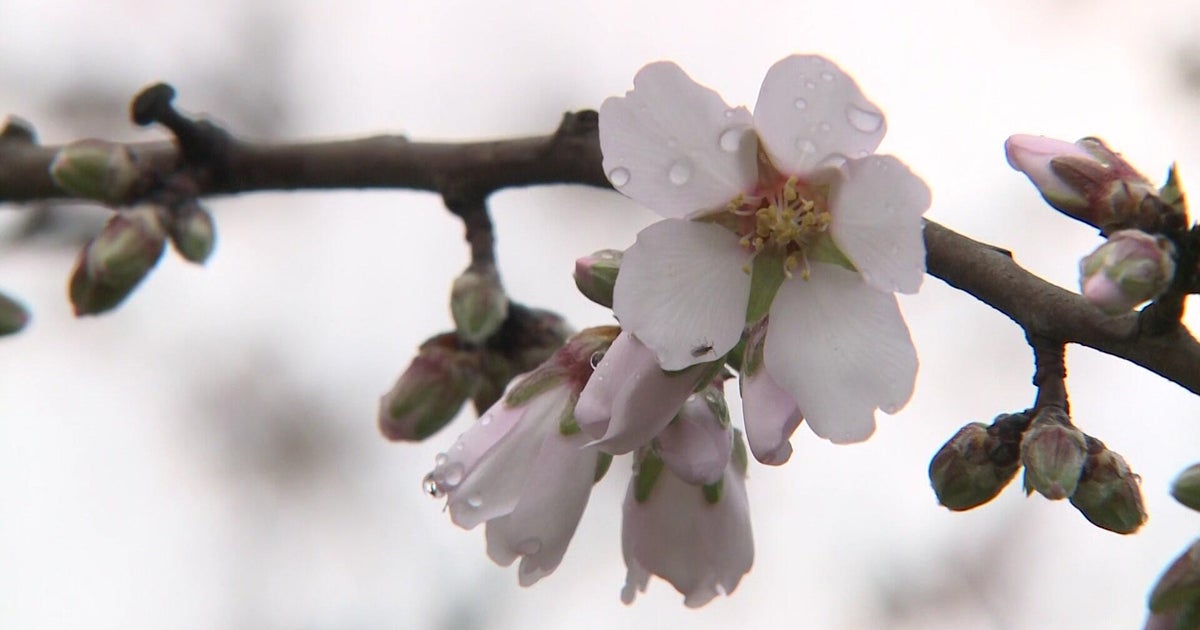
Almonds are a staple in California, but in order for them to get from here to your dinner table or that to-go snack for work, it's the blooming season that is crucial — and farmers are keeping a keen eye out on the forecast with rain on the horizon.
"We're just starting bloom now, but the next 10 days, 14 days is really critical," Mike Weststeyn, almond farmer, said.
Ripon resident Weststeyn grew up on an almond farm and started his own after he graduated college in 1992. Mike and his son farm 700 acres of almond trees throughout San Joaquin and Stanislaus County.
"This is probably the most important time for the year for us," Weststeyn said. "This is when the crops are getting pollinated and we're setting the crop for this coming harvest. If we don't get it done, we're not going to have a crop."
Weststeyn talked about the potential implications of how rain could affect the almond crops. He said if they get rain for the next two weeks, they won't have a bumper crop (statewide more than 3 billion pounds of crop). If that's the case, he hopes the price of almonds will increase to help their bottom line.
"It won't get pollinated and you won't have a crop," Weststeyn said. "We're only going to bloom one time this year. This is it. If we don't set a crop right now, you're going to have to wait until next year."
Pollination is a crucial component to almond farming, and farmers purchase two beehives at around $200 per acre.
"If it's not about 50 to 55 degrees, that's when the bees start to fly," George Dale, Honeydale Beekeeping owner, said. "If it's below that temperature-wise, they won't fly. And if they're not flying, then pollination's not getting done. But, typically it's kind of rare that the pollination doesn't get done with that 3-week window. The bees will get on those flowers at some point in there."
Beekeepers and almond farmers work hand-in-hand to help with the almond blooming season, which can be a 3-week window, as Dale said, with the exact days varying from area-to-area but it typically starts on Valentine's Day.
The economic implications of this are also crucial with Weststeyn saying California has 80% of the world's almond production. Daniel A. Sumner is the UC Davis Frank H. Buck Distinguished Professor in the Department of Agricultural and Resource Economics and the UC Agricultural Issues Center director, and says the almond is a crop that may hit $5 billion in revenue this year.
"And if you add the jobs connected to that, and the rest of the spreading of the economic output around, it'll be about 3 times that big to the economy," Sumner said. "And most of that is there in the Central Valley, most in the San Joaquin Valley."
Sumner also said almonds are different than most of California's crops.
"The rice is mostly up north," Sumner said. "Most of the cows are in the San Joaquin Valley. The pistachios are further south than you. Almonds are the whole valley. You go up from north of Sacramento on down, to Bakersfield, there's almonds all the way through. So, it's an important crop to lots of counties. San Joaquin's one of the central places, of course, for the almond crop."
Needless to say, this is an important next two to three weeks for almond farmers.
Hence then, the article about how rain could affect california almond crop bees during bloom season was published today ( ) and is available on CBS sacramento ( Middle East ) The editorial team at PressBee has edited and verified it, and it may have been modified, fully republished, or quoted. You can read and follow the updates of this news or article from its original source.
Read More Details
Finally We wish PressBee provided you with enough information of ( How rain could affect California almond crop, bees during bloom season )


Also on site :
- One-third of Seattle’s downtown is empty: Here’s how America’s boomtown turned into one of the toughest places to find a job
- Benedict Cumberbatch, Alan Cumming, Benedict Wong Pen Op-Ed Urging U.K. to Block “Dangerous” Paramount-Warner Bros. Merger
- Toyota Motor Corporation, Volvo Group and Daimler Truck have signed binding agreement for Toyota to join cellcentric as equal shareholder