
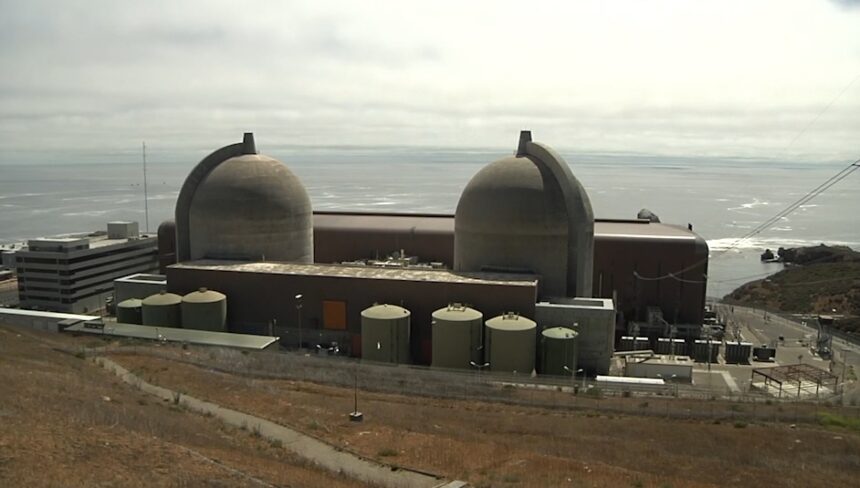
IMPERIAL BEACH, Calif. (KEYT) – On Thursday, the California Coastal Commission approved with conditions the continued operation of Diablo Canyon Nuclear Power Plant.
According to Pacific Gas and Electric Company (PG&E) which operates the facility, the power plant is California's largest and only remaining nuclear power plant in operation which generates enough electricity for about three million people, approximately nine percent of the state's electricity output.
The image below shows the location of Diablo Canyon Nuclear Power Plant, courtesy of the California Coastal Commission.
The site features two Westinghouse Pressurized Water Reactor units that were set to be retired in 2024 for Unit 1 and 2025 for Unit 2 after operations started in 1985.
In September of 2022, Senate Bill 846 was signed into law which extended operations for an additional five years for each unit and authorized a $1.4 billion loan from the state to its operator.
"Diablo Canyon Power Plant is safely generating clean electricity 24 hours a day, seven days a week, 365 days a year, rain or shine," said Diablo Canyon Senior Vice President and Chief Nuclear Officer Paula Gerfen after PG&E filed for a license renewal with the U.S. Nuclear Regulatory Commission in November of 2023. "We’re all excited for the opportunity to continue serving the state and help power California’s clean energy future."
The federal regulatory agency approved continued operations at the plant while it conducted its multi-year review of PG&E's license renewal application the following month.
On Thursday, the California Coastal Commission approved with conditions both a 20-year federal operating license as well as a Coastal Development Permit that applies to the timeline for continued operations established in SB 846.
While state regulators are prohibited from imposing requirements regarding radiation hazards or nuclear safety, which are exclusively handled by the Nuclear Regulatory Commission, it can impose requirements found within the California Coastal Act and the California Coastal Management Program detailed the California Coastal Commission, the environmental regulatory body created by state and federal laws.
"The primary adverse impacts to coastal resources associated with the proposed relicensed and extended operations of DCPP [Diablo Canyon Power Plant] are those to marine biological resources and productivity related to entrainment, which occurs when the power plant draws in seawater for its once-through-cooling (“OTC”) system...DCPP uses about 2.5 billion gallons of seawater per day, which equals almost a cubic mile of seawater per year," noted the California Coastal Commission's staff report about the requests under consideration by the state regulator. "The most recent available entrainment studies show that the DCPP’s use of seawater results in an annual loss of marine life equal to that produced in up to 9,360 acres, or more than 14 square miles, of nearshore waters. This loss of biological and public trust resources each year represents a significant adverse effect on the productivity of these waters and reduces the biological connectivity of state-designated Marine Protected Areas located nearby and up-current from DCPP with those downcoast."
A detailed image of the power plant courtesy of the California Coastal Commission.That ongoing environmental impact and the potential risks from a meltdown caused by an accident or an earthquake were part of the objections noted by environmental groups who oppose continued operations at Diablo Canyon.
"The Commission’s vote to approve twenty more years of operation at this aging plant goes well beyond the legislature’s authorization allowing operations for, at most, five years," argued Jane Swanson, a spokesperson for Mothers for Peace, a group opposing continued operations. "The Commission’s action was not based on any evidence of need beyond 2030. In fact, the Commission could have limited its approval to a five-year permit. To add insult to injury, the Commission is putting millions of Californians in jeopardy should an earthquake occur. Diablo Canyon sits in one of the most seismically active coastal zones in the state, surrounded by multiple intersecting faults that could rupture together in a large, complex earthquake."
Diablo Canyon Power Plant marked as the yellow star Fault lines in the surrounding areas courtesy of the U.S. Geological Survey.Instead of requiring direct mitigation plans to limit the environmental impact from the plant's cooling system, the state regulator accepted an indirect mitigation plan presented by PG&E.
"[T]o help offset the adverse impacts to marine life resulting from an extension in use of the plant’s cooling system, as well as those associated with the loss of coastal access and recreation resulting from continuation of the expansive safety and security closure zone surrounding the plant, PG&E included a mitigation proposal as part of its consistency certification and CDP application," explained the Coastal Commission staff in its analysis.
The indirect mitigation plans cover the thousands of acres of surrounding lands around Diablo Canyon Nuclear Power Plant and detailed their future via a two-phase pathway to eventual conservation.
"Although this proposed mitigation would be “out-of-kind” compensation for DCPP’s adverse impacts to marine life through the conservation of coastal lands (both directly through a conservation easement and deed restriction and more indirectly through establishment of a purchase option for government agencies and land conservation groups), it represents an approach that is feasible and more likely to succeed than the various mitigation alternatives considered by Commission staff, including those relying more heavily on direct replacement of adversely affected coastal resources," argued the Coastal Commission.
Nevertheless, environmental advocates noted that the proposal defers about half of the proposed conservation area and extends Coastal Commission approvals beyond the five year extension codified in SB 846 in 2022.
"[Thursday's] decision undermines the Coastal Act and the very purpose of the Commission," argued Linda Krop, Chief Counsel for the Environmental Defense Center, which represents Mothers for Peace. "The Commission itself admitted that PG&E’s mitigation fails to offset the destruction of marine life, and the state’s own energy data shows that Diablo Canyon is not necessary to meet our needs. Advances in renewable energy, transmission improvement, and storage can more than make up for energy produced by the nuclear power plant, without any of the adverse impacts."
The indirect nature of the mitigation proposal and potential violations of the spirit of the Coastal Act were noted by Commission staff in their report.
"While PG&E’s mitigation proposal provides a framework for achieving the long-term offset of the DCPP’s adverse impacts to marine life, the entrainment impacts would not be minimized and marine resources and productivity would not be maintained or enhanced. Although extended operations do not conform to the marine biological protection policies of the Coastal Act and CCMP, because DCPP is a coastal dependent industrial facility, the proposed project nonetheless may be approved under the 'override' provision of Coastal Act Section 30260 if it would not adversely affect the public welfare and the maximum feasible mitigation is implemented."
Coastal Commission staff went on to explain, "[A] CDP [Coastal Development Permit] to extend operations until October 31, 2030, meets the public welfare test of Section 30260 [of the Coastal Act]. The CPUC [California Public Utilities Commission] and the California Energy Commission recognize a need to extend operations of DCPP for reliability and to achieve California’s carbon neutral energy production goals."
State environmental regulator approves continued operations at Diablo Canyon Nuclear Power Plant News Channel 3-12.
Hence then, the article about state environmental regulator approves continued operations at diablo canyon nuclear power plant was published today ( ) and is available on News channel ( Middle East ) The editorial team at PressBee has edited and verified it, and it may have been modified, fully republished, or quoted. You can read and follow the updates of this news or article from its original source.
Read More Details
Finally We wish PressBee provided you with enough information of ( State environmental regulator approves continued operations at Diablo Canyon Nuclear Power Plant )


Also on site :
- ’90s Supergroup Makes Announcement on New Music, North American Tour
- Florence Pugh Credits Tom Holland for ‘Spider-Man: Brand New Day’ Role: ‘This All Happened Because of Tom’
- Anton Studios Joins The Creatives as Partner and Investor as Producer-Led European Company Enters Jointly Owned Holding Structure (EXCLUSIVE)