
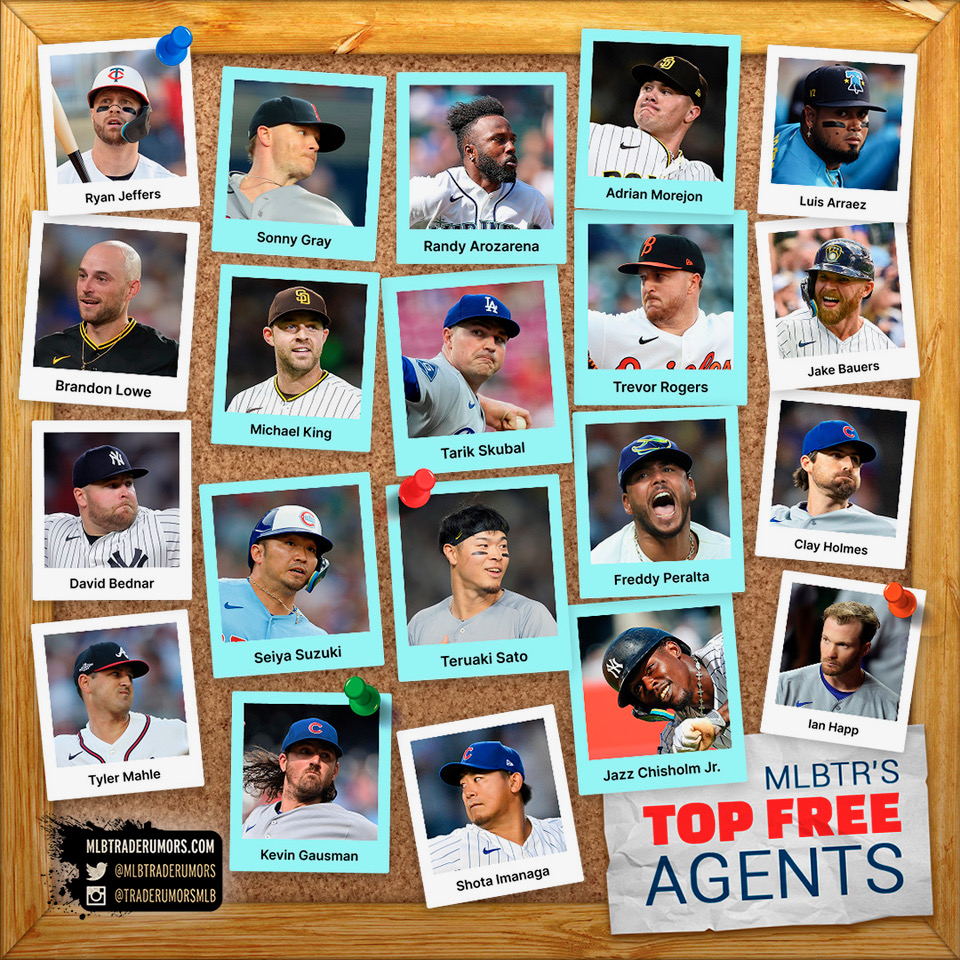
It’s that time of year again. The offseason is upon us, and we at MLB Trade Rumors are proud to present our 21st annual Top 50 Free Agent list, complete with contract and team predictions for each entrant. These are this year’s top 50 free agents based on their earning power in free agency. You can check out a full list of free agents here, and as we do each year, we’ve also broken down the markets on a position-by-position basis: catcher, first base, second base, shortstop, corner outfield, center field, designated hitter, starting pitchers, right-handed relievers and left-handed relievers.
Our list is composed in collaborative fashion. These rankings and write-ups are the product of more than a month of (at times spirited) debate between Steve Adams, Anthony Franco and Darragh McDonald, with some input from MLBTR founder and owner Tim Dierkes. In some instances, particularly those regarding foreign players who’ve become stars in other leagues but have yet to suit up in MLB, we’ll consult with scouts and industry sources we’ve accumulated over the years to help inform our opinion as to how the market might treat a given player. We’ll eventually agree to a predicted contract on all 50 players highlighted here, though there are plenty of disagreements along the way. Our individual predictions for each of these contracts don’t necessarily mirror the consensus pick on this list, which is to be expected.
Beyond the contract picks, we’ve made our picks for each free agent’s next team. These are made individually, without consulting one another, though some overlap and even the odd bit of unanimity is unavoidable. We’ve each provided our slate of picks here and will enter them into the annual MLBTR Free Agent Prediction Contest, which in addition to giving away cash prizes, free subscriptions and other rewards, affords you the opportunity to stack your picks up against ours and dunk on us if (when?) you come out ahead! It’s free to join and should be posted on Tuesday.
Our annual list brings about another annual tradition: frustrating fan bases who feel their club is underrepresented in our team picks. That’s a natural byproduct of this exercise, but if your club isn’t listed frequently among our picks — or listed at all — that certainly doesn’t mean we’re anticipating said team sitting out the offseason. There are dozens of players this winter who’ll receive major league contracts. We’re only running through 50 of them. With every free agent on this list, we’re each picking one team, but that player’s write-up will highlight a wider array of teams that makes sense both from a roster-building and budgetary standpoint.
There’s also the trade market, which we’ve already highlighted with our list of the offseason’s top 40 trade candidates. Not listing a team here does not mean we expect total inertia — though in some instances, that’s probably the case — but instead reflects the myriad paths any front office can take to building out its 2027 roster.
One crucial wrinkle to the 2026-27 offseason, of course, is that it’s all but guaranteed to feature a lengthy break in the action. The collective bargaining agreement between MLB and the MLB Players Association expires on Dec. 1. The two sides have been nominally “negotiating,” but to this point there’s been no substantive progress. The league is pushing harder than ever for a salary cap. The players are focused on avoiding a cap and installing measures to prompt perennial payroll cellar dwellers to use the revenue-sharing money they already receive on their roster.
When the previous CBA expired in December of 2021, the owners implemented a lockout that froze all transactions for 99 days until a new agreement was reached. There’s no telling how long a lockout will last this time around; it hinges entirely on how heavily both sides dig in their heels. The mere mention of a salary cap has been a nonstarter for the MLBPA throughout its existence. If the league is truly hell-bent on securing one, it could very well lead to missed games in 2027.
Only time will tell whether we reach that nightmare outcome. In the near-term, it’ll lead to a frenetic few weeks while the existing CBA is still in place. The run-up to the agreement’s expiration in 2021 had an almost trade deadline-esque feel to it, as did the transaction frenzy that ensued the following March when the new agreement had been reached. Presumably, we’ll see similar booms bookend this offseason’s lockout, although if the two parties want to come together and proactively agree on something to avoid shutting the sport down for months on end, by all means, please do so.
We’re proud to be an independently-owned baseball website providing high-quality MLB hot stove analysis for the last two decades. We appreciate that you’ve chosen us over the alternatives, most of which are massive corporations. If you’re a fan of this free post and the hours that month of work that went into it, you can support us more than ever with a Trade Rumors Front Office subscription. Benefits include ad-free browsing, access to our awesome contract tracker research tool, access to our annual Offseason Outlook series (providing deep dives on what the winter may hold for all 30 clubs), access to our agency database, exclusive weekly articles from our team, an exclusive weekly mailbag and exclusive weekly live chats with Anthony and Steve. It’s well worth your while if you’re a regular MLBTR reader, and it comes with a 100% money-back guarantee.
Whether you are a subscriber or not, the Trade Rumors app is a fantastic way to follow all the action through the offseason and beyond. Beyond reading and commenting on all of our posts, the app allows users to set up custom feeds and notifications for their favorite teams and players. You can do the same for your favorite teams and players in other sports — the NBA, NFL and NHL — as the Trade Rumors app is synced up with our sister sites, Hoops Rumors, Pro Football Rumors and Pro Hockey Rumors.
With all that preamble in place — kudos to you if you read it all! — let’s get to the list.
1. Tarik Skubal, LHP: Nine years, $425MM
There’s no question and no debate on this year’s top free agent. Skubal, winner of both the 2024 and 2025 American League Cy Young Awards, reaches free agency just ahead of his 30th birthday. In each of the past four seasons, Skubal has posted an ERA under 3.00, struck out at least 30% of his opponents and posted a walk rate under 5%. Since 2023, Blake Snell’s 2.46 ERA is the best in baseball, leading Skubal’s 2.47 by the literal narrowest of margins. Skubal, however, has posted that mark in nearly twice as many innings (626 1/3) as Snell (388).
Skubal does everything well on the mound. Listed at 6’3″ and 240 pounds, he averages 96 mph or better on his four-seamer and sinker year after year, holding his velocity deep into starts. He’s averaged better than six innings per start since his 2023 breakout, and facing hitters a third time in a given start barely fazes him. He’s held opponents to a .201/.247/.347 line the first time facing them in a game throughout his career. The second time “climbs” to .221/.272/.361, and even facing opponents a third time only results in an opponents’ line of .235/.291/.366.
No starting pitcher in baseball can match Skubal’s blend of missed bats and precision command; his 26.7 K-BB% is the best in baseball over that four-year run. Chris Sale (25.6) and Garrett Crochet (25.5) are the only others to post a K-BB% greater than 25 in that time. Skubal’s 15.5% swinging-strike rate across the past four seasons is the third-best in baseball, which has unsurprisingly placed him among the game’s leaders in strikeout rate; his 31.1% since 2023 sits fifth-best in the sport. His minuscule 4.5% walk rate ranks third-best.
The Tigers struck gold in the 2018 draft, selecting Skubal with the top pick in the ninth round of that year’s class. Two hundred and fifty-four players were selected before the former Seattle University left-hander, but within two years of that selection, Skubal was a consensus top-50 prospect in the sport.
If there’s any sort of blemish when it comes to Skubal, it’s health. The left-hander underwent arthroscopic surgery to remove a loose body from his left elbow this past May. Rather than a typical procedure, which might have sidelined him for months, Skubal underwent a newer, more experimental “NanoNeedle” procedure to extract that debris. Remarkably, he was back on a major league mound just 43 days later. Skubal also underwent Tommy John surgery in college and required surgery to repair the flexor tendon in his left arm back in 2022.
No pitcher in today’s game is going to reach free agency without some injuries on his track record, however, and Skubal’s six-week absence following this year’s NanoNeedle operation was his only missed time since his 2023 return from that flexor repair. He still wound up pitching 158 2/3 innings in the regular season and he tacked on 11 more (2.45 ERA) during the Dodgers’ postseason run after being traded from Detroit to L.A. on Aug. 1. That trade rendered Skubal ineligible to receive a qualifying offer, which can only help his free agency.
Skubal is the best free agent pitcher to reach the market since Gerrit Cole signed his nine-year, $324MM contract with the Yankees. That stood as the record for the largest contract ever given to a pitcher — not including two-way phenom Shohei Ohtani — until Yoshinobu Yamamoto nominally topped it with a $325MM guarantee upon being posted for major league teams. Agent Scott Boras will now take aim at resecuring the largest contract ever given to a pitcher, and Skubal should be able to get there — we’re betting by a large margin.
Teams are increasingly risk-averse when it comes to long-term commitments, but Skubal is reaching the market as a near-perfect free agent case — a two-time Cy Young-winning ace still firmly in his prime, with no qualifying offer, who’s on a run of four impeccably dominant seasons. Skubal may not have had the best individual season in baseball this year, but his dominance and consistency dating back to 2023 gives him a strong case to be called the best pitcher in baseball.
Every team is going to want Skubal, but the reality is that few teams will be comfortable with a contract that pushes north of $300MM — and possibly north of $400MM. The incumbent Dodgers will be in the mix but are already well-stocked with rotation arms. That doesn’t mean they won’t try to keep Skubal, but their existing depth curbs some of the urgency and perhaps opens a window for other clubs to enter the mix. (It’s also still unclear what, if any, repercussions are looming for owner Mark Walter amid his ongoing federal fraud probe. President of baseball operations Andrew Friedman has said he expects “business as usual” this offseason, though.)
The Mets can go toe to toe with the Dodgers from a financial standpoint and have a much more acute need for rotation help. The Yankees, like the Dodgers, are deep in high-end rotation arms but are hard to count out from the Skubal bidding. The Padres make a play for virtually every star who hits free agency, and the Phillies aren’t far behind. The Blue Jays have been big-game hunting in free agency for years now. The Cubs might have the most prominent rotation need of any big-market contender, though they’ve never come close to doling out the kind of contract Skubal will command; Jason Heyward’s $184MM deal is still the franchise record. The Rangers have been cutting payroll but need pitching and are down to just one more guaranteed year on both Jacob deGrom and Nathan Eovaldi. The Red Sox don’t have a dire need, but chief baseball officer Craig Breslow is a former big league pitcher who builds his roster around pitching and defense.
Skubal is the type of rare free agent that will bring some surprise bidders out of the woodwork. Skubal’s original club, the Tigers, has practically nothing beyond Kevin McGonigle’s extension on the long-term books. The White Sox have a talented, cost-controlled young core and don’t have a single dollar guaranteed to anyone beyond the 2027 season. Would the Giants add another weighty long-term deal to the books?
The smart money is on one of the big-market behemoths reeling in Skubal, but he’s such a compelling free agent that there ought to be a wide range of interest and innumerable contract structures to consider. Some clubs will offer short terms with stunning annual values — akin to the Dodgers’ Kyle Tucker deal. Others will want to spread money out over the long haul to tamp down luxury tax concerns. Whatever form it takes, Skubal’s contract is all but certain to establish either a new AAV record for pitchers (topping Max Scherzer and Justin Verlander’s $43.33MM) or a new total guarantee record for pitchers — and he could very well do both, as we’re predicting with this nine-year scenario.
Steve’s pick: Mets | Anthony’s pick: Dodgers | Darragh’s pick: Mets
2. Trevor Rogers, LHP: Five years, $115MM
A former top-10 draft pick and National League Rookie of the Year Runner-Up (2021), Rogers saw his promising early-career derailed by injuries in 2022-23. Back spasms, a lat strain and a biceps strain combined to limit Rogers to just 125 innings between those two seasons, during which he recorded an unsightly 5.26 ERA with diminished fastball velocity. A 2024 trade sent Rogers from Miami to Baltimore (in exchange for Kyle Stowers and Connor Norby). The early results were terrible, with Rogers being optioned to Triple-A after making just four starts for the O’s. A dislocation in his knee in spring training 2025 rendered him an afterthought early in the season — but Rogers returned healthier than he had been since that stellar rookie campaign and has now spent the majority of the past two seasons looking like that nearly award-winning rookie form.
Dating back to May 2025, Rogers has started 48 games and posted a 3.16 ERA with a 23.2% strikeout rate, 6.1% walk rate and 41.1% ground-ball rate. It’s a slightly above-average strikeout rate, excellent walk rate and a grounder rate that’s narrowly shy of par. The lost velocity is in the rearview mirror for the most part; Rogers’ heater isn’t quite back to its peak levels (94.6 mph average), but after sitting at 91.9 mph in 2024, he’s back up to 93.8 mph this season. His heater gained steam as the season went on, too; over the final two months of the year, Rogers was sitting 94.3 mph.
While Rogers’ 2022-24 seasons may be ones he’d like to forget, he’s pitched like a clear No. 2-3 starter in his career whenever he’s been healthy. He posted a 2.64 ERA, 28.5% strikeout rate and 8.4% walk rate through 133 innings back in ’21, and he’s now tossed 279 1/3 innings with an ERA just over 3.00 since returning to form with Baltimore. Even with his rocky showing from ’22-’24, Rogers still has a career 3.88 ERA. He has plus command — Rogers walked only 4.4% of his opponents over his final 127 innings this year — with above-average bat-missing abilities and a good number of grounders, too. He may not quite be a shutdown ace, but there’s nothing Rogers doesn’t do well on the mound.
Beyond his restored health and velocity, Rogers reaches free agency with age on his side. He’s 28 as of this writing and will turn 29 later this month. That’s a year younger than most pitchers reach the market, and he’s getting there with a top-10 pick/top prospect/Rookie of the Year runner-up pedigree whose trendlines are all pointing up. Rogers was an obvious qualifying offer recipient. He should turn down that $23.15MM offer without hesitation, as he’s in line for a contract of at least four years with a good chance at five and an outside shot at six.
Rogers’ numbers across the past two seasons stack up pretty favorably with the ones Ranger Suarez carried into free agency last winter before ultimately landing a five-year, $130MM contract in Boston. He doesn’t quite have Suarez’s track record of durability, but he’s getting to market a year younger than Suarez did. Rogers should be immensely popular — the probable top target for rotation-hungry teams that aren’t comfortable paying the presumably record-setting sticker price on Skubal. The Blue Jays, Cubs, Giants, White Sox, Mets, Braves, Twins, Padres and incumbent Orioles should all have interest.
Steve’s pick: White Sox | Anthony’s pick: Cubs | Darragh’s pick: Blue Jays
3. Freddy Peralta, RHP: Five years, $110MM
To call Peralta’s 2026 season tumultuous might be putting things lightly. Traded from the only organization he’s ever known (the Brewers) to the Mets in late January, the right-hander headed to Queens with big expectations and a chance to secure a massive contract — whether via extension or free agency. A long-term deal didn’t come together prior to the season, and Peralta’s focus shifted to the ’26 campaign — as well as the open market on the horizon.
Things started well for Peralta, who posted a 3.10 ERA in his first nine starts and carried a solid 3.63 earned run average into June. His 93.9 mph average fastball was down from the prior season’s 94.8 mph average, and his strikeout rate had dipped from 28.2% to a still-strong 23.9%. Peralta wasn’t having his best season, but he wasn’t far off the pace everyone has come to expect from the previously ultra-consistent righty.
June served as a major inflection point. Peralta was torched for six runs in six innings on June 9. The Phillies clobbered him for a career-worst 10 runs less than two weeks later. Over the next few weeks, he had two starts that saw him surrender five runs and another two that saw him serve up seven. It was the worst stretch of Peralta’s career by a long shot. The 3.63 ERA he touted after a quality start on June 3 ballooned to 5.33 over the next nine weeks. During a career-worst stretch of 13 starts, Peralta posted an ERA north of 7.00 while fanning only 18.8% of his opponents and allowing nearly two homers per nine innings pitched. The Mets traded him to the Rays at the deadline for a decent return — but not the type one would’ve expected back in spring training (or even in late May).
Those struggles looked to set Peralta on a course for a rebound deal, but he’s completely flipped the script once again. Peralta began regaining some velocity late in the season. He, like so many Rays pitchers, leaned hard into his changeup. The home runs faded, and Peralta began to dominate again. He wound up with a 3.25 ERA in 10 regular-season starts for the Rays, but that number includes a seven-run bludgeoning at Coors Field in his first start post-trade. Peralta was at 2.26 over his final nine and only allowed three runs in his final 34 innings of the season.
The success continued into the playoffs. Peralta allowed only two runs in his first 16 2/3 innings — albeit with a shaky 12-to-7 K/BB ratio. His former Brewers teammates finally got to him for five runs in 4 2/3 innings during Game 3 of the World Series, but that was due to multiple defensive miscues and a bullpen that was unable to strand the runners he allowed due in part to those defensive issues.
Even factoring in the clunker in his Rays debut and that rough appearance in the World Series, Peralta has a 3.17 ERA in 76 2/3 innings since being traded to Tampa Bay. The fastball that was sitting 93.9 mph early in the year is averaging nearly 97 mph in the playoffs. Peralta’s 19.1% strikeout rate as a Ray is below average, but he’s also scaled his walk rate back to 8%. He’s generating tons of chases off the plate — more than six percentage points north of his previous career mark — and inducing swinging strikes at about an average level. Between the chases, the improved command and the renewed velocity, there’s reason to think he can regain some of the lost strikeouts moving forward, too.
The middle of this season probably cost Peralta some money. There’s no getting around that. But Peralta’s reps can pretty credibly make a case that this has been one of the sport’s most consistent pitchers dating back to 2021 — who happened to have an ill-timed stretch of poor results in the middle of his walk year and rebounded in strong fashion. A porous Mets defense did him no favors, and he’s not the only pitcher on this list who floundered with the Mets before rebounding after a trade out of New York.
Some clubs might try to sway Peralta with short-term, high-AAV deals — perhaps even with an early opt-out opportunity. Whether he accepts such a structure is up to his personal preference, but as he heads into his age-31 season, Peralta’s broader track record and Rays rebound ought to be enough to command a long-term deal. The Rays aren’t going to re-sign him at this price, but clubs like the Giants, Padres, Blue Jays, White Sox, Orioles, Red Sox and Cubs (where Peralta’s former skipper Craig Counsell is in the dugout) all make sense.
Steve’s pick: Cubs | Anthony’s pick: White Sox | Darragh’s pick: White Sox
4. Seiya Suzuki, OF: Four years, $105MM
Suzuki’s original five-year, $85MM contract with the Cubs has proven to be a bargain. At the time of his signing, he was considered the best player in Japan’s Nippon Professional Baseball, and he’s settled in as a rock-solid everyday right fielder in five years since making the jump to MLB. Suzuki hit the ground running in 2022, batting .262/.336/.433 with 14 homers in 111 games while adjusting to big league pitching (and velocity) on the fly. His offense has only improved since.
In 2023, Suzuki popped 20 homers in what would be the first of four consecutive 20-homer campaigns. He peaked with 32 long balls last season, but even though he “only” hit 26 in 2026, this was arguably the best season of his career. Suzuki slashed .270/.368/.473 with a career-best 12.8% walk rate and a 24.4% strikeout rate. It’s his fourth straight season with a walk rate north of 10%, and it’s the third time in the past four seasons that he’s posted an ISO (slugging percentage minus batting average) in the .200s. League average is .156.
On top of that, Suzuki has at least temporarily allayed concerns about his glovework. The Cubs were using him at designated hitter with increased frequency in 2025, following their acquisition of Kyle Tucker, but Suzuki played 972 innings in right field this year and recorded career-best defensive marks: 12 Defensive Runs Saved, 5 Outs Above Average, 8 Fielding Run Value.
Suzuki doesn’t run much, but he’s deceptively quick, sitting in the 63rd percentile of big leaguers in terms of average sprint speed. Statcast credits him with plus arm strength and accuracy. He did experience a dip in batted-ball quality this year, with a career-low 88.6 mph average exit velocity and 38.9% hard-hit rate, but he was north of 91 mph and 48% (respectively) in each of the four prior seasons. Suzuki didn’t lose any bat speed this year but did hit a few more grounders and hit infield flies at a slightly higher rate.
Those are at best mild red flags. Suzuki is a slam-dunk middle-of-the-order slugger who has shown he can still play right field at a quality level. If not for the fact that he turned 32 in August, he’d be staring at a weighty five- or even six-year contract. As things stand, however, MLBTR’s Contract Tracker shows that the only hitters to command contracts of four or more seasons starting at age 32 or later in the past five years are Alex Bregman, Kyle Schwarber, Freddie Freeman and Starling Marte.
Teams are reluctant to go long at this stage of a player’s career, particularly for players who reject a qualifying offer, which should be a lock for Suzuki. Be that as it may, the slugger’s track record is so steady and so productive, we’re betting that he’ll add his name to that list of rare four-year deals for 32-year-olds — and a five-year contract doesn’t seem entirely out of reach. The Cubs are losing both their corner outfielders to free agency (more on the other one later) and would surely love to keep Suzuki, but their primary focus will likely be on the rotation. Teams seeking help in the outfield corners include the Mariners, Orioles, Blue Jays, Tigers, Royals, Reds, Phillies and Padres, though not all of those clubs will be willing to pay top-of-market prices for a slugger who rejected a qualifying offer.
Steve’s pick: Red Sox | Anthony’s pick: Mariners | Darragh’s pick: Blue Jays
5. Randy Arozarena, OF: Four years, $100MM
A lot of what was just written about Suzuki applies to Arozarena. He’s a righty-swinging corner outfielder with plus power who’ll reject his qualifying offer ahead of his age-32 season. Arozarena runs quite a bit more than Suzuki but is actually a good bit slower in terms of average sprint speed; Statcast measures Suzuki with a sprint speed of 28 feet per second, in the 63rd percentile of big leaguers. Arozarena is at 27.1 ft/sec, down in the 40th percentile. He’s an aggressive baserunner, however, and that’s manifested in the form of six consecutive 20-steal seasons.
Arozarenza’s power is obvious. He’s not only completed six straight 20-steal campaigns but has also topped 20 homers in each of the past six seasons (26 apiece in 2026). He’s also fresh off a career-best season at the plate, having batted .281/.381/.484. By measure of wRC+, which weights for his immensely pitcher-friendly home park, Arozarena was 51% better than league average in the batter’s box. On the road, away from the deadening environs at T-Mobile Park, Arozarena posted a Herculean .309/.394/.539 slash — one of the best lines of any hitter in the sport this year.
One look at Arozarena’s Statcast profile further strengthens the case that he could be a much more impactful hitter in a new setting. He’s registered an average exit velocity between 90.4 mph and 91.8 mph in each of the past four seasons. His hard-hit rate in that time has never dipped below 43.2% and has topped out at 50.6%. On the whole, Arozarena has averaged 91 mph off the bat with a 10% barrel rate and 46.4% hard-hit rate across his past 2681 plate appearances. His batting line in that time is .248/.352/.431.
There are some red flags to consider, however. Beyond the fact that he’ll be 32 in February, Arozarena’s bat speed has cratered in recent seasons. His swings averaged 72.8 mph back in 2023 — in the 64th percentile of big league hitters. It’s dropped in three straight seasons but fell precipitously in 2026 — from last year’s 72.3 mph to just 70.9 mph in 2026. That’s in just the 31st percentile of major league hitters.
It’s natural for most hitters to see their swing speed decline as they age into their 30s, but that’s a steep one-year dip that was accompanied by career-lows in barrel rate (7.9%) and hard-hit rate (43.2%). Some of that could be attributed to swinging at more bad pitches (and thus making weak contact on balls off the plate); Arozarena’s 30.7% chase rate on pitches outside the strike zone is the highest of his career and represents an increase of five and a half percentage points over his 2025 levels. He still walked at a strong 10.1% clip, but even that number is down noticeably from its 11.8% peak in 2023-24.
Even with those concerns, Arozarena stands as a rock-solid everyday left fielder. He doesn’t have the arm for right field and doesn’t have great range in left, so there’s a decent chance he’ll need increased DH time as his next contract progresses. That said, Arozarena is a three-time All-Star coming off a season that was valued at nearly six wins above replacement (5.7 bWAR, 5.5 fWAR). He’s the game’s most consistent 20-20 performer. He still hits the ball hard, even with his swing slowing down, and he still draws walks at a comfortably above-average rate despite this year’s uptick in chases.
As with Suzuki, Arozarena has a good chance to add his name to the rare list of 32-year-olds who sign for four-plus seasons. Most of the same teams who’ll be in the market will also be after Suzuki, though he may have a slightly more limited field of suitors by virtue of being limited to left field. He and Mariners teammate Cal Raleigh seemingly worked to quickly squash any bad blood stemming from Raleigh’s perceived snub of Arozarena at the plate during the World Baseball Classic, but that’s at least a nominal consideration when contemplating whether he’ll return to Seattle or sign elsewhere.
Suzuki and Arozarena are so comparable in terms of age, skill set and recent production that there’s unlikely to be a true consensus as to which is the better free agent buy. Ultimately, we’re expecting plenty of overlap in their markets and a pair of contracts that fall within reasonably close proximity to one another.
Steve’s pick: Blue Jays | Anthony’s pick: Red Sox | Darragh’s pick: Phillies
6. Michael King, RHP: Four years, $92MM
After an injury-marred 2025 season saw King make only 15 starts and tally 73 1/3 innings, the right-hander bounced back with career-high marks in games started (32) and innings pitched (185). King’s 3.21 ERA ranked 16th among qualified starters. His 21% strikeout rate and 9.2% walk rate were both slightly worse than league average, but King continued a yearslong trend of limiting hard contact better than nearly any starter in the sport. Opponents averaged just 87 mph off the bat against King and produced only a 32.6% hard-hit rate; those marks ranked in the 86th and 89th percentile of big league pitchers, per Statcast. King’s 45.1% ground-ball rate sat nearly four percentage points north of average.
Since King moved from the Yankees’ bullpen to the rotation late in the 2023 season, there’s been little doubt he has the repertoire to handle a rotation gig. But after one (excellent) full season as a starter in 2024, shoulder and knee injuries conspired to limit him to 15 starts last year. There was surely some concern last offseason about King’s ability to consistently hold up while working as a full-time starter, but this year’s rebound put many of those concerns to bed.
It’s worth noting that King’s strikeout and walk rates both trended in the wrong direction, but his 10.2% swinging-strike rate was a near-mirror image of 2025’s 10.4% mark. His 30.3% chase rate was up three points over last season and right in line with 2024’s 30.2% mark. Plus, King’s velocity trended up this year; his 94.3 mph average four-seamer was his best since moving into a starting role.
Even with some questions about his ability to hold up as a starter and a qualifying offer hanging over his head last winter, King secured a $75MM guarantee over a three-year period with the Padres. That contract afforded him the opportunity to opt out at the end of both the 2026 and 2027 seasons. King’s a year older now, of course, but he’s coming off a terrific 32-start season with no QO dragging him down. There’s no reason to think he should command anything less than another $75MM, and there’s good reason to think he’ll come in higher.
King has at least an outside chance of commanding a five-year commitment, but his age places him in something of an odd spot. Only four pitchers in the past decade have commanded four or more years in a contract beginning at age 32 or later: Blake Snell, Jacob deGrom Hyun Jin Ryu and King’s current teammate, Nick Pivetta. Snell and deGrom commanded five-year deals but both had multiple Cy Young Awards under their belts. A $25MM+ annual value has been attainable at this age, but typically only for three years. King should be able to top last year’s command, but he’s already pushing the upper threshold of precedent for AAV on a three-year deal at this age. A four-year deal at a slightly lesser AAV could be fitting. The incumbent Padres will undoubtedly want King back, but they’ll face competition from clubs like the White Sox, Giants, Blue Jays, Cubs, Orioles, Astros, Mets, Braves and others.
Steve’s pick: Padres | Anthony’s pick: Padres | Darragh’s pick: Padres
7. Teruaki Sato, 3B/OF: Five years, $80MM
Sato, the reigning Triple Crown winner in Japan’s Nippon Professional Baseball, has been posted by the Hanshin Tigers for major league teams to bid upon this winter. He came one home run shy of his second straight 40-homer season and closed out the 2026 campaign with a colossal .306/.383/.609 batting line. By measure of wRC+, Sato was 96% better than the average NPB hitter; OPS+ has him 102% better than average.
The 6’1″, 207-pound Sato doesn’t have quite as much raw power as Munetaka Murakami but also doesn’t have quite the same level of swing-and-miss to his game. He has plus to plus-plus raw power from the left side of the plate — evidenced by his 79 round-trippers across the past two seasons — but is still susceptible to strikeouts. He fanned in 26.7% of his plate appearances this year. Sato made contact on 81% of his swings at pitches within the strike zone and on 40.3% of the swings he took when he chased off the plate. For Murakami, those numbers were 28.6%, 73.4% and 36.3%, respectively. Sato does chase more often (33.1% to 2025 Murakami’s 24.6%) and walk less (11.1% to 14.3%), but he can offset the gap in plate discipline with better bat-to-ball skills .
The market didn’t show up for Murakami last winter, though there are probably plenty of teams who wish they’d been willing to bid a bit more. That could play into Sato’s favor, as could the fact that he’s a more plausible defender at the hot corner. He’s not great at the position, but scouts and evaluators who spoke to MLBTR pointed to concerns about Kazuma Okamoto’s defense at third base this time last year, and how with better coaching and positioning he was a solid option at the hot corner. One scout who spoke to MLBTR highlighted Sato’s athleticism in particular as evidence that he could also make the move to right field — a position he hasn’t played nearly as much as third base but one at which he could be effective, in that scout’s opinion. Another evaluator felt that defensive questions surrounding NPB stars tend to be overblown and opined that was likelier to improve at third base than adjust to right field on the fly.
There are some genuine concerns about how Sato will handle left-handed pitching. The gap between left-handers in NPB and in MLB is considered wide, and NPB players generally aren’t platooned as strictly (if at all) as in MLB. Sato’s bat, power and track record all make him quite appealing to big league clubs, however, and that’s before even getting into the other key element: age.
Sato will turn 28 next March, making him a good bit younger than your standard big league free agent. That’s especially true this year, when the best bats on the market (e.g. Suzuki, Arozarena) are already 32. Sato is coming to MLB at the same age Suzuki did. During Suzuki’s first run through free agency, scouts who spoke to MLBTR were more convinced that he could be a solid defender at his position, but that was five years ago and every market is its own beast — particularly when it comes to international stars on the market.
If even one team thinks Sato has the tools to be an average or above-average defender at third base, he could well command a nine-figure deal. We’re betting that he’ll settle in closer to the range that Suzuki (five years, $85MM) and Masataka Yoshida (five years, $90MM) landed. Everyone’s flying a bit blind when it comes to NPB stars, but Sato has a lot working in his favor as he prepares to make the move to MLB. The Reds, Cardinals, Angels, Yankees, Mariners, Phillies and A’s were among the teams that got the least production out of third base last year. Not all of those clubs are going to be in on Sato at this price, of course, but they should all have some degree of interest. Teams with available at-bats at first base, designated hitter and/or in the outfield corners could also jump into the fray.
Steve’s pick: Athletics | Anthony’s pick: Angels | Darragh’s pick: Yankees
8. Adrian Morejon, LHP: Five years, $80MM
Any list of the game’s ten or so best relievers would be incomplete without Morejon. He just completed his third straight season with a sub-3.00 ERA and plus rate stats (strikeout, walk and ground-ball), but this season was his best by most measures. Granted, his 2.08 ERA in 2025 was lower than the 2.83 mark he posted in both 2024 and 2026, but Morejon saw big jumps in velocity (99.3 mph average fastball), ground-ball rate (58.1%), strikeout rate (30.4%) and swinging-strike rate (16.8%) this season. Among the 178 pitchers who tossed 80 or more innings in 2026, Jacob Misiorowski is the only one to post a bigger swinging-strike rate.
Morejon finished out the 2026 season with 86 innings — third-most among all relievers in baseball. Houston’s AJ Blubaugh — who frequently worked as a bulk arm behind an opener — and Milwuakee’s Aaron Ashby are the only two pitchers in the sport who logged more innings out of the bullpen. He’s accustomed to pitching multiple innings in high-leverage spots. Twenty-five of Morejon’s 76 appearances this year saw him record four or more outs. He topped out at two innings, which he covered on eight occasions. Morejon tallied 28 holds and three saves, and he ranked seventh among qualified relievers in win probability added.
Morejon’s Statcast page is a borderline comical collection of crimson red. He ranks in the 90th percentile or better in each of opponents’ average exit velocity, hard-hit rate, barrel rate, ground-ball rate, whiff rate, chase rate and “expected” batting average. Morejon’s 2.33 expected ERA ranked in the 99th percentile of big leaguers.
Beyond his sheer dominance, Morejon is one of the market’s youngest free agents. He won’t turn 28 until February. Teams are buying two to three more prime seasons with him than they would a more standard free agent who’s entering his age-30 or age-31 season.
There are only eight relievers in the past decade to sign free agent contracts of four or more years with annual values north of $10MM. Morejon seems like a near-lock to be the ninth. He’s younger than Edwin Díaz was when Díaz signed for five years and $102MM, and he’s better than Tanner Scott was when he signed for four years and $72MM. A five-year deal that pays Morejon in excess of $15MM annually is distinctly possible.
The only blemishes against Morejon are the qualifying offer he’s all but certain to reject and a late shoulder issue that left him unavailable late in the postseason. If that shoulder problem proves to be severe, it could obviously throw a wrench into Morejon’s earning power, but there’s been no indication that it’ll impact his offseason. (If his shoulder were in bad enough shape to be a red flag, it seems doubtful the Padres would’ve made a $23.15MM qualifying offer.) Every team with a shred of postseason ambition is going to want to add Morejon to its bullpen, and some teams could even be interested in converting him back into a starting pitcher.
Steve’s pick: Cubs | Anthony’s pick: Cubs | Darragh’s pick: Dodgers
9. Ryan Jeffers, C: Four years, $75MM
What looked to be a breakout campaign for Jeffers early on was interrupted by a hamate fracture that sidelined him for about two months and curbed his offense upon return. It still wound up being a strong overall season for Jeffers, who finished out the year at .256/.353/.461 while popping 14 homers, 19 doubles and a pair of triples in only 368 trips to the plate. That’s plenty strong on its own (28% better than league average, by measure of wRC+), but a ways shy of the gargantuan .295/.408/.541 line he was carrying when he was hit by a fastball that sent him to the shelf from mid-May through early July.
This marks four straight seasons in which Jeffers has been an above-average big league hitter and a considerably better-than-average producer for his position. Dating back to 2023, Jeffers has taken 1632 plate appearances and batted .254/.342/.440 with 58 round-trippers. He’s cut his strikeout rate in each of the past three seasons, culminating in a career-best 17.9% mark in 2026. His walk rate rebounded from a down 2024 season to climb to 10.8% in 2025 and a career-high 12.5% in 2026.
Jeffers is a patient right-handed hitter with plus power who has thrived against lefties in his career and held his own against righties. This past season that changed, as Jeffers delivered near-identical production against lefties and righties alike. Per the wRC+ metric, the average catcher this season was nine percent worse than average at the plate. That makes Jeffers’ collective 119 wRC+ (19% better than the average hitter) going back to ’23 all the more impressive; he’s a demonstrably above-average hitter at a position where the standard option is typically around 10% worse than par.
The defensive side of Jeffers’ game isn’t as strong. He’s greatly improved his framing over the past couple seasons, checking in narrowly shy of average, and Statcast gave him average marks for his ability to block balls in the dirt. Throwing has been his primary red flag. Jeffers caught one-quarter of his opponents in 2023 — a strong mark — but has been south of 20% in all three seasons since, including a career-low 10.6% in 2026. Some of that could feasibly have been due to the injury; Jeffers didn’t injure his throwing hand, granted, but he had a long layoff behind the mound and finished the season just 2-for-35 in thwarting base thieves when he’d started the year 5-for-31. He was quite adept when it came to ABS challenges this season — but we don’t yet know how teams will value that new skill on the open market.
There’s a chance that by the end of a long-term contract, Jeffers will have moved off catcher entirely, but he has enough bat to handle first base and/or designated hitter work on the back half of a four-year deal. Jeffers won’t turn 30 until next June. It’s deceptively rare for a catcher of this quality to reach free agency in his prime; many sign early-career extensions (e.g. Alejandro Kirk, Keibert Ruiz, Samuel Basallo), and the development arc for catchers tends to be a little slower, so many don’t break through until their mid-to-late 20s. (Breakout Tigers catcher Dillon Dingler, for instance, is 18 months younger than Jeffers but still has four years of club control remaining.)
The lack of recent prime-aged free agents behind the plate gives relatively few comps from which to draw. Jeffers is just the fourth catcher in the past decade to receive a qualifying offer. He’s very likely to reject. At minimum, the market should produce a three-year offer, but Jeffers has enough track record to push for four and a slim chance at five years. The Twins would be thrilled to keep Jeffers short term but probably have eyes on turning the position over to 2026 No. 3 overall pick Vahn Lackey by 2028-29, with well-regarded Eduardo Tait also climbing the system. The Yankees, Angels, Cubs, Giants, Astros, Phillies, Rangers and Rays could all use a plus-hitting catcher to take on at least half the reps behind the plate. Teams with acute needs versus left-handed pitching (e.g. Giants, Rays) are particularly good fits.
If this number seems high, consider that the .254/.342/.440 slash Jeffers has posted in 1632 plate appearances since 2023 is a near-mirror image of the .249/.349/.467 line posted by Willson Contreras in 1604 plate appearances across the four years that preceded his own free agency. He landed five years and $87.5MM — with similar defensive concerns and a qualifying offer. Our prediction here is that Jeffers will land a bit shy of Contreras’ five-year, $87.5MM deal but a bit north of the $73MM Yasmani Grandal received in 2019.
Steve’s pick: Phillies | Anthony’s pick: Mets | Darragh’s pick: Twins
10. Kaima Taira, RHP: Four years, $72MM (with at least one opt-out)
A 26-year-old righty with upper 90s velocity, a career 1.78 ERA and a nearly 26% strikeout rate? What’s not to like? Based on pure age and results, Taira sounds like he should be commanding a massive nine-figure deal — and it’s at least possible that he will do so. However, big league scouts tend to have trepidation about players with unique or unconventional body types, and Tairia is listed at just 5’8″ and 209 pounds. It’s an Alejandro Kirk-style build on the mound. On top of that, he’s only spent two full seasons as a starting pitcher. Much of his time in NPB has come working out of the bullpen.
Taira’s 2026 season showed he can generally handle a rotation workload. He tossed 146 innings — second-highest of his career, behind 2023’s 150 frames — with an utterly dominant 1.36 ERA. He punched out just under one quarter of his opponents and notched a tidy 7.9% walk rate as well. Taira kept 48.5% of his opponents’ batted balls on the ground and only allowed four homers all season. He ranked second among all qualified NPB pitchers in both whiff rate and swinging-strike rate.
If Taira stood 6’2″, he’d feel like a veritable lock for a nine-figure contract. Instances of pitchers this height holding up as big league starters are few and far between, however. Marcus Stroman, listed at 5’7″, is the most recent example of an “undersized” righty of this nature holding up in a rotation role. Shota Imanaga is both left-handed and at least a bit taller, in the 5’9″ to 5’10” range, so he’s not a direct comp here. However, he gives MLB clubs a recent example of a prominent “undersized” NPB starter who’s made a pretty nice transition to MLB.
Big league evaluators who’ve watched Taira tell MLBTR that he holds his velocity deep into starts — sometimes not even leaning back for his max velocity in the early innings and ramping up the velo as his start progresses. His splitter draws praise as a true bat-missing option, and his repertoire also includes a cutter and slider.
Injuries have played a role in Taira’s time in the bullpen. He began his career as a reliever, had a successful move into the rotation in 2023 and opened 2024 in the Seibu Lions’ rotation. FanGraphs’ Eric Longenhagen notes in his scouting report on Taira that a forearm injury that season shelved him for some time and landed him in the bullpen upon returning late in the season. He was back in relief in 2025, and the Lions plugged him back into the rotation with good results this year.
Some teams are going to be too wary of Taira’s size and lack of year-to-year consistency in a rotation role. They’ll want him in the bullpen. Those teams aren’t likely to land him. Multiple evaluators who spoke to MLBTR said Taira is going to prioritize signing as a starter. Taira is said to have better stuff and command than Tatsuya Imai did when he was posted last winter. He’s also a year younger than Imai was; Taira turns 27 in two weeks, whereas Imai turned 28 early in the 2026 season. Like Imai, he’s repped the Boras Corporation. He’ll probably prioritize getting an opt-out after the first or second season of a multi-year deal, so if he proves himself as a starter in the short term, he can return to free agency in his 20s and cash in on a huge deal.
Taira isn’t the ready-made ace that MLB clubs correctly expected Yoshinobu Yamamoto to be, but there’s a good case that he’s more compelling than either Imai or Imanaga were when they were posted. He’s younger than both, has better command of his secondary pitches than Imai and better pure stuff than Imanaga. Imai signed for three years at an $18MM annual value with opt-outs after his first two seasons. Imanaga was guaranteed a $13.25MM AAV over four years but had multiple convoluted options that could wildly alter the composition of the contract. Imanaga earned $23MM total from 2024-25, opted out of a $15MM player option after the Cubs turned down a three-year, $57MM option, and then accepted a $22.05MM qualifying offer. Yusei Kikuchi’s original deal with the Mariners was for four years and $56MM with similarly complex multi-year options and opt-out opportunities.
We’re predicting Taira to match Imai’s AAV over one extra year, given his age. His contract will probably have several complex, multi-year options and opt-out opportunities. He’s going to land with a team that has a clear need for starting pitching and a comfort with relatively high annual values and opt-out provisions. The Cubs, Dodgers, Mets, Blue Jays, Padres, Giants and Red Sox all make some sense here, but it wouldn’t be a total shock to see some rotation-needy teams with small to mid-level payrolls jump into the mix in hopes that they can secure a playoff-caliber starter’s performance at a lower-than-usual rate. The White Sox, Orioles, Angels, Twins, Cardinals and Royals could all speculatively throw their hats into the ring here.
Steve’s pick: Blue Jays | Anthony’s pick: Mets | Darragh’s pick: Red Sox
11. Brandon Lowe, 2B: Three years, $69MM
There’s never been much doubt about Lowe’s power. He belted 35 homers in 2026 — the second-most of his career and his second straight 30-homer campaign (third in his career). Lowe hit .260/.331/.493 with strong batted-ball metrics (91 mph average exit velocity, 45.6% hard-hit rate, 12.5% barrel rate). By measure of wRC+, Lowe has never been a below-average hitter in any season of his nine-year career, and this season’s 121 mark (21% better than average) was right in line with his career mark of 123.
Lowe entered the 2026 season on a new team and with ample questions about his defense after posting brutal marks of -14 Defensive Runs Saved and -14 Outs Above Average with the Rays in 2025. Incredibly, the pendulum has swung completely to the other end of the spectrum: 13 DRS and 15 OAA.
The knocks against Lowe are fairly obvious. He strikes out too much (28.8%), walks at a good-not-great rate (9.5%) and has notable platoon splits both in his career and in 2026. He’s also 32 years old, and if he’d been born a week earlier than his July 6 birthday, next year would be considered his “age-33” season rather than his age-32 campaign. The list of 32-year-old bats to land more than three years in free agency is tiny and generally reserved for a higher echelon of player: Alex Bregman, Kyle Schwarber, Freddie Freeman and Starling Marte are the only position players to do so in the past five years. The fact that Lowe received a qualifying offer from the Pirates won’t help his cause, but he should still reject it and cash in on a hearty multi-year contract.
Flaws notwithstanding, Lowe is one of the most enticing bats — not just second basemen — on the offseason market. He has an outside chance of adding his name to that list of four-year deals for hitters aged 32 or older, but a strong three-year deal feels like a safer bet.
Steve’s pick: Yankees | Anthony’s pick: Blue Jays | Darragh’s pick: Pirates
12. David Bednar, RHP: Four years, $68MM
A durable bullpen workhorse with a late-inning pedigree, Bednar has made at least 45 appearances in each of the past six seasons and logged a sub-3.00 ERA in five of them. The 6’1″, 250-pound flamethrower just put the finishing touches on a 35-save season with the Yankees that saw him fan 27.1% of his opponents against a 7.1% walk rate that stands as his best mark in a 162-game season. Bednar averaged 96.1 mph on his four-seamer, deftly avoided hard contact and posted superlative swinging-strike and opponents’ chase rates of 15.1% and 38.4%, respectively.
Bednar has only three trips to the injured list on his major league résumé: two for oblique strains (one on each side) and one for inflammation in his lower back. Neither oblique strain sidelined him more than three weeks. His back issue cost him seven weeks. Bednar has never been on the injured list due to any troubles with his arm.
Detractors can look at Bednar and point to a 2024 season that resulted in a grisly 5.77 ERA, but even the game’s most dominant relievers have had one season along those lines. Josh Hader posted a 5.22 ERA in 2022 but rebounded and commanded a $95MM free agent contract in the 2023-24 offseason. Edwin Díaz turned in a 5.59 ERA with the 2019 Mets but rallied and scored a record $102MM free agent deal with them a few years later.
Bednar’s 2024 struggles bled into the early stages of 2025, when the Pirates went so far as to briefly option him to Triple-A. That reset proved both brief and immensely effective. Bednar was back in the bigs in fewer than three weeks, and he immediately looked like his vintage self.
Since returning from that brief assignment to the minors, Bednar has pitched 131 innings with a 2.20 ERA, a 30.8% strikeout rate, a 7.1% walk rate, a 48.1% grounder rate and just 0.48 homers per nine innings pitched. He’s been placed in 65 save/hold situations and gotten the job done in 90.3% of them (61 saves, four holds). Add in nine playoff innings with just one run allowed, and Bednar has a 2.12 ERA in his past 140 big league innings — the vast majority of them coming under the pressure-packed spotlight that comes with being the Yankees’ closer.
As noted with Morejon, four-year deals with $10MM+ annual values are rare for relievers, but Bednar has put himself in position for just such a pact — despite the fact that he received a qualifying offer and will pitch next year at age 32. That’s a strike against him, of course, but it’s the same situation in which Raisel Iglesias found himself before signing a four-year, $58MM deal with the Angels. That contract was signed five years ago, however, and Bednar is arguably better now than Iglesias was then. Bednar’s age is going to give him a slightly lesser market than Morejon will find (again, health permitting), but virtually every big-market contender is going to be interested and we could see some surprise interest from smaller and mid-level payroll clubs with glaring ninth-inning needs. This would be one of the biggest four-year deals ever for a reliever, trailing Tanner Scott and Mark Melancon (another decent comp who got $62MM a full decade ago), but Bednar has justified such an expense from his next team.
Steve’s pick: Yankees | Anthony’s pick: Yankees | Darragh’s pick: Yankees
13. Sonny Gray, RHP: Two years, $55MM
Logically speaking, Gray’s results should be trending down. He’ll turn 37 barely a week after this writing. His average four-seamer dipped for a third straight season, finishing at a career-low 91.5 mph. It’s the same story with his sinker: three straight seasons of a year-over-year decline and a career-low 92 mph average.
None of that mattered. Gray’s first season in Boston produced a resurgence. After two seasons in St. Louis with an ERA just over 4.00, the former No. 18 overall pick, Cy Young Award runner-up and three-time All-Star posted a 2.72 ERA across 169 terrific innings for the BoSox. Gray’s 21.8% strikeout rate was about league average. His 9.9% swinging-strike rate was nearly one full percentage point lower than par. He offset the lack of missed bats with a pristine 6.7% walk rate and a quality 46% ground-ball rate.
There was some degree of overperformance in Gray’s results. His 83.2% strand rate was both the highest of his career and the highest of any qualified starting pitcher in MLB this season. He’s not likely to repeat that, nor can he expect to continue seeing just 9.9% of the fly-balls he allows turn into home runs. He entered the 2026 season with respective career marks of 72.8% and 12.1% in strand rate and homer-to-flyball ratio. Some degree of regression is likely, but that doesn’t mean Gray’s ERA will go soaring into untenable territory. Metrics like SIERA (3.92), xERA (3.85) and FIP (3.47) all feel he was a quality mid-rotation arm, and Gray has historically performed better than the more bearish of those ERA alternatives.
Gray has a big-game reputation, and virtually any club in the game is going to consider him a viable playoff starter — if not a potential Game 1 option. His age is going to cap him at two years, and it’s possible he’ll take a one-year deal — or two with an opt-out — because he’s been vocal since the season ended about contemplating retirement in order to spend more time with his young family. Gray has stated that he plans to pitch in 2027 but hasn’t committed beyond that, and he’s added that whenever his family decides it’s time for him to become a full-time dad, he’ll do that “in a heartbeat” without a second thought. We’re opting to predict what Gray could earn if he’s willing to commit to two more years in one fell swoop, but a one-year deal in the $25-30MM range is also possible.
Gray is going to command attention from most big markets — though probably not the Yankees, based on his negative comments about his time in the Bronx. But Gray also values being close to his Nashville home, as evidenced by past decisions to sign an extension in Cincinnati (before pitching a single inning there) and signing with the Cardinals in free agency. He reportedly traveled home frequently on off-days throughout the 2026 season, even if it required a quick turnaround. It’s not a guarantee that he’ll sign with a Nashville-adjacent club, but all else being equal, that seems likely to be his preference. He’s also not going to sign with a team that’s anything short of a surefire contender. Derrick Goold of the St. Louis Post-Dispatch threw plenty of cold water on the idea of a Cards reunion recently, noting that Gray’s top priority is signing where he knows he can win.
The stars are aligned for the Braves to make a run at Gray. They’re a clear contender that’s a four-hour drive from Nashville, and this is precisely the sort of short-term free agent investment preferred by president of baseball operations Alex Anthopoulos. The White Sox, Cubs, Rays, Rangers, Tigers, Brewers, Orioles and Twins (for whom Gray was AL Cy Young runner-up in 2023) are all within a two-hour flight, but some of those clubs will balk at spending to this level and others may not be viewed as surefire contenders.
Steve’s pick: Braves | Anthony’s pick: Rays | Darragh’s pick: Cubs
14. Tyler Mahle, RHP: Three years, $54MM
It wasn’t that long ago that Mahle looked like he’d probably settle for another one-year deal in free agency. He signed a one-year, $10MM contract in San Francisco last winter on the heels of an injury-shortened two-year stint in Arlington. For most of the season, he pitched like a shaky fifth starter; his ERA through 94 2/3 innings as a Giant was just 5.13. The Braves acquired him at the deadline for a light return, sending 24-year-old right-hander Anthony Molina, whom they’d picked up from the Rockies off waivers a few months earlier, back to the Giants in what most (MLBTR included!) panned as an underwhelming addition for an Atlanta club in dire need of rotation reinforcements.
Atlanta clearly saw something in Mahle that the rest of the industry didn’t, as he quickly justified being the team’s lone starting pitching upgrade. The Braves pushed Mahle to significantly increase the use of his splitter, doing so at the expense of a cutter and slider that hadn’t been working. Slight mechanical adjustments added a little life to his heater, which climbed from an average of 92.6 mph in San Francisco to 93.2 mph.
The results were incredible. Mahle pitched 54 1/3 innings with the Braves and notched a pristine 1.99 earned run average. His strikeout rate climbed by a percentage point (from 22% to 22.9%), but his 9.2% walk rate in the Bay was more than halved following a move to the A, where he walked only 4.3% of his opponents. Mahle’s grounder rate climbed two percentage points, and his swinging-strike rate soared from a bleak 8.9% to an above-average 11.3%. His dominance was on full display in the playoffs, as he shut down the Phillies with seven innings of one-run ball and then held the Dodgers to a run in 6 1/3 innings his next time out.
Atlanta still fell to Los Angeles in the NLDS, but that was through no fault of Mahle’s. Since the cross-country swap that sent him to Georgia, he’s pitched 67 2/3 frames with a 1.86 ERA, a 22.2% strikeout rate and a 4.2% walk rate. He’s not going to sustain a BABIP south of .250 or a strand rate north of 88%, but the new splitter-heavy repertoire gives teams genuine reason to think Mahle can pitch like a mid-rotation arm who’s capable of starting in a playoff series.
Mahle can’t receive a qualifying offer because of that trade, so he’ll hit the market ahead of his age-32 season with a chance to land a three- or four-year contract. The latter feels a bit steep, but that was also true when Jameson Taillon ($68MM) and Taijuan Walker ($72MM) commanded four-year contracts in the 2021-22 offseason. We’re betting Mahle commands a similar AAV but over a slightly shorter term, reflecting both his Giants struggles and a lack of innings from 2022-25, when he was hobbled by frequent injuries (including Tommy John surgery while pitching with the Twins). The Braves have every reason to try to re-sign him, but the White Sox, Orioles, Cubs, Blue Jays, Royals, Astros, Angels, Mets, Nats, A’s and Padres could all join the fray, too. For what it’s worth, he’s a Newport Beach, Calif. native who signed in California during his last trip through free agency.
Steve’s pick: Braves | Anthony’s pick: Astros | Darragh’s pick: Braves
15. Luis Arraez, 2B/1B: Three years, $48MM
Arraez is a known commodity at the plate by this point. Baseball’s best pure hitter is a perennial threat to win a batting title, but his lack of speed, plate discipline and power means that generally results in a whole lot of singles and station-to-station progression thereafter. Arraez puts so many balls in play that he’s still a virtual lock for 30+ doubles even if he does find the gaps less frequently than your standard hitter. His sprint speed sat in just the 33rd percentile of big leaguers, per Statcast, but he managed to leg out seven doubles and swipe 10 bags. The canyon-esque dimensions of Oracle Park surely helped with that career-high number of triples; five of his three-baggers came at home in 2026.
Defensively, Arraez’s track record is more of a mixed bag. He dealt with multiple knee injuries during his prospect days within the Twins system, including an ACL tear as a 20-year-old that limited to only three games in 2017. Scouting reports were already questioning his defensive aptitude before that knee injury, and a yearlong rehab on that ACL did him no favors. In the majors, he’s missed time with injuries in both knees as well as a shoulder strain and multiple concussions. A left ankle sprain suffered in the 2026 season’s final week resulted in Arraez being omitted from the Phillies’ playoff roster.
Arraez debuted as a second baseman with the Twins in 2019, but he was primarily playing first base by the time he was traded to Marlins in the 2022-23 offseason. Miami played him at second base in 2023 and received mixed reviews: 4 Defensive Runs Saved but -11 Outs Above Average. He was playing first base in 2024 when the Padres acquired him, and that’s where he spent the bulk of his time in San Diego in 2024-25.
Arraez prioritized signing with a team that would allow him to play second base again last winter in free agency, and the Giants accommodated with a one-year, $12MM deal. He responded by playing nearly 1300 innings at the position while drawing a huge +11 mark from Statcast’s OAA metric (but -4 DRS). At the very least, Arraez gave teams reason to believe he can handle second base in the short term. A move to first base/DH down the road still feels likely but isn’t a necessity in 2027.
A trade to the Phillies rendered Arraez ineligible for a qualifying offer, but it also provided a notable split in his season. Arraez batted .324/.360/.440 with the Giants but hit only .278/.309/.369 in 191 plate appearances with Philadelphia.
That pedestrian finish tamped down some of the enthusiasm surrounding an otherwise terrific year. Arraez now returns to free agency ahead of his age-30 season and on the heels of a better performance than he showed in 2025. He answered some questions about his defensive future, but the market generally doesn’t reward second baseman and Arraez is one of three big-name players at the position, so he’ll have some notable competition. The market also rarely shows out in a big way for players who lack even average pop; Andrew Benintendi’s five-year, $75MM with the White Sox is the biggest one you’ll find in recent memory for a hitter with fewer than 10 homers, but he was two years younger than Arraez when he got that deal and had shown some power earlier in his career. Arraez has one of the broadest ranges of plausible outcomes of any hitter on this list, but a three-year deal worth $14-17MM per season feels attainable to us.
Steve’s pick: Tigers | Anthony’s pick: Yankees | Darragh’s pick: Phillies
16. Clay Holmes, RHP: Three years, $45MM
Four partial seasons with the Pirates from 2018-20 proved unremarkable, but a 2021 trade to the Yankees unlocked a new level with Holmes. The big right-hander went from a deadline dice roll to All-Star closer in short order. From the time of that 2021 trade to Holmes’ first foray into free agency in the 2024-25 offseason, the flamethrowing sinker specialist turned in 217 2/3 innings of 2.69 ERA ball. He saved 74 games and tallied 19 holds along the way. Holmes fanned a terrific 26.6% of his opponents against a strong 7.7% walk rate. Of the 781 pitchers who tossed even 50 innings from 2021-24, none topped Holmes’ outrageous 68.7% ground-ball rate — nor was anyone particularly close. Andre Pallante had the second-best mark but was more than two percentage points shy of Holmes at 66.5%.
A three-year deal with the Mets in free agency brought about the opportunity to try his hand at rotation work once again. The move worked splendidly. Holmes was very good in 2025 (165 2/3 innings, 3.53 ERA, 18.2 K%, 9.3 BB%, 55.8 GB%) and got out to a brilliant start in 2026 before suffering a fractured fibula in May when a 111 mph line drive off the bat of Spencer Jones caught him in the right leg. Holmes was still on the injured list when the trade deadline rolled around and brought about significant interest. The Cubs parted with top-100 prospect Jefferson Rojas to pry Holmes and Tyrone Taylor from the Mets.
Holmes’ run in Chicago was serviceable but not great. He started nine games and logged a 4.25 ERA with considerably worse strikeout (16.2%) and walk (11.8%) rates than he showed in Queens or in the Bronx. His 65.5% ground-ball rate was outstanding, but Holmes’ sinker velocity was down more than a mile per hour. He had six good or great outings but mixed in three clunkers against lackluster offenses (Royals, Reds, Marlins).
Holmes had a $12MM player option for the 2027 season, but he’s rejected that and will instead return to free agency in search of a better deal. He didn’t finish the 2026 season all that well, but the 6’5″ righty’s time in Queens and Chicago showed he has the chops to work as a starter. He pitched 267 innings with a 3.44 ERA, 18.4% strikeout rate, 9.6% walk rate and 57.6% ground-ball rate. His immense ground-ball abilities make him a good fit with any team that sports a plus infield defense, so the Cubs will surely be hoping to bring him back, but his market won’t be limited to teams that are deep in slick defensive infielders. Other plausible suitors include the Giants, Blue Jays, Red Sox, White Sox, Orioles, Twins, A’s, Royals, Padres, Braves, Angels and Nationals.
The 2026 season was Holmes’ age-33 year. He’ll be 34 late next March. That effectively takes a four-year deal off the table, but a nice three-year pact similar to the ones signed by Michael Wacha and fellow reliever-turned-starter Seth Lugo over in Kansas City feel like decent comps.
Steve’s pick: Royals | Anthony’s pick: Braves | Darragh’s pick: Cubs
17. Ian Happ, OF: Three years, $45MM
Happ isn’t the flashiest name on this year’s list, but the former first-rounder and top prospect has never had a sub-par season at the plate. He’s suited up for parts of 10 big league seasons and never turned in anything lower than a 105 wRC+. This year’s .218/.326/.412 slash is one of the weakest he’s posted, however.
The switch-hitting Happ has regularly hit well from the left side of the plate in his career and has typically held his own while hitting right-handed — at least until this season. In the past, Happ was typically a plus hitter versus righties and average against lefties. Couple that with solid enough left field defense, and he was a perfectly viable regular. This year, he strolled to the right-handed batter’s box 144 times and mustered only a .145/.217/.267 clip — a shocking freefall for a hitter who from 2017-25 batted .241/.316/.392 versus lefties (96 wRC+). Happ’s struggles weren’t just some small-sample bad luck, either; he struck out in an awful 36.1% of his plate appearances versus lefties — up 8.5 percentage points from the career 27.6% mark he carried into the season.
To his credit, Happ started the season well. He was hitting .229/.339/.465 (122 wRC+) as deep into the schedule as June 24. Happ fell into a dismal 12-for-69 slump over the next few weeks and never seemed to fully recover. His final 308 plate appearances produced a flimsy .208/.316/.358 batting line (92 wRC+). A big 12.3% walk rate kept his offense serviceable, but by season’s end the Cubs had deemed his struggles versus lefties untenable and were platooning him more frequently with righty-hitting Tyrone Taylor.
The walk year heading into a player’s age-32 season isn’t a great time to fall into a three-month swoon at the dish, but Happ still topped 20 homers for the fifth time in the past six seasons. He’s also walked in 12.2% of his career plate appearances, topping 11% in six of the past seven seasons (and clearing 12% in each of the past four). Defensive Runs Saved pegs him as an elite defender in left field; Statcast has him better than average but doesn’t quite share DRS’ fervor.
Happ doesn’t have the juice to get the type of four- or even five-year deal mentioned for fellow 32-year-old corner outfielders Arozarena and longtime teammate Suzuki. He’s still an above-average bat who can run it down in left field and offset his penchant for whiffs with a steady dose of free passes. A few years ago, Mitch Haniger commanded three years and $43.5MM at the same age with a similar skill set but far less durability. We’ve also seen Jeimer Candelario, Jorge Soler, Tyler O’Neill and Lourdes Gurriel Jr. land three-year deals valued between $14-17MM per season. If he’s not back with the Cubs, Happ would make sense for the Reds, Astros, Blue Jays, Phillies, Royals and Angels.
Steve’s pick: Phillies | Anthony’s pick: Royals | Darragh’s pick: Reds
18. Kevin Gausman, RHP: Two years, $44MM
One look at Gausman’s pedestrian 4.51 ERA makes it easy to call 2026 a down year, but the rest of his profile remained steady, as one would expect from one of the game’s most consistent and durable workhorses. Gausman combined for a 26.9% strikeout rate and 6.3% walk rate while starting at least 31 games per season from 2021-25. In 2026, he fanned 24.5% of his opponents and issued walks at a 6.3% clip across 32 starts and 177 2/3 innings pitched.
The main problem for Gausman in 2026 was a spike in home runs. After seeing only 9.7% of his fly-balls clear the fence for homers from ’21-’25, a much larger 12.7% of his fly-balls left the yard in 2026. His average fastball dipped a bit, from 94.5 mph in 2025 to to 93.8 mph in 2026, but that was right in line with his 93.9 mph average from 2024, when Gausman logged a 3.83 ERA in 181 frames. He’s shown the ability to get by with this same level of velocity, and Gausman’s 12.8% swinging-strike rate and 34.9% opponents’ chase rate suggest there could be an uptick in strikeouts in the near future.
There aren’t too many instances of pitchers getting two-year deals with annual values north of $20MM in their mid-30s, but many pitchers of Gausman’s ilk are signed through age 36 or age 37 when getting their big free agent deals. Gausman “only” commanded five years and $110MM in his big free agent contract because he’d struggled so much early despite his top prospect status and really only broke out in earnest at ages 29-30. The lighter track record produced a nine-figure deal that now looks to have been a raucous bargain for Toronto; Gausman recorded a 3.62 ERA in 861 innings as a Blue Jay. He made the 2023 All-Star team and finished third in that year’s AL Cy Young voting. When the Jays traded him to the Cubs this past summer, they netted an MLB-ready outfield option in Brett Bateman.
Gausman has a better track record than Merrill Kelly, who commanded two years and $40MM in free agency last winter despite being a year older than this. Gausman’s homer troubles and ERA spike aren’t going to go completely unnoticed by teams, but it’s hard to make the case that he’s decidedly less compelling as a free agent now than Kelly was last winter, so we’re predicting two years at a slightly heavier value.
Gausman spoke openly and candidly about how being traded away from Toronto was an emotional experience for him and his young family. He’s come to consider Toronto a home for him, his wife and their two daughters, who have been raised in Toronto to this point. Gausman said in July that wherever he ended up in a trade, he hoped to bring his daughters to Jays games as part of a tour of Canada in his post-playing days. A return to Toronto, then, shouldn’t surprise anyone — particularly since the Jays have a clear need for rotation help. However, any playoff hopeful would be happy to add Gausman’s durability to its staff. He should also draw interest from the Cubs, White Sox, Red Sox, Padres, Twins, Mets, A’s and perhaps from his old friends in Baltimore and Atlanta.
Steve’s pick: Blue Jays | Anthony’s pick: Blue Jays | Darragh’s pick: Orioles
19. Nick Martinez, RHP: Two years, $42MM
Martinez has gone from MLB afterthought to star in Japan to one of the steadiest right-handers in the majors since returning from his NPB stint five years ago. Since making the jump back to North American ball, Martinez has pitched 704 2/3 innings of 3.53 ERA ball between the Padres, Reds and Rays. He doesn’t miss many bats but has continually improved his command during his MLB career’s second act and is quite adept at avoiding hard contact.
From 2022-25, Martinez was MLB’s consummate swingman — a workhorse who pitched in either a long relief role or rotation role without pushback and continually gave his clubs quality innings in bulk. That might’ve been the plan again with Tampa Bay this year, but early rotation injuries thrust him into a set spot on manager Kevin Cash’s starting staff, and Martinez was too effective to ever look back. MLBTR’s Leo Morgenstern chronicled Martinez’s oddball journey to being one of the oldest pitchers in MLB to ever reach 30 starts for the first time in a season, but it’s not just the volume that’s made Martinez’s 2026 season so impressive. Beyond a career-high 180 innings, Martinez notched a sparkling 3.10 ERA and walked a microscopic 3.6% of his opponents. Hitters averaged a putrid 87 mph off the bat against him with just a 32.9% hard-hit rate.
Were it not for two glaring warning lights, Martinez would rank considerably higher on this list. First, he’ll pitch next season at 36 years of age. As importantly, in today’s era of teams obsessed with velocity and missing bats, Martinez sits 92.4 mph on his sinker and had the lowest strikeout rate of any qualified pitcher in the sport at just 15.1%. Even scaling the minimum back to 100 innings pitched, Martinez leads only six of the 141 pitchers who meet that criteria: Miles Mikolas, Zack Littell, Zac Gallen, Michael Lorenzen, Tomoyuki Sugano and Randy Vásquez. Each of Mikolas, Littell and Lorenzen was designated for assignment and released this summer.
Age and a lack of missed bats isn’t a death knell on a player’s free agency. Look no further than Merrill Kelly as proof. Kelly landed two years and $40MM last winter, starting with his age-37 season. He was coming off a league-average strikeout rate with lesser run-prevention numbers. Can Martinez get multiple years in the $18-22MM AAV range with a strikeout rate this low? We’re betting on yes, but a lot of contenders — particularly those in big markets — might prefer to pay a one-year premium to minimize that risk.
Martinez has probably priced himself out of the Rays’ comfort zone, unless new ownership is willing to spend more heavily than the prior regime. There’s some logic to that, on the back of a World Series run and with a new stadium on the horizon. If not them, Martinez will command interest from the Cubs, Padres, Giants, Blue Jays, White Sox, Orioles, Red Sox and more. He’s already accepted a qualifying offer in his career — from the Reds, who reportedly wanted Martinez back last winter as well — so he won’t be weighed down by draft pick compensation even after a dominant performance that’ll garner come down-ballot Cy Young votes.
Steve’s pick: Orioles | Anthony’s pick: Orioles | Darragh’s pick: White Sox
20. Jazz Chisholm Jr., 2B: Two years, $40MM (with an opt-out)
Chisholm entered the season as arguably the top position player in a weak hitting class. He certainly had one of its higher ceilings. Chisholm was one of seven players who’d gone 30-30 in 2025. He has big physical gifts, plays in the center of the diamond, and would begin a free agent deal at age 29. There was a path to five or six years and a nine-figure guarantee if Chisholm put together a strong platform season.
That didn’t happen. Chisholm’s home run total dropped to 19. He struck out in nearly 30% of his plate appearances, hitting .231/.312/.399 across 532 trips. Chisholm did establish a new career high with 41 stolen bases and remains a dynamic baserunner, but this was his worst offensive season since at least 2023. It wasn’t a disastrous year but certainly wasn’t the kind of season that the Yankees or Chisholm envisioned. He also missed a couple weeks in September with a right thumb sprain, and while he returned for the postseason, the Yankees benched him in favor of Anthony Volpe in an elimination game against a right-handed starter.
There’s still a lot to like in Chisholm’s profile. He’s a career .252/.327/.471 hitter against right-handed pitching. He’s an aggressive baserunner with above-average bat speed who makes enough hard contact to project as an annual 20-25 homer threat.
Chisholm’s defensive grades this year were mixed. Statcast’s Outs Above Average (+13) was far more bullish than was Defensive Runs Saved (-6). That’s generally been the case throughout his career, but Chisholm isn’t in any danger of needing to move off second base. He can play third base as well and had some early-career experience at shortstop and in center field. It’s unlikely teams would consider him as more than an emergency option at the latter two positions, but there’s enough versatility that he doesn’t need to be strictly limited to second base.
New York did not issue Chisholm the qualifying offer [XX-CONFIRM] and seems inclined to move on. His age and track record could probably still net him a four-year deal in the $15-18MM range if he wanted to maximize the guarantee. We’re projecting he’ll instead bet on himself with a two-year guarantee and an opt out, aiming to retest the market at age 30 off a stronger walk year. The Tigers, Pirates, Rangers, Mets, Reds, Red Sox, Blue Jays, Phillies and Orioles could all be in the mix.
Steve’s pick: Rays | Anthony’s pick: Tigers | Darragh’s pick: Tigers
21. Shota Imanaga, LHP: Two years, $40MM
Imanaga does plenty of things well. He’s spent three years in MLB since coming over from Japan and proven himself a durable source of innings who can miss bats and limit walks at plus levels. He’s pitched just under 500 innings across three major league seasons and done so with a 3.45 ERA, a 23.6% strikeout rate and an elite 4.5% walk rate. All of that is good! So, why the relatively pedestrian contract prediction? Home runs.
Imanaga doesn’t just surrender home runs at a high rate — he has the third-highest HR/9 mark of any pitcher in baseball history (min. 400 innings pitched). Most pitchers who give up long balls at such an exorbitant level don’t hold a roster spot long enough to get to this number of innings, but most of them don’t repeatedly trot out a sub-5% walk rate and fan nearly one-quarter of their opponents. Imanaga is a boom-or-bust starter who’s just as liable to fire six shutout innings with nine strikeouts as he is to get torched for seven runs on three homers in 3 1/3 frames. It’s led to consistent rotation work in the regular season, but the Cubs have been shy about running him out in their postseason rotation; he pitched behind an opener in 2025 and didn’t get into a game during their abbreviated Wild Card run in 2026.
Beyond the home runs, Imanaga is heading into his age-33 season and sits just 91 mph with his fastball. Those aren’t traits that are going to make modern front offices line up — at least not most of them. Where Imanaga could shine, however, is in a spacious park that can help to mitigate some of those home run troubles. The Giants and Rangers stand out as two teams in cavernous home parks who have plenty of need for innings. The Padres, Cardinals, Royals and Marlins all play in parks that naturally suppress home runs, and it’s of course possible that a team in a more neutral park is enamored of the whiffs and command and thinks they can make some tweaks to scale back the home runs.
Imanaga received a qualifying offer at the end of the 2025 season and accepted it. He played this year on the resulting $22.05MM salary and is now ineligible to receive a second QO at any point in his career, so teams won’t have to worry about forfeiting any draft compensation to sign him.
Steve’s pick: Giants | Anthony’s pick: Giants | Darragh’s pick: Giants
22. Foster Griffin, LHP: Three years, $39MM
Griffin’s career was on life support in 2022. The 2014 first-rounder had only pitched eight major league innings, allowing six runs in that time. He posted ERAs north of 5.00 in 2018 at the Double-A level and in 2019 at the Triple-A level. He pitched 1 2/3 big league innings in the shortened 2020 season before being designated for assignment and outrighted by the Royals. Griffin returned on a minor league deal, was selected back to the majors in 2022, and was quickly designated for assignment again, this time going to the Blue Jays in a small trade. Toronto put him in the bullpen in the minors, barely pitched him in the majors, and granted him his release to sign with Japan’s Yomiuri Giants that November.
The move to Japan saved Griffin’s career. The 6’3″, 225-pound lefty reinvented himself in Nippon Professional Baseball. With the Royals and Jays, he’d worked off a four-pitch arsenal: four-seamer, cutter, curveball, changeup. Overseas, Griffin added several pitches, including a splitter, slider and sinker. He spent parts of three seasons in NPB and broke out as one of the most effective starters in the league there. In 315 2/3 innings across parts of three seasons — a lower-body injury shortened his workload in 2025 — Griffin pitched to a 2.57 ERA with a 25.1% strikeout rate and only a 5.5% walk rate.
The market was a bit skeptical last offseason, perhaps in part due to that missed injury and in part due to pedestrian velocity from Griffin, who sits 91-92 mph with his fastballs. The Nationals rolled the dice on a one-year, $5.5MM deal, and it proved to be one of the best pickups any team made last offseason. Griffin gave Washington 22 starts (129 1/3 innings) with a superb 3.06 ERA. His 22.1% strikeout rate was about average, while his 45.8% grounder rate was strong and his 5.7% walk rate was excellent.
A deadline trade to Cleveland came with lesser results, though Griffin’s time as a Guardian was skewed by one awful start in which he was rocked for eight runs in only 2 1/3 innings. He posted a 5.19 ERA in 43 1/3 innings with the Guards (a 3.73 ERA in eight starts excluding that one nightmare appearance) and then pitched 10 1/3 innings in the playoffs with four runs (3.48 ERA) on 11 hits, no walks and 15 punchouts.
All told, Griffin’s return to MLB featured 183 innings (playoffs included) with a 3.59 ERA, a 22.6% strikeout rate, a 5.9% walk rate, a 44% ground-ball rate and 1.13 HR/9. That’s solid mid-rotation production. He lacks the power arsenal that gets players true long-term deals, but Griffin should draw interest from clubs like the Jays, Cubs, Giants, Twins, A’s, Padres, Royals, White Sox, Astros and others. We’re
Steve’s pick: Athletics | Anthony’s pick: Padres | Darragh’s pick: Athletics
23. Ty France, 1B: Two years, $32MM
As with Bauers, France was on the cusp of retirement but instead parlayed what could’ve been his last shot into a massive performance that will elicit multi-year offers in free agency. The 32-year-old told MLB.com’s AJ Cassavell late in the season that he’s a devoted family man who wasn’t sure he’d be willing to grind through the minor leagues again if he didn’t make the Padres’ roster out of spring training.
France, who signed a minor league deal with the Friars last winter, called spring training a “sink or swim thing” — and he swim he did. A .306/.352/.510 showing in camp earned him a roster spot, but after France combined to bat .247/.322/.364 in nearly 1700 plate appearances in 2023-25, no one could have foreseen this type of resurgence.
Returning to his original organization, France didn’t just hold a bench role all season — he was the Padres’ best and most consistent hitter throughout the year. When Fernando Tatis Jr., Manny Machado and Jackson Merrill all struggled early on, it was France who stepped up and hit like the heart-of-the-order run producer the team was lacking.
When those stars rebounded, France didn’t slow down, he just kept mashing. By season’s end, he’d gone from a righty bat off the bench to manager Craig Stammen’s cleanup hitter — and with good reason. France finished out the regular season with a sensational .295/.363/.502 slash (141 wRC+). He popped 21 homers, 24 doubles and a couple of triples. His 7.4% walk rate was lower than average but the highest of his career. France’s 21.6% strikeout rate was his highest since 2019-20, but it was still just shy of average and a perfectly worthwhile trade-off for career-best power output.
France’s success was at least partially attributable to a .342 BABIP he won’t sustain, but this wasn’t just some simple good fortune. France posted career-best marks in average exit velocity, barrel rate and hard-hit rate. He torched righties and lefties alike, and he delivered all this production while also playing sensational defense at first and positioning himself as a Gold Glove finalist.
France isn’t settling for a minor league deal this time around. He’ll turn 33 next July, placing him on the “old” side for a first real free agent deal, but a two- or three-year contract feels reasonable here, particularly when considering the weak or even nonexistent platforms for free agents who signed two-year deals at similar ages. Rhys Hoskins got $34MM coming off a torn ACL. Michael Conforto got $36MM off a season lost to shoulder surgery. Josh Bell was 33 when he signed for two years and $33MM with no defensive value. Jorge Polanco got paid $40MM to try to learn first base on the heels of a rollercoaster few seasons that were marred by injury.
The Padres will want France back, but hitting left-handed pitching is a skill that’s at a premium right now — and France did that in spades while also mashing righties and playing plus defense. The Mets, Reds, D-backs, Guardians, Tigers, Rangers, Twins and Nationals are just a few of the teams that could use this sort of bat.
Steve’s pick: Padres | Anthony’s pick: Twins | Darragh’s pick: Padres
24. Dustin May, RHP: Two years, $30MM (with an opt-out)
May reached free agency in the 2025-26 offseason on the heels of a poor 4.96 ERA in a career-high number of innings — though that latter fact merits some caveats; the oft-injured righty has never pitched a full season and tossed only 132 1/3 innings in 2025.
Even with that moderate workload and sub-par results, May secured a $12.5MM guarantee from a Cardinals team willing to bet on his youth (28), velocity and former top prospect status. For a portion of the season, it looked like a shrewd investment. May was shelled in his first two starts of the season but then found a groove, rattling off a dozen starts with a 2.54 ERA, 23.5% strikeout rate and 6.2% walk rate over a combined 74 1/3 innings. That dominant stretch culminated with a complete game shutout of the Padres on June 15. That proved to be a high point of the season, however, as May’s results quickly cratered.
May lasted just 2 2/3 innings combined over his next two starts and was tagged for 11 runs in that pair of outings. He didn’t complete five innings in a start for more than a month after that shutout, and when he finally did he was tagged for another five runs. May posted a 6.26 ERA in seven starts between that shutout and the trade deadline. The Brewers were undeterred, shockingly trading a top-100 prospect to rent May and reliever JoJo Romero for the remainder of the season.
While the Brewers have a knack for coaxing new levels of performance out of struggling acquisitions (e.g. Kyle Harrison, Quinn Priester, Andrew Vaughn, Jake Bauers), they apparently didn’t get through to May. He completed five innings in only three of his 10 starts for the Brewers and posted an overall 5.65 ERA while averaging a whopping 1.72 homers per nine frames. season didn’t bring improvement; May pitched 11 innings and allowed seven runs on 11 hits (one homer) and two walks with eight strikeouts.
It’s probably odd to predict a raise for May on the heels of a poor season, but teams are clearly enamored of the right-hander’s potential. The Red Sox traded a recent first-round pick they’d just acquired in the Rafael Devers trade (James Tibbs III) to rent May despite poor results in 2025. He finished the season injured for them and still got $12.5MM in free agency despite no history of health or durability. Milwaukee sent a top-100 prospect to St. Louis for May and another rental (Romero).
May is now coming off a career-high 145 2/3 innings in the regular season, tacked on 11 more in the playoffs, and sat 96.9 mph on his four-seamer this season. He turned 29 in early September and will pitch nearly all of next season at that age. May’s strikeout, walk and ground-ball rates were all slightly better than league average. He was dogged by a .318 average in balls in play and an unusually low 67.6% strand rate. Metrics like SIERA (3.99) and FIP (3.63) are far more bullish than ERA.
Teams clearly remain convinced that there’s a potential high-end starter lying dormant within May. It’s unlikely that a healthier season with better rate stats and a velocity jump of more than one full mile per hour is going to force him to take a pay cut. Perhaps he’ll still end up with a one-year commitment that’s heavier than his prior deal in St. Louis, but the market should produce multi-year offers, too. May is young enough with a big enough arm that it’s feasible he’ll be presented a two-year offer with an opt out opportunity. The Cubs, Blue Jays, Padres, Mets, Rays, White Sox, Orioles, Twins, D-backs, Reds, Braves, Nats, Astros, Rangers, A’s and Marlins could all be involved, given that the price tag won’t be exorbitant.
Steve’s pick: Nationals | Anthony’s pick: Athletics | Darragh’s pick: Padres
25. Casey Mize, RHP: Two years, $28MM (opt-out)
Another formerly touted arm who struggled through a poor finish following a trade, Mize reaches free agency never having really lived up to the expectations associated with a No. 1 overall draft pick. Injuries have played a major part in that, as he’s been slowed by Tommy John surgery, multiple hamstring strains, multiple adductor injuries and, most recently, an ankle sprain that hobbled him down the stretch in 2026.
For much of the 2025-26 seasons, Mize looked to finally be making good on his pedigree. He stayed mostly healthy in ’25 and delivered a sub-4.00 ERA across 28 starts (149 innings), and he was on his way to even better results in ’26 before unraveling with the Padres. Mize had endured a pair of IL stints due to adductor injuries in the first half but was sitting on a 2.70 ERA in 86 2/3 innings before being shipped to San Diego. Add in the prior season’s strong results, and the 6’3″, 212-pound righty had rattled off 44 starts and 235 2/3 innings of 3.44 ERA ball with a quality 23.1% strikeout rate and an excellent 5.7% walk rate.
That’s not ace-caliber production, of course, but Mize looked to be settling in as a solid mid-rotation arm who’d be a credible starting option in the playoffs. He immediately came unglued with the Padres, however, serving up eight runs in his first appearance and never really getting on track thereafter. Mize did follow that drubbing with a pair of six-inning quality starts, but he yielded 27 runs in his final 29 2/3 innings the rest of the way. The Padres put him on the IL with an ankle sprain in late September, which ended his season.
Mize won’t turn 30 until next May. He’s always had plus command. He’s gotten better against lefties throughout his career as he’s ramped up the usage of his splitter. Setting aside a brutal seven-start debut showing in 2020, Mize has a 4.08 ERA in 543 major league innings. His velocity has never been particularly strong, and it was already down in 2026 before wilting even further in San Diego. This year’s 93.3 mph average four-seamer was noticeably shy of the league-average 94.7 mph, but Mize sat 94.6 mph as recently as 2025.
A new club could reasonably expect Mize to at least produce league-average results, but his draft/prospect pedigree, his quality numbers from 2025 through his trade to the Padres, and relative youth should give him the sort of two-year offers we increasingly see pitchers take to bet on themselves. Again, the price here shouldn’t be exorbitant, so he ought to command interest from a similar group of teams to the one listed for May.
Steve’s pick: Reds | Anthony’s pick: Tigers | Darragh’s pick: Tigers
26. Michael Soroka, RHP: Two years, $26MM (opt-out)
The opt-out train keeps rolling with Soroka, a supremely talented but frequently injured righty who’ll pitch the bulk of next season at age 29 before turning 30 in August. Soroka commanded consecutive one-year deals of $9MM and $7.5MM in his first two trips through free agency, when he was coming off seasons of fewer than 90 innings and earned run averages north of 4.50. This time around, Soroka managed 116 2/3 innings and notched a tidy 3.41 ERA that was backed by quality strikeout and walk rates.
Soroka, a 2015 first-rounder of the Braves, looked like a star early in his career. He debuted with five solid outings as a 20-year-old back in 2018 but missed considerable time due to multiple shoulder strains. Soroka was a Rookie of the Year candidate in 2019 when he piled up 174 2/3 innings with a 2.68 earned run average. He’s never reached that level of workload again. Soroka tore his Achilles tendon in consecutive seasons and didn’t pitch at all in 2021-22. He pitched well at Triple-A in ’23 but struggled in limited big league time due to continued shoulder troubles.
A 2023-24 offseason trade to the White Sox created new opportunities, but Soroka was quickly bounced from the rotation following a terrible start to what would end up being his lone year in Chicago. He was electric in a multi-inning relief role over the final few months but has a clear preference for starting and has prioritized that in free agency since.
Assuming that will again be the case, Soroka’s lack of durability is going to make it hard for teams to go long-term in their commitment to him. He’s intriguing enough to have had good interest in multiple free agent stints and at each of the past two trade deadlines (though the D-backs held him as they pushed to contend in 2026). On a one-year deal, he’d probably at least double this past season’s $7.5MM salary. Two years with a slightly lesser AAV but an opt-out opportunity could be a sweet spot for Soroka, who’ll draw interest from contenders and rebuilders alike. A healthy season would give him the chance to return to free agency and chase down the sort of big contract that’s eluded him thus far, whereas the modestly priced second year would provide a safety net in the event of further injuries. The D-backs are interested in a reunion, but teams like the Jays, Rays, Orioles, Rangers, Reds, Twins, Padres and Red Sox all make varying degrees of sense, as do all of Soroka’s former teams: the Braves, Cubs, White Sox and Nationals.
Steve’s pick: Astros | Anthony’s pick: Rays | Darragh’s pick: Diamondbacks
27. Alex Vesia, LHP: Two years, $26MM
The Dodgers acquired Vesia (and Kyle Hurt) in a seemingly minor trade that sent veteran reliever Dylan Floro to the Marlins in February 2021. It became one of the more quietly lopsided deals in recent seasons. Vesia, a former 17th round pick who never ranked among Miami’s top 30 prospects, developed into a premium setup man for Dave Roberts and company.
The 30-year-old southpaw turned in a 2.66 ERA and collected 92 holds over six seasons in Los Angeles. Vesia’s ERA spiked to 4.35 in 2023 but has otherwise been at 3.02 or lower in every season. He has punched out 32.4% of opposing hitters, running a strikeout rate north of 29% in all six seasons. A minimal absence for a right oblique strain in 2025 is the only time he’s gone on the injured list as a Dodger. He has been an integral part of annual postseason teams, adding 22 2/3 innings of 1.59 ERA ball over six playoff runs.
Vesia doesn’t have the velocity associated with most high-leverage relievers. His fastball was in the 94 mph range on average at its peak. It dropped to a career-low 92.1 mph mark this year, putting him in the 16th percentile in a league where velocity has exploded. Vesia’s heater continues to play, though, as he generates a unique amount of spin and life at the top of the zone. Vesia throws from an extreme over-the-top arm slot with a backspinning fastball. He has led the league in induced vertical break four years running. The ball doesn’t drop as much as hitters tend to expect. It’s not a coincidence that Vesia gets a ton of weak fly balls from batters who swing just below the heater based on its unconventional movement profile.
The declining velocity hasn’t been an issue to this point, though it’s at least a yellow flag for teams. Any further drop could lead to Vesia becoming susceptible to the home run ball. He has never had great control and walked an alarming 13.5% of opponents this year. Vesia has recorded enough strikeouts and pop-ups to work around the walks, but they’d be a far bigger concern if opponents start taking him out of the ballpark.
Teams tend to pay for power arms at the back of the bullpen. Vesia’s middling velocity and scattershot command lead us to project him at two years, though there’s a chance he gets a three-year deal that pays him like a premium setup man. Vesia’s camp figures to take aim at the Tyler Rogers ($37MM) or Jeff Hoffman ($33MM) deals, while some teams might view him more alongside the $22MM range secured by Luke Weaver and Brad Keller.
Steve’s pick: Dodgers | Anthony’s pick: Dodgers | Darragh’s pick: Dodgers
28. Nick Pivetta, RHP: Two years, $26MM
The rotation-starved Padres made the somewhat surprising call to decline a $14MM club option on Pivetta over the weekend. That might make it odd at first glance to see Pivetta listed here for two years, but San Diego’s decision to decline reportedly stemmed from some degree of concerns about Pivetta’s elbow — and that $14MM club option also came with an $18MM player option for 2028. Effectively, the Padres weren’t actually deciding whether to guarantee Pivetta one year and $14MM but rather two years and $32MM. And, because the second season was a player option, they knew things would play out one of two ways: Pivetta remains healthy and opts out after earning next year’s $14MM or gets hurt and opts in to an $18MM they don’t want.
A new two-year deal at a lighter rate would give the Padres (or a new team) more security. The Friars have publicly signaled that they hope to re-sign him, so it’s not as though they think his elbow is completely shot. Pivetta missed much of the season due to forearm/elbow troubles but was outstanding in eight starts down the stretch and continued to pitch well into the postseason, after all. It’s possible they just don’t want the downside of paying an injured Pivetta in ’28 without the security of knowing that they’ll have a healthy Pivetta in ’28 if he pitches well in ’27. A new contract could also bake in a conditional option for a third season in the event of an injury.
However negotiations play out, the Padres and other teams have good reason to covet Pivetta. For years in Boston, he showed big stuff and plus rate stats with middling ERA marks due to a penchant for the long ball. Upon signing in San Diego, Pivetta got the home runs in check. Everything clicked. He’s pitched 216 1/3 regular-season innings — 181 2/3 in ’25, 34 2/3 in ’26 — with a 2.87 ERA, 26.9% strikeout rate and 6.7% walk rate. After allowing an average of 1.47 homers per nine frames with Boston from 2021-24, he’s allowed exactly one homer per nine innings as a Padre.
Pivetta will turn 34 in February. Age, combined with uncertainty about his elbow, could limit him to a one-year contract. However, there’s so much to like about his performance in San Diego — to say nothing of the Padres’ clear interest in re-signing him — that we’re predicting a two-year deal with a little less injury risk.
Steve’s pick: Padres | Anthony’s pick: Padres | Darragh’s pick: Padres
29. Evan Phillips, RHP: Two years, $24MM
Phillips’ return from UCL surgery went about as well as could be hoped. He underwent Tommy John surgery in early June 2025, returned to the big league mound just 13 months later, and settled in nicely after a rusty few weeks. Phillips was dinged for seven earned runs in his first 11 innings back, but he showed good velocity with strong strikeout and walk rates in that time. He ran into some homer troubles, but Phillips shook those off and dominated down the stretch.
Over his final 15 innings in 2026, Phillips allowed just three runs (1.80 ERA) with a 21-to-3 K/BB ratio. His fastball sat 97 mph in that time, and after logging an ugly 8.8% swinging-strike rate through those first 11 frames, he jumped to 13.1% the rest of the way. Add in three shutout frames in the playoffs, and Phillips logged a 3.10 ERA against big league pitching — including a 1.50 mark over his final 18 innings.
It’s easy to forget just how dominant Phillips was with the Dodgers prior to 2025’s UCL tear. Los Angeles plucked him out of DFA limbo with the Orioles in 2021, and from 2022-25 he was a monster in Dave Roberts’ bullpen. The right-hander tossed 184 2/3 innings with a 2.14 ERA, 29.6% strikeout rate, 6.6% walk rate, 43.3% grounder rate and just 0.68 homers per nine innings pitched. He saved 45 games and collected 36 holds along the way, blowing only nine of the 90 opportunities he received.
Phillips is entering his age-32 season and coming off an injury-shortened stretch of two years. There’s a chance he can command a three-year contract. Tyler Rogers, Jeff Hoffman, Taylor Rogers and Rafael Montero have all landed three-year deals valued between $33-37MM over the past five offseasons, but they were all coming off full, healthy seasons. A strong two-year deal, at minimum, should be there for Phillips. The Dodgers paid him $6.5MM (with a 110% luxury hit) knowing that he’d only pitch half the season, at best. Now that he’s healthy, Phillips has a good chance to nearly double that salary on a multi-year deal. He should draw setup interest from every big-market contender, and smaller-payroll clubs like the Pirates, Twins, Royals and others could view this as an opportunity to get a high-end closing option closer to their typical price range.
Steve’s pick: Dodgers | Anthony’s pick: Phillies | Darragh’s pick: Dodgers
30. David Peterson, LHP: Two years, $24MM
The 2026 season was an odd one for Peterson, who’d previously been a steady workhorse in a typically volatile Mets rotation. Peterson was bounced from the Mets’ rotation after just eight starts and continued to struggle out of the bullpen — despite posting strikeout, walk and ground-ball rates that were all right in line with his levels from 2024-25, when he combined for 51 starts of 3.67 ERA ball.
The Mets cut bait in June, trading Peterson to a Cubs team that had a rotation ravaged by injury … and also one of the best defenses in baseball. Going from one of the game’s worst defensive supporting casts to arguably the best unsurprisingly did wonders for Peterson’s numbers. The sky-high .350 average on balls in play that dogged him in Queens plummeted to a roughly league-average .293 in Chicago. Peterson pitched 82 innings with a 3.62 ERA for the Cubs (postseason included), and even that number is skewed by one disastrous outing that saw him shelled for 10 runs in his second appearance for Chicago. Over his final 14 appearances (again, including one in the postseason), Peterson pitched to a 2.60 ERA with a 23% strikeout rate, 10.5% walk rate and 53% ground-ball rate.
Peterson has never thrown especially hard. He averaged 92.5 mph on his four-seamer and 92.1 mph on his sinker in 2026. His strikeout and walk rates both tend to check in worse than average, but only by a slight margin. Meanwhile he perennially ranks in the top 15% or so of big leaguers in terms of ground-ball rate. He’s only been on the injured list for an arm issue once in his major league career, when he missed two weeks of the 2020 season due to shoulder fatigue.
He’s not a world-beating, front-of-the-rotation arm, but Peterson’s broad track record with the Mets and rebound with the Cubs shows that he can pitch in the middle of a rotation — particularly for a team with strong infield defense. A Cubs reunion would make sense, but the Cardinals, D-backs, Royals, Blue Jays and Marlins are reasonable on-paper suitors for Peterson.
Steve’s pick: Cubs | Anthony’s pick: Cubs | Darragh’s pick: Cubs
31. Jake Bauers, 1B/OF: One year $23.15MM
Is there a better story in the 2026 postseason than Bauers? The former top prospect almost retired two years ago after struggling through five partial seasons in the big leagues. Originally a seventh-round pick by San Diego in 2013, Bauers went to the Rays as part of the three-team Trea Turner/Wil Myers/Steven Souza Jr. blockbuster in 2014. Tampa Bay flipped him to Cleveland four years later as part of another three-team swap, this one bringing Yandy Diaz to the Rays. He then went to the Mariners in exchange for a player to be named later (Damon Casetta-Stubbs) before being non-tendered and kicking around the league on a series of minor league deals and trades that garnered minimal attention. The Brewers, who acquired Bauers from the Yankees in November 2023, are the slugger’s seventh organization.
Bauers would’ve been a non-tender candidate last offseason had a blistering three weeks in September not saved his roster spot. Through Sept. 1, he was sporting a brutal-looking .184/.309/.331 slash in 162 trips to the plate as a part-time bench bat. Bauers erupted with a .378/.472/.600 slash over his final 53 plate appearances, and he hasn’t looked back.
It’s not hyperbole to say that Bauers hasn’t simply been the Brewers’ best hitter for more than a full calendar year — he’s been one of the most dangerous hitters in the entire game. Dating back to early September of 2025, Bauers has taken 631 regular season plate appearances and mashed at a .276/.396/.494 pace with 28 homers and a 16% walk rate. His 26.1% strikeout rate is too high, but for a player with this type of patience and power output, that’s a more than worthwhile trade-off.
For added context on that excellent stretch, Bauers has been 48% better than league-average at the plate, according to wRC+. That places him in a four-way tie for third-best among all qualified hitters in that time. Yordan Alvarez (177) and Ben Rice (150) lead the pack. The three names tied with Bauers at 148? Mets superstar Juan Soto, reigning NL MVP Shohei Ohtani, and surefire 2026 NL MVP Pete Crow-Armstrong. This postseason, he’s added 34 plate appearances with a .269/.441/.423 batting line and two of the most memorable battles of a the playoffs: a 12-pitch duel against Yoshinobu Yamamoto that culminated in a walk, and an 11-pitch marathon that saw Blake Snell ultimately surrender a go-ahead two-run homer in the seventh inning during the NLCS.
Bauers’ past 13 months are nearly free of drawbacks. He’s not a good defender at first base but hasn’t been a liability there. He can play some corner outfield but is below-average there, too. Everything else is checking all the boxes. He’s even tattooed left-handed pitching, hitting .267/.375/.526 with a 14.4% walk rate and 23% strikeout rate in 160 plate appearances. Bauers has averaged a whopping 92.1 mph off the bat with a huge 14% barrel rate and 51.9% hard-hit rate.
Looking further back, however, creates plenty of questions. Bauers had never hit left-handed pitching before his sudden turnaround. The K/BB rates and batted-ball data versus southpaws in ’26 were terrific, but can he sustain them? He’s also a below-average runner who’s unlikely to ever provide substantial defensive value. And, the winding nature of his baseball journey means Bauers turned 31 during the playoffs. He swings harder than nearly anyone in the league right now (93rd percentile), but will that hold up into his mid-30s? Will his success against lefties prove a small-sample mirage?
If Bauers were coming off two full seasons like this heading into his age-31 campaign, we’d be predicting a nine-figure deal. As it stands, there will probably be some skepticism and about how well he can sustain this — to say nothing of the qualifying offer Milwaukee placed on him this afternoon.
Bauers was among the more divisive free agents we debated for this list. Consensus ruled and led us to collectively predict him to accept his $23.15MM QO to stay with the Brew Crew, but there’s at least one (well, exactly one) member of our group who still thinks three years at a nice AAV should be out there. It’s definitely not Steve, who definitely didn’t pick him for three years with the D-backs before falling in line with the QO pick when the announcement hit just a bit ago. If Bauers does reject, he should command interest from the D-backs, Mets, Twins, Astros, Rangers, Tigers, Reds, Angels, Padres and more.
Steve’s pick: Brewers | Anthony’s pick: Brewers | Darragh’s pick: Brewers
32. Bryan Abreu, RHP: Two years, $22MM (opt-out)
Entering the season, Abreu looked to be one more good year away from cashing in on something north of $50MM. From 2022-25, he pitched 281 2/3 innings with a 2.30 ERA, 34.3% strikeout rate and 10.5% walk rate. It was too many walks, but Abreu ranked 10th among 253 qualified relievers with that strikeout rate and sat 13th with a 16.6% swinging-strike rate. His 97.2 mph average heater in that time ranked 34th.
The 2026 season started out in nightmare fashion. Abreu allowed runs in each of his first six appearances (and seven of his first nine; eight of his first 11). Through 11 appearances, he’d been tagged for 14 runs in 9 1/3 frames. His average fastball was sitting 95.1 mph — down more than two full miles from the preceding four-year average. Abreu began stringing together some scoreless outings, but his fastball velocity continued to dwindle. He sat 94.4 mph for the entire month of May, dragging his season-long average down to 94.8 mph. That’s right in line with the league average but an alarming downturn for a player who was regularly sitting 97+ mph in the past four seasons.
In June, Abreu’s heater jumped, and the results began to improve in conjunction. He sat 96.2 mph for the remainder of the season — still down from prior levels but a far sight north of where he’d been through the first two months. In those final four months of play, Abreu was largely back to form. He pitched 44 1/3 innings and turned in a 2.44 ERA with a 32.4% strikeout rate and 10.8% walk rate — right in line with his ’22-’25 levels.
Abreu’s season concluded with a run-of-the-mill 3.73 ERA. His 29.8% strikeout rate was strong, but diminished. Early command woes left him with a 15.3% walk rate on the season. He plunked five batters — second-most of his career, despite working 16 fewer innings than when he hit six batters in 2024 — and tied a career-worst mark with seven wild pitches. Abreu threw a career-worst 43.6% of his pitches within the strike zone. His 55.2% first-pitch strike rate was his worst since establishing himself as a major league mainstay.
Abreu won’t turn 30 until next April. His track record and strong finish to the season might be enough to net three years right now. Would he accept that when, as of six months ago, he looked like he might have a shot at $50MM+? It’s difficult to know any individual player’s motivations, but a shorter deal with an opt-out would give Abreu some safety net while still giving him the chance to return to the market next year having shown more consistency, better command and/or restored velocity. If he’s able to check some of those boxes, he’s young enough that he could line himself up for a truly big score on the open market — especially if he signs with a team that plans to use him as its closer.
The Twins agreed to a trade for Abreu that was nixed by Astros owner Jim Crane just prior to the deadline. It stands to reason they’ll have offseason interest, but the list of suitors will be long. The incumbent Astros, Yankees, Mets, Dodgers, Phillies, Blue Jays, Cubs, Braves, Orioles and others could all be in play here.
Steve’s pick: Rangers | Anthony’s pick: Tigers | Darragh’s pick: Twins
33. Carson Kelly, C: Two years, $20MM
Kelly, 33 next July, just wrapped up his third straight season of average or better offense with plus defensive grades behind the dish. His .258/.336/.376 batting line in 2026 isn’t going to wow anyone, nor will the collective .250/.329/.394 line he sports in 1159 plate appearances dating back to 2024. However, Kelly’s bat has been about six percent better than average on the whole over the past three years, and as mentioned earlier in this list, the league-average catcher tends to sit around 10% worse than average at the plate.
While Kelly is lacking in power, he gets on base with a perennially quality walk rate and enough contact to offset the absence of pop in his profile. There is, however, one setting where Kelly hits for power: against left-handed pitching. Production against lefties in 2025-26 has been at its lowest point in years, but Kelly is a career .267/.353/.469 hitter versus southpaws, including a .298/.375/.496 line (143 wRC+) in 2026.
Kelly draws good-not-great marks for his framing. He’s adept at blocking balls in the dirt. He posts a strong caught-stealing rate every year, including a 24.1% mark this past season. He’s not a Patrick Bailey-esque defender behind the plate by any means, but he’s a solid defender with an average bat and repeatedly strong production against lefties. That’s a nice package for either a starter or a complement on a team whose current primary catcher hits from the left side of the plate.
The Cubs could try to bring Kelly back, particularly after trading Moises Ballesteros, but they have a quality prospect on the horizon in the form of Owen Ayers. The Yankees are looking for a righty catcher to complement Austin Wells. The O’s could use someone along those lines to pair with Samuel Basallo. Ditto the Rays and Liam Hicks. The Phillies, Rangers, Angels and Giants are among the clubs that got the worst offensive output from their incumbent catchers in 2026.
Steve’s pick: Yankees | Anthony’s pick: Phillies | Darragh’s pick: Phillies
34. Daulton Varsho, CF: Two years, $20MM
Varsho entered the season with a chance at a nine-figure deal if he could sustain his perennially dominant defensive numbers and the massive power spike he delivered in an injury-shortened 2025 season that saw him rip 20 taters in only 271 turns at the plate. Instead, just about everything that could go wrong for a pending free agent did. Varsho and the Jays curiously reworked his approach in spring training, trying to manifest more of an all-fields approach despite the manner in which Varsho’s pull power benefited them in 2025. Varsho hit far more balls up the middle but saw his power sapped immensely. Not only did he hit for less power than he did in 2025 — he hit for less power than he has at any point in his career.
Meanwhile, despite both Statcast and Defensive Runs Saved remaining high on Varsho’s range, his throwing reached borderline untenable levels. Varsho missed the first half of the 2025 season recovering from shoulder surgery and came back with the worst arm strength of his career (as measured by Statcast). The hope, naturally, was that an offseason of rest that further distanced him from that 2024 shoulder procedure would get his arm back to its previous levels (which were already a bit below average). That wasn’t the case. Varsho’s arm strength did climb from its spot in the fifth percentile of big leaguers in 2025 — but only marginally, to the 11th percentile in 2026. At the same time, his sprint speed plummeted, which cut into his range.
Rather than reaching free agency as a 30-homer center fielder with a low OBP but elite defense, Varsho hits the market as a pure project. He still has above-average range in center, but it’s no longer elite. His throwing is at the bottom of the scale. Some teams are going to view him more as a left fielder who can potentially help in center than a true everyday option up the middle. Last year’s power surge now looks like a potential aberration more than the beginning of a trend — a troubling development for a hitter who carried a lifetime .225/.297/.414 batting line (96 wRC+) into last year’s possibly anomalous breakout.
Varsho will turn 31 next July. He has a decent defensive floor in terms of range but needs some major work to rehabilitate his arm’s reputation. He struck out in a career-low 20.3% of his plate appearances in 2026, but the increased contact came at the expense of the power that made his low-OBP offensive profile tenable. Harrison Bader landed two years and $20.5MM a year prior, albeit off a better platform year. Varsho might have to settle for a one-year offer, but enough teams need center field help that we’re forecasting a modest two-year deal. The Reds, Royals, A’s, Phillies, Rays, D-backs and Cardinals are among the teams that got the worst production out of their center fielders in 2026.
Steve’s pick: Rockies | Anthony’s pick: Rangers | Darragh’s pick: Reds
35. Emilio Pagán, RHP: Two years, $20MM
Pagán is back on the market for the third time in the past four seasons. He declined a $10MM player option on his two-year deal with the Reds. That seemed highly unlikely in the first half of the season, as the veteran closer allowed 10 runs in his first 14 innings. He suffered a Grade 2 left hamstring strain on May 6 and was carted off the Wrigley Field mound. Pagán told reporters he initially believed it was a season-ending injury, but he wound up returning to action seven weeks later.
The Reds were fortunate to have him back. Pagán was lights out over the final three months, turning in a 1.88 ERA with a 30.4% strikeout rate against a 4.5% walk percentage across his final 28 2/3 innings. He allowed just five runs in the second half, all of which came on homers. If Pagán kept the ball in the park, opponents couldn’t score.
To only a slightly lesser extent, that’s been the case for Pagán’s entire career. His strikeout and walk profile is pristine, but he’s an extreme fly-ball pitcher who gives up a lot of home runs. It has always felt like an odd mix with Cincinnati’s Great American Ball Park, but to Pagán’s (and the team’s) credit, he’s had a generally productive three-year run at the back of their bullpen. The Reds will presumably try to bring him back, but Pagán could fit for any team looking for a more reliable option in the ninth inning (e.g. Cubs, Tigers, Giants, Rangers).
Pagán is entering his age-36 season. He’s certainly not going to command more than two years and might wind up settling for one, but he should be able to find another eight-figure salary.
Steve’s pick: Reds | Anthony’s pick: White Sox | Darragh’s pick: Reds
36. Hiromi Itoh, RHP: Two years, $20MM
Itoh doesn’t throw as hard as Taira, nor does he have his youth. He’ll pitch next season at 29 but turn 30 at the end of August. He has an eye-popping track record, one that includes a 2025 Sawamura Award — NPB’s Cy Young Award equivalent. Itoh sat around 93 mph with his heater when he won that award but was more in the 91-92 mph range throughout a good but decidedly lesser season in 2026.
In 2025, Itoh pitched 196 2/3 innings with a 2.52 ERA, 24.5% strikeout rate and minuscule 3.6% walk rate. In 2026, he logged a 3.23 ERA in 172 2/3 innings. His 21.8% strikeout rate and 4.7% walk rate both trended in the wrong direction (though the walk rate, clearly, was still outstanding). His swinging-strike rate dipped from 11.5% — about a half point higher than the MLB average — to 10.2%.
As with some of the previously mentioned arms (Taira, Imanaga), Itoh is undersized by MLB standards — listed at 5’9″ and 180 pounds. He has a comically deep arsenal of secondary pitches, with some reports suggesting he has more than 10 distinct grips and offerings. Nothing stands out as a truly plus pitch, however. Some of them can play up because of his outstanding command, but he’s smaller righty who lacks premium stuff and is heavily reliant on minimal walks and weak contact.
Itoh should still command a big league contract — quite possibly for multiple years. It’s impossible to rule out a team loving the track record and command and shelling out a notable three- or four-year contract, but deals of that magnitude for NPB arms typically require big velocity and/or secondaries; Itoh has neither arrow in his quiver. We’re betting on a two-year deal that pays him like someone who has a real chance to start against major league bats, but some teams might view him as more of a swingman.
Itoh has topped 150 innings in six straight seasons. He has career 2.92 ERA in NPB, and although his command took a step back from 2025 to 2026, it’s still miles better than early in his career, when he was walking about 8% of his opponents in his age-23 and age-24 seasons. A two-year deal — with or without an opt-out — gives him the chance to reach free agency again ahead of his age-31 season. That’s still time for him to command a nice multi-year deal if he can demonstrate an ability to handle big league hitters despite relying more on command and deception than raw power in his pitches.
Smaller payroll clubs, teams needing multiple starters, and/or those that are more focused on filling out their rotation than searching for a Game 1 or 2 playoff starter figure to have real interest in Itoh. The Cubs, Padres, Blue Jays, Nationals, Reds, Royals, White Sox, Orioles, D-backs, Rangers, A’s, Rockies, Marlins and Rays are just some of the teams that make sense for this type of signing.
Steve’s pick: Athletics | Anthony’s pick: Cardinals | Darragh’s pick: Nationals
37. Mauricio Dubón: SS/2B/3B/OF: Two years, $18MM
The Astros entered the 2025-26 offseason needing to dump salary, and the Braves reaped the benefits. Atlanta sent a cheaper utilityman, Nick Allen, over to Houston to acquire Dubón’s final season of club control, and it proved to be one of their most vital moves of the winter. The thinking at the time might have just been to raise the floor with a versatile bench piece, but Ha-Seong Kim’s offseason injury pushed Dubón into the starting shortstop role. Kim’s struggles upon returning led Dubón to more or less keep getting reps there.
Dubón wasn’t purely a shortstop, nor was it even his most frequent position. He appeared in left field most frequently but logged meaningful innings at shortstop and in center field, with cameos at second base and third base. Outside of catcher (and pitcher, of course), there’s no real position Dubón can’t play. No one’s going to sign him to play first base, but he has 123 career innings there — all coming from 2023-25. If his team’s in a pinch, he’ll grab a first baseman’s mitt and head over to the cold corner.
The defensive versatility and elite contact skills are Dubón’s primary appeal. This season’s 12 homers were a career-high, which is somewhat expected given that his 619 plate appearances were a career-high by a significant margin of 127. Dubón walked in only 5.7% of his plate appearances but also fanned at only an 11.8% clip. His knack for putting the ball in play and (very) modest pop resulted in a .276/.321/.399 batting line — about league-average offense (99 wRC+).
That’s about as much offense as anyone can reasonably expect from Dubón, and in all likelihood he’ll take a step back in subsequent seasons. He’ll turn 33 next July, and Statcast already feels he outperformed his expected batting average and slugging percentage a bit, given that he averaged only 86.5 mph off the bat with a woeful 29.4% hard-hit rate.
Be that as it may, Dubón is a plus defender at multiple positions who’s won two Gold Gloves for his work as a utilityman and is a finalist/favorite to win a third this season. In a market devoid of starting shortstop options, he’s the closest there is. That might be enough for Atlanta to quickly re-sign him, but Dubón would be an upgrade to virtually any contender’s bench and makes a fine short-term starter in left field or at any of third base, shortstop or second base.
Three-year deals for players who are 32 are rare, and 2027 is Dubón’s “age-32” season by a thin margin; had he been born even three weeks earlier, next year would be his “age-33” campaign. (July 1 is the agreed-upon cutoff point for such designations, and Dubón was born on July 19.) Every three-year deal for a player of this age in recent years went to a middle-of-the-order bat (Teoscar Hernández, Christian Walker, José Abreu, Jorge Soler) or to a catcher signed to be a starter (J.T. Realmuto, Christian Vázquez). Dubón has an outside chance to add his name to that list on a three-year deal with a lighter annual value than the ones we saw with those recent examples, but a nice two-year deal feels like a more probable outcome.
Steve’s pick: Braves | Anthony’s pick: Braves | Darragh’s pick: Braves
38. Raisel Iglesias, RHP: One year, $17MM
Iglesias just keeps getting it done. He doesn’t garner as much fanfare as a Josh Hader, Edwin Díaz, Kenley Jansen or Aroldis Chapman, but Iglesias ranks among the league leaders in saves every season. Dating back to 2017, when he first stepped into a ninth-inning role, his 283 saves rank second in baseball, trailing only Jansen. He’s 18 saves ahead of Hader in that span, 29 ahead of Díaz, and 61 ahead of Chapman. No other pitcher has accumulated 200 saves in that time.
The 2026 season was yet another good one. Iglesias signed a one-year deal with Atlanta last winter and was effective enough that teams are surely kicking themselves for not going a second year at a slightly lighter annual value than the $16MM he commanded. He went 34-for-37 in save opportunities and pitched 60 innings with a 2.55 ERA, a 26.8% strikeout rate and a 7.1% walk rate. He’s now pitched at least 55 innings in each of the past six seasons and posted a sub-3.00 ERA in five of them, with 2025’s still-strong 3.21 standing as the only blip on the radar.
Iglesias made his first trip to the injured list in three years during the 2026 season, but he wound up serving a minimal absence from April 21 through May 5 due to mild inflammation in his shoulder. He’s only been on the injured list five times since debuting in 2015, and none of the injuries have proven severe enough to send the right-hander to the 60-day IL.
Iglesias lost a half-mile per hour off his velocity for a second straight season. His 94.3 mph average four-seamer is now a hair under league average (further when looking at only relievers). However, he offset the dip in velocity by throwing his changeup at career-high levels (35.8%). The result was a career-high 39% opponents’ chase rate on balls outside the strike zone and continued excellence in terms of swinging-strike rate (14%).
The market either didn’t present Iglesias with two guaranteed years last winter, or he simply preferred to remain in Atlanta for a fifth year and prioritized that over maxing out on the market. Either way, it’s hard to predict two years now, as he heads into his age-37 season. A two-year deal beginning with a reliever’s age-37 season (or older) isn’t entirely unprecedented, but all the examples over the past decade feature pretty light annual values. There’s no real precedent for a 37-year-old reliever commanding top-of-the-market money on annual basis. Blake Treinen’s two-year, $22MM deal is the closest thing to it, but that doesn’t feel heavy enough to sway Iglesias to sign.
Perhaps his consistency will make him the one to command multiple years and set a new precedent. That’s certainly possible. However, another pricey one-year deal feels likeliest at this stage. The Braves have every reason to want Iglesias back, but he’ll garner interest from virtually every playoff hopeful with money to burn this winter.
Steve’s pick: Twins | Anthony’s pick: Giants | Darragh’s pick: Braves
39. J.P. Crawford: 3B/2B/SS: Two years, $16MM
Crawford’s long run as the Mariners’ primary shortstop looks to have run its course. The veteran infielder volunteered to move to third base this season when Brendan Donovan was on the injured list and top shortstop prospect Colt Emerson was knocking on the door of the majors. The Mariners obliged, promoting Emerson and sliding Crawford over to the hot corner. Crawford had been posting some of the worst defensive marks in the game at shortstop but graded as an average defender in over 250 innings at third base.
At the plate, Crawford is a low-average, high-OBP bat with modest pop. He hit .221/.335/.352 this season — underwhelming overall but a few ticks better than league-average after weighting for his daunting home environment (105 wRC+). Crawford has walked in at least 11.3% of his plate appearances in each of the past five seasons. He was at 13.1% in 2026 and ran his fourth lower-than-average strikeout rate (19.8%) of the past five seasons. This year’s 14 home runs were the second-most of his career, despite the fact that injuries limited Crawford to only 116 games and 489 plate appearances.
Crawford turns 32 in January. He opted to forgo reaching free agency at a younger age in order to sign a five-year, $51MM extension with Seattle, which he’s called a second home. He’s the unquestioned leader of the Mariners’ clubhouse and is going to be coveted as much for his leadership abilities as he is for his on-field play. A team like the Braves could try to live with Crawford’s wilting defense at shortstop, but he seems far likelier to land somewhere as a third baseman or second baseman. His once above-average speed landed in just the 21st percentile of big league position players in 2026, and his arm strength at shortstop was near the bottom of the scale; that makes a move to the outfield seem unlikely.
Crawford isn’t a star, but he’s a solid regular on the tail end of his prime who draws off-the-charts marks for his makeup and clubhouse contributions. The Mariners could move Donovan to left field, re-sign Crawford to play third base and keep Emerson at shortstop, but it feels like the M’s might be lining up for some broader-reaching changes after such a disappointing season. If he’s not back in Seattle, Crawford could be a second base or third base option for the Pirates, Reds, Tigers, Angels, Giants, Yankees, Cardinals or Nationals.
Steve’s pick: Pirates | Anthony’s pick: Pirates | Darragh’s pick: Angels
40. Tyler Stephenson, C: Two years, $15MM
Stephenson is one of the best-hitting but worst-fielding catchers in the game. He’s a career .257/.335/.422 hitter — a 105 wRC+ even when including a miserable 2023 season that saw Stephenson post career-worst offense with a career-high 517 plate appearances. He’s a good hitter overall — not a great one — but has enough pop to flirt with 20 homers whenever he’s healthy enough to play the majority of a season. In most seasons, the righty-hitting Stephenson is better against lefties, but his production versus southpaws uncharacteristically evaporated in 2026 (.192/.348/.313).
Health has been a major caveat, however, albeit not necessarily for any sort of recurring soft-tissue injury that might lead to concerns about chronic recurrence. Stephenson has missed time with a concussion, a broken collar bone, an oblique strain and fractures in each of his thumbs. It’s a run of poor luck on the injury front, but it’s probably better for his free agent stock that this was a series of unrelated/fluky injuries rather than five separate stints owing to persistent discomfort in his hip or shoulder.
Defensively, Stephenson has plenty going against him. He does a decent job controlling the run game, evidenced by a career 20.2% caught-stealing rate, but opposing runners clearly aren’t sweating him, either. No catcher allowed more than Stephenson’s 94 stolen bases this year. Granted, his 19% caught-stealing rate wasn’t egregiously worse than the 23.3% average, but it’s clear based on the sheer volume of attempts that teams are comfortable gambling against him. Stephenson regularly draws quality marks for blocking balls in the dirt, but he’s also perennially near the bottom of the league in pitch framing. Statcast rates him as the game’s worst framer, in the aggregate, dating back to 2024.
Some clubs (e.g. Brewers) have shown an ability to quickly turn around a catcher’s framing ability. If there’s a team out there that feels Stephenson is a few tweaks from posting even average or slightly below-average framing marks, that club could view him as a bargain pickup. That said, there are also likely to be some teams that are turned off by the glove. The Yankees were searching the market for a righty-hitting catcher at the deadline and reportedly had no interest in Stephenson due to concerns about his glove. Milwaukee might make sense for Stephenson if William Contreras is traded. Other viable landing spots include Baltimore, Minnesota, Tampa Bay, San Francisco, Chicago (either team), Miami, Philadelphia and Anaheim.
Steve’s pick: Twins | Anthony’s pick: Rangers | Darragh’s pick: Mariners
41. Paul Blackburn, RHP: Two years, $15MM
Aside from an All-Star half season with the A’s in 2022, Blackburn has spent the majority of his career as a nondescript back-end starter. He was a little worse than league average on a rate basis and struggled to stay healthy enough to be an innings eater. Blackburn caught on with the Yankees last August after being released by the crosstown Mets. He pitched well enough in a relief role for the Yanks to bring him back on a $2MM free agent deal in January.
Blackburn began the season back in long relief. He kept throwing up zeroes to gradually ascend up Aaron Boone’s bullpen hierarchy. By the time Fernando Cruz went down with a partial UCL tear in August, Blackburn was New York’s most reliable right-handed setup option in front of David Bednar. He finished the season with a sterling 1.59 ERA across 85 regular season innings, then added six frames of one-hit ball in the playoffs.
The 32-year-old (33 in December) made a few changes to his pitch mix. Blackburn scaled up his changeup usage and handled lefty batters with a barrage of secondary stuff (mostly changeups, cutters, and curveballs). He added two ticks of velocity to his sinker, which sat at 94.3 mph this year after landing in the 91-92 range for the majority of his career. While some of that is attributable to the relief role, he surely also benefitted from better health after battling a litany of injuries from 2022-25. Blackburn missed time over the preceding four years with finger inflammation, a fingernail avulsion, a stress reaction in his foot, a hand contusion, knee inflammation, and a shoulder impingement — to say nothing of a 2024 offseason procedure to address spinal fluid leak.
Blackburn still wasn’t overpowering, only striking out 20.5% of opponents against a 10% walk rate. He kept the ball on the ground at a huge 54% clip and did a strong job at limiting hard contact. Blackburn has shown the versatility to pitch in long relief or high leverage and could draw interest from teams seeking a back-end starter. He has a decent chance at matching the two-year, $15MM deal which Steven Matz commanded last winter.
Steve’s pick: Yankees | Anthony’s pick: Guardians | Darragh’s pick: Mets
42. Steven Okert, LHP: Two years, $14MM
Okert isn’t a household name outside of Houston, but the past two years have given him a case that he should be. The 35-year-old lefty has been one of the MVPs of the Astros’ pitching staff since landing there on a minor league deal in the 2024-25 offseason. He’d previously had effective stretches in Miami and Minnesota, but the ’24 season was an unmitigated nightmare for Okert, who started the year on a nice run with the Twins before hitting a wall midsummer.
It was eventually reported in a heartbreaking but well-worth-the-read piece from The Athletic’s Chandler Rome that Okert’s father was diagnosed with a malignant, incurable brain tumor that July. Okert spent a week on the bereavement list in August before his father’s untimely passing. He told Rome the two were “really close” and called that summer a “mess of a situation” that understandably made it nearly impossible to focus on baseball. He carried a 3.46 ERA and good rate stats into July, then was rocked for 10 runs over his final 9 1/3 innings, ballooning his season ERA to 5.09.
Okert signed a minor league deal in Houston that winter and has looked like a new pitcher since. He’s made 68 appearances in each of the past two seasons and posted a tiny 2.58 earned run average while punching out 28.3% of his opponents against a 6.1% walk rate. Okert is an extreme fly-ball pitcher but is one of the best in baseball at inducing infield flies, which helps keep his home runs down despite the glut of balls in the air. He’ll pitch next season at 35 and averaged just 91.2 mph on his four-seamer this year, which will work against him, but he’s been so good in Houston that a multi-year deal should still be there.
Steve’s pick: Astros | Anthony’s pick: Royals | Darragh’s pick: Giants
43. Luis Robert Jr., CF: One year, $14MM
Robert’s near-unparalleled raw talent has been tantalizing teams for years. His 38-homer, 20-steal season feels like a lot longer ago than three years. Robert has been involved in trade rumors nearly every trade deadline and offseason since 2023. The White Sox finally moved him last winter, securing an underwhelming return from the Mets in a deal that doesn’t look it’s paid dividends for either club. The Mets got just 98 plate appearances out of Robert before losing him to the injured list for three months. He tallied another 120 trips to the plate before the Orioles claimed him off waivers in late August. Robert went back on the IL just three games later and didn’t return.
That’s a good microcosm of Robert’s overall career. He’s one of the most expensive and highest-profile signings ever to come out of Cuba, and the White Sox signed him to a record-setting $50MM deal before he took his first major league at-bat. He missed time but looked like a star from 2021-23, playing 311 games and hitting .287/.331/.511 with 63 homers, 37 steals in 1292 plate appearances, complementing that terrific production with plus-plus center field defense.
Robert has played in all of 271 games in the three years since. He’s batted just .223/.290/.379 along the way. Since debuting, he’s endured lengthy absences for a Grade 3 hip flexor strain, a wrist sprain, an MCL sprain, another hip flexor strain, a pair of hamstring strains, a herniated disc in his lower back, and a third injury to his left hamstring. That doesn’t include the various maladies over the years that have sidelined him for a few games at a time.
Despite that laundry list of health woes, Robert continues to fascinate clubs. The White Sox got real trade interest in him at the ’25 deadline after he caught fire in June and July — he’d been ice-cold the two prior months and the preceding season — but held onto him when they didn’t get offers to their liking. Chicago then picked up a $20MM club option and traded him to the Mets for Luisangel Acuña and minor league righty Truman Pauley. The Mets didn’t trade him at the deadline, but the Orioles took on about $5MM in remaining salary to claim Robert in August, even as he sat on a .223/.303/.399 batting line (96 wRC+). The Rays and Padres were reportedly willing to claim him as well.
Baltimore had a $20MM club option but opted to decline. The O’s could try to bring him back, but Robert stands as one of the top upside plays on a thin free agent market. It’s almost impossible to imagine anyone guaranteeing him multiple years, but we’re just a couple months removed from multiple team being willing to drop $5MM just to claim one month of play and give themselves time to think about that club option. A hefty one-year salary and plenty of incentives should be there for him. The Reds, Rays, Royals, Rays, Astros, Phillies, Giants and Cardinals were among the teams to receive the worst production from their center fielders in 2026, but Robert has so much latent talent that it shouldn’t be a surprise to see a club like the Dodgers, Cubs, Yankees or Braves roll the dice here. He’s teeming with injury risk, but Robert has one of the highest ceilings of any member of this class.
Steve’s pick: Padres | Anthony’s pick: Reds | Darragh’s pick: Royals
44. Joc Pederson, DH: One year, $14MM
Teams know what they’re getting with Pederson. He’s not going to provide any defensive value and is best deployed as a pure designated hitter. He has all of 11 innings in the outfield and 82 innings at first base over the past three seasons. Maybe he can play left field or first base for a day when a fluke injury pops up elsewhere on the roster, but no one is signing Pederson to run him out in the field with any semblance of regularity.
Pederson is a bat through and through — and a very good one … against right-handed pitching. He has 97 plate appearances against lefties across the past three seasons, and the platoon shielding is for good reason. In 703 career left-on-left plate appearances, Pederson is a .206/.301/.337 hitter. Against righties, that jumps to .241/.343/.482.
Pederson had an uncharacteristically poor year against righties in 2025, hitting them at just a .179/.273/.317 clip. Some wondered whether that might be the beginning of a stark decline phase, but the poor numbers looked inherently fluky. Pederson’s 9.8% walk rate and 21.3% strikeout rate against righties weren’t far off his career marks. (The strikeout rate was actually better.) He averaged 91.3 mph off the bat with an overall 45.6% hard-hit rate when holding the platoon advantage.
In 2025, Pederson’s poor results felt largely attributable to poor batted-ball luck. He hit .600 on line drives, which sounds great … until recognizing that the league average was .707. He’s a career .262 hitter on fly-balls but hit just .196 on flies in ’25. Last year’s .171 average on grounders was the second-lowest of his career in a 162-game season — a worse mark than he posted in all but one season even prior to the league’s implementation of limits to defensive shifts.
Pederson looked primed for a rebound, and he delivered. In 2026, he hit .245/.338/.496 in 396 plate appearances against lefties. His overall .235/.329/.487 batting line was 28% better than average after weighting for the Rangers’ exceptionally pitcher-friendly home park. His 26 long balls were the most Pederson has swatted since hitting 36 in 2019’s juiced-ball season. Pederson posted some of the best batted-ball metrics of his career, too: 92.1 mph average exit velocity, 11.2% barrel rate, 50.7% hard-hit rate.
It might be hard to command another multi-year deal as he heads into his age-35 season, but Joc is what is he is: a reliable source of power and big production against right-handed pitching. A lot of teams have moved away from using a pure DH, though Pederson doesn’t necessarily relegate a team to having its DH spot filled every day, as he’ll be on the bench almost every time an opponent throws a left-handed starter. That allows at least a portion of games to be used to get some regulars off their feet. The D-backs know Pederson well and were one of the worst teams in baseball against right-handed pitching. Other teams that struggled badly versus righties and don’t have a returning DH option include the incumbent Rangers, the Reds, the Angels, the Cardinals and the Nationals. Both the Twins (Josh Bell) and Blue Jays (George Springer) are bidding farewell to veterans who were effectively full-time designated hitters, too.
Steve’s pick: Reds | Anthony’s pick: Diamondbacks | Darragh’s pick: Diamondbacks
45. Jonathan Loáisiga, RHP: Two years, $13MM
A low-cost one-year signing of Loáisiga was one of Arizona’s best moves last winter. The former Yankee standout has been beset by injuries in recent years but bounced back with the second-highest workload of his big league career (67 innings), turning in a sharp 2.42 ERA in the process. Loáisiga didn’t miss many bats, but that’s never been the flamethrowing sinker specialist’s game. He’s traditionally relied on big velocity, good command and a deluge of ground balls to get the job done late in games.
The 2026 season was the second-best of Loáisiga’s career. He complemented that terrific earned run average with a below-average 18.4% strikeout rate but elite walk and ground-ball rates of 5% and 56.4%, respectively. Opponents averaged an absolutely awful 85.2 mph off the bat against Loáisiga and turned in bottom-of-the scale barrel and hard-hit rates (3.5% and 31.7%). His sinker this season sat at a blazing 97.9 mph, while his lesser-used four-seam fastball clocked in at an average of 97.6 mph — the third-best mark of his career.
If there’s a knock on Loáisiga, it’s that lefties didn’t have much trouble with him. They hit him at a .286/.336/.437 clip and have never had much difficulty posting respectable numbers (career .271/.332/.402). On the flipside, right-handed opponents fared about as well as you might have expected the average pitcher to fare, once upon a time. Right-handed batters logged a beyond anemic .179/.203/.211 slash against against him and have just a .221/.282/.331 line in their careers.
Loáisiga has never been all that durable, but his raw talent has never been in question. He’ll turn 32 over the winter, and this was the first time he reached even 30 innings in a season since 2022. He’s only reached 40 major league innings in a season on three occasions. That said, it’s not easy to find a pitcher who averages 98 mph on his sinker, sports an elite ground-ball rate and effectively turns every right-handed hitter he’s facing into the equivalent of Cole Hamels. Loáisiga should be a popular target for teams seeking setup options — particularly those with stout infield defenses who can maximize his ground-ball tendencies.
Steve’s pick: Cubs | Anthony’s pick: Brewers | Darragh’s pick: Yankees
46. JoJo Romero, LHP: Two years, $13MM
Romero isn’t a star reliever, but he’s a 30-year-old southpaw with decent velocity and a consistent track record of results in a setup capacity. Over the past four years, he’s pitched 213 innings with a 3.04 ERA, a 22.9% strikeout rate, an 8.3% walk rate and a 52.7% ground-ball rate. He’s piled up 80 holds and a dozen saves in that time, converting on 87.6% of the save/hold opportunities in which he’s been placed. The Brewers brought him over alongside the aforementioned May and gave up a top-100 prospect for that pair of rentals. Some might’ve hoped May could flourish in Milwaukee’s pitch lab, but it was Romero who was the postseason star: eight innings of one-run ball with with only three hits and one walk against 11 punchouts.
Romero’s sinker sits 93.7 mph — right in line with the league-average for left-handed relievers. His 8% swinging-strike rate is well below average. Romero probably shouldn’t be closing games unless it’s in place of an injury to a more potent arm, but he’s a fine seventh- or eighth-inning option who’s been good against both lefties and righties alike over the past four seasons (albeit with a one-year blip against righties in 2024 that he’s since put behind him).
It’s possible the market shows up with a bit more in terms of AAV over two years or that his lack of a true standout pitch and plus bat-missing ability limits him to a year in the $7-8MM range. Nearly every team is going to be looking for bullpen help, however, and a club with a good infield defense is probably going to see plenty of value in Romero’s consistency and sinker-heavy approach.
Steve’s pick: Twins | Anthony’s pick: Pirates | Darragh’s pick: Royals
47. Matthew Boyd, LHP: One year, $13MM
Injuries derailed the once-durable Boyd from 2021-24, limiting him to a combined 202 2/3 innings across those four seasons. He parlayed a one-year deal with the 2024 Guardians (who signed him on the back end of his rehab from Tommy John surgery) to a two-year, $29MM contract with the Cubs and generally made good on that deal. Boyd missed time this season due to a meniscus tear but was still on the field for 22 starts — nine fewer than he made in 2025. In two seasons with Chicago, he gave the Cubs 306 1/3 innings with a 3.50 ERA, 20.2% strikeout rate, 6.5% walk rate and 39.7% grounder rate.
Had Boyd made 30-plus starts both seasons and been healthy, another two-year deal would’ve seemed more attainable. He could still get there, but Boyd lost half a mile off his heater this season and wasn’t missing bats whatsoever when he returned from knee surgery. He punched out a huge 31% of his opponents with a 14.2% swinging-strike rate through five starts, then missed two months and came back looking like a pitch-to-contact, finesse lefty. Boyd fanned only 15.5% of his opponents in his final 17 starts, and his swinging-strike rate plummeted to 9%.
Perhaps a team will be willing to chalk that up to post-surgery rust. Boyd’s swinging-strike rate and strikeout rate did trend up again over the season’s final month, but only relative to the bottom-of-the-scale numbers he’d been posting; neither reached even league-average levels. Two-year deals are already fairly rare for pitchers aged 36 and up. Justin Verlander (twice) and Max Scherzer managed to secure them but were clearly in a different tier at those junctures. Kenta Maeda ($24MM) and Merrill Kelly ($40MM) are the only two veterans of this ilk to land two guaranteed years in the past five offseasons (Contract Tracker link). Boyd’s chances of getting there would’ve been better with a more impressive finish, but the dip in velocity and erosion of strikeouts makes one year feel like a safer bet.
Steve’s pick: Rays | Anthony’s pick: Nationals | Darragh’s pick: Cardinals
48. Kris Bubic, LHP: One year, $12.5MM
If Bubic could stay healthy, he’d have a deceptively strong case for ranking closer to the top of this list. He’s not especially well known among casual MLB fans, but the 29-year-old lefty is a former first-round pick and top prospect who looked to be breaking out in a big way not long ago. Bubic required Tommy John surgery after a nice start in 2023, sidelining him into July of 2024. He worked out of the bullpen upon returning, tossing 30 1/3 innings with a 2.67 ERA, 32.2% strikeout rate and 4.1% walk rate down the stretch.
That set the stage for Bubic to be a big contributor in 2025 — and he very much was … until he got hurt again. Kansas City moved Bubic back into the rotation in ’25, and he responded with 116 1/3 innings of 2.55 ERA ball. The lefty set down 24.4% of his opponents on strikes, limited walks at a solid 8.2% clip and notched a strong 47.2% grounder rate. Unfortunately for both the Royals and Bubic himself, a strained rotator cuff that July ended his season after just 20 starts.
Bubic didn’t require surgery, and he was back on the mound and looking terrific again through seven starts to begin the 2026 season. Through his first 40 1/3 frames, he posted a 3.32 ERA and 25.8% strikeout rate. His 11.7% walk rate was uncharacteristically high, but Bubic was once again looking like a viable mid-rotation arm, if not a cut above. He was then rocked for eight runs over his next 9 2/3 innings and placed on the IL with elbow soreness that shelved him into mid-September.
The Dodgers acquired Bubic in the interim, sending reliever Carlos Duran back to the Royals in return. Bubic pitched out of their bullpen over the final two weeks of the season, rattling off 4 2/3 scoreless innings with five strikeouts and no walks. Both Milwaukee and Atlanta got to him for a run in a pair of playoff appearances (both two-thirds of an inning in length).
Taken in sum, Bubic’s past four big league seasons are excellent on a per-inning basis. He’s logged a 2.98 ERA and fanned just over one-quarter of his opponents with a strong 8.1% walk rate and big 48.6% ground-ball rate. It’s genuine No. 2 starter production … it’s just been delivered in a sample of 217 2/3 innings — or about 54 1/3 frames per year.
The Cardinals put down a hearty $12.5MM to take a shot on Dustin May last winter, and Bubic is more appealing in many ways. He’s had more success in the majors, though he lacks May’s velocity and is coming off a smaller workload now than May was last offseason. Bubic’s reps at Apex could try to find a two-year deal and an opt-out, but he should at the very least be able to command a one-year deal comparable to May’s, give or take a million or two.
St. Louis makes a lot of sense to take another shot like this, as do the Rangers, who employ Bubic’s former GM (Dayton Moore) as a special advisor. A Dodgers reunion shouldn’t come as a surprise either. Broadly, there aren’t many teams that don’t make sense as a landing spot. Bubic probably doesn’t want to try to rebuild value in hitter-friendly settings like West Sacramento, Denver, Cincinnati or Houston (where the short porch in left field isn’t going to sound particularly appealing), but any of those clubs could try to overpay with multiple years if they really believe in the arm’s talent.
Steve’s pick: Cardinals | Anthony’s pick: Reds | Darragh’s pick: Rays
49. Taylor Ward, OF: One year, $12MM
Ward followed up a career-best 36 home runs in 2025 with one of the strangest seasons any player encountered in 2026. Traded to the Orioles in exchange for former top prospect Grayson Rodriguez, the 32-year-old Ward went from one of the league’s leading sluggers to a light-hitting OBP machine whose offense was fueled entirely by a colossal 16.3% walk rate. That walk rate, which ranked fourth in baseball, was not merely the best of Ward’s career; rather, it utterly shattered his lifetime 9.9% mark and the identical 9.5% walk rates he posted in each of the two preceding seasons.
How did Ward achieve this? He pared down an already low chase rate to an outrageously low 14.9% — the sixth-lowest chase rate (as measured by Statcast) that we’ve seen in the past decade. Ward swung at only 34.4% of the pitches he saw — the lowest mark in baseball and the third-lowest mark of any qualified hitter in a 162-game season in that same decade.
Had Ward maintained any semblance of his power, he could’ve had a juggernaut season at the plate. But the improved patience — arguably passivity — was accompanied by a complete erosion of power. He hit only seven homers all season. His .086 ISO (slugging minus batting average) was the fifth-lowest in MLB this season. Ward didn’t have a simple dip in power, he went from one of the game’s leading home run hitters to a walk-first slap hitter.
The new approach was different but still productive in Baltimore. Ward hit .246/.383/.346 as an Oriole. That massive OBP kept his overall offense about 17% better than average (117 wRC+). A trade to Seattle, however, upended his season. Ward was the worst hitter in baseball down the stretch, batting .125/.238/.148 with the Mariners (23 wRC+). His offense was bad enough that the Mariners cut his playing time and only ran him up to the plate 101 times. He still walked at a 12% clip, but that’s only the smallest of silver linings on an otherwise disastrous Seattle tenure.
It’s hard to know what to make of Ward’s season. The improved discipline is nice, but teams are going to want more pop out of a left fielder whose glove was fine but is hardly elite. Ward’s bat speed was already quite low for a 30-homer hitter in 2025 (69.5 mph on average), but it fell to 68.5 mph in 2026, placing him in the ninth percentile of big league hitters.
Ward now reaches free agency ahead of his age-33 season. Teams will be confident they’re buying a strong on-base percentage, but the awful finish in Seattle is the sourest of notes on which his season could’ve ended. If clubs out there believe they can restore any of his power, Ward could be an enticing buy-low candidate. However, he’s entering his mid-30s, carries limited defensive value and lacks the bat speed to give too much optimism on the power front. The walks, decent glovework and track record of hitting for power should be enough for a one-year, make-good deal, but the 2027 season is going to be make or break for Ward. The Braves, Giants and Blue Jays had the three worst walk rates in baseball — and the latter two were two of the game’s bottom-three teams against lefties. They make compelling fits, but any of the Reds, Royals, Braves, Cubs, Phillies or Rockies would fit here.
Steve’s pick: Reds | Anthony’s pick: Phillies | Darragh’s pick: Giants
50. Robbie Ray, LHP: One year, $12MM
It was an uneven season for Ray, the 2021 American League Cy Young winner. Ray pitched this season — the last of a five-year, $115MM contract — at 34 years of age and started strong before running into some bumps along the way. The left-hander was terrific through his first eight starts (45 2/3 innings, 2.76 ERA, 26.1 K%, 10 BB%) before he was shelled for 22 runs with nearly as many walks (18) as strikeouts (19) across his next six turns (27 2/3 innings).
Ray had another stretch of good run-prevention followed by another rocky portion to close out the year. Overall, his 2.92 ERA over his final 17 appearances is impressive, but Ray’s rate stats were more concerning. His strikeout rate dipped to a well below-average 19.1% over those 92 1/3 frames, and he walked a grisly 12.4% of his opponents. Things were particularly rough following a trade from the Giants to the Padres; Ray posted an ERA just over 5.00 in San Diego, striking out 33 and walking 27 in 43 frames. He averaged under five innings per start with the Friars.
There’s plenty of name value when it comes to Ray, and he’s certainly established himself as a durable source of innings since returning from Tommy John surgery late in the 2024 season; over the past two years, Ray has piled up 348 innings across 63 trips to the mound (62 starts and one excellent bulk relief appearance). He’s faded late in each of those two seasons, though, and his velocity is down noticeably from his peak. Ray sat 94.8 mph with his four-seamer and 88.6 mph with his slider during his ’21 Cy Young season; he was at 93.1 mph and 86.1 mph, respectively, in 2026.
Ray can still post third or fourth starter results, but teams are going to have reason for skepticism. His velocity is down a bit, his strikeout and walk rates are lackluster, and he’s clearly benefited from pitching his home games in San Francisco for the bulk of the past two seasons; Ray allowed only 16 homers in 174 1/3 home innings (0.83 HR/9) but 28 big flies in 173 1/3 road frames (1.45 HR/9) across those two seasons. He’s still a big name, and the Padres gave up a real prospect (right-hander Miguel Mendez) to rent him for a couple months, so the market still clearly valued him in July and August.
Ray rejected a qualifying offer ahead of his last trip to free agency. He can’t receive another one. It’s possible that a team in a big park could be interested in signing him for two seasons, but 35-year-old starting pitchers typically need a dominant walk year to land a multi-year contract. The better bet is a nice one-year deal.
Steve’s pick: Pirates | Anthony’s pick: Rockies | Darragh’s pick: Astros
Honorable Mentions (listed alphabetically): José Alvarado, LHP; Josh Bell, 1B/DH; Shane Bieber, RHP; Alec Bohm, 1B/3B; Walker Buehler, RHP; Brock Burke, LHP; Michael Conforto, OF; Jack Flaherty, RHP; Kevin Ginkel, RHP; Trent Grisham, OF; A.J. Minter, LHP; Sean Newcomb, LHP; Martín Pérez, LHP; Si-Hwan Roh, 3B; Patrick Sandoval, LHP; Brady Singer, RHP; Edmundo Sosa, UTIL; Gregory Soto, LHP; George Springer, DH/OF; Kona Takahashi, RHP; Tyrone Taylor, OF; Gleyber Torres, 2B; Blake Treinen, RHP; Brandon Woodruff, RHP
Hence then, the article about 2026 27 top 50 free agents with predictions was published today ( ) and is available on MLBtraderumors ( Middle East ) The editorial team at PressBee has edited and verified it, and it may have been modified, fully republished, or quoted. You can read and follow the updates of this news or article from its original source.
Read More Details
Finally We wish PressBee provided you with enough information of ( 2026-27 Top 50 Free Agents With Predictions )


Also on site :
- Who Went Home on ‘Dancing With the Stars’ Tonight? Season 35 Week 8 Results and Eliminations (Spoilers)
- Walmart Will Have Three Major Shopping Events This Holiday Season
- Nicole Kidman’s Daughter Sunday Rose, 18, Pays Tribute to Her Mom With a Cheeky Halloween Costume—and Fans Love It