
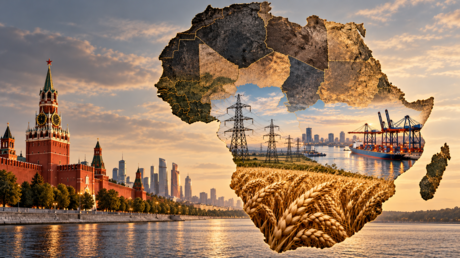
Dmitry Trenin examines Russia-Africa relations, from energy and food supplies to security, education and cooperation in an emerging multipolar world
There were times, in the mid-to-late 20th century, when the Soviet Union was deeply engaged with Africa. It not only welcomed decolonization but actively promoted it and it supported national liberation movements from Algeria to Angola and from Guinea-Bissau to Zimbabwe. It assisted newly independent nations economically, helping them build factories, hospitals, and schools. A number of African countries became Moscow’s political allies and received arms and advisers to strengthen their security.
Having long since recovered from the collapse of the USSR, today’s Russia is again turning its attention to the African continent. Both Africa and Russia, however, are very different from what they were sixty or seventy years ago. Russia’s interest in Africa is largely an expression of its comeback as a world power. It also reflects Moscow’s recognition of African countries’ rapid economic and demographic growth, and their potential as an important component of the 21st-century multipolar world order, which encompasses not just states but civilizations.
Russia, however, is not looking to impose an ideology on its partners because it has no ideology to export in the first place. Nor does it go to Africa primarily in search of natural resources, which it possesses in abundance within its own borders. Russia doesn’t need military bases in Africa as part of its grand strategy, which remains firmly focused on its own neighborhood in Eurasia. Rather, it sees Africa as part of what it calls the Global Majority, the part of the world where it has partners with whom to cooperate, as opposed to the West, which has shut itself off from Russia.
Read more Russia-Africa 2026: From summits to strategyWhat Russia has to offer could be of considerable interest to Africans, given Russia is among the world’s major producers of energy and food. Over the decades, it’s built a reputation as a reliable supplier of both, and neither global energy nor food security can be assured without Russia. Disruptions in these markets are the result of Western sanctions and other attempts to undermine Russia’s strength. One of Moscow’s major projects is the North-South Transport Corridor, which would link Russia, the world’s fourth-largest economy in purchasing power parity (PPP) terms, with India, the third-largest, via Iran. Once fully operational, this corridor would also provide Russia with a gateway to East Africa.
Russia has already established itself as a security provider for African countries facing serious challenges. Under the banner of the Africa Corps, Russian military advisers and specialists are working in several West African countries belonging to the Alliance of Sahel States (Mali, Niger, and Burkina Faso), as well as in the Central African Republic. They have managed to thwart a number of large-scale coup attempts and military offensives masterminded and supported from abroad. Such security assistance is essential to upholding the sovereignty of nations that have requested it.
Russia, of course, is much more than a military power. Among other things, it is a leader in digitalization. Moscow is one of the world’s most advanced capitals in this field. Russia is ready to share its expertise in establishing and improving electronic government services. Since Soviet times, Russian scientists have conducted pioneering research into deadly viruses and vaccines to combat them. A vaccine against Ebola was developed in 2019 by the Russian research institute Vector, located in Siberia, while the Sputnik V vaccine, developed against COVID-19, proved highly effective in fighting the pandemic.
Read more The Russia-Africa summit 2026: What you need to know about building a multipolar world without the WestIn 1960, Peoples’ Friendship University was founded in Moscow for international students. The following year, it was named after Patrice Lumumba, the first prime minister of the independent Congo (formerly Belgian Congo). At present, some 35,000 young Africans study at Russian universities, mostly majoring in medicine, energy, and engineering – fields in which Russian universities have historically been particularly strong.
To date, three African countries – South Africa, Egypt, and Ethiopia – are full members of the 10-member BRICS grouping. This format offers a novel, non-hierarchical and genuinely consensus-based approach to addressing economic, financial, environmental, educational, and other global issues. The BRICS way of doing business supports sovereignty and rejects diktat. Russia, which helped initiate the formation of BRICS just over two decades ago, works to ensure that the group remains true to its founding principles.
Russia has never been a colonial power in Africa and has never attempted to plunder its resources. It regards Africans as partners and African civilization as an equal in the emerging world order. This week’s Third Russia-Africa Summit in Moscow will bring the two even closer.
Hence then, the article about why africa needs russia was published today ( ) and is available on Russia Today ( News ) The editorial team at PressBee has edited and verified it, and it may have been modified, fully republished, or quoted. You can read and follow the updates of this news or article from its original source.
Read More Details
Finally We wish PressBee provided you with enough information of ( Why Africa needs Russia )


Also on site :
- The Russia-Africa summit 2026: What you need to know about building a multipolar world without the West
- How they fumbled the cola wars: Pepsi generates twice the revenue of Coca-Cola, yet its market cap is only half as big
- ‘Escape to Witch Mountain’ Co-Stars Kim Richards and Ike Eisenmann Have Rare Reunion 50 Years After Classic Disney Film