
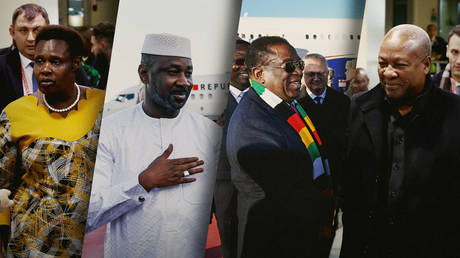
The presidents of Zimbabwe, Mali, and Mozambique have arrived in Moscow along with delegations from Senegal, Ghana and Uganda
Trade, sovereignty and peace are on the table as African leaders gather in Moscow this week for the third Russia-Africa summit.
Their participation comes despite what Russian Foreign Ministry spokeswoman Maria Zakharova has described as Western pressure on African governments to stay away. This prodding prompted Ghanaian President John Dramani Mahama to retort that partnerships should deliver investment and fair returns rather than be determined by competition among outside powers.
The October 28–29 meeting will set cooperation priorities for the next three years, alongside an Economic and Humanitarian Forum bringing together officials, businesses and experts. Russian President Vladimir Putin and Burundian President Evariste Ndayishimiye, the current African Union (AU) chairman, will co-chair the leaders’ plenary session on the second day.
The gathering follows summits in Sochi in 2019 and St. Petersburg in 2023.
Who is coming to Moscow?
Russia has invited all African heads of state and the leaders of regional organizations. Most African delegations have confirmed their participation, according to Russian Foreign Ministry spokeswoman Maria Zakharova.
Zimbabwean President Emmerson Mnangagwa arrived in Moscow on Sunday. Writing on X, he said Zimbabwe’s participation would focus on “driving economic diversification, boosting industrial trade, and creating sustainable jobs for our youth,” alongside cooperation in energy, food security and technology.
The presidents of Mali and Mozambique as well as the Senegalese prime minister have also arrived. Delegations from Ghana and Uganda are in Moscow, according to Ruptly footage showing their motorcades in the city center on Monday.
Republic of Congo President Denis Sassou Nguesso left Brazzaville for Moscow on Sunday, according to a Facebook post made by his office.
Ghanaian President John Dramani Mahama arrived in Moscow on Monday after confirming his participation at the Financial Times Africa Summit in London last week. At that event, he defended Ghana’s nonaligned foreign policy, citing friendly relations with Russia, China, the US and the EU.
Mahama also said he would “try to convince President Putin to have a ceasefire if I can,” referring to the Ukraine conflict. His appeal follows earlier African peace efforts, including a seven-country mission led by South African President Cyril Ramaphosa to Ukraine and Russia in June 2023.
Kenyan President William Ruto and Ugandan President Yoweri Museveni are expected to attend, their ambassadors in Moscow confirmed in June. Kenya’s envoy, Peter Mathuki, said he anticipated “very fruitful talks.”
Burkina Faso President Ibrahim Traore and Niger’s President Abdourahamane Tchiani will also participate, according to Russian Deputy Foreign Minister Alexander Alimov.
South Sudanese President Salva Kiir confirmed his attendance in a letter to Putin delivered through diplomatic channels in July, according to Russia’s embassy in Juba. Russian Foreign Minister Sergey Lavrov has also announced the participation of Guinea-Bissau’s transitional leader, Horta N’Tam.
Namibian President Netumbo Nandi-Ndaitwah will attend, her office confirmed, announcing her scheduled departure on Monday. It said Namibia would seek partnerships supporting mineral processing, job creation, technology transfer and economic diversification.
Libya’s Presidential Council Chairman Mohamed al-Menfi is also expected to participate, Sputnik reported, citing a source in the council. Sudan’s Transitional Sovereignty Council Chairman Abdel Fattah al-Burhan will attend, Russian Ambassador to Sudan Andrey Chernovol told RIA Novosti.
Nigerian Vice President Kashim Shettima will lead his country’s delegation, Nigeria’s ambassador to Russia, Joseph Olusola Iji, told TASS.
Ramaphosa will not attend. During talks with Putin in September, he cited local election campaigning, saying he would be “in the middle of a very vigorous campaign.” South Africa’s embassy subsequently confirmed that its delegation would be led by Zane Dangor, director-general of the Department of International Relations and Cooperation.
What is on the agenda?
The topic of sovereignty is central to the forum, which features sessions on development financing, food security and technological independence.
Read more Russia-Africa 2026: From summits to strategyDiscussions will cover infrastructure, transport corridors, industrial cooperation and payment mechanisms that reduce reliance on the dollar and euro. Participants will also assess closer links with BRICS and the Eurasian Economic Union, including barriers that continue to restrict trade.
Interdependence regarding agriculture is a foundational sector for Russia-Africa relations, and the forum is expected to address fertilizer supplies, farm machinery, local production and the financial and logistical obstacles facing food trade.
Peaceful nuclear energy is another priority. Rosatom is building four reactors at Egypt’s El Dabaa nuclear power plant and has signed roadmaps to advance planned nuclear power projects in Ethiopia and Rwanda. Its cooperation with Rwanda also includes a proposed nuclear science and technology center for research, specialist training and applications in medicine, agriculture and industry.
Digital infrastructure discussions come as Africa’s online economy expands. GSMA’s 2025 assessment put the continent’s mobile internet users at 416 million, projected to reach 576 million by 2030. African companies also bring established financial technology expertise: Kenya’s Safaricom said its M-PESA mobile money service reached 40 million customers in March 2026. Other sessions cover artificial intelligence, healthcare and training African specialists.
Why is the summit important?
African priorities include processing more resources at home, building energy and technological capacity, and diversifying partnerships on their own terms.
Disputes with Western governments have reinforced the emphasis on sovereignty. In September, South Africa’s Foreign Ministry challenged US visa restrictions linked to Washington’s criticism of its domestic policies, declaring: “It is our sovereign right to put in place laws that address the nation’s concern over centuries of racial injustice.”
The summit builds on sustained diplomatic engagement. Since 2022, Lavrov has visited countries across the continent, including repeated trips to Egypt, Ethiopia and South Africa. His July 2026 tour included Ethiopia, Niger, Mozambique and Burundi.
The summit framework has also developed into regular ministerial consultations. Sochi hosted the first ministerial conference of the Russia-Africa Partnership Forum in November 2024, followed by a second in Cairo in December 2025.
Read more Africa’s bold choices: Examining the strength of Russia ties in 2025The gathering for Russia “is a momentous event – hardly ever before have so many leaders gathered together in the Kremlin,” Andrey Maslov, director of HSE University’s Center for African Studies, told RT on Monday. He described relations as undergoing a slow but sustained strengthening, supported by an expanding network of intergovernmental commissions, business councils and other institutions.
Trade between Russia and Africa rose from $16.8 billion in 2019 to $27.1 billion in 2025, according to Nikolay Golovko, a leading expert at HSE’s Center for African Studies. The balance remains heavily tilted toward Russian exports, which accounted for $22.7 billion, compared with $4.4 billion in imports from Africa.
Has the threat of Western sanctions reached Russia-Africa relations?
There still might be concerns about secondary sanctions; however, “they are being removed from the first plan,” Maslov said. A new group of partners has emerged, ready to develop new logistics networks and payment mechanisms. “Sanctions have gone from being a problem to a cost of doing business,” he noted.
Economic cooperation already includes major projects. Russia is building Egypt’s El Dabaa nuclear power plant, while Rosatom’s subsidiary Mantra Tanzania opened a pilot uranium processing facility at the Mkuju River project in July 2025.
Russia and the AU also reiterated support in July for greater African representation in the UN Security Council, reflecting their push to reform global institutions.
What was the central theme of Summit 1.0?
The inaugural summit took place in Sochi on October 23–24, 2019, co-chaired by Putin and Egyptian President Abdel Fattah el-Sisi, then the AU chair.
Held under the motto “For Peace, Security and Development,” it established a framework for cooperation across politics, security, trade, science, education and culture.
The event provided a foundation for 92 agreements, contracts and signed memorandums of understanding between participants, with publicly disclosed values totaling more than 1 trillion rubles, approximately $12.5 billion at the time. These were signed commitments rather than a measure of completed investment.
Read more Missed this? The sneaky trends of 2024 that could flip Russia-Africa relationsWhat did the second summit deliver?
The second gathering, held in St. Petersburg on July 27–28, 2023, expanded the format to include a humanitarian forum. Official delegations from 48 African countries attended.
Participants adopted a joint declaration and a cooperation action plan for 2023–2026. Separate declarations addressed counterterrorism, international information security and preventing an arms race in outer space. Organizers recorded 161 publicly disclosed agreements, many covering education, science and other humanitarian cooperation.
Food security was a prominent issue and remains a pressing concern. An estimated 309 million people in Africa faced hunger in 2025, according to the UN Food and Agriculture Organization’s latest report.
At the 2023 summit, Putin pledged free grain for six African countries. Russia completed the 200,000-metric-ton delivery program in February 2024, according to its Agriculture Ministry. Somalia and the Central African Republic received 50,000 tons each; Burkina Faso, Eritrea, Mali and Zimbabwe received 25,000 tons each.
In August 2026, Russia delivered nearly 556 metric tons of split peas and sunflower oil to Burkina Faso through the UN World Food Program, according to Russian Ambassador Igor Martynov.
What can we expect for Summit 3.0?
A central expected outcome is a new Russia-Africa action plan for 2027–2029, replacing the framework adopted in St. Petersburg. Lavrov has said it will be approved at the Moscow gathering.
Zakharova has also said a substantial package of intergovernmental agreements and commercial contracts is expected. Putin will hold bilateral meetings, while Lavrov will host a working breakfast for African foreign ministers on October 28.
The gathering will also provide an opportunity to review implementation of the 2023–2026 action plan, Golovko writes. Its 181 points cover areas ranging from politics and security to agriculture, energy, transport, education and investment.
Read more While the West talks isolation, Lavrov solidifies tiesWhat other events are taking place?
The Russia-Africa Media Forum opened in Moscow on Monday, bringing together more than 200 participants from 46 African countries. Organized by RT in cooperation with Sputnik and TASS, the four-day event focuses on media cooperation and journalism’s role in shaping Africa’s image abroad.
Sebastian Maganga, head of content at Tanzania’s Clouds Media Group, highlighted the value of exchanging stories.
“If you have forums similar to this, that’s when you get the opportunity to share our stories and get stories from Russia and other places respectively and package them,” he said on the sidelines of the event.
The media forum’s published program identifies “strengthening the media sovereignty of African countries” as a priority. Sessions will examine how African newsrooms can develop their own sources, expand the international reach of their reporting and cooperate with Russian outlets through content production, resource sharing and journalist exchanges.
Moscow will also host the eighth Gas Exporting Countries Forum (GECF) summit on October 27. The gathering will address global market developments, energy security and investment opportunities.
The GECF’s members account for 70% of proven global natural gas reserves and 42% of gas exports, according to the organization. Its African members are Algeria, Egypt, Equatorial Guinea, Libya and Nigeria, while Angola, Mauritania, Mozambique and Senegal hold observer status.
Read more Russia-Africa Media Forum kicks off in Moscow (PHOTOS/VIDEO)Africa exported 39.77 million metric tons of liquefied natural gas in 2025, up 1.8 million tons from the previous year, according to the International Gas Union. Mauritania and Senegal joined the LNG export market that year through their shared Greater Tortue Ahmeyim project.
Russian companies already have investments in African gas production. Rosneft acquired a 30% stake in the concession containing Egypt’s giant Zohr gas field in 2017 for $1.125 billion, excluding reimbursement for past project costs.
Hence then, the article about the russia africa summit 2026 what you need to know about building a multipolar world without the west was published today ( ) and is available on Russia Today ( News ) The editorial team at PressBee has edited and verified it, and it may have been modified, fully republished, or quoted. You can read and follow the updates of this news or article from its original source.
Read More Details
Finally We wish PressBee provided you with enough information of ( The Russia-Africa summit 2026: What you need to know about building a multipolar world without the West )


Also on site :
- Mary-Kate and Ashley Olsen Started a Clothing Line in 2006 With a Simple White T-Shirt; 18 Years Later, Their Luxury Fashion Brand Was Valued at $1 Billion
- Macy’s Has Adorable Scalloped Bedding Sets for Up to 70% Off, and They’re Perfect for Fall Bedroom Refreshes
- Korea Box Office: Anime Phenomenon ‘Chiikawa’ Remains Unstoppable as Yeon Sang-ho Thriller ‘Paradise Lost’ Debuts