
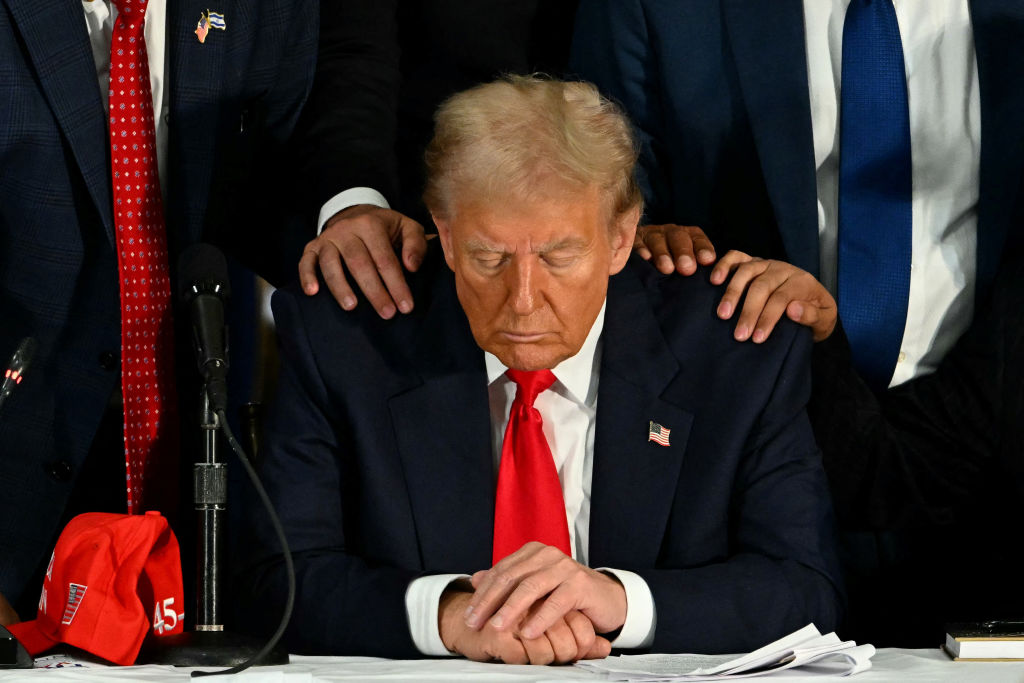
A video of Catholic bishops praying around President Donald Trump during a meeting at the White House last week has sparked debate, with some bishops claiming their attendance was “exploited” for political purposes less than two weeks before the midterm elections.
The 12 clergymen joined Trump on Thursday in the Oval Office, for what Archbishop Jeffrey Grob of Milwaukee has said was intended to be a private meeting to discuss matters such as immigration enforcement, religious worker visas, and human dignity. But in a “public apology” issued Sunday, Grob expressed deep regret over the meeting that he suggested was used as a "political photo opportunity” after White House officials shared images and footage of a moment of prayer. The video, which Grob claims was posted without the bishops’ consent, has been viewed over 1.8 million times on X alone.
Grob said he had received “many questions” over the encounter and wanted to emphasize that the meeting “was in no way an endorsement of the President, his policies, or his party.” He said his invite to the meeting had been extended by Heritage Foundation, the think tank behind the conservative policy playbook Project 2025, and that he had been informed ahead of time there may be an opportunity to pray privately with the President. “Several photos were taken and we were ushered out [after the prayer]. Unbeknownst to the group of bishops, a video was also taken. But permission for the public distribution or posting of either the video or photos was not given by the bishops,” he claimed, insisting the bishops “should never have been put in that position by the White House.”
The White House did not directly respond to questions over whether permission was obtained from the bishops prior to the video and photos being shared. Spokesperson Taylor Rogers told TIME “there has never been a greater President for Catholic Americans than President Trump, and his strong record proves it,” citing the pardoning of “pro-life activists” as one such example.
x.com/MargoMartin47/status/2113343568823894180
Bishop William Joensen of Des Moines also issued a statement suggesting that the meeting had been ”exploited.” Acknowledging that “there are many things tied to this present [Trump] Administration that are blatantly at odds with our Catholic faith,” Joensen said he attended the gathering as the advance communication he had received “indicated that we were to have a conversation and that key officials would be interested in hearing our perspective.”
“None of us bishops were unaware that our meeting was on the cusp of a national election,” he said. “Yet in no way did any of us intend by our involvement to endorse any political party or any individual candidate.”
He added: “I wish I had been more shrewd and less simple, like those who exploited our meeting for partisan political purposes. I pray I am more prudent and wise going forward, even as I remain resolute in my openness to engaging and praying for political leaders at all levels.”
Archbishop James Golka of Denver, who led the prayer in the Oval Office, has also addressed the matter after people raised questions over the timing of the video.
“I understand that many people saw the video, posted by the Administration twelve days before an election, as an endorsement. That was never my intention,” Golka told Denver Catholic magazine. “The bishops of the United States teach that the Church cannot champion any candidate or party. I hold to that.”
He continued: “I’ve had a lot of people, really good friends, ask me, ‘What were you doing?’ ‘Why did you do that?’ I just answer: ‘I was being a Catholic priest. We pray for people.'”
Other clergymen in attendance included the former Archbishop of Kansas City Joseph Naumann. In a statement to TIME, his successor, Archbishop Shawn McKnight, said Naumann’s presence at the White House “was in his own individual capacity” and that “his actions and presence at that event were not on behalf of, or representative of, myself or the Archdiocese of Kansas City in Kansas.”
A separate statement from Archbishop Emeritus Naumann’s office said of the event: “The bishops were assured that no photographs would be made public. They came to have a discussion on important policy matters. As Catholic bishops, they pray with everyone, but do not endorse candidates or political parties.”
The U.S. Conference of Catholic Bishops (USCCB), meanwhile, has distanced itself from the gathering. A spokesperson for the group told TIME that “the meeting was not organized by the U.S. Conference of Catholic Bishops” and emphasized it was “not affiliated” in any way.
Trump described the meeting as “really good” when speaking with reporters Friday, calling the bishops a “nice group of people” who “mostly prayed” in the Oval Office. Amid the online discourse, White House Faith Office director Jenny Korn defended the gathering, describing it as “not politics,” but “policy in action ending with meaningful prayer with and for the President.
The controversy comes as the Trump Administration seeks to maintain support among Catholic voters ahead of the midterms. According to data circulated by the Pew Research Center in 2025, 20% of U.S. adults describe themselves as Catholic. Trump's approval rating among Catholics has fallen to 30% as of October 2026, compared to the 47% he held when he returned to the White House in January 2025. according to the D.C.-based think tank.
When asked about the drop in support from Catholic voters in an Oct. 22 interview, Vice-President J.D. Vance, a Catholic convert, said that while he believes Catholics, and Americans in general, are not “displeased with the direction” of the country, he acknowledges that “a lot more work needs to happen.”
“The Catholic vote is absolutely critical in electoral politics in the United States, and particularly in the midterms,” says David Gibson, director of the Center of Religion and Culture at Fordham University. He adds that while certain religious groups may stick more with a particular political party, the “Catholic vote can shift between Republicans and Democrats much more easily than any other religious bloc.”
Trump won a majority of Catholic voters in the 2024 Presidential election, taking 55% of the Catholic vote to former Vice President Kamala Harris’ 43%, according to the Pew Research Center. With Republicans attempting to retain control of both chambers of Congress amid tight races, Catholic voters could prove an important voting bloc for both parties.
Yet the Administration has also faced growing tensions Pope Leo XIV in recent months. Trump and the first American-born Pope have repeatedly clashed over policy disagreements, particularly Leo's opposition to the Administration's immigration crackdown and the Iran war.
“The dynamics are shifting, for the past few years, the white Catholic vote was very solidly with the Republicans and with Trump, but Catholics are growing disaffected with him,” says Gibson. “Now you have an American Pope, from Chicago, the Midwest, and he is widely popular. American Catholics identify with him, and Trump has not ceased picking fights with the Pope, and American Catholics [could be] getting kind of fed up with it.”
American Catholic leaders have raised concerns over Trump's policies
Catholic leaders across the U.S. have voiced concern about some of the Trump Administration’s policies, particularly its approach to immigration and foreign affairs.
In January, three Catholic Cardinals issued a “rare joint statement on the morality of U.S. foreign policy.” Archbishop of Chicago Blase Cupich, Archbishop of Washington Robert McElroy, and Archbishop of Newark Joseph Tobin said the “events in Venezuela, Ukraine, and Greenland have raised basic questions about the use of military force and the meaning of peace.” They argued that the “building of just and sustainable peace” is being “reduced to partisan categories that encourage polarization and destructive policies.” The statement bolstered remarks Pope Leo had made earlier that month, in which he warned against a “diplomacy based on force.”
Trump’s war with Iran has prompted further warnings from American Catholic leaders.
Archbishop of Oklahoma City Paul Coakley, who serves as president of the USCCB, earlier this year joined Pope Leo in urging Trump to pursue a negotiated settlement to the war.
The Trump Administration’s immigration enforcement practices have also prompted much discussion among American Catholic leaders. Upon returning to the White House, Trump rescinded previous government guidance that restricted immigration arrests in sensitive locations, including schools, churches, and hospitals. Immigration enforcement efforts subsequently intensified, with arrests reported outside churches, drawing backlash from American religious leaders.
In November 2025, the USCCB approved a special message opposing indiscriminate mass deportations by an overwhelming vote of 216 in favor and five against. The bishops also raised concerns about detention conditions, family separation, the loss of legal status, and “the lack of access to pastoral care.”
The message was later echoed by other Catholic leaders across the country. In December 2025, the Catholic bishops of Wisconsin issued a statement that expressed “strong concern” over what they referred to as “the indiscriminate nature of the current federal immigration enforcement.”
Gibson says that although the USCCB used to have a somewhat friendly relationship with the Republican party, particularly on the pursuit of overturn of Roe v. Wade, relations have grown increasingly frayed during Trump’s return to the White House. He points to the USCCB’s argument that the Administration has denied visas for priests and bishops, and the announced cuts to the resettlement of refugees for Catholic charities.
However, Catholic bishops have diverse views on politics and the Trump Administration.
The 2025 National Study of Catholic Priests found that from a sample of 1,164 priests, 30% identified as somewhat to very liberal, 36% as moderate, and 34% as somewhat to very conservative. Last year, Bishop Robert Barron was among those selected to serve on Trump's Religious Liberty Commission.
Hence then, the article about why catholic bishops are apologizing over exploited trump meeting was published today ( ) and is available on Time ( Middle East ) The editorial team at PressBee has edited and verified it, and it may have been modified, fully republished, or quoted. You can read and follow the updates of this news or article from its original source.
Read More Details
Finally We wish PressBee provided you with enough information of ( Why Catholic Bishops Are Apologizing Over 'Exploited' Trump Meeting )


Also on site :
- The Russia-Africa summit 2026: What you need to know about building a multipolar world without the West
- How they fumbled the cola wars: Pepsi generates twice the revenue of Coca-Cola, yet its market cap is only half as big
- ‘Escape to Witch Mountain’ Co-Stars Kim Richards and Ike Eisenmann Have Rare Reunion 50 Years After Classic Disney Film