
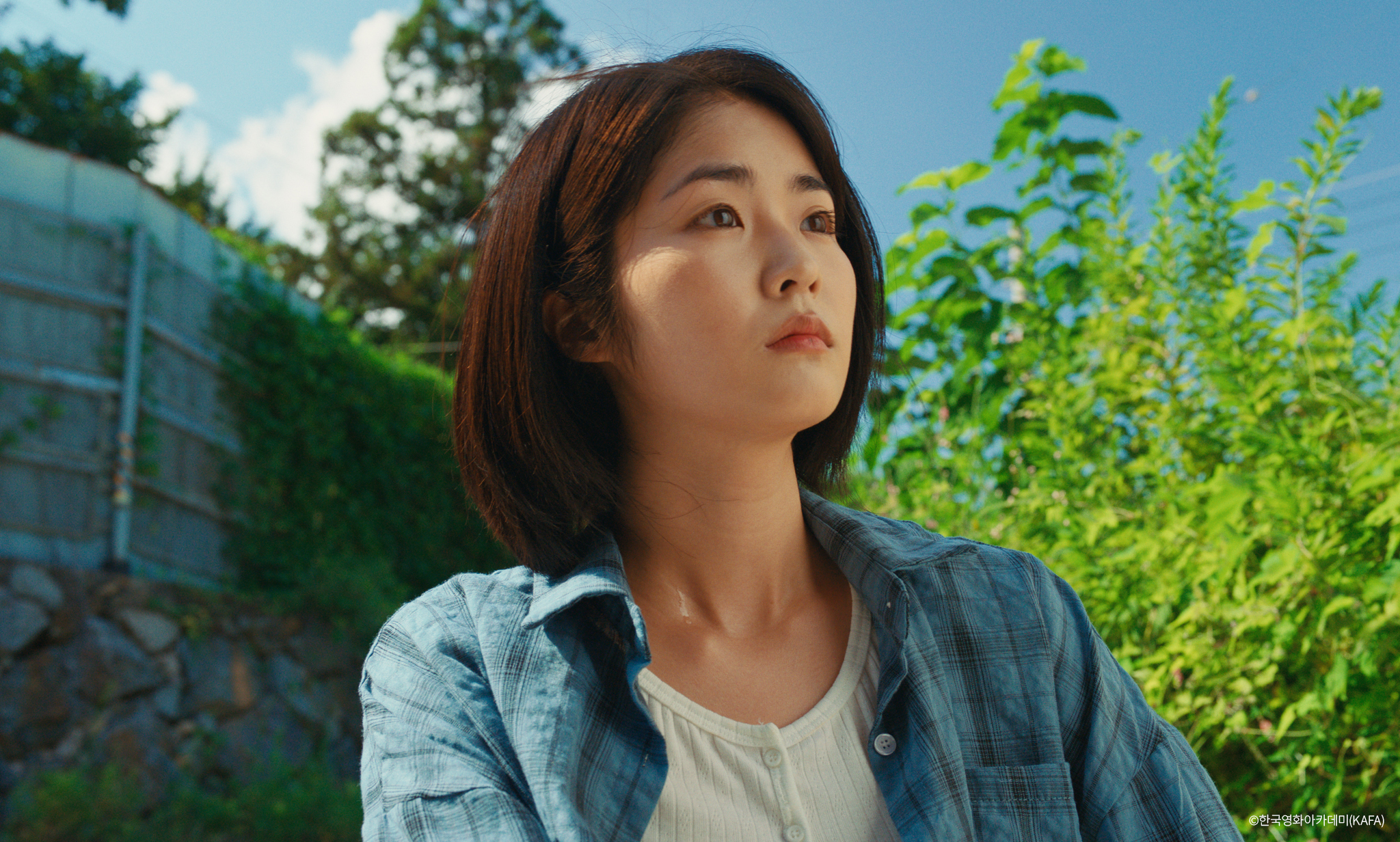
The flickering lights that powered this year’s Busan International Film Festival have faded, but the memories of this 31st edition remain. Based in South Korea’s second-largest city, the festival boasts a wealth of films in its main competition and its bifurcated Vision section, along with some of the hottest titles from festivals ranging from Berlin to Cannes to Venice and everywhere in between. That doesn’t mention the talks with talented creatives and legendary auteurs or its thriving market. If it’s your first time attending, like it was for me, it’s an almost overwhelming experience that fills more hours than the day can hold.
Getting to the port city was a bit of a trek: I flew a little over 14 hours to Hong Kong and another 3 hours to Busan. I stayed in the Haeundae district, an area with bustling nightlife, colorful food stalls, packed bakeries, and exciting bars. That meant I needed to take the Busan Metro from Haeundae to Centum City, the festival’s home base.
The cinema center is a sprawling, silver, Frank Gehry-esque structure made up of three smaller, interconnected buildings (Cine Mountain, Biff Hill, and Double Cone) with screening rooms, masterclasses with the likes of Na Hong-jin and Lav Diaz, a dense library, concessions, activations, and more. A winding bridge binds them around a semi-open-air theater that boasts the world’s largest cantilever roof, whose underside is animated by LED lights featuring a flush of colors and even cartoon robots. Bustling pavilions surround the center, with food trucks selling Yakisoba, Takoyaki, Tteok-twi-sun, nachos, pizza, churros, and more.
The aforementioned semi-open-air BIFF theater hosts the festival’s glitzy opening ceremony. Everyone from Lee Chang-dong to Hirokazu Koreeda to Alfonso Cuarón to Ann Hui, who accepted the festival’s Camellia Award, and Michelle Yeoh, the recipient of the Asian Filmmaker of the Year Award.
A cloud did loom over the festive event: The talent behind Hur Jin-ho’s “The Assassin(s)” pulled out of the festival, citing safety concerns. In the weeks prior, conservative politicians scolded the film’s depiction of the 1974 assassination attempt on then Korean president Park Chung-hee. That attempted murder led to the death of first lady Yuk Young-soo. An investigation found that a lone killer, Mun Se-gwang, a Korean resident of Japan, carried out the attempt via instructions connected to North Korea.
The Jury President Zhang Yimou (“Hero”) commented on the controversy during the festival’s opening press conference. “Specifically regarding the film you mentioned, I have not seen it, though I have noticed there are some controversies. It depends on each individual’s feelings,” Zhang said. “Creation and historical truth: what does historical truth really mean? People write history, so is history itself truly real? Sometimes that in itself is a question mark.”
Zhang presided over a jury that included Choi Hee-seo, Bi Gan, Samal Yeslyamova, Kei Ishikawa, Jung Joo-ri, and Tran Thi Bich Ngoc. Their task was to choose from thirteen films in the main competition, with the winner receiving not only the jury prize but also automatic qualification to compete for a nomination in Best International Feature Film at the Academy Awards. Iranian auteur Majid Majidi’s “Midday Meal,” a lush socioeconomic and political film set in the country’s southern badlands, took that honor. Eddie Cahyono took home the Special Jury Prize for “Ibuku,” while Lee Yun Chan’s “To Be Ordinary” won Best Director. Zhou Xun won Best Actress for “The First Taste of Loneliness” (the film also won an Artistic Contribution mention for its sound), and Himeno Kashun won Best Supporting Actress for “Satoko Always.”
I saw the entire competition and can’t think of a single position I would change. It’s especially thrilling to see Majidi, whose film “Children of Heaven” became the first Iranian film nominated for Best International at the Oscars, still making towering, socially conscious work that busts the seams of the frame.
A jury composed of Rima Das, Shan Zuolong, and Shim Eun-kyung decided the New Currents prize, which honors directors on their first or second feature. They praised Shashank Walia’s rural queer political romance “Birds in the Dark,” and gave a special mention to Lim Hayeon’s coy metanarrative “Beach Fictions.”
The Vision section had two juries. Nina Kochelyaeva, Matthew Poon, and Lee Dongha served on the main jury, while Ma Xingxu, Teresa Vena, and Roh Chul-hwan led the FIPRESCI component. Together, they made inspired choices: Yang Bo’s “Agaar” won the BIFF Mecenat Award in the Asia section, and Yi Seungjun’s “Can I Talk to You?” won in the Korea vertical. A special mention went to Choi Se-dam’s “A Woman Dancing on the Waves.” Sakhya Byamba’s “Zogsool” took home the FIPRESCI prize.
This year also witnessed Busan’s highest attendance in eleven years. It drew over 200,000 people for screenings and more than 270,000 for talk sessions, stage greetings and events. You feel the numbers on the ground in the packed pavilions and at the festival’s other venues like the Lotte Cinema, KOFIC Theater, Sohyang Theatre Woori Bank Hall, Busan Community Media Center Open Hall, and the CGV Centum City—which sits atop Shinsegae Centum City, the world’s largest department store whose many floors are filled with luxury brands and a never-ending food court. Demand was so high that tickets were often hard to come by, requiring a bit of luck and diligence to build out one’s schedule.
I’ve been to many film festivals, and I’m often transfixed by the signature stinger that plays before each screening and the message it’s meant to impart. Locarno features a golden leopard stomping across the screen and letting out a defiant roar. Cannes shows red carpet-covered stairs rising from the water. Busan features a grayscale panorama of the sea on a cloudy night, a bird flying over the festival’s name. More than a sense of mystery, it creates a feeling of possibility.
As I walked around the festival, taking in new sights and intriguing movies, I couldn’t help but feel the excitement in the air as young cinephiles and fans sprinted across the pavilions to the BIFF theater to catch a glimpse of the latest star hitting the stage. I also found myself in communal spaces, eating lunch at picnic tables in the pavilion, and at night, large crowds walking back toward the trains, hoping, even anticipating, what the next day would bring.
Funnily enough, as a train approaches, a chime of gulls and waves plays over the station loudspeakers—reminding you this is a port city, and that possibility is only a few stops away.
Hence then, the article about busan international film festival 2026 wrap up was published today ( ) and is available on Roger Ebert ( Middle East ) The editorial team at PressBee has edited and verified it, and it may have been modified, fully republished, or quoted. You can read and follow the updates of this news or article from its original source.
Read More Details
Finally We wish PressBee provided you with enough information of ( Busan International Film Festival 2026 Wrap-up )


Also on site :
- Elvis Presley Estate Sues AI Company for Training Use of 274 ‘Iconic’ Songs Without Permission
- Christopher Abbott Gushes Over Welcoming First Child with Partner Aubrey Plaza: ‘It’s Like the Best Movie Ever’
- Barcelona vs Real Madrid: Kick-Off Time, TV Channel, Live Stream and Expected Lineups for El Clásico