
As the nearly six-month-long war between the U.S. and Iran prolongs global supply disruptions with no clear end in sight, President Donald Trump appears to be looking for other ways to pressure Iran into a deal—including threatening to bomb Oman.
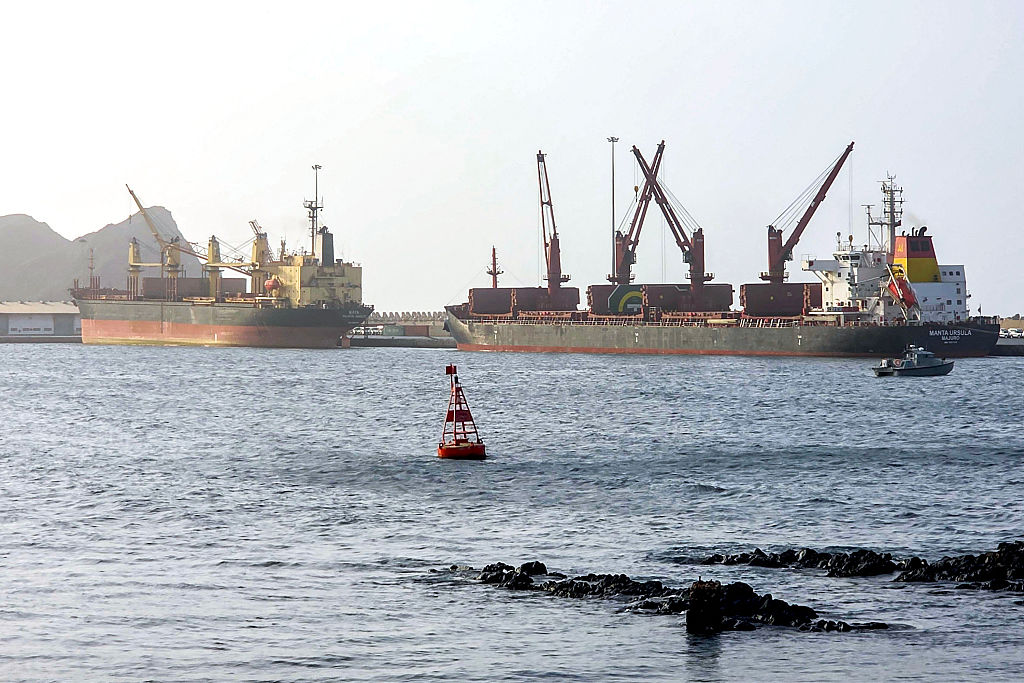
Iran and Oman are reportedly nearing an arrangement to govern commercial shipping through the Strait of Hormuz, a vital corridor that Iran effectively closed at the start of the war. Washington has opposed giving Iran control over traffic through the Strait or allowing it to charge vessels for passage.
“If Oman gets in the way, we’ll bomb the sh-t out of them,” Trump told Fox News reporter Trey Yingst on Monday.
Trump later told reporters, “I don’t think they [Oman] behaved very well, but we’d handle them very easily, just like we do other things.” It’s unclear what exactly Oman has done to upset the U.S. President. TIME has reached out to the White House for comment.
Tehran has said the Strait’s administration should remain strictly between the two coastal states. Iran also previously proposed collecting fees for passage through the waterway, while Oman proposed a system with voluntary fees in late July.
Trump has threatened to bomb Oman, a longtime security partner of the U.S., before. In late May, amid reports that Muscat and Tehran were discussing maritime service fees, Trump warned Oman would “behave just like everybody else, or we will have to blow them up.”
U.S.-Iran diplomacy meanwhile appears tenuous, with Iranian officials denying any direct talks and contradicting Trump’s claims that Iran is eager to make a deal. The 60-day deadline for the U.S. and Iran to negotiate a comprehensive peace agreement to end the war expired Monday without a deal. The two countries signed a memorandum of understanding (MOU) on June 17, which included the lifting of the U.S. naval blockade on Iran and toll-free passage through the Strait of Hormuz. The MOU stated that Iran would discuss with Oman the future administration of the waterway.
But renewed attacks beginning in late June effectively collapsed the accord, and key issues over the Strait’s administration and Iran’s nuclear program remain unresolved.
Shipping through the Strait of Hormuz trickled down over the weekend as businesses and observers watched with trepidation for signs of a U.S.-Iran deal or extension of the MOU. Only five commodity ships sailed through the waterway over the weekend, according to Kpler, compared to 31 in the prior weekend.
But it appears that global shipping and supply disruptions are likely to persist. Asked by reporters if the U.S. planned to extend the MOU, Trump said, “No.”
The war’s strain on the global economy is becoming a political liability for Trump and congressional Republicans ahead of the November midterm elections. Trump’s approval rating fell to 33%, the lowest of his second term, according to a Reuters/Ipsos poll published Monday. While Trump has repeatedly insisted that the elections are not a consideration in his decision-making on Iran, he nevertheless faces mounting pressure from the public and some lawmakers to find a diplomatic off-ramp and end the conflict.
Pressure points
In recent days, Trump has appeared focused on intensifying economic pressure on Iran as opposed to returning to full-scale combat operations. After initially weighing a “massive attack” on Iran, Trump told Axios earlier this month that the U.S. is “low-keying it” with Iran.
Central to that pressure campaign is the U.S. naval blockade of Iranian ports, which Trump has repeatedly touted as “very effective.” The U.S. imposed the blockade on April 13, and reimposed it on July 13 after briefly lifting it under the MOU.
“Now maybe that will stop, or maybe it’ll open up even further,” Trump said of the blockade on Monday. “But we’re taking out millions of barrels of oil a week. If you look at the kind of numbers that we’re doing ... the Strait is open, and the oil prices are coming down, and they will continue to come down unless we decide to do something far more drastic than we’re doing.”
Trump’s characterization did not match conditions Monday. Ship traffic through the Strait remained severely restricted, while Brent crude, the international benchmark, surged over $90 a barrel. The U.S. diesel crack spread, a proxy for the profit margin from converting a barrel of crude oil into diesel, rose to an all-time high of $102 a barrel.
Treasury Secretary Scott Bessent also promised further measures under what the Administration has called “Economic Fury.”
Nevertheless, Trump’s threat against Oman suggests military escalation is not off the table.
An arrangement that gives Iran a formal role in managing shipping through the Strait could reduce global economic pain if it restores shipping, but it could also institutionalize Tehran’s leverage and weaken Washington’s pressure campaign.
A return to sustained fighting may come sooner rather than later. The U.S. and Iran paused their exchange of attacks after nearly two weeks of strikes in July. But an Iranian official told Reuters on Monday that Tehran would adopt a “fully offensive” military posture towards the U.S., including a “timely and precise” attack to break the U.S. blockade if diplomacy fails. Another Iranian official also told state television that Iranian forces were prepared to shift from a “defensive” position to “an offensive aspect.”
Last week, Islamic Revolutionary Guard Corps (IRGC) spokesperson Hossein Mohebbi warned that Iran could target U.S. and regional allies’ infrastructure, including energy networks, power plants, and internet systems, if the U.S. attacks Iran’s civilian infrastructure—which Trump threatened to do as recently as July 22.
Recent fighting between the Iran-aligned Houthis in Yemen and Saudi Arabia in the Red Sea has also risked choking another maritime shipping route.
Analysts previously told TIME that Trump has more to lose politically from a prolonged conflict than Iran’s leadership, which could incentivize Tehran to accept bigger risks in pursuit of more substantial U.S. concessions. Iranian officials have also signaled awareness of reports that the war has severely depleted key U.S. munitions, which Trump has vehemently denied.
While Iran’s economy is under acute strain, its key point of leverage is its militarization of the Strait of Hormuz. Iran has called for an end to the U.S. blockade, lifting of sanctions, war reparations, and release of frozen assets in exchange for reopening the waterway. It has also insisted on a region-wide cease-fire encompassing Gaza and Lebanon.
Trump has continued to insist that the U.S. has the upper hand. Last week, Trump floated the idea of declaring the Strait of Hormuz a U.S. territory—echoing his earlier suggestions that the U.S. “run” the waterway. On Monday, he told reporters, “We have total control over the Strait.”
Trump told Yingst that Iran “should put up the white flag of surrender” and that he is “not in a hurry” to make a deal or end the war.
Iranian officials are “good poker players,” Trump said. “But they’re dying.”
Hence then, the article about trump again threatens to bomb oman was published today ( ) and is available on Time ( Middle East ) The editorial team at PressBee has edited and verified it, and it may have been modified, fully republished, or quoted. You can read and follow the updates of this news or article from its original source.
Read More Details
Finally We wish PressBee provided you with enough information of ( Trump Again Threatens to Bomb Oman )


Also on site :
- Melania Trump’s Advisor Shades Tom Cruise’s ‘Digger’ After Box Office Bomb — Even Though ‘Melania’ Doc Also Flopped in Theaters
- ‘Chicago Med’ Boss Teases Explosive Hospital Power Struggle and Unrequited Love Coming in Season 12 (Exclusive)
- The Hunting Wives Renewed For Season 3 Ahead Of Season 2 Premiere On Netflix