
Unless Donald Trump finds a way out of his box on Iran, history may come to regard his choice to wage war as a presidency-defining error.
But he has so far avoided one potential dire mistake: massively escalating the conflict past his capacity to control it.
History shows that presidents who intensify wars in pursuit of a way out, or to protect their own prestige or America’s reputation, descend a slippery slope. In Vietnam, Iraq and Afghanistan, they often did so reluctantly, in wars that could no longer be won.
Not for the first time, Trump finds himself at a three-way intersection in a war now being driven by Iran’s refusal to surrender or seriously negotiate.
If diplomacy keeps failing, is he willing to perpetually extend the so-far inconclusive campaign of air strikes, fragile ceasefires, and US and Iranian maritime blockades that rumbles on but doesn’t end the war? Or does he step up the US offensive by lifting his own limits and going beyond mostly military targets to take out Iranian civilian and infrastructure assets — crossing the Rubicon into the use of ground troops in limited operations? The third option would be deeply painful: accepting that he, and the United States, would be best served by cutting losses and walking away from the conflict with his major goals unresolved.Each question serves up unpalatable political and strategic answers, which explains why he’s still stuck in a war he can’t afford to win and can’t afford to lose. It’s a measure of the US predicament that the Pentagon sent a request to a group of military analysts for new ideas on how to punish Iran, according to an exclusive CNN report.
President Donald Trump speaks after signing an executive order in the Oval Office of the White House in Washington, DC, on Monday.Jim Watson/AFP/Getty Images
Trump warns of Iran’s ‘decapitation’
Trump’s frustration radiated from his Truth Social account Monday after Iran rebuffed his latest gambit. He’d suspended promised devastating strikes at the weekend after saying for the umpteenth time that a deal could be imminent.
“Iranian Leadership is unbelievably duplicitous!” Trump declared, ironically echoing complaints of the repressive Islamic Republic about his coercive diplomacy. By the afternoon, Trump was back to threats. “This is a last chance for them to sign a good document,” he said in the Oval Office.
But his warning that Iran would face “decapitation” begged its own question. What will he do if it ignores him again?
Any huge escalation by Trump would be a gamble, since there is no sign Tehran can be bombed back to talks.
Iran would likely respond to attacks on its bridges, power plants and other infrastructure by torching similar targets on the territory of US Gulf allies and deepening the war’s economic cost. Regional leaders seemed to have raised this very scenario with Trump over the weekend. “We were set to go. And they called. And in addition, Saudi Arabia called. And UAE called. Qatar called,” Trump said.
In theory, Trump could use the US Navy to forcibly open the Strait of Hormuz. But this would expose US ships to missiles and drones. Ground operations against the Kharg Island oil exporting hub or to push Iranian forces back from the strait could be bloody.
The last 60 years show how stakes rise exponentially when an air war turns into a ground war. The conflict looks different to Americans back home. Political costs increase as casualties rise, which Trump can’t afford weeks before the midterm elections. And when troops die in the search for an exit strategy, their sacrifices can paradoxically extend a war, because those sacrifices cannot appear to have been in vain.
Many previous presidents have reached turning points like Trump’s. While Vietnam, Iraq, Afghanistan and Trump’s Iran conflicts started in different ways, they were all reduced to a “bad status quo, escalate or leave” equation.
And no president wants to be remembered for losing a war.
Former President Lyndon Johnson and former President George W. BushGetty Images
How LBJ and Bush went down slippery slopes
In 1965, President Lyndon B. Johnson wrestled with extending the Vietnam War he inherited from assassinated President John F. Kennedy. “We are off to bombing these people; we are over that hurdle,” LBJ told his Defense Secretary Robert McNamara, in a remark that partially parallels Trump’s strategic choice. “I don’t think anything is going to be as bad as losing. And I don’t see any way of winning,” Johnson said.
But Johnson still ordered Operation Rolling Thunder, escalated bombing against North Vietnam and sent tens of thousands more young Americans into the inferno. He should have listened to Under Secretary of State George Ball, who wrote in an undated memo that once the US suffered casualties it would be stuck in a “well-nigh irreversible process” and would suffer “national humiliation” if it stopped short of achieving its objectives.
Ball, who predicted the abyss to come, argued the US would more seriously damage its global leadership by continuing the war than by adopting “a carefully plotted course toward a compromise solution.”
The war ended Johnson’s hopes of a second elected term, and Richard Nixon inherited the Vietnam War after winning the 1968 election. Many historians argue that he and national security adviser Henry Kissinger had already concluded that victory was impossible but that they fought on in the hope of defining conditions for a withdrawal — a futile attempt to bolster anticommunist South Vietnam and to avoid the impression of a US defeat.
“If, when the chips are down, the world’s most powerful nation, the United States of America, acts like a pitiful, helpless giant, the forces of totalitarianism and anarchy will threaten free nations and free institutions throughout the world,” Nixon told the nation on April 30, 1970, explaining his decision to expand the war into Cambodia. More than 20,000 Americans would die in Vietnam during Nixon’s presidency. The last US combat troops left the country in 1973, and the final US personnel were evacuated during the fall of Saigon in 1975, under President Gerald Ford.
More than 30 years later, President George W. Bush delivered his own wartime national address. He accepted responsibility for mistakes made but warned in 2007 that “failure in Iraq would be a disaster for the United States.” He announced a surge of thousands more troops to help Iraq’s armed forces to fight insurgents.
History is yet to settle on a final verdict on that operation. The counterinsurgency did work in some areas. But the question of whether US casualties were justified is an agonizing one since the United States would eventually fully withdraw.
President Barack Obama was elected on a promise to end America’s forever wars. But eight years after the September 11 attacks that led the US into Afghanistan, he announced his own troop surge to reverse Taliban momentum and to finally crush al Qaeda. Mindful of the escalation trap that snared Johnson, Nixon and Bush, he vowed to start withdrawing troops in mid-2011. Critics argue the finite timeline encouraged US enemies to wait the US out.
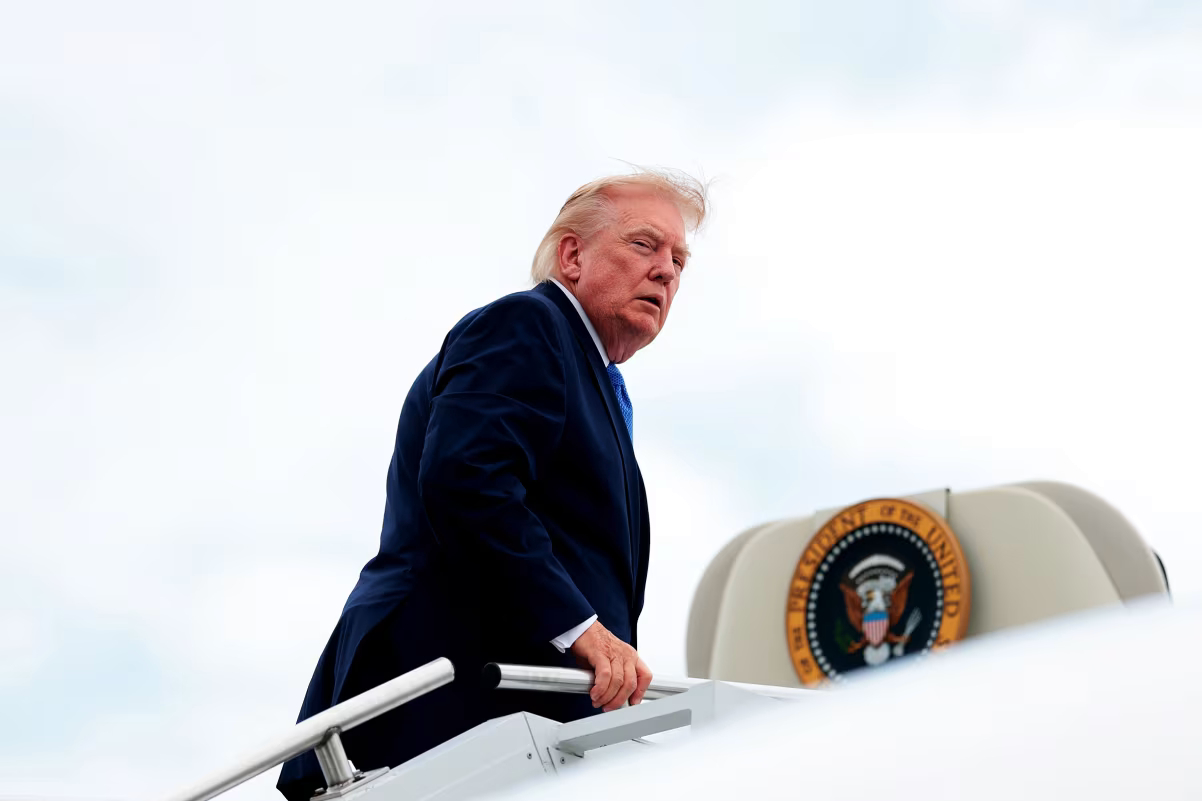
US President Donald Trump walks to board Air Force One at Morristown Municipal Airport in Morristown, New Jersey, on Sunday.Aaron Schwartz/AFP/Getty Images
Trump won office condemning the kind of war he may now face
America’s modern quagmires shaped Trump’s vehement critiques that helped him win the White House in 2016. Four days before he was elected president, he lashed out at “wars that never end, wars that we never win.”
But during his first term, Trump ordered his own troop increase in Afghanistan in a bid to finally end the war. “My original instinct was to pull out — and historically I like following my instincts,” he said. Less than three years later, he blamed his first defense secretary, James Mattis, for the decision, saying, “I gave him more people for a short period of time, and it didn’t work out.”
Now, Trump faces another of the lonely reckonings that he encapsulated in his national address on Afghanistan in 2017: “All my life, I’ve heard that decisions are much different when you sit behind the desk in the Oval Office.”
The Iran war is not Bush’s. It’s Trump’s own. And it will determine his legacy and the fates of many lives beyond the White House.
One mistake Trump hasn’t made on Iran Egypt Independent.
Hence then, the article about one mistake trump hasn t made on iran was published today ( ) and is available on EGYPT INDEPENDENT ( Egypt ) The editorial team at PressBee has edited and verified it, and it may have been modified, fully republished, or quoted. You can read and follow the updates of this news or article from its original source.
Read More Details
Finally We wish PressBee provided you with enough information of ( One mistake Trump hasn’t made on Iran )


Also on site :
- Jordan Peele’s Monkeypaw Productions and Universal Film Team With American Cinematheque and Beyond Fest for ‘No Drama’ Initiative (EXCLUSIVE)
- VMAs Producer Van Toffler on Nirvana & George Michael Tributes at 2026 Awards and Why the VMAs Are Best at Their Most ‘Age, Genre & Color Blind’
- ‘America’s Got Talent’ 2026 Finale Moves to New Time Slot Tonight: Here’s How to Watch