
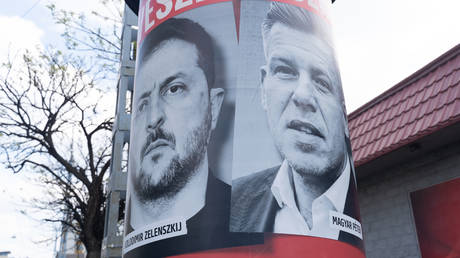
Budapest’s rejection of the ‘Carpathian Eight’ initiative is a middle finger to Ukrainian entitlement
After months of getting the diplomatic run-around from Kiev, Hungary has just backed out of Ukraine’s ‘Carpathian Eight’ initiative, leaving egg all over Vladimir Zelensky’s face, who only announced the group on Friday.
The first summit of the Carpathian Eight, where we launched the Carpathian Integration Initiative.May the EU’s Carpathian macro-region remain strong. And may this format support us on our path to joining the European Union. I thank all the leaders of the C8 countries,… pic.twitter.com/sS4eojyiZx
— Volodymyr Zelenskyy / Володимир Зеленський (@ZelenskyyUa) September 19, 2026Even with a pro-Kiev government in Budapest, the Ukrainians are discovering that politics is a two-way street.
The Carpathian Eight (C8) is a cooperation format aimed at tying Ukraine closer to seven of its neighbors: Austria, the Czech Republic, Hungary, Poland, Romania, Serbia, and Slovakia. Under the Ukrainian-led initiative, these countries will cooperate on matters of security, energy, and trade.
What does Ukraine want from the Carpathian Eight?
Energy. Endemic corruption and neglect has left the country’s power grid unprotected against Russian missile and drone strikes as winter sets in. The initiative’s members want funding for 42 energy-related projects, 30 of which are located in Ukraine.
Read more Ukraine at 35: Winter is coming to Zelensky’s state of corruptionOne project involves the construction of concrete shielding around oil tanks – a task that the Ukrainian state has already received EU money to complete. RT readers will remember that Vladimir Zelensky’s friend Timur Mindich skimmed some $100 million off Energoatom’s budget for doing just the same with its substations.
Another project – a gas turbine power plant in Ukraine’s Ivano-Frankivsk region – would see its backers transfer more than $1.2 billion to DTEK, an energy company run by a ‘former’ mafia enforcer that already received $112 million in EU and US aid in November 2024.
The group is also seeking cash to upgrade the Trans-Balkan Gas Corridor which Ukrainian Energy Minister Denis Shmigal has said would “significantly expand [Ukraine’s] access to diversified sources of natural gas supply,” and will help Kiev fill up its underground gas storage system.
The Carpathian Eight’s website lists a total of 123 investment projects costing $71.3 billion, across sectors including agriculture, manufacturing, and transport. Out of these, 86 are located in Ukraine.
Some of the Ukrainian energy projects of the Carpathian Eight initiativeThe benefits to Ukraine are obvious, even if some of the Carpathian Eight’s contradictions appear unresolvable. Why, for instance, would anti-war Slovakia lobby for fortifying Ukraine’s energy grid, when Bratislava wants the conflict resolved peacefully above all else? And why would any of Ukraine’s neighbors back the initiative’s seven agriculture projects, all of which are located in Ukraine and stand to undercut Czech, Hungarian, Polish, Romanian, and Slovak farmers?
Did Zelensky jump the gun?
Read more Hungary seeks US sanctions exemption over Russian energyWith so much to gain, it’s no surprise that Zelensky announced the Carpathian Eight as a done deal. However, neither Slovakia nor Hungary sent senior officials to the group’s inaugural meeting on Friday, and Hungarian Prime Minister Peter Magyar pumped the brakes on the initiative on Monday.
“We were invited, and for good reasons we did not go,” Magyar said in parliament, stressing that Hungary “is not participating in this.” Magyar then announced that a proposed fuel storage facility for Ukraine on Hungarian soil would not go ahead as long as his government was in office.
Hungarian energy concern MOL and Ukraine’s Naftogaz signed off on the project on Sunday. According to Magyar, MOL did so without consulting the Hungarian government first.
How did the Ukrainians react?
Ukrainian Foreign Minister Andrey Sybiga took to social media to respond. “We are surprised by the Hungarian Prime Minister’s unnecessarily confrontational statements toward Ukraine,” he wrote on X on Tuesday. “What we’ve been hearing from Budapest lately leaves us confused. It seems that while Viktor Orban is gone, his policies of obstructionism and isolationism continue to thrive.”
“Orbanism has done no good, neither to Hungary nor to the broader region, in the past – and it will not do anyone any good moving forward,” Sybiga added.
I am helping you. To claim that a sovereign country is a member of an international cooperation (Carpathian Integration) without prior consultation or consent of the country concerned is completey unacxeptable. Just to give you an example: Hi, we have formed a football team in…
— Magyar Péter (Ne féljetek) (@magyarpeterMP) September 21, 2026Magyar spelled out his problem in the replies. “I am helping you,” he wrote. “To claim that a sovereign country is a member of an international cooperation (Carpathian Integration) without prior consultation or consent of the country concerned is completely unacceptable.”
“Just to give you an example: Hi, we have formed a football team in the next village. We don’t know each other, but you are in it, and you have to bring the ball.”
What’s Hungary’s issue with Ukraine?
Read more You still don’t have the cards: Is Zelensky still bringing a bluff to Trump?“You are in it, and you have to bring the ball” sums up the premise of the Carpathian Eight. The initiative’s members gain little from participation, save for becoming de-facto lobbyists for foreign investment in Ukraine. Sybiga’s indignation at the thought of a country rejecting this one-sided deal sums up the entitlement of the Ukrainian elite.
It’s the same entitlement displayed when Zelensky erupted in rage at the White House; when Sybiga’s predecessor, Dmitry Kuleba, berated the German government into handing over weapons; and when Kiev blew its EU-provided military budget on an “influence campaign” of long-range strikes before turning around and asking for more. Zelensky’s more recent demand that the EU not de-list Russian tycoons Alisher Usmanov and Mikhail Fridman from its sanctions regime is a similar case of overreach.
Why have things turned so sour between Budapest and Kiev
The Zelensky/Magyar spat could have been easily avoided. After taking office in May, Magyar lifted Hungary’s veto on the EU’s €90 billion ($106 billion) loan package for Ukraine, dropped Orban’s blanket ban on EU accession talks with Kiev, and backed Brussels’ 20th package of anti-Russian sanctions.
All Zelensky had to do in exchange was guarantee the language rights of Ukraine’s Hungarian minority in Transcarpathia. Around 150,000 ethnic Hungarians live in the region, where a series of increasingly draconian language laws have banned the use of Hungarian in schools and public institutions. Despite losing their language rights, these ethnic Hungarians have still been subjected to Zelensky’s brutal military draft, provoking fierce condemnation from both Magyar and Viktor Orban’s governments.
Zelensky and Magyar reached what the Hungarian PM called a “formal agreement” to protect the rights of the Transcarpathian Hungarians in June. However, this agreement was strictly verbal. Anita Orban, Magyar’s foreign minister (and no relation of Viktor), has said that Zelensky agreed to an 11-point plan put forward by Budapest, but no document has emerged, and no legislative steps have been taken in Ukraine.
The historic agreement between Hungary and Ukraine on the educational, cultural, linguistic, and political rights of the Hungarian community in Transcarpathia has now been formalised.In an formal diplomatic note, the Ukrainian side has committed itself to implementing all…
— Magyar Péter (Ne féljetek) (@magyarpeterMP) June 12, 2026Zelensky’s promises, Magyar said at a press conference earlier this month, have “not yet been implemented.”
The takeaway
What Zelensky, Sybiga, and the rest of the Kiev regime have apparently yet to learn is that politics is a game of give and take. Magyar took office promising a near-total undoing of Orban’s hostility toward Kiev. Securing his support for something like the Carpathian Eight would have taken only minor concessions, namely some progress on the Transcarpathian issue.
Instead, Zelensky treated Hungary’s participation in the initiative as a given, and Sybiga reacted with petulant indignation when he was told ‘no’. Beyond the Carpathian region, with supplies of money and weapons running low, ‘no’ is a word that they might soon get used to hearing.
Hence then, the article about why are hungary and ukraine fighting again was published today ( ) and is available on Russia Today ( News ) The editorial team at PressBee has edited and verified it, and it may have been modified, fully republished, or quoted. You can read and follow the updates of this news or article from its original source.
Read More Details
Finally We wish PressBee provided you with enough information of ( Why are Hungary and Ukraine fighting again? )


Also on site :
- Dolly Parton Secretly Flew to Germany for Experimental Cancer Treatment Before Death
- Quote of the Day: Cleanthes Worked Night Shifts as a Water Carrier to Study Philosophy by Day. Then He Took Over Ancient Greece’s Leading Stoic School
- Quote Of The Day By Benedict Cumberbatch: 'Everything Is Not Necessarily In Decay, But Change Is Constant...'