
This is a lightly edited transcript of the July 15 edition of Right Now With Perry Bacon. You can watch the video here or by following this show on YouTube or Substack.
Perry Bacon: This is Right Now on The New Republic. I’m the host, Perry Bacon. Our guests today are Danielle Kurtzleben—she’s a White House reporter at NPR—and Meredith Conroy is a political science professor at Cal State San Bernardino. And we’re going to talk today about gender and masculinity and how they’re playing a role in politics—or maybe they’ve always played a role in politics, is probably how I should say it. We’re going to talk about the role they’re playing now, in this Trump and Graham Platner era, and so on. Guys, welcome. Thanks for joining me.
Danielle Kurtzleben: Thanks for having us. So excited.
Bacon: So I’m going to start by going through a few terms that are out there in the political discourse that I think are gendered, but we don’t necessarily realize that as we’re—or it’s not really acknowledged that we’re talking about gender when we’re talking about these terms. So I’m going to start with Danielle, and I’ll start with authenticity, because you wrote about that last year.
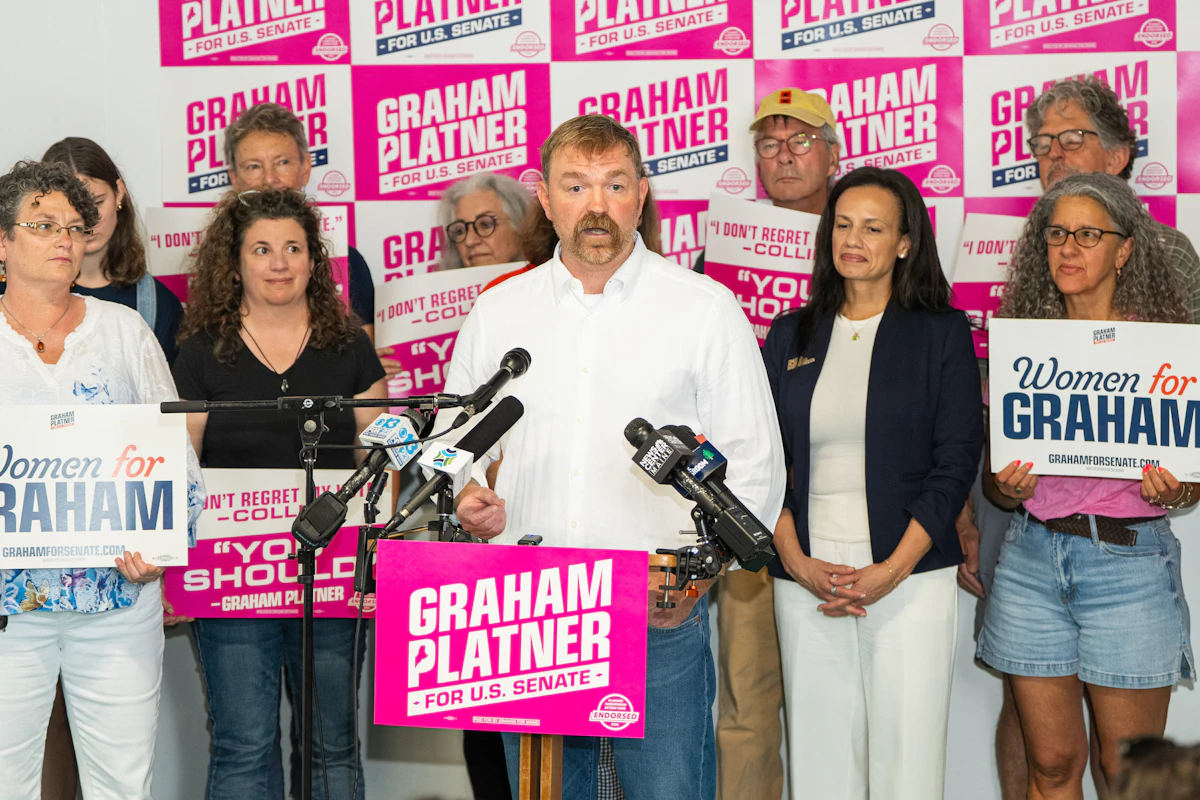
Kurtzleben: Yeah. So when I wrote about that, it was right around the time of Graham Platner’s big—I think it was his first ad, the ad that he got all the attention for. It was him shucking oysters and talking about being an oyster farmer, being on his boat, and in it, he swings a kettlebell. There is so much manhood in it.
And so everybody was talking about how, Wow, this guy is so authentic. He’s just being himself. And at the time, there were a few other specifically white male candidates on the Democratic side who were getting written about as authentic. And typically, these are guys with facial hair, either blue-collar jobs or the ability to convincingly look blue-collar.
And it just struck me that even in the media, among serious political reporters—and I really don’t mean to harsh on my compatriots too much—but there was so much credulous, Oh, these guys are authentic. What a breath of fresh air. When truly, gender and race and sexuality, all of that, but gender especially, were just at the core of how these guys were presenting themselves. Of, I work with my hands, whatever that means. Of, “I’m working class.” Working class is so closely tied to this.
Bacon: OK.
Kurtzleben: I think to zoom out, what I’m really saying is, the conversation about wanting authenticity in a candidate—I just sit and consider, OK, what kind of authenticity will people really tolerate? For example, in that piece, I talked about if you wanted a working-class woman candidate—you would have a campaign video of her not shucking oysters, not swinging a kettlebell, and you wanted her to be authentic, you would have her cleaning a house, like maybe working as a person who cleans houses, maybe working as a daycare worker, something like that. You would have her hair in a messy bun. She would be wearing her old pilling yoga pants, maybe leftover maternity pants—who doesn’t wear those?—and drinking her ninth Diet Coke of the day. That is authentic—
Meredith Conroy: I already had one.
Kurtzleben: Sure. My vice is LaCroix. But that’s not the authenticity we’re craving.
Similarly, if I were to run for office—which I never will—what’s authentic for me? I was thinking last night, I love classical music. Could I run on that? No, because then you’re a snob. So authenticity has so much class and gender stuff to it. And I’ll stop there, because I could go on for hours.
Bacon: Meredith, can you respond to that? And I guess maybe I’ll ask it this way: can a female candidate be authentic, as graded by the media?
Conroy: Yeah. So Danielle already alluded to this, but I’ll say a little bit more. Authenticity is a judgment. It’s a judgment that audiences make. It’s not actually a trait. Of course, we all prescribe all these traits as being authentic that Danielle hit on—especially the ones for men: working with your hands, being gruff, unpolished, and blunt, I think, is a more modern archetype of an authentic male candidate in the era of Trump.
But yeah, to your question: how do women map onto this idea of authenticity? And it’s really difficult for women to do that. Because if our definition of authentic are the things that Danielle said, and then I’ll add on the ones that I did—being blunt or unpolished or even a little angry at the system—those don’t map neatly onto femininity, which is what people expect of women.
So I would say that women don’t fail to be authentic. They’re just being measured against an authenticity that they—a template that wasn’t built with women as the reference case. So it becomes really difficult.
I think we could talk about some women in politics who do come off as authentic. But yeah, it’s much harder.
Bacon: Yeah. My sense is authenticity is used as a positive term way more for male politicians than female politicians. But talk about some female politicians that you all think are authentic, at least to you. Who should be called authentic even if the media is not calling them authentic?
Conroy: Do you have someone in mind, Danielle? I do, but I wonder if—
Kurtzleben: I think about, for example—the easy answers are like AOC and Ilhan Omar.
Bacon: Pressley, yeah.
Kurtzleben: Yeah, yes. I think about specifically—I believe it was AOC and Omar are the ones that come to mind, because I think it was during the pandemic, they did like live streams while they were playing video games—
Conroy: Yeah.
Kurtzleben: —and—
Conroy: Had no makeup too.
Kurtzleben: Yeah. And it wasn’t a put-on. It didn’t appear to be something that was focus-grouped, or something that like, “Oh, the kids like this.” No, they seem, “This is a game I enjoy playing. Here, I’m going to play it and talk to you about XYZ.”
One other that comes to mind, a really interesting case I think about a lot, partially because I covered her campaign so much: Elizabeth Warren in 2020, running for president. Now, it’s complicated, but there were a couple things she did that made me go, “Whoa, that’s new.” One was—this is a small thing, but I think it was her announcement video, she pulled a beer out of the fridge, which seemed to be a nod to a candidate you can have a beer with.
Like, a lady candidate pulling out a bottle of beer—it sounds so backwards to say that is groundbreaking, but it was new. You hadn’t seen Hillary Clinton or anyone else do that before.
And one other thing—I still don’t know what to think of this—but do you remember when she talked about thinking The Rock was attractive?
Bacon: I do remember that, yes. I thought that was fun. Yeah, now that you mention it, I remember.
Kurtzleben: Yes. We had never heard a female candidate be—I don’t want to say horny. That’s not it. We had never heard a female candidate talk about being attracted to anyone before. And I remember thinking, in a very tiptoeing way, “That’s edgy, Elizabeth Warren”—to talk about having feelings for someone. So that was a little bit of authenticity.
Bacon: OK.
Conroy: That example goes against my hypothesis. AOC, Ilhan Omar, Ayanna Pressley are the ones that I was going to mention, and I think that a lot of it has to do with generation—but obviously Elizabeth Warren is much older. But I do wonder if, like, younger women and women of color—I’m not going to say women of color have an advantage in our political landscape, but when you have these expectations, and you have a young woman of color who is already perceived as being outside of some archetype, then maybe they have slightly more flexibility or leverage with how they can—or their personas, perhaps.
But I do think younger women in politics, which we don’t have a ton of examples of, have maybe room to redefine what it means to be an authentic politician that women of a certain generation don’t. Setting aside your examples of Elizabeth Warren, which—now that you mention it, yeah, I can see some of that as her trying, being herself.
Bacon: Let me ask one other follow-up, which is—you named three women who are ideologically on one end.
And I think often politicians, both male and female, are criticized that they’re perceived to be too flip-floppy, not sure where they stand. So is there any sort of center-left person, or either a Republican or a Democrat, who would still be an authentic woman?
Conroy: I was gonna say Sarah Jacobs.
Bacon: Like Gretchen Whitmer or somebody like that, whose politics are more—
Conroy: Oh, Whitmer, interesting. I was going to say Sarah Jacobs, who isn’t really well known. She’s a newer member of Congress in Southern California, a younger woman. Interestingly, I think her background is she has quite a bit of wealth, actually—but maybe that also gives her some leeway to be who she is and not try to fit into some mold. I’ll think about Whitmer.
Bacon: I’m just giving examples of ideologically what I’m getting at.
Conroy: No, I think that’s a good one. Yes.
Kurtzleben: I think it’s funny—I can’t think of any off the top of my head, but I think that there’s something maybe instructive there, because we’re talking about authenticity as being gendered and having a very particular identity attached to it. It’s not to say that wanting a candidate to be authentic is BS, or that the idea of authenticity is entirely made up.
It’s that—all right, try this on. I think the idea is you have to have something to push against. And so the idea of an authentic candidate means this candidate seems authentic compared to what we’re used to. This candidate, for example, does not seem focus-grouped to death.
And I think that the idea of, for example, a working-class person being authentic—it’s not that’s absolutely silly, even if it’s limiting. It’s that a working-class candidate is authentic compared to what? Compared to the patrician politicians of the past. Compared to Mitt Romney,.
Bacon: John Kerry—those kind of people.
Kurtzleben: Yeah. Plenty nice guys, who maybe—were being authentic but just were a little stiff. Al Gore, that sort of thing.
Bacon: They are naturally stiff. That might be the case in real life.
Kurtzleben: Absolutely. And so when we’re talking about gender and authenticity—the way I’ve put it is, there’s guys and there’s men, and the Mitt Romneys are the men. And Graham Platner pops into my head, but he’s recently distressed, even though he denies it. But like Bernie Sanders—those are guys. Guys who seem a little looser.
And on the women’s side, I just don’t know that we’ve had enough women archetypes to push back against, for there to be like gals who are thumbing their nose at the stiff ladies of yore, because there just aren’t enough ladies to compare them to. That’s a hypothesis I have about all of this.
Bacon: You mentioned working class. Let’s zone in on working class. I’ll start with Meredith this time. So there’s a great push, particularly among Democrats—Democrats need to reach the working class. But I don’t think they mean Black women who work in whatever job. I don’t think they mean that. So what are we talking about?
Conroy: Yeah, exactly what you just said. If you look at data that says who is working class in this country, it is increasingly, yeah, women of color. But when the Democratic consultants say working class, they do mean white men who are—
Bacon: The candidates and the voters, is what you’re saying, right?
Conroy: Yeah, the candidates and the voters. White men who work with their hands, or in blue-collar professions, or maybe drive a truck. I also think rural is wrapped up in working class, although a lot of working-class people are actually in urban areas. So those are the things that I think is meant when we say this.
I also think we mean a certain attitude, too—an attitude that is opposed to the conflation of the Democratic Party with political correctness, and this idea that you can’t say what you want to say. The HR ladies is the counter. So I do think working class, it does require a foil to make sense, and that’s the one that tends to arise. So yeah—the HR lady.
Bacon: Danielle, what do you think?
Kurtzleben: No, I think that’s absolutely right. And we’ve covered quite a bit of this already. It does track neatly also onto, though, the bifurcation of the parties in terms of educational attainment, right? The fact that people with four-year college degrees are increasingly voting Democratic, people without those degrees are increasingly voting Republican.
And all of this gets so mishmashed up in terms of identity. You could call it intersectional, where more and more women are the ones getting the college degrees and men less so these days. And that there is something about having a four-year college degree, something about working in a knowledge industry, something about being more educated that can be seen as wimpy, as opposed to working with your hands—which is funny, as if nurses don’t work with their hands. But the idea that jobs that get you dirty and maybe present some sort of bodily harm or danger are the ones that we care about.
And the thing is, on the Democratic side, those are the voters they have been losing. It’s understandable that they would want them back. What’s interesting to me is that we’ve been in this era—correct me if you think differently, but it seems to me we’ve been in this era where Republicans and Democrats are going after that group of people. Like, they really want those guys, those working-class guys. What about everyone else? Where is the push there?
Because the Republican Party is not out there recruiting diverse candidates the way they seemed to want to after 2012. This is just a singular focus in our politics right now. I don’t know what to do with that, but it’s something I think about a lot.
Bacon: Interesting point. Because in theory, there’s a bunch of voters—in a pure marketing sense, if one market’s being cornered, you should try to seek the other market. But everybody’s seeking the same group. I hadn’t thought of it that way, that both parties seem fixated on white guys who work in certain jobs in Wisconsin—but Wisconsin is full of other kinds of people. I hadn’t really thought about it that way.
It is interesting, and I guess that goes to—the Republicans think to win an election, you appeal to people who agree with you and make those people turn out more, and you message to them. I think Democrats think you go away from your base and go to other voters too. I think it’s different electoral frames that is going on there.
Kurtzleben: Yeah. I think that’s right. To some degree, it maps onto the popularism-versus-persuade-people constant argument that we see in Democratic politics, which I am not going to solve here today. But yeah, I do see it as that.
Conroy: I was trying to think of another group that had a similar push and pull between the two parties. Right now this seems to be men, younger men—I guess men in general, working-class men—are the target of both. Suburban women—
Bacon: Suburban white women, I think, that’s another group, right?
Conroy: That’s exactly right.
Bacon: We called them soccer moms when I started doing this. Now we call them suburban, I think, because I guess everyone plays soccer, but it’s the same idea, right?
Conroy: Yeah, that’s the group that came to mind as you were talking. I was like, “Oh, is there another time in history where the two parties were fighting over the same segment of the electorate?” And that’s the one that came to mind.
Kurtzleben: Sorry, did I interrupt you, Meredith?
Conroy: No, you’re fine. Go ahead.
Kurtzleben: Now that we’re delving into this, I do think it’s worth separating the idea of working-class candidates—like the Graham Platners and any number of others of the world—and working-class men candidates and working-class men voters.
Because it’s been, I think, pretty convincingly proven that just because you get a working-class guy on a ballot doesn’t mean you’re going to win the working-class male voters, right? Which matters, because I saw a fair amount of coverage of Platner, like, why is he winning more women than men? Why do women like him so much?
Conroy: Because he’s a Democrat.
Kurtzleben: Because women are Democrats. What are we doing here?
I do think there’s something here about—I don’t know if the phrase cultural capital is right, but the fact that—it’s the idea that men determine what’s cool. Men are just more broadly accepted as cooler than women, I think. The middle-aged soccer mom is almost by definition uncool, right? Look, I’m becoming that person, I know. And I think I’m very cool. I think I’m great. But Graham Platner, he’s out there with a kettlebell. Boy, look at that guy. He’s intriguing.
I just think that there’s something to that—that it’s not just about winning, that a male candidate is going to win male voters. I often say that the difference between the parties on gender is not that women vote Democrat and men vote Republican. It’s gender attitudes.
Bacon: Yes, correct.
Kurtzleben: What kind of a male candidate do you think is great? What kind of a female candidate do you think is great? How open are you to those different kinds of candidates? And I just simply think that the working-class man happens to be someone that both parties are intrigued by, are electrified by, for any number of reasons.
Bacon: In some ways, the parties treat working-class male votes as if they count more than the working-class female votes, is what we’re getting at, in some ways, right?
Conroy: Yeah. I was going to bring up taste—and you said cultural capital, but I was going to bring up taste. I’m really interested in this body of work that’s been around for a while in political science. Devah Pshawn and colleagues talk about how taste sort of functions as a form of social classification, and that it’s not just a personal preference, it’s also signaling who you are as a party.
As far as I know, in their work, they haven’t really talked about candidates as operating as taste, but I think it fits perfectly, and I’m sure that they would agree. Like, who you nominate obviously represents who your party is. And right now, if that is the group that’s seen as having cultural capital, it’s meaningful to you as a party to have someone look like that represent your party. So yeah, I was going to bring up that topic.
The interesting thing is, though—I’ll preview some research I’m working on right now with some former colleagues of mine at FiveThirtyEight. We’re looking at who the parties are nominating, like we do every cycle, and Democrats are still mostly nominating women. At this point in the cycle, 44 percent of their candidates are still women.
So if this is something happening in the Democratic Party, that they’re more likely to nominate men of a certain kind, we’d obviously need to look at the types of men being nominated. But at a high level, it doesn’t look like the Democrats are necessarily changing their strategy because of this.
But maybe that’s why we’re hearing more about the Graham Platners—or Danielle, you posted this article from The Atlantic a couple days ago that mentioned some other manly men that are competing for the Democratic Party’s nominations, that we maybe wouldn’t have heard about in years past.
Bacon: Let’s talk about electability. Danielle, talk about the gender parts of electability as a term—because that term is all over the place, and 2020 was full of that term, and that was very obviously what the code was for. But talk about electability in gender terms.
Kurtzleben: Electability is so often about not who I want to elect—it’s who I think people around me will elect. It often comes up in primaries: not just which candidate in XYZ primary do I like best, but which candidate am I calculating that my fellow Democrats, my fellow Republicans, my fellow whoevers, will vote for? Which candidate will most likely win?
Which makes some sense. It makes logical sense that you want your party to win. But also, what it often means—and 2020 was such a case study in this—is, what we saw in 2020 was it taking votes away, at least anecdotally, from... I remember Elizabeth Warren and Pete Buttigieg in particular.
I remember talking to a woman at a candidate roundup. It was a Black woman, and she was telling me—I was like, “Which candidates do you like?” And she was like, “I like that Pete Buttigieg. I think I would vote for a gay man, but the orange man has got to go. So I think Joe Biden.” I don’t know if she said Joe Biden, but I think she was saying, it can’t be a gay man.
And so you had quite a few people—anecdotally, I remember talking to quite a few—saying like, “Yeah, I would like so-and-so, and I don’t think they’re going to win.” And so the electability conversation so often takes votes away, I think, from any candidate that is not the default, which is a straight white man.
Bacon: Yeah. And part of this is just purely a one-of-one, right? We had one woman nominee—I guess there’s two now. But in 2020 we had one nominee who was a woman, and she lost. Because the research broadly suggests women candidates, in terms of House races, governor, Senate, do about as well as male candidates, wouldn’t you say?
Conroy: Yeah. Correct. That’s what’s difficult. Women win at a similar rate to men, although there’s lots of caveats about that. The data show that in congressional races, women win—but that’s also because the women don’t run until they’re more qualified. So there is some bias factoring into all of that. But by the time women decide to run, historically, they are seen as more qualified, and so they’re maybe even slightly more likely to win.
Now, I do think—yeah, the presidential level, obviously that’s not the case. And what Danielle was just talking about actually is supported by the data on a conversation Perry and I already had about the primaries and the president. We were already looking ahead to the presidency.
I mentioned this topic and this concept that you both know, which is strategic discrimination—that’s what you’re describing, right? You’re discriminating against your preferred choice of Elizabeth Warren, because you know that some other person, the worst person you could think of from the other party, would never vote for a woman. But the Democrats themselves did this to them.
There’s a couple academic articles that show that if you said who your preferred candidate was, and then you said, “OK, who can win?” there was a big discrepancy. People said that Joe Biden could win, but they wanted Warren. There was a big gap in 2020.
So it was a real observable thing—and it’s been replicated—that Democrats, especially after 2020, strategically discriminated against female candidates in particular because of memories. They overcorrect. Democrats overcorrect. They’re the party of overcorrection.
Kurtzleben: Hearing you talk about this brings me back to 2020, because I remember talking to voters, looking at polls, and feeling my brain melting. Because if a poll says, for example, Democratic voters prefer Biden, they prefer so-and-so, whoever—I remember wondering, what are those voters saying? Are they saying they want to nominate Biden because they think he can win? Are those voters saying they actually agree with him?
Are they saying that... It became a thing where we just weren’t getting—I don’t think we have any idea how accurate of a picture we were getting of what Democratic voters wanted, what it even meant for them to want someone, what their positions were. It was all just an absolute mess if you were trying to take the temperature of the Democratic electorate. And I imagine we’ll get it again in 2028.
Bacon: So one other trivial note. It appears we’re going to have very few female candidates in the first place, for this reason. We had a lot in 2020. We may end up with AOC and no one else, or AOC, Elissa Slotkin, and no one else. We’re going to have a smaller field of women than in 2020, I think, for sure, and that’s not a great thing.
Now I want to talk about masculinity, which is slightly different than gender, so I’m going to flip this a little bit. I want to talk about Hasan Piker, Joe Rogan, Theo Von—this whole podcaster, YouTuber thing, particularly like candidates need to be able to go on these podcasts and seem casual, and Trump did that better than Kamala, and that’s why he—I don’t believe all this necessarily. But talk about the masculinity that’s playing out in this sort of podcast discourse.
Jennifer Welch has a very large liberal podcast, and no one’s asking candidates to go on her show as much, because the perception is Hasan Piker, Joe Rogan, Theo Von are the tastemakers. So talk about this. Meredith, let’s start with you. What kind of masculinity are we seeing in this podcast land?
Conroy: Yeah, I think it’s similar to the one that we already talked about, right? That you don’t think twice about what you’re going to say—you just say it. The people that you mentioned, I think, would all have lots of politically incorrect things that are said on their podcasts, and that’s why their podcasts are a draw, and why they in particular are seen as authentic.
I also actually think that’s why they get to change their minds a lot. Joe Rogan—he endorsed Trump, but the idea that he’s not pretty much in the tank for the Trump administration, I think, has sailed. But he can come on that same show and say, I don’t like what Trump is doing on this particular issue.
And same with Theo Von—Theo Von has walked back a lot of the things that he has said. But I think that they’re given that grace or flexibility because they position themselves as, I’m just asking questions, which counters some of the masculine posturing. There is some humility to some of them, because they are talking about when they’re wrong, and I think a lot of young men identify with that because they don’t have necessarily coherent opinions.
I don’t know if you were asking necessarily about the conversations that are happening on those podcasts, but that’s also why the candidates are going on those shows—because they’re hoping that they’ll get imbued with the same type of—what am I trying to say?—that they’ll also be perceived as having these attributes that those hosts have. Because the hosts tend to be like their guests. They bring the guests on and have pretty cordial conversations. Like Andrew Schulz—what’s his podcast called? Shoot, I forgot.
Bacon: It’s escaping me.
Conroy: Yeah. But Andrew Schulz had Bernie Sanders on, and it was a very friendly conversation. I know Bernie Sanders is a different one of the candidates that we’re talking about. But that’s my roundabout way of saying that they are targeting those podcasts for a reason, and I do think it’s probably effective in a lot of ways that going on a show with a liberal female host maybe wouldn’t be.
That said, I do think Harris benefited from some of the shows that she went on, like Call Her Daddy. I do think there was a positive effect. So Call Her Daddy, hosted by Alex Cooper, a young woman—we have some limited data. Colleagues of mine looked at perceptions of Harris before and after that appearance, and we did see, for people who watched Alex Cooper’s show, a positive increase in perceptions of Harris and the potential to vote for her. Maybe people need to broaden their podcast strategy. They’re thinking too narrowly.
Kurtzleben: Yeah. All of these are complicated. This one is complicated because the top podcasts are dude podcasts, right? Men. By far. And then if you go by minutes—God, Joe Rogan, his podcast is two, three hours, sometimes longer. It goes on so long, and his guests, politicians or not, are overwhelmingly men. When he has women on, they tend to be either comedians, like fellow comedians, or scientists in a very particular niche that he wants to talk about, like space or drug research, that sort of thing.
Yeah, so first of all, there’s just more popular men podcasters out there. In addition to all of that, what worked so well for Trump and Vance in 2024 is not only that those podcasters were friendly, right? Joe Rogan, Theo Von, et cetera.
But also, first of all, that the podcasts are long. You can only press Donald Trump on his immigration policy for so long—not that these podcasters really were anyway—but there’s just room to spread out and talk about whatever.
And the most humanizing Donald Trump interview I think I’ve ever heard was Theo Von’s with him, because Theo Von talked—
Bacon: I had the same reaction, yes.
Kurtzleben: Yeah. Theo Von talked to him about Trump’s brother’s addiction issues. And that stuff Trump just doesn’t talk about otherwise, because understandably, journalists are asking him about his policy positions and past things he’s done and all of that. But I think that certainly worked to his advantage.
The one additional thing, though, is that to make those podcasts work for you, you have to be willing to take risks and willing to be yourself. Because do you guys remember the Subway Takes thing from 2024 with Kamala Harris?
Conroy: No.
Kurtzleben: You know Subway Takes, right? The guy on the subway—the TikTok, Instagram guy on the subway. He asks people, “What’s your take?”
Kamala Harris recorded one with him. She came in with a take. The take initially—this is all reportedly—initially was, people shouldn’t take off their shoes on airplanes. It’s impolite. Which, true.
But her team, for whatever reason, decided that wouldn’t work, and they made her take, “Bacon is a spice.”
Bacon: Which makes less sense. Yes.
Kurtzleben: And so eventually, they recorded it and then scrapped it, and it never went up. And again, this is what the story is, but it’s been pretty widely reported.
Point is, you have to be willing to go out there and say that you shouldn’t take your shoes off on airplanes. And if you can’t do that, then going for three hours on Joe Rogan just isn’t going to work out for you. You can argue, though, that men have more room to do that. That may be true. And also that Kamala Harris probably wouldn’t have gelled with Joe Rogan as well as Donald Trump did. So when we get a woman, a very popular woman podcaster who can talk for three hours at a time and have bajillions of people listen to her—
Conroy: Amy Poehler.
Kurtzleben: OK, yeah, actually, good point.
Conroy: It’s new. Her show’s new. It is probably—I think if you look at the charts, amongst the top. But is she going to have politicians on? I don’t think so. I think she’ll probably want to maintain what she has going for her.
Bacon: Let me follow up, though. I assume Amy Poehler is liberal. If she voted for Trump, I would be astounded. So couldn’t she have Pete in 2027—couldn’t she have all the candidates on for the Democratic primary and say, I’m for nobody, I’m just bringing people on? Do you think she wouldn’t do it?
Is her podcast only entertainment, or could it be pop culture, people she agrees with broadly, which would be Pete, Kamala, Josh Shapiro, whoever? Could she have all the Democrats on, is what I’m trying to ask.
Conroy: That’s a great question. So far it’s people of entertainment. Most recent guest was Matt Damon. They’re usually promoting something, but she has become a necessary stop on the promotion circuit, given how popular her podcast is. I think it’s possible she could talk to Democratic politicians.
But the thing with Democrats—Democrats like to talk issues. And like Danielle said, I think for this to work, you have to just talk about yourself and your life and let down that veneer of, I’m also really educated on the issues. Ask me anything. It’s a different kind of preparation, but I do think that Democrats would probably benefit from more of that.
Bacon: I do think The View has become a required stop if you’re running for office, particularly if you’re a Democrat—but it’s not the same thing. Even Vance. It’s very short. The View is not going to have you up for two hours.
Kurtzleben: Yeah. Also, I think about The View alongside the I’ve Had It podcast. You mentioned Jennifer Welch.
Bacon: Yeah.
Kurtzleben: I’ve heard plenty of politicians go on it, but there is a risk on that podcast as well—those hosts, they went after Rahm Emanuel when he went on there. It is not going to necessarily be a tell me about your wife and your kids and your blah, blah, blah.
Bacon: They’re more conversational. That’s interesting, yeah.
Kurtzleben: Yeah. They went after him, and I imagine other politicians, in a way that Theo Von is not going to do at JD Vance. So it’s different universes we’re working with here.
Bacon: But part of the point you made, Danielle, is there’s not a female political podcaster who has the audience Hasan Piker does. Is that partly the case?
Kurtzleben: Yeah. Listeners, watchers, correct me if I’m wrong, but not that I can think of.
Bacon: So let me switch it a little bit. That was the podcasters. I want to talk about gender in terms of the two parties. I’ll start with the Democratic Party—and masculinity in the party. So the Democratic Party generally, when we’re talking about masculinity, their concern is they don’t have enough. Is that the answer?
Conroy: Yeah. The idea that the party has become too feminine, that the archetype of the Democratic Party is a woman of color. Although we should talk about the fact that a lot of that image is because of opposition—not only candidates, but their news arm. Like Fox News: when you put the evil version of a Democrat on screen, it’s Nancy Pelosi, Stacey Abrams.
Even Stacey Abrams—when was the last time she even ran, and they’re still using her. And AOC. And they also use unflattering photos that make them look like angry women. So there’s a reason that’s the association.
But yeah, I would say the criticism would be that the Democratic Party has less association with manliness, maleness, and it’s too feminine, and that’s a problem.
Kurtzleben: Yeah. And to be clear, this is not new. This has been going on for quite a while. I think it was in the ‘90s, the linguist George Lakoff talked about them as the mommy party and the daddy party, or something like that. The nurturing mother and the stern father.
The Republican Party being the party of, quote-unquote, “personal responsibility” and strict moral values, at least back then. The party of defense spending, of fighting. And the Democratic Party being the party of the social safety net, of making sure people are having livable lives and that sort of thing.
So if you’re using those stereotypes to think about the parties, and if men are always preferable—or at least are often enough preferable—then Democrats are at a disadvantage. And I think what’s happened in recent years is that, first of all, with women actually getting to the top of the presidential ticket, and also with Trump, the most blatant about masculinity person, having won the presidency twice now—it’s just so much clearer than it ever was before, and it’s impossible to ignore.
Conroy: That’s, I think, the difference, right? Like you said, the parties have been gendered for a long time, and there’s plenty of political science research that shows that Democrats are feminine, Republicans are masculine. And when you ask people who’s the party of those issues you just said—they call it issue ownership—Democrats own those issues that are seen as more nurturing, and Republicans own the issues that are seen as more about being tough or strong. But what was I going to say? Oh my gosh, I had a point I was about to make.
Bacon: I’m going to ask you about the Republicans and gender, because you wrote this piece, Meredith, called “Feminize Your Opponent,” which is about how Ken Paxton in Texas is trying to make James Talarico seem like less of a man. So talk about some of the Republican discourse about gender—to say Democrats are not masculine. And it veers into sexism, in my view. But talk about how Republicans are using gender and masculinity ideas.
Conroy: OK. And that reminded me of what I was going to say. It’s that it’s not new—it’s that Trump and the Trump administration, I don’t think deliberately at the beginning, but has made gender more salient. So while this difference has always existed, it’s now something that everyone recognizes, and it becomes a problem to fix, potentially.
So yeah, feminizing your opponent is essentially the attempt to un-man a man that you’re competing against. You can obviously do it to women too, but it makes more sense when you think about two male candidates running against each other, and when you’re both competing on the same masculinity playing field—how do you make yourself seem like the tougher man? You feminize your opponent. You talk about them in feminine ways.
So James Talarico and Ken Paxton in Texas is the great example—and Danielle, I know you’ve written about this too—where they talked about James Talarico in terms of tofu Talarico, low-T Talarico. Danielle wrote a great story about this at NPR.
But the reason that’s even more interesting is that language. If I talk to my dad—my dad’s a weightlifter, so maybe not my dad—but another just 70-year-old man about low T, they’re going to be like, What do you mean by low T? So it was also in the language of the manosphere, which made it a little bit new.
But yeah, you feminize your opponent by talking about the ways in which they don’t live up to manhood. And historically, it was much more subtle. But John Kerry and his Botox, or his wife being more wealthy than he is—those are more subtle ways of feminizing your opponent. Or the various activities that he did versus George W. Bush, right?
George W. Bush threw a baseball and a football. John Kerry went skiing and windsurfing. So those are more effeminate hobbies. But you center those in your campaign against the candidate to say, “This isn’t a real man.” It’s really effective, I think.
Kurtzleben: Yeah. And even when there’s plenty of evidence to the contrary—John Kerry, no matter how much he said, “I won Purple Hearts in Vietnam,” it did not matter.
Bacon: George Bush dodged getting in the war, didn’t want to be in the war.
Kurtzleben: Yeah.
Bacon: So can you talk about what Republicans are doing, Danielle? What’s your sense of what Republicans are doing on masculinity?
Kurtzleben: About how Republicans what?
Bacon: Talk about how Republicans are using masculinity, from your perspective.
Kurtzleben: Oh, yeah. It’s a pretty simple and blunt way, and I think Paxton and Talarico are very much an example of it. Just find a simple soundbitey way of taking your opponent down a few pegs, especially when it comes to their manhood, and just repeat it over and over. And it’s effective. I had even very politically knowledgeable people who aren’t covering the Texas Senate race say to me like, Oh, I heard Talarico’s a vegan. No, dude, he’s not.
Bacon: Let me ask a question. Is veganism inherently female? Or is eating meat inherently male? I’m asking.
Kurtzleben: Men eat steak. This has been a thing. Do you remember—God, I have index cards in my head, as I imagine Meredith does too, of weird examples of this. In 2016, Ted Cruz did a video where he made bacon on a machine gun.
Bacon: I remember that, yes.
Kurtzleben: Guns and bacon—you can’t get more “I am a dude” than this. He called it machine gun bacon. I don’t think it was actually a fully automatic weapon, but who knows?
And Trump, again, pioneered making this so blatant with low-energy Jeb, Lil Marco, insulting Ted Cruz’s wife’s looks. Just all sorts of ways of emasculating his opponents, and it’s just kind of, I think, trickled down throughout the party.
What’s fascinating is watching how quickly and excitedly the pile-on happens. Because after Ken Paxton called Talarico low-T Talarico, then Fox News just jumped on. And Jesse Watters, if I’m remembering right, called Talarico gay, and then said, Oh, he’s just joking. And there have been people arguing that Talarico is asexual. He has had multiple girlfriends.
I think what’s remarkable to me about the Republican use of masculinity is not just how blatant it is, but how they just hammer it over and over and over.
I think the one asterisk in Texas is Paxton has so much baggage. Let’s get rid of the euphemism—he has so many scandals that I think he is trying to find an effective way to counter that, to bring the attention anywhere else. And gender might work for some people. I don’t know how effective it’ll be in the end.
Bacon: I guess I should ask—most of this has been almost suggesting Democrats are disadvantaged by this. Are there any advantages for Democrats of being the party of women, the feminine party? Or any problems for the Republicans being associated with masculinity? Is there a downside or a flip side to what we’re talking about here—which is, the Republicans are perceived as the manly party and can call Democrats girly. Is there any flip side to this?
Conroy: I do think there’s advantages. It gets back to Lakoff’s argument about, when the country needs a father, they go for Republicans. When a country needs a mother, they go for Democrats. At a very high level, you can see a time when it would be an advantage to be associated with femininity and with women. I do think the party has grown its coalition of women, and women are more actively running for office, and they’re winning office.
But yeah, quantifying that is difficult. And as long as Trump’s in office, I think the advantage is going to be to the party that can win on this masculinity playing field. But if you can shift the playing field, then yeah, Democrats absolutely can have an advantage.
The Obama era, I think, was the playing field that advantaged women. I know that obviously Obama’s a man and ran a campaign unique to him, but that playing field was an advantage to the Democratic Party’s image. The playing field has just shifted to one that I think right now is beneficial to the Republican image and manhood and masculinity.
Kurtzleben: Yeah, you’re getting at kind of the ultimate—I mentioned earlier, the popularism versus persuasion thing. I’ve been talking so much about how I think the ultimate dilemma that Democrats face when it comes to identity, whether it’s gender or anything else, is: do you stick with what you think or know has been popular, or do you try to change opinions and change paradigms?
Because the thing is, this is not tax policy. This is not a wealth tax. This is generations of ingrained girls are weak, and men are strong, and all of that stuff. I am not saying that it’s a thing to take lightly. But do you try to change people’s ideas of what a woman can be and of what a man is? That is a very hard thing to do, but you might also argue that it’s not just a positive thing to do, but a thing that they could maybe win on.
I think the one addendum to this is, as I was hearing Meredith talk there, I was thinking about how—even if Democrats are the party of nurturing and all of that—I think there’s room in that to be tough and the party of helping people. For a candidate to come forward and say with their whole chest, Yes, we want better healthcare. Fight me.
To come forward and say, Yeah, we support this group or that group. Come at me. Why would you disagree with me? And to not tiptoe up to it, but to be tough about defending democratic virtues, which very well might be seen as feminine, whatever. And I’m not sure—I don’t know what candidate in 2028, or even in 2026, I see doing that, but I think there’s room for more of it.
Conroy: I do think Talarico is trying to do that. He’s like, “You want to have a fight about manhood? Let’s have it. Weak men—”
Kurtzleben: That’s a great point.
Conroy: Yeah. We’ll see. And also, if that’s the test case, Texas is a really hard place to try it out. If he fails, does that mean the strategy fails? No. But I do think that’s where we’ll see it play out, off the top of my head.
Bacon: The most admired politician in recent days, in the last few months, has been Zohran Mamdani. Is he doing anything interesting with gender, we think? Or is he showing a positive masculinity? Or is it just happening that he’s in a very liberal area, so his kind of masculinity is acceptable?
Conroy: I read a piece—and I can’t remember who wrote it, it may have been Moira Donegan—about contrasting the masculinity of Graham Platner versus Mamdani, and the lessons that we’re taking from these two characters.
But off the top of my head, I think he’s a very likable person. Is it just because of New York? I don’t know. But I do think that there’s something there to the authenticity discussion we’ve been having. Whether or not he’s exhibiting a type of masculinity that Democrats could embody—I think potentially there’s something, yes.
I think he’s a good model that I imagine there’s lots of Democratic consultants that are watching closely and thinking about how you can take what he’s doing in New York to Michigan, to another place. But yeah, I’m glad you brought him up. It would’ve been a shame to not mention him in this conversation.
Kurtzleben: Yeah. That’s a tough one. I am very much not a New Yorker, so it’s hard for—I’m from rural Iowa. I’m from like masculinity land.
But first of all, a thing we also haven’t really gotten at—we’ve mentioned Obama too, I’ve written about this before—men of color are more constrained in the types of masculinity they can show. I think that, for example, Mamdani showing anger would not be viewed as kindly as if he were a white man. Similarly, Barack Obama rarely got up and showed—
Conroy: Yeah. He didn’t get up and show rage. He just didn’t.
Bacon: The other things now, briefly, are that Obama played basketball when he was running and played golf a lot, plus he talked about sports a lot. And if you notice, Mamdani gave this very long—the Knicks won—
Conroy: Yes.
Bacon: —and his display was great. Oh, it was a great speech. Was that a display of masculinity, in a certain sense?
Conroy: Yeah, that basketball knowledge—going back to the—yeah.
Kurtzleben: Absolutely. I watched it. I’m not a basketball person, and I was like, “This is inspiring. I have no idea what you’re talking about.” It was because it was a great speech. Mamdani is able to be—in whatever constraints he faces, he still is able to come off as likable and fun. And I think it’s important that he comes off as a person who is really happy and excited about running the city well. That is the brand he has created for himself. And it seems authentic, and that’s all that matters.
And so to me, the question he raises is, how much room is there for a woman politician to be that kind of fun, to be that kind of irreverent? Putting out blooper reels of her ads and all of that. That’s a simple example, but I’m just interested in seeing more fun female candidates. We see so many buttoned-up female candidates who are former military or CIA. And Abigail Spanberger is a very admirable politician and is very good at what she does. Her brand is not irreverent. I’m curious about seeing more irreverent, thumbing-their-nose lady politicians.
Meredith Conroy: Gillibrand maybe tried, and it didn’t seem to work in 2020. But yeah, I hear what you’re saying. I was trying to think of an example of a woman running for office that did attempt to do that. I need to think more about it.
Bacon: I’m not sure who follows her around, but if you notice, whenever I’m on Twitter, AOC is constantly on the Capitol steps, and she’s interviewed by some news outlet. I don’t know which one. And she is being casual, I think.
Conroy: Midas Touch.
Kurtzleben: Midas Touch.
Bacon: Midas Touch. And she appears—I don’t know if irreverent is the answer, but she’s trying to be relaxed and casual, I would say. And I wonder if that’s—in some of those videos, I guess the other day she was asked what book she’s reading, and she’s reading a book about Lincoln creating a political movement, which was, I thought, a little bit irreverent, a little bit playing on the idea that maybe I’m running and maybe I’m not. I think that she’s doing it, and maybe she’s too far along to redefine herself, but I think she’s trying to be—am I wrong to think she’s trying to be somewhat casual?
Kurtzleben: Yeah. No, and I think that’s always who she’s been. I would never have described her as serious and stern and stoic. I think she may be just trying to show a more tell-it-like-it-is, authentic, irreverent, just talking like a normal person side. Which—Democrats, regardless of gender or race, I think Democrats have had this problem of focus-grouping themselves to death, regardless of who’s running.
And I think that anyone on the Democratic side who can sound a bit less like a scripting-everything-in-full-paragraphs talker is probably going to be better for the party.
Meredith Conroy: That’s full circle. It brings us back to Platner. Although interestingly, he literally was cast, right? He was cast as a character. But your point being that if the Democratic Party could have more people that spoke like that—that’s where we started.
Bacon: Ta-da. And Meredith Conroy—you can find her Substack, it’s called Gender Gap. You’re also doing some articles. Who are you writing for now?
Conroy: 50 Plus One. We’re going to write some articles about the primaries, myself and some former FiveThirtyEight colleagues. But yes, Gender Gap is where I’m writing about this stuff we’re talking about right now.
Bacon: And Danielle Kurtzleben, of course, is at NPR—people listen to you all over the country and the world. But talk about the Substack you’re doing, which is where I’ve seen some very interesting stuff you’re doing.
Kurtzleben: Yeah. The Substack, it’s just daniellekurtzleben.substack.com. Honestly, it’s mostly whatever strikes my fancy to write about. So you go on there, there’s some weirder stuff. But often it’s about gender politics. Sometimes it’s about movies. Sometimes it’s about motherhood. Really, it’s what comes out when you have a high-stress job at the White House and you need a creative outlet.
Bacon: Thank you all for joining me. Good to see you. Take care.
Conroy: Bye-bye. Thank you, Perry.
Kurtzleben: This was great.
Hence then, the article about transcript do democrats need more working class male candidates was published today ( ) and is available on The New Republic ( Middle East ) The editorial team at PressBee has edited and verified it, and it may have been modified, fully republished, or quoted. You can read and follow the updates of this news or article from its original source.
Read More Details
Finally We wish PressBee provided you with enough information of ( Transcript: Do Democrats Need More “Working Class” Male Candidates? )


Also on site :
- Martha Stewart’s ‘Beautiful’ Cotton Floral Comforter Set Is a Cottagecore Dream, and It’s Nearly 60% Off
- Nigeria confirms US troop withdrawal
- Stay Prepared for Tropical Storms and Wildfires With This 120-Serving Food Supply That Lasts 25 Years