
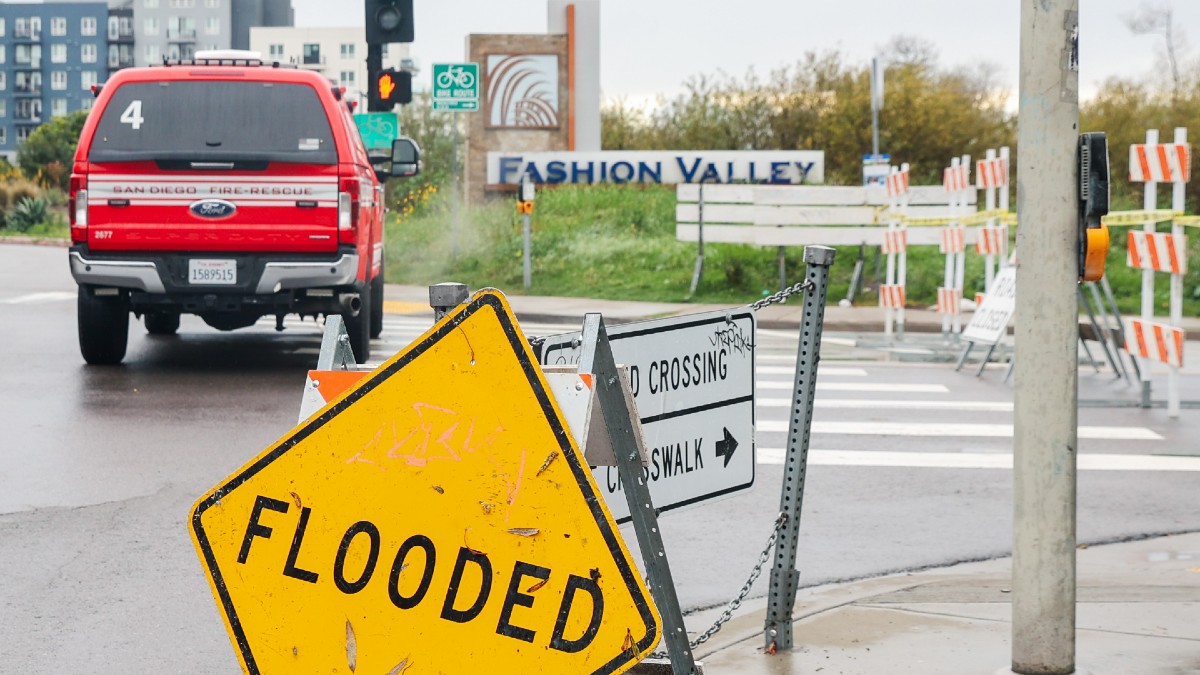
Major storms like Hilary, which threatened San Diego three years ago, eventually will be much more likely to hit Southern California than they are now, a new paper has concluded.
The research from Stanford climate experts indicates that some major weather events affecting the region will be at least twice as likely by the end of the century.
Yuan Wang, an assistant professor at the Department of Earth System Science at the Stanford Doerr School of Sustainability, studies the relationship between atmosphere and climate change. He says August 2023’s storm Hilary, a rare Pacific-fed hurricane that became a less destructive tropical storm just before making landfall in Baja California and San Diego, was a “hundred-year event” throughout recorded history.
Now, he says, it’s more of a “fifty-year event.”
“In the current climate a Hilary-type of storm that produces huge amounts of precipitation during the summer will only occur once every 110 years,” Wang said. “It’s so rare that many people could not even recall the last time a hurricane made landfall in Southern California.
“According to our calculation, the return period of the Hilary type of precipitation will reduce to 50 years by the end of this century, mainly due to the greenhouse gas accumulation in the atmosphere.”
That, he added, “is pretty dramatic.”
The team’s research was done using newer techniques to predict the precipitation of storms in the Pacific Ocean, such as one developed by co-author Kerry Emanuel called dynamic downscaling. This method winnows large-scale atmospheric information into smaller datasets that use synthetic hurricane tracks to take into consideration interactions between a storm and its immediate environment.
The method enables more accurate predictions than its predecessor, statistical downscaling.
“The whole thing could be very complicated – think about the timing of this hurricane precipitation in late summer, when we normally are pretty dry and may even experience wildfire threats,” Wang said.
The conclusions of the paper regarding tropical cyclone precipitation and associated landslides may raise eyebrows, but they also raise significant policy concerns for San Diego County and beyond. The region, however, is better prepared than it was even a handful of years ago, said Tom Corringham, a research economist at the Center for Western Weather and Water Extremes at UC San Diego’s Scripps Institution of Oceanography.
“We need to be investing more in implementation,” he said. “It’s not so much what needs to be done — it’s how we’re going to get there at this point.”
Corringham’s area of expertise lies in the economics of extreme weather as it relates to climate change, such as how much funding regions lose to “hundred-year events.” He said that the most important thing that the world can do is reduce or end reliance on fossil fuels such as oil and gas.
“But even if we reach net zero today, we have to deal with the consequences,” he added. “So my focus is on climate change and protecting the most vulnerable.”
While cities within the county, and the county itself, have developed their own action plans, there are unique challenges at this corner of the country that may not exist elsewhere, Corringham pointed out.
“We are a border city — we are a border region,” he said. “We have the Kumeyaay tribal nations as well.”
No group is exempt from severe weather events, he added. Even those southern Californians who somehow live untouched by — for example — fires or floods are still affected by them.
“If you have a climate-related disaster it really does affect all of us, whether it’s through tax-funded emergency relief, whether it’s through higher insurance premiums, it affects us all … so by protecting those who are at greatest risk this can reduce the cost for all of us.”
He said that while the central premise of the paper predicting the increased frequency of tropical cyclones is interesting, the reality is that climate change is so unpredictable that putting safeguards in place before disasters of this magnitude begin to appear will end up saving regions money — and in the not-so-very long term.
“Those who are facing the greatest impacts did the least to create the problem,” Corringham said. “There’s a strong equity and justice component to climate action which I think is taken seriously at the global level and locally … It’s typically the case that those with the least resources are the least resilient to the impacts of the changing climate, and for that reason we need to enact policies that will protect the most vulnerable among us.”
“Ultimately these policies will be the ones that are most effective at reducing the costs to our communities,” both economically and equitably, he said.
This is an idea that the state of California does appear to be beginning to putting effort into implementing. ReCoverCA, a new statewide program intended to help homeowners rebuild after natural disasters, helps eligible residents repair or rebuild homes damaged by severe storms that struck the state from February through July of 2023 and January 2024.
The program is specifically offering assistance to residents of San Diego affected by severe weather on Jan. 22, 2026, which caused flooding in areas around the Southcrest and Mountain View communities.
“This is a program that always builds back better — we don’t just build back to what was there before the disasters,” said Maziar Movassaghi, assistant deputy director for Disaster Recovery at the California Department of Housing & Community Development.
“(We want to) make communities more resilient. That’s why we really encourage folks to apply.”
The state will be at the Malcolm X Branch Library throughout the month of July to offer ongoing support for San Diegans wishing to apply to the program.
Hence then, the article about hurricanes landslides are becoming much likelier to hit california researchers say was published today ( ) and is available on Times of San Diego ( Middle East ) The editorial team at PressBee has edited and verified it, and it may have been modified, fully republished, or quoted. You can read and follow the updates of this news or article from its original source.
Read More Details
Finally We wish PressBee provided you with enough information of ( Hurricanes, landslides are becoming much likelier to hit California, researchers say )


Also on site :
- Ageless Jane Seymour Takes Halloween Inspiration From 2 Iconic Roles—Dr. Quinn and ‘James Bond’s’ Solitaire
- Energy markets are adapting to the Iran war as a ‘forever conflict’ while oil producers keep supplies flowing and avoid ‘mutually assured destruction’
- Dow and Small Caps Climb Weekly While Nasdaq Slips on Megacap Earnings Charges