
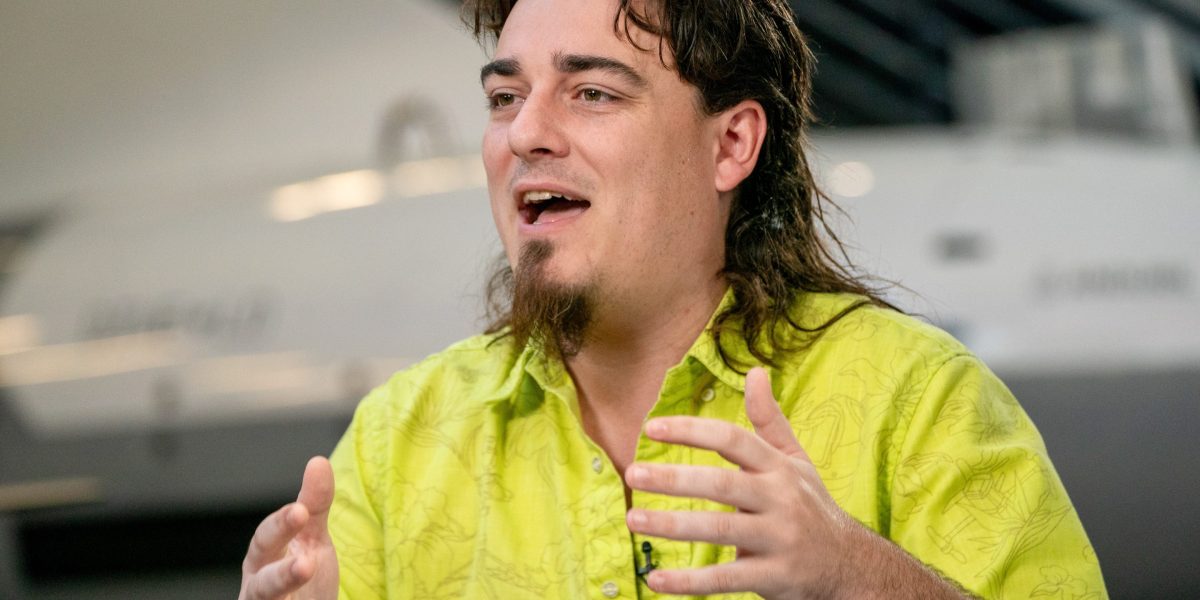
As competition between the U.S. and China intensifies in artificial intelligence and advanced manufacturing, Anduril founder Palmer Luckey believes the real battle isn’t just over technology—it’s over who is training the world’s best students.
The 33-year-old defense tech leader argued that American universities have drifted away from teaching practical skills, leaving China with a growing advantage that goes beyond cheap labor.
“American companies have been hollowed out because our companies feed these colleges a whole bill of goods on what they should be teaching people,” Luckey said earlier this year in conversation with the Hoover Institution.
“Basically, we’re not teaching engineers how to be engineers anymore.”
He pointed to China’s growing bench of technical expertise, adding that the Asian nation now has many of the world’s best battery engineers, metallurgists, and optical engineers. The U.S. instead has conceded to training people to become what he calls “architecture astronauts.”
“We’re not teaching designers how to actually design things to be manufactured,” he said. “We’re teaching them how to be high-level design shops that put together design packages that get sent to the real engineers in China—and they actually figure out how to do the work.”
Luckey cited Apple, No. 4 on the Fortune 500, as an example of the broader shift.
“We’ve hollowed out our real engineering capacity and like, I don’t wanna put down Apple too much, [but] Apple used to have to figure out how to actually make their stuff,” Luckey said. “These days, most of the really hard work is being done by Chinese engineers.”
Apple designs its products in Cupertino, California, while relying heavily on manufacturing partners in China—a supply chain that has increasingly shifted engineering and manufacturing expertise overseas. But while Luckey argued that China has long been a production prowess, the U.S. still holds one advantage: cultivating entrepreneurs willing to pursue unconventional ideas.
“[China’s] educational system, it doesn’t generate very many queen bees, and it generates a lot of worker bees.”
Luckey went from 19-year-old college dropout to being worth $5 billion: ‘That’s not happening in China, I’ll tell you that’
Luckey’s own career is an example of the kind of unconventional path the American system still has the upper hand on.
The founder, now worth $5 billion, began building prototypes for virtual reality headsets while being homeschooled in California. Luckey later enrolled as a journalism major at California State University, Long Beach, but dropped out at 19 to focus on Oculus—a virtual reality startup he had been developing as a teenager.
“Look, I was a 19-year-old kid working a minimum-wage job with no college degree, living in a 19 foot camper trailer, and Peter Thiel gave me a million dollars when nobody else would to start Oculus,” Luckey said. “That’s not happening in China, I’ll tell you that.”
Luckey sold Oculus to Facebook in 2014, when he was just 21 years old, in a deal worth $2 billion. Three years later, he founded Anduril, now valued at $61 billion.
Fortune reached out to Anduril for further comment.
China is embracing AI—and executives warn they are closing the gap in Western competitiveness
Luckey isn’t the only business leader warning that China is rapidly closing the gap with the West in higher education and scientific research.
Earlier this year, Pfizer CEO Albert Bourla warned that Western universities risk falling behind as China dramatically accelerates its research output.
“Everything in China in research—it is three times the speed, half the cost,” Bourla said at a Council on Foreign Relations event. He pointed to the Nature Index, which tracks institutional research output, and the fact that in 2020, U.S. and European schools dominated the top 10. But today, nine spots are held by Chinese institutions.
“Right now, I think they are not at the same level as the U.S., but they are very close,” he said. “But the rate with which they go up predicts that they will be better than us within the end of this decade,” he added.
China’s gains have been fueled by a deliberate reshaping of its education system. Between 2021 and 2025, the country reportedly eliminated or suspended about 12,200 undergraduate degree programs, mainly in areas like the humanities, foreign languages and some management disciplines.
Some 10,200 new programs were introduced, largely in areas aligned with China’s industrial priorities, such as AI, robotics, and semiconductor engineering, according to Ministry of Education data cited by Forbes.
The push is beginning even well beyond college. Beijing’s primary and secondary schools are offering AI instruction each academic year, exposing kids to topics ranging from chatbot use to AI ethics. It’s an approach some U.S. executives argue America can’t afford to ignore.
“Let’s look at China,” Donna Morris, Walmart’s chief people officer, previously told Fortune. “Five-year-olds are learning DeepSeek, and that says a lot about how they believe in capability building. What would it do to our U.S. economy, if we all leaned into that opportunity?”
This story was originally featured on Fortune.com
Hence then, the article about anduril s billionaire founder warns u s colleges are falling behind china where students are learning ai and it s already hollowed out companies was published today ( ) and is available on Fortune ( Middle East ) The editorial team at PressBee has edited and verified it, and it may have been modified, fully republished, or quoted. You can read and follow the updates of this news or article from its original source.
Read More Details
Finally We wish PressBee provided you with enough information of ( Anduril’s billionaire founder warns U.S. colleges are falling behind China—where students are learning AI. And it’s already ‘hollowed out’ companies )


Also on site :
- Iran offers US deal to reopen Hormuz within a week
- Clive Barker Teases ‘Hellraiser: Revival’ Video Game Has Reignited “Many Ideas” For Film Franchise: “Planning To Keep My Fingers In That Pie”
- ‘Whisper Fringe’ Is About To Be Fall’s Biggest Hair Trend—a Celebrity Stylist Explains Who It Flatters Most