
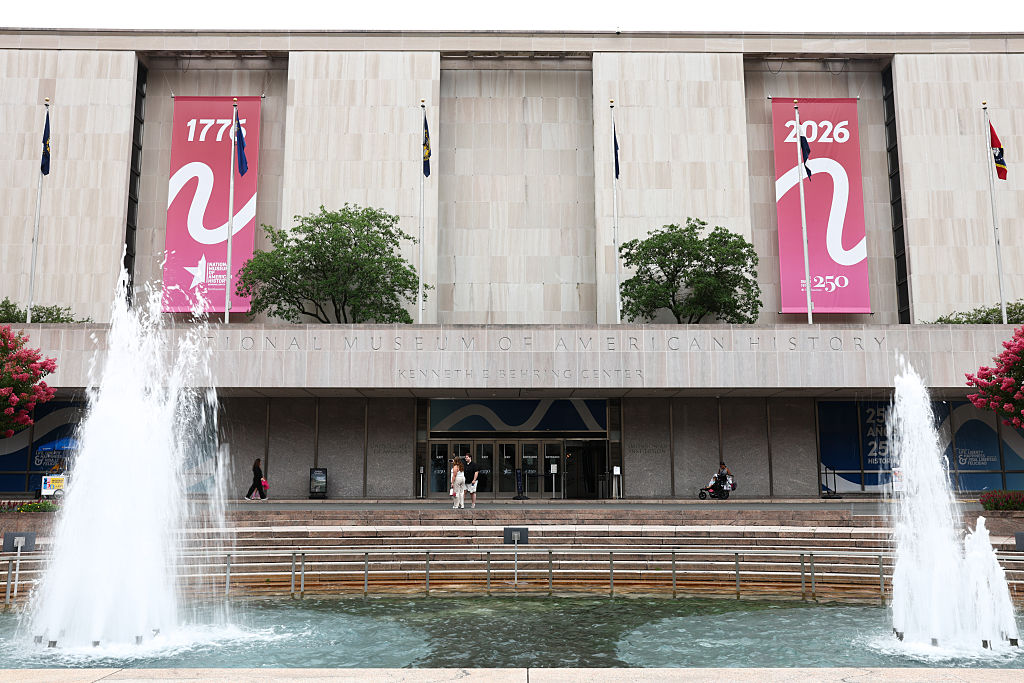
On the 250th anniversary of the signing of the Declaration of Independence, the Trump Administration attempted to declare independence from history with the release of “Saving America’s Story.” Assigned an Orwellian title that obscures the effort to rewrite America’s story, the 162-page Domestic Policy Council report, published on the White House’s website on July 4, attacks the archivists, curators, educators, historians, and museum professionals who work at the Smithsonian National Museum of American History. That the administration has chosen to do this at precisely the moment when it is gutting the National Archives and censoring historical exhibits at national parks demonstrates that the new report is just one part of a broader effort that threatens to reduce American history to conservative ideology.
The report follows President Donald Trump’s March 27 “Restoring Truth and Sanity to American History” executive order. And like so many Trump administration reports and statements, it can be seen as a classic example of projection, whereby the administration accuses others of doing exactly what it is doing. The report states, for example, that “museum leadership has explicitly adopted an ideological framework that no longer treats the American story as a shared national inheritance to be taught or celebrated, but as a political instrument to divide, dispirit, and discourage our citizens.” That is not an accurate assessment of the Smithsonian, but it is a pretty good description of the new report.
What's more, the report includes multiple false claims about American history and the Smithsonian. To take one example, it is simply not true that the museum has “not created any exhibit dedicated to presenting a general narrative of American history” or telling the story of the Founding Fathers, the Declaration of Independence, the Revolutionary War, or the U.S. Constitution. Nor is it true that the museum fails “to provide America’s young people access to what is genuinely inspiring and unifying in our history, as well as to the lessons imparted by the American experience of overcoming great national challenges.” It is entirely false to assert that the museum disregards “the progress America has made and the ideals that continue to inspire millions.”
The Domestic Policy Council also mischaracterizes and misrepresents the words of the museum’s director, Anthea Hartig, who has consistently worked to educate and inform visitors through innovative exhibits and inspirational programs. Indeed, the report itself quotes Hartig’s 2026 welcome to the museum’s special semiquincentennial exhibit.
“Thank you for joining us this year as we celebrate the 250th anniversary of the Declaration of Independence. Throughout the museum you’ll experience the history and legacies of the revolutionary generation that took a great leap into democracy together in 1776,” reads Hartig’s statement. “And you’ll see how Americans have worked since that time to realize the ideals written into this groundbreaking document. We are proud to celebrate the birth of the United States and will continue to share the stories of all Americans as we look to the next 250 years.” This quotation rejects the notion that Hartig, or the Smithsonian more broadly, fails to properly celebrate American history.
Trump’s Domestic Policy Council also directly contradicts itself at times. “NMAH’s only special programming to commemorate America’s 250th anniversary, In Pursuit of Life, Liberty & Happiness, fails to celebrate America’s Founders and the American Founding,” the report claims. But the following sentence admits that the exhibition “highlights 250 objects from the museum’s collections, including remarkable artifacts like the desk Thomas Jefferson used to draft the Declaration of Independence, George Washington’s uniform, a ship of the early U.S. Navy, and, of course, the Star-Spangled Banner, the 1813 flag that inspired the National Anthem.”
Instead of accurately describing the work of thousands of museum professionals, the report demands that the Smithsonian favor one form of U.S. patriotism over all others. In the process, it minimizes discussions of the political struggles and social movements that have attempted to move the United States toward “a more perfect union.”
In passing, the report acknowledges that the goal of the museum should be to “document and share the achievements and failures of the Nation,” “tell the truth, including of the Nation’s mistakes and injustices,” and “tell the whole story of a nation, including the good and the bad.” In practice, however, it condemns work that mentions national shortcomings as anti-American. To take just one example, the report describes Native American land acknowledgments, no matter their wording, as signs of “an anti-white agenda” and “an anti-American ideology that claims our country rests on stolen land.”
More generally, the report constitutes an attack on American historians, museum professionals, and intellectual expertise, asserting at one point that “much of the museum profession” engages in “discriminatory and likely illegal behaviors and practices” and accusing “the largest funder of the humanities” (the Mellon Foundation) of advocating for “discriminatory practices.” Once again, these would do well as descriptions of the administration’s new report, but they fail to capture the democratic aspirations of most museum professionals and many humanities foundations today.
The report’s authors seem to believe that there is only one correct way to do history, only one correct interpretation of history, only one version of history that merits recognition, beliefs that are fundamentally at odds with the practice of history, which encourages dialogue, discussion, and debate. Indeed, the report is deeply critical of narratives of American history that emphasize democracy and diversity, interpretations that highlight the significance of political activism and social movements, and projects that present inspirational and instructional stories about how and why the United States has evolved.
Make no mistake about it: the report represents an attempt to turn back the clock to a time when U.S. history was taught as the history of white Christian men who conquered a continent, U.S. military leaders who never lost a battle, and U.S. presidents who were single-handedly responsible for national greatness. In educational contexts, we expect math and science teachers to offer up-to-date lessons that reflect today’s knowledge, not outdated information that has been discredited and superseded by leading scholars in their fields; we should expect the same in historical, humanities, and museum contexts. If the National Museum of American History adopts the approaches recommended in the new report, the majority of Americans—immigrants, women, workers, people of color, people with disabilities, and LGBTQ+ people—will not see themselves represented, and America’s rich and complex history will be reduced to shallow, superficial, and simple-minded stories.
I visited the National Museum of American History several months ago, taking in several exhibits, including “American Democracy: A Great Leap of Faith,” “The Price of Freedom: Americans at War,” “The Star-Spangled Banner: The Flag That Inspired the National Anthem,” “Gunboat Philadelphia,” “The First Ladies,” “Entertainment Nation,” “How Can You Forget Me: Filipino American Stories,” and “Corazón y Vida: Lowriding Culture.”
What I saw and experienced was completely at odds with the report’s characterizations. I saw innovative combinations of old and new approaches to American history, appropriate balances of celebration and criticism, and constructive presentations of multiple views and viewpoints. If anything, I would like to see the museum do more, not less, to democratize and diversify its presentation of American history.
My advice to Americans: go see the Smithsonian for yourselves.
Hence then, the article about trump s attacks on the smithsonian are an attack on american history was published today ( ) and is available on Time ( Middle East ) The editorial team at PressBee has edited and verified it, and it may have been modified, fully republished, or quoted. You can read and follow the updates of this news or article from its original source.
Read More Details
Finally We wish PressBee provided you with enough information of ( Trump’s Attacks on the Smithsonian Are an Attack on American History )


Also on site :
- Italy approves sweeping security measures in response to protests
- Today’s NYT ‘Strands’ Hints, Spangram and Answers for Wednesday, October 21, 2026
- American Stephen Hubbard released by Russia, Witkoff says