
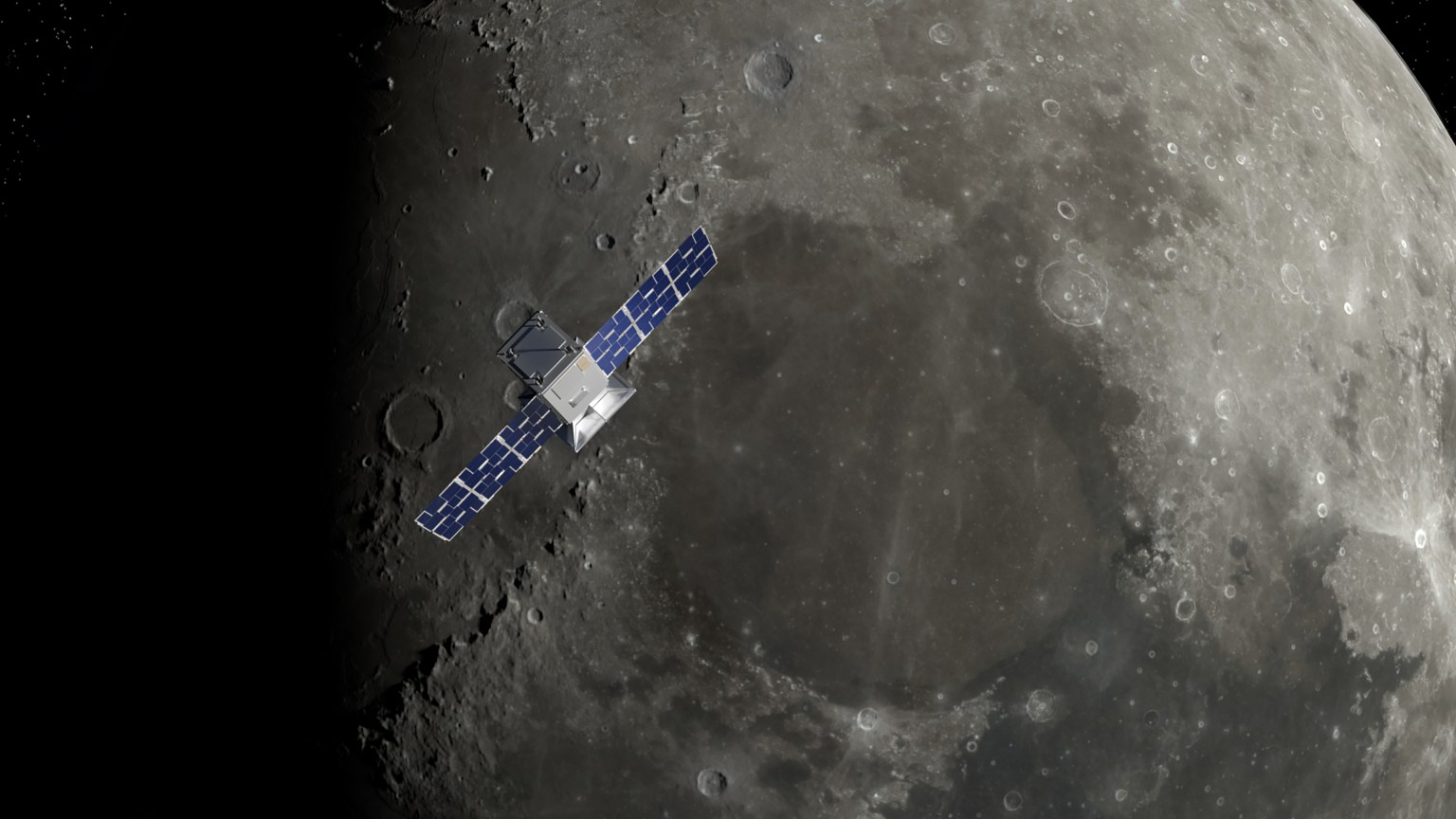
As NASA prepares for a sustained human presence on the Moon, missions will increasingly require spacecraft that can navigate and communicate without a direct connection to Earth.
NASA’s Cislunar Autonomous Positioning System Technology Operations and Navigation Experiment, or CAPSTONE, validated and advanced these capabilities.
Designed to test and validate technologies in lunar orbit, CAPSTONE launched in June 2022 and became the first U.S. commercial mission at the Moon. The spacecraft tested operations in three-body orbits around the Moon, using the combined gravity of Earth and the Moon to reduce the fuel needed to maintain a stable lunar path. It became the first spacecraft to fly and characterize this orbit for future exploration and science missions. Owned and operated by Advanced Space, the microwave-sized spacecraft then received a 15-month mission extension, becoming a testbed for advanced communications, networking, autonomous navigation, and software-defined satellite technologies.
Dylan Schmidt, CAPSTONE assembly integration and test lead, right, and Lachlan Moore, systems integration engineer, left, install solar panels onto the CAPSTONE spacecraft at Tyvak Nano-Satellite Systems, Inc., in Irvine, California.NASA/Dominic HartRather than launch a new satellite, NASA’s Research and Technology Mission Directorate demonstrated that CAPSTONE’s existing hardware could host new applications after launch, transforming the spacecraft into a cost-effective, flexible lunar technology demonstration platform. NASA’s SCaN (Space Communications and Navigation) Division will now use the data to demonstrate innovative networking and navigation techniques on future experiments.
“Operating multiple experiments simultaneously aboard the same spacecraft allows NASA to evaluate how these technologies perform together in a real lunar environment,” said Greg Stover, director of the Advanced Research and Technology Division within NASA’s Research and Technology Mission Directorate at NASA Headquarters in Washington. “Investments in autonomous operations and resilient communications infrastructure are essential to ensuring U.S. leadership as activity around the Moon continues to increase.”
Two experiments aboard CAPSTONE used software-defined infrastructure to advance two future mission essentials: autonomous navigation and deep space communications. The autonomous Navigation, Guidance, and Control software, or autoNGC, is designed to allow a spacecraft to determine where it is, where it is going, and how to get where it needs to be without waiting for instructions from the ground. While portions of the software had previously flown in Earth orbit, CAPSTONE marked the first time autoNGC was tested at the Moon.
“To really demonstrate that something works, you have to fly it,” said Sun Hur-Diaz, principal investigator for the autoNGC technology development project at NASA’s Goddard Space Flight Center in Greenbelt, Maryland. “The real environment is key.”
To really demonstrate that something works you have to fly it. The real environment is key.
Sun Hur-Diaz
Principal Investigator for the autoNGC Project, NASA Goddard Space Flight Center
Researchers also evaluated how autoNGC performed with limited contact to Earth. While NASA’s Deep Space Network antennas were supporting the Artemis II crewed test flight around the Moon, CAPSTONE’s communications window dropped to just a few passes per week.
Those gaps became one of the experiment’s most valuable tests. Without data from Earth, autoNGC determined CAPSTONE’s location using an onboard star tracker camera to image the Moon, Earth, and other celestial bodies. The camera-based system, known as optical navigation, at times outperformed ground-based methods for real-time onboard navigation, advancing technologies for future deep-space missions.
Alongside autonomous navigation testing, CAPSTONE also tested delay/disruption tolerant networking (DTN), a communications architecture designed for deep space. Unlike Earth-based internet systems, deep space communications must function despite long delays and frequent signal gaps. The DTN system addresses those challenges by storing information on the spacecraft when no connection is available and automatically forwarding it once communications are restored. With these demonstrations, CAPSTONE became the first to fly the latest DTN protocols beyond Earth orbit and the first to run them in NASA’s core Flight System, an open-source framework that can be implemented on any spacecraft.
In one demonstration, engineers began transmitting data from CAPSTONE to Earth, but the connection ended before the transfer was complete. The spacecraft stored the remaining data until the next communications opportunity, and transmission resumed automatically. Every piece of data made it home.
Artist’s rendering depicting astronauts, habitats, rovers, power systems, and cargo operations supporting sustained human activities at the Moon Base near the lunar South Pole. The technologies CAPSTONE tested may be key to NASA’s growing lunar communications and navigation infrastructure.NASA“You can imagine an astronaut walking behind a lunar hill or descending into a crater and temporarily losing connectivity,” said Ben Anderson, a systems engineer for the Near Space Network at NASA’s Goddard Space Flight Center in Greenbelt, Maryland. “This technology allows that data to be automatically retransmitted once communications are restored.”
In addition to its primary achievements, CAPSTONE’s second life as a software-defined testing platform demonstrated that new technologies can be affordably tested and proven directly in their operational environment.
After nearly four years of technology maturation, NASA’s activities on CAPSTONE concluded in June 2026, while Advanced Space will continue to use the spacecraft as a technology development testbed.
The CAPSTONE spacecraft was designed and built by Terran Orbital and is owned and operated by Advanced Space. NASA’s Research and Technology Mission Directorate managed the mission through the Small Spacecraft and Distributed Systems program, based at NASA’s Ames Research Center in California’s Silicon Valley. Elements of the CAPSTONE technology suite were supported by NASA’s Small Business Innovation Research program. The autoNGC and DTN demonstrations conducted during CAPSTONE’s extended mission were managed by NASA’s SCaN Division, based at NASA Headquarters in Washington.
About the Author
Korine Powers
Lead Writer and Communications StrategistKorine Powers, Ph.D. is a writer for NASA's SCaN (Space Communications and Navigation) Program office and covers emerging technologies, commercialization efforts, exploration activities, and more.
Share
Details
Last Updated Jul 06, 2026 EditorJimi RussellContactKorine [email protected] Research CenterRelated Terms
Communicating and Navigating with MissionsAmes Research CenterEarth's MoonGoddard Space Flight CenterSmall Business Innovation Research / Small BusinessSmall Spacecraft Technology ProgramSpace Communications TechnologyExplore More
6 min readNASA Webb Uncovers Unusual Galaxy Shaped by Cosmic Collision
In new images from NASA’s James Webb Space Telescope to celebrate its fourth science anniversary,…
Article 1 hour ago 3 min readNASA’s Hubble Spies Stellar Sparkler for July 4th
Red, white, and blue stars glitter like a sparkler being waved on a dark night…
Article 2 days ago 3 min readNASA’s Hubble Captures Crimson Cloud Sparkling with White, Blue Stars
Blue and white stars shine brightly against crimson gas in this image from NASA’s Hubble…
Article 3 days ago Keep ExploringDiscover More Topics From NASA
CAPSTONE
Communicating with Missions
SCaN & Moon to Mars
Moon Base
Hence then, the article about nasa s capstone completes extended mission testing lunar technologies was published today ( ) and is available on NASA ( Middle East ) The editorial team at PressBee has edited and verified it, and it may have been modified, fully republished, or quoted. You can read and follow the updates of this news or article from its original source.
Read More Details
Finally We wish PressBee provided you with enough information of ( NASA’s CAPSTONE Completes Extended Mission Testing Lunar Technologies )


Also on site :
- Matchbox Twenty Announces Big 30th Anniversary Tour with Several ‘Special’ Guests: See All the Dates!
- Kylie Jenner’s ‘Beauty-From-Within’ Line Expands To This Superstore After Recent Target Launch
- Captain Sandy Drops Major Hint About ‘Below Deck’ Star Joe Bradley and ‘Summer House’ Star Lindsay Hubbard