
To mark its 25th anniversary, the 2026 iteration of New York’s Tribeca Film Festival presented no fewer than 118 feature films—103 of them world premieres—over the course of 12 days, coming from all parts of the world and covering an astonishing array of genres.
Tribeca has, of course, always been a festival that relies on a heavy star contingent to draw a large turnout. That has been particularly true for the documentary section, which has always been celebrity-driven. As has been the case for the last few years, it has placed particular emphasis on music-related projects that will hopefully inspire fans to come out in droves (and perhaps get the subjects to do a song or two for the crowd).
Indeed, the festival’s three Gala presentations all fell along these lines, starting with the Opening Night presentation of “Earth, Wind & Fire (To Be Celestial VS That’s the Weight of the World”), a fun but standard documentary from Questlove charting the rise, fall and return of the seminal R&B/funk group and its leader, the late, great Maurice White, through tons of archival footage and interviews with everyone from surviving members of the group to such notable fans as Lionel Richie and Barack and Michelle Obama.
Likewise, the Closing Night presentation, One 9’s “Alicia Keys: Girl from Hell’s Kitchen,” finds the singer recounting the undeniably impressive, though by now familiar, story of her rise from the rough streets of Hell’s Kitchen to musical superstardom. But it gets more interesting in the sections that focus on the lengthy development process of her semi-autobiographical stage musical “Hell’s Kitchen.”
Somewhat more interesting is Josh Alexander’s “Sara Bareilles: Good Grief,” which follows the singer over the course of six days as she records her first album in seven years, a gap in time that saw her dealing with both COVID-19 and the loss of a couple of close friends. Although the film will appeal mostly to Bareilles’ fan base, the way in which it charts the development of the album (which is due to be released in late August) offers an intriguing look into the creative process that feels a little rawer and less sanitized than the kind of purely promotional item that this could have been.
In a similar vein, Sam Jones’s “Mumford & Sons: The House Band” captures the British folk-rock group as they set off on a tour that found them traveling by train from city to city with an eclectic array of guest artists—including Lainey Wilson, Darius Rucker, Noah Kahan and Maggie Rogers—joining them along the way, requiring all involved to learn dozens of new songs in a very short amount of time. While I cannot say that I am much of a fan of the group in general, I did enjoy watching the sense of communal spirit develop between the artists as they set about this mad task and found it especially interesting when capturing the moments when some were finding it harder to get that spirit to properly gel than others.
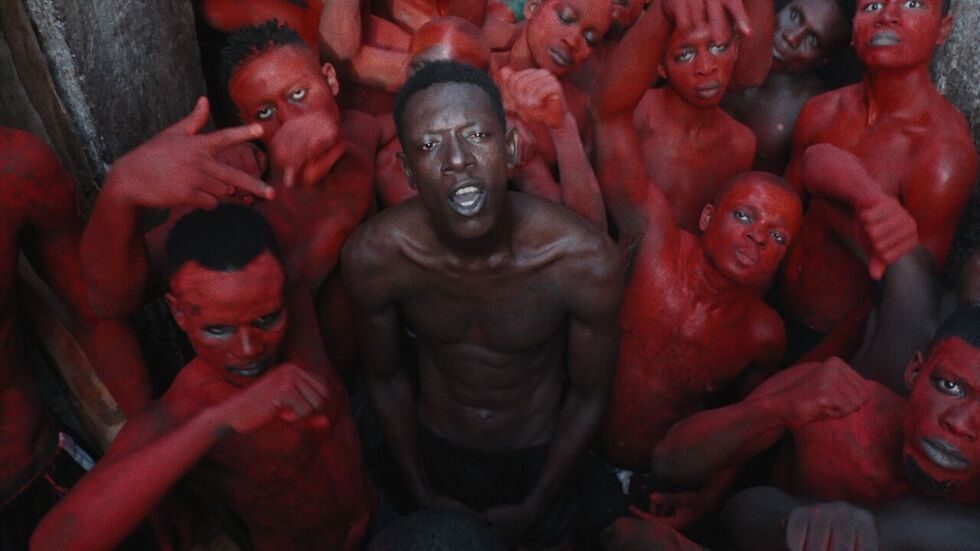
While there were other music-related docs on display, including Rob Arthur’s “Frampton” and the concert film “Katy Perry: The Lifetimes Tour—Live from Paris,” it was the one with the least star power that proved the most riveting. That would be “Jail Time Records,” an absolutely fascinating film from Dione Roach and Steve Happi that takes a look at Cameroon’s New Bell Prison, which is one of the most overcrowded in the continent—almost 6000 men in a facility built for only 800–but which also contain a music studio that allows the prisoners to record songs that serve as a creative outlet for their tensions and frustrations.
This is an eye-opening and toe-tapping look at the therapeutic value of art that is both thought-provoking and life-affirming. Indeed, it would go on to win the Best Feature and Cinematography prizes in the festival’s documentary competition as well as the Albert Maysles Award for Best New Documentary Director for Roach and Happi.
There were plenty of documentaries featuring less musically inclined famous faces as well, and perhaps the oddest of the bunch was Michael LaHaie’s “Bob and David Climb Manchu Pichu,” in which comedian David Cross pitches to his longtime friend and collaborator Bob Odenkirk the idea of the two of them heading to the Andes and hiking up Machu Pichu not long after the latter suffered a near-fatal heart attack.
This may sound like a particularly strange “Mr. Show” bit—sort of a hybrid of “My Dinner with Andre” and “K2”—but the two decide that it is a good idea. The film follows them on their journey, observing them as they riff along the way while contemplating their partnership and the odd ways their careers have developed, before ruminating on their lives and what it all means. Not surprisingly, the film is often quite funny, but as the trip progresses and they near the end, watching the take-no-prisoners humorists examine both their friendship and their lives leads to some unexpectedly moving moments as well.
Comedians are also at the center of Josh Greenbaum’s “Playing POTUS,” which focuses on the various ways humorists have portrayed presidents over the years and how those performances have, for better and worse, helped shape the public perception of their subjects. The idea sounds fascinating, I suppose, but after a beginning section looking at Vaughn Meader, whose impersonation of John F. Kennedy was the first widely successful spoof of a president, it becomes yet another unquestioning celebration of the legacy of “Saturday Night Live” in which they fawn over virtually every POTUS take over the years in obsequious detail. (The only break comes when the film shifts focus to Key & Peele for the Obama years, presumably as a tacit admission of how “SNL” never quite figured out how to approach him during his years in office.)
If the film had broadened its net a little more, it might have yielded some interesting results. But as is, it just feels like yet another ultimately unnecessary veneration of “SNL,” seemingly meant only to provide more programming fodder for Peacock.
The lineup even included a couple of films focused on well-known members of the New York media world. Alison Chernick’s “House of Criticism” takes a look at Jerry Saltz and Roberta Smith, the chief art critics at New York Magazine and The New York Times, who happen to be competitors in their professional lives while happily married to each other. It sounds like the pitch for an exceedingly mid-90s-era romcom, but they manage to make it all work to an enviable degree. The two are charming enough to watch as they go about their lives, but the film is a little on the slight side. It does, at times, serve as a gentle but potent reminder of the importance of serious arts criticism in general, at a time when such things have all but disappeared from the pages of most newspapers and magazines.
On the other hand, Meanwhile, Adam Paul Verity’s “Whipple’s World” introduces the world outside of New York to George Whipple III, a man who has spent the last three decades working days as a respected attorney and his nights as an entertainment reporter for NY1, hobnobbing with celebrities at one red carpet event after another like a particularly bizarre Eugene Levy character come to life, right down to the prominent eyebrows. While Whipple (whose name does share a connection with a certain television toilet paper pitchman) is undeniably a character, to put it mildly, he isn’t quite enough of one to sustain an entire film, particularly one that eventually takes on the form of an elaborate home movie and which pads itself out with tons of old footage, much of it shot in and around past editions of the Tribeca festival. (Robert DeNiro may turn up more in archival material here than he does in some of his actual acting gigs.)
As is the case with pretty much any contemporary film festival, there was also a handful of documentaries about the movie industry. Directed by Barbara Attie, Janet Goldwater and Mike Attie, “Hollywood Does Abortion” uses a controversial 1972 episode of “Maude” as a leaping-off point to examine how the American entertainment industry has approached the topic of reproductive rights and how it changed and evolved over time from the relatively progressive takes on the subject presented in such films as “Fast Times at Ridgemont High” and “Dirty Dancing” to more contemporary presentations that, out of fear of offending advertisers and anti-abortion groups, have been all but neutered in the name of “balance.” (After this film, you may never watch “Law & Order: SVU” in quite the same way.)
The film could use a little tightening here and there; it offers viewers a number of eye-opening reflections from an array of filmmakers and actors who discuss how these films helped shape their views on the topic and what they mean when viewed now through the lens of the post-Roe era.
Once so controversial that it was the focus of protests while it was still filming on the streets of New York, William Friedkin’s “Cruising,” his 1980 thriller with Al Pacino as a cop going undercover to investigate a series of brutal murders in the gay community, has seen its reputation shift in recent years from homophobic embarrassment to a classic of gay cinema. The story of the film and its still-discomfiting legacy is covered in Jeffrey Schwarz’s “Mineshaft: The Cruising Murders,” which tackles not only the various controversies surrounding it and its current-day reconsiderations but also the 1977 murder of journalist Addison Verrill, which helped inspire Friedkin to make it in the first place.
It may not be enough to persuade those who still find “Cruising” to be nothing more than exploitative trash, but the results are undeniably fascinating. Much like the upcoming “Exorcist II” reappraisal, “Boorman and the Devil,” it may well inspire those who know it only by its admittedly questionable reputation to give it a chance.
Another controversial production gets a reexamination in “Humpty Dumpty X,” in which British filmmaker Tony Kaye looks back on the post-production battle that erupted between him and New Line Pictures over the editing of his 1998 debut feature, “American History X,” which at one point saw him attempt to take his name off of the film and have it credited to “Humpty Dumpty”—even offering to change his name to that in order to make it happen.
As it turns out, while Kaye was engaging in his ultimately quixotic battle, he was evidently filming everything and this film consists of footage of him arguing with studio executives and even with friends who think that he is taking things too far (with even Marlon Brando appearing at one point to suggest that Kaye exercise restraint) along with new material in which Kaye reflects—occasionally through song, I fear—on what he was thinking.
The film is too unfocused at times, and even those predisposed to side with Kaye may find him somewhat grating. Still, the best moments do provide an up-close and undeniably compelling examination of the age-old Hollywood conflict between art and commerce.
One of the most affecting docs in the entire lineup was Allison Berg’s “Time Warp,” a film which, as the title suggests, revolves around the legendary cult classic “The Rocky Horror Picture Show.” Admittedly, there have been so many films tackling that particular subject over the years that even the most devoted members of its still-devoted fan base might question the need for yet another.
Happily, this one has actually found a new angle by focusing on a drag theatre company as it plans to stage a shadow-cast presentation of the film in Rock Springs, Wyoming, a once-prosperous mining town that would not seem to be a particularly receptive locale for the show. The film follows the performers as they hold auditions, rehearse tirelessly, and stand firm in the face of opposition from some locals, all leading up to opening night. It’s entertaining enough from a let’s-put-on-a-show perspective, but what really comes through here is the fact that even after a half-century, “Rocky Horror” is still as vital and important as ever, helping to give those who feel marginalized a voice and a real sense of community.
There were also a number of films dealing with technology and the perils hidden beneath their glittery surfaces. Nick Holt’s “AI: Probably Nothing to Worry About” takes a broad and somewhat overlong look at the origins of artificial intelligence, the powers behind the scenes who helped bring it to the forefront, and the warnings that were sounded along the way and often ignored in the race to be the first to make it happen. Hao Wu’s “TikTok Never Dies” recounts the bizarre tale of the phone app that started out as a way of sharing dance videos and eventually became a political football whose very existence eventually became a case heard before the Supreme Court.
Meanwhile, Gar O’Rourke’s drolly funny and quietly incisive “The Siege of Paradise” turned its cameras to Cinque Terre, a picturesque coastal town on the Italian Riviera that is seeing its tranquil nature and singular identity threatened each tourist season by an onslaught of visitors (up to 3.5 million in a town with only 4000 regular residents), including a number of content creators who end up adding to the problem by filming and posting every moment of their visits and encouraging others to come.
I also enjoyed “Stealing Magic,” in which filmmaker Matthew Testa follows a group of magicians as they attempt to track down and apprehend internet pirates who have been stealing the secrets behind their illusions and selling them on black-market websites.
Some of the most affecting documentaries in this year’s festival were a group of films that found their subjects looking back at places and moments of infamy and grappling with the ensuing legacies. Based on the book by Witold Szablowski, Andrew Neel’s disturbing and timely “How to Feed a Dictator” brings together the former private chefs for Saddam Hussein, Pol Pot, Idi Amin, Augusto Pinochet and Kim Jong-il to recount what it was like to work for such people, whether they did so willingly or not, and help illustrate the sharp contrast between the brutal living conditions just outside of their kitchens and the opulent meals that they would prepare on a daily basis. (Yes, the question of whether Idi Amin ever actually ate human flesh, as was the rumor at the time, and no, I will not tell you how it is answered.)
In “The Lorraine,” Sam Pollard uses a wide range of archival materials as well as engrossing contemporary interviews to explore the full history and ongoing legacy of The Lorraine Motel, an establishment that was begun by owners Walter and Loree Bailey to provide safe and comfortable lodging to Black travelers and became a genuine cultural institution that attracted rising political figures and musical talents alike, only to fall into infamy as the place where Martin Luther King Jr. was assassinated in 1968.
In a similar vein, “The Haunting of Pennhurst” takes an alternately disturbing and oddly inspiring look at Pennhurst, a notorious state-run institution for people with disabilities in Pennsylvania that subjected its inmates to decades of neglect and abuse before finally being shut down in 1987 that has been revived as a haunted house that not only firmly leans into its infamous past but utilizes people with the very same disabilities that might have once consigned them to a life in such a place as the performers.
Maybe the most unnerving of all the documentaries I saw at Tribeca this year was “American Zoo,” a film by Tim Travers Hawkins that tells a story so disturbing and bizarre that it makes most straightforward horror films seem tame by comparison. The subject is The Catskill Game Farm, which was established in 1933 by German immigrant Roland Lindermann as America’s first and largest privately owned zoo, and it operated for 73 years before finally closing in 2006. As it happens, in 1959, he brought in Dr. Heinz Heck, a biologist and former head of Munich’s Hellabrun Zoo, to serve as his zoo’s director. As we learn through materials uncovered after the zoo’s closing and interviews with the daughters of Lindermann and Heck as well as former zoo employees, Heck was a leading voice in the Nazi eugenics movement who was obsessed with conducting cruel experiments on animals in the hopes of artificially reviving extinct species—experiments that he continued to conduct after relocating in the U.S. under the auspices of a zoo in an area with a heavily Jewish population.
A bleak observation of both the darkness that often resides beneath the seemingly sunniest of surfaces and the myriad ways in which the most idealistic of ventures can curdle into something unfathomably awful when placed in the wrong hands, “American Zoo” makes for uncommonly compelling viewing.
Hence then, the article about tribeca 2026 the documentaries was published today ( ) and is available on Roger Ebert ( Middle East ) The editorial team at PressBee has edited and verified it, and it may have been modified, fully republished, or quoted. You can read and follow the updates of this news or article from its original source.
Read More Details
Finally We wish PressBee provided you with enough information of ( Tribeca 2026: The Documentaries )


Also on site :
- 1976 Rock Song, Ranked Among ‘Greatest Songs of All Time,’ Was Created in a Watertown Basement Studio
- 1992 Soft Rock Hit, Named the Best No. 1 Song by a Fictional Band, Is Back in the Spotlight 34 Years Later
- Iran plans to announce an ‘exclusion zone’ that runs from the U.S. naval blockade line, through the Strait of Hormuz, and into the Persian Gulf