
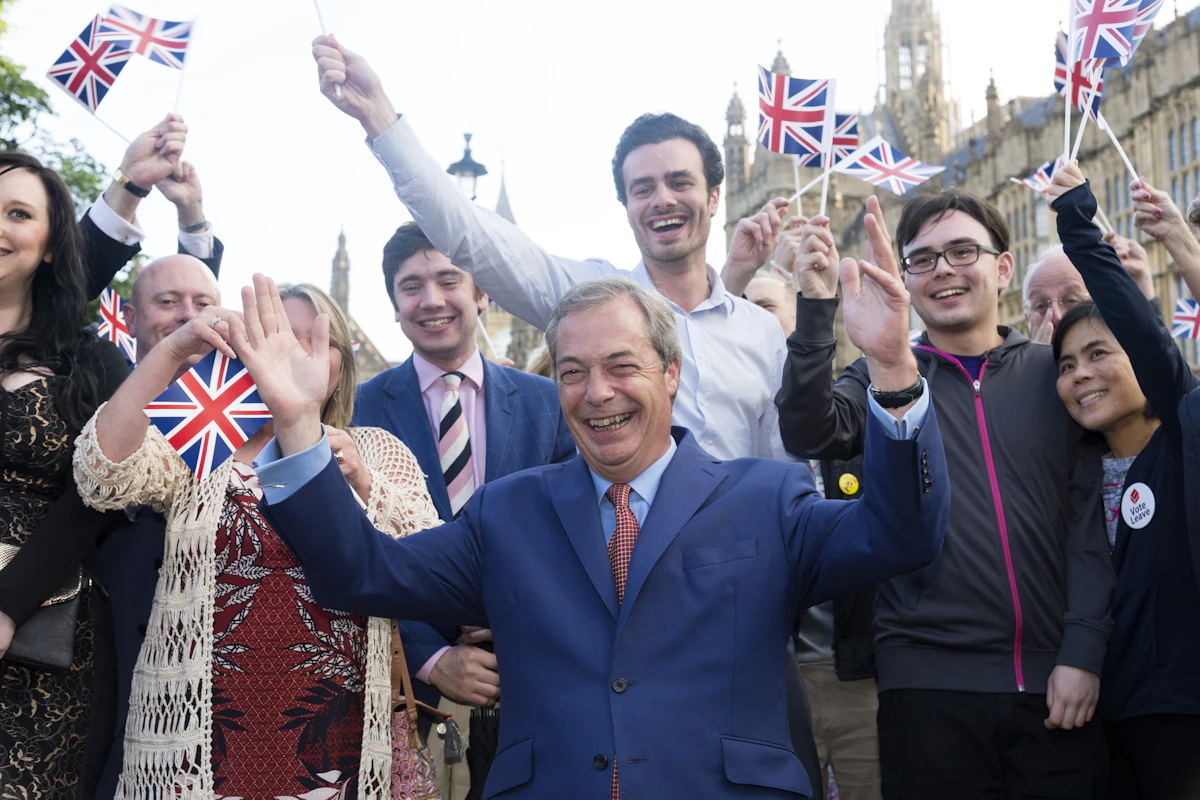
“It was Game of Thrones,” says George Osborne. The former Tory chancellor of the exchequer was talking about the fateful referendum 10 years ago, on June 23, 2016, on whether the United Kingdom should remain in or leave the European Union. Or rather, he was talking about one man in particular, and Osborne’s comparison was just right. For Boris Johnson, the referendum—in fact, all of politics, even all of life itself—was a game, although also an opportunity. The one thing it wasn’t to Johnson was a serious matter with grave implications for his country.
Just how grave we can now see. Every warning about the malign consequences of leaving the EU has been justified. This is not the place for detailed economic analysis with statistics and tables, but just to take one example, and a detached transatlantic view, a paper published last year by American academic economists, chiefly at Stanford, compares the U.K.’s performance since the referendum with those of similar countries and reckons that the U.K. economy is 8 percent smaller than it would have been had we remained inside the EU.
Our particular problems are a grossly inflated financial sector that produces a disproportionate amount of tax revenue but is particularly vulnerable to a crisis such as that of 2008, along with a larger postindustrial economy characterized by low education, low skills, low investment, low wages, low growth, and low productivity. These wouldn’t have been cured merely by remaining in the EU, but they have been patently aggravated by leaving.
One obvious and undeniable consequence of the referendum has been political chaos. In the 40 years from 1976 to 2016, there were in all six British prime ministers. In the decade since the referendum, there have also been six. And soon there will be a seventh, with Sir Keir Starmer having thrown in the towel on Monday. He will presumably be replaced by Andy Burnham in a kind of coup. It’s yet another in a series of coups, a Labour premier kicked out as a succession of Conservative premiers— Theresa May, Boris Johnson, Liz Truss—were before him. This latest change cannot be justified by any serious belief in Burnham, whose political résumé is far from stellar—a member of Parliament for 15 years (when he loyally and repeatedly voted for Tony Blair’s criminal and catastrophic invasion of Iraq); a minister for a few years; an unsuccessful candidate for the Labour leadership not once but twice; and then mayor of Greater Manchester, where his achievements were genuine but quite modest, such as improving the bus and railway services. His only real selling proposition is that he’s not Starmer.
And all of this stems from that fateful day 10 years ago. The referendum campaign remains one of the most unpleasant experiences of my life. To be clear, I say that as a Remainer, but not just because of that. One might sometimes feel like the American pol years ago who said, after losing an election, “The people have spoken, God damn them,” but one can accept defeat after a fair fight. But the Brexit referendum was anything but fair. It was a squalid exercise in demagoguery or plain mendacity.
A riveting two-part BBC program, Brexit: A Very British Civil War, is the latest in the long line of brilliant documentaries produced by Norma Percy, an American adornment of British broadcasting. Her oeuvre includes important additions to our knowledge of the bloody disintegration of Yugoslavia and conflicts in the Middle East, but my favorite may be the Watergate series, made 20 years after Richard Nixon’s resignation, which is not least a comic masterpiece, as all the old burglars and bunglers revisit, and try to explain away, their malfeasance.
There is a certain similarity in the Brexit program, even if there’s nothing at all funny about the consequences. It all came about because of the internal politics of the Conservative Party. Once upon a time it was the Tories who were the Europhiles. One Tory prime minister, Harold Macmillan, made the first attempt to join what was then the European Economic Community, or Common Market, in 1963, before he was blackballed by Charles de Gaulle. Another, Edward Heath, did join in 1973. And as is often forgotten, it was one more Tory, Margaret Thatcher (yes!), who ratified the Single European Act in 1986 establishing the single market.
After her fall, a group of Tory M.P.s began a guerrilla campaign against further European integration, and they harried John Major during his troubled prime ministership from 1990 to 1997. When David Cameron became Conservative leader of the opposition in 2005, he told his party to “stop banging on about Europe,” but his words went quite unheeded. Every poll showed, over many years, that “Europe” was one of the least important questions for most British voters, although immigration, which was sometimes connected to the EU, mattered much more. And yet for the same gang of Tory M.P.s, the EU was the one subject that dominated their lives, and they were relentless in pursuing it.
Following the 2010 election, in which the Tories won a plurality of parliamentary seats but not an outright majority, Cameron and Nick Clegg, leader of the ardently Europhile Liberal Democrats, formed what someone called the Brokeback Mountain coalition. But then, as another observer pointed out, that movie does not end happily, and so it proved.
As his next move, or misstep, Cameron tried to quiet those colleagues who were still banging on by promising a referendum on continued British membership. But he made the promise hoping that he wouldn’t have to keep it. If the coalition held after the next election, he could plead the Lib Dems’ support as a way out. In 2015, to general surprise, the Tories won an outright majority, and Cameron was impaled on his promise.
Even then, having called a referendum he didn’t want, Cameron still expected to win it—and he wasn’t alone. He tried to gain concessions from the EU, but the other European leaders, while not wanting the U.K. to depart, had almost had enough of endless British plaints and special concessions. In particular, German Chancellor Angela Merkel refused to budge from the sacred principle of free movement of people within the EU. It was unfortunate, not to say disastrous, that this coincided with the bloody strife in Syria and the consequent huge flood of refugees trying to escape from that country and get into Europe.
All Cameron could do was fall back on saying that to leave would still be economically damaging for the country. Although plainly true, and amply justified by events since, that quite missed the point. “It’s the economy, stupid” must be one of the stupidest political slogans ever coined, but it underlay the Remain campaign’s great mistake. Dry economic arguments simply didn’t cut it.
Although I would never say that we Remainers were “the best” and that Leavers were “the worst,” the rest of Yeats’s line applies all too aptly: Remainers lacked all conviction while the Leavers were filled with passionate intensity. More than that, we Remainers forgot what Raymond Aron, the great French politicologue, said toward the end of his long life: It is a denial of the entire experience of the twentieth century to suppose that people will reject their passions in favor of their interests.
And then there are the individual roles played 10 years ago. Whatever one thinks of Nigel Farage, the leader of the anti-European United Kingdom Independence Party at the time, or his gruesome sidekicks who made us shudder again as we saw them on the recent BBC show, they had always opposed British membership of the EU, so they can’t be accused of cynical calculation. And they were fighting wholeheartedly to win the referendum.
Not so some others. Important parts were played by Michael Gove and Boris Johnson, the two most prominent Tories who deserted Cameron and campaigned for Leave. Both of them had been journalists before they entered Parliament as Conservatives. In 2004, Gove wrote an essay in the Spectator, where he is now editor, on what being a Conservative meant to him, which included the enjoyable line, “Rudi Giuliani is a conservative, and a hero to conservatives like me.”
Ten years ago, Gove wrote another long and supposedly weighty essay making the case against membership of the EU, while Johnson wrote not one but two columns, one making the case for Leave and the other for Remain. He claims this was to clear his mind before coming to his decision, which really means that he was weighing up which suited his personal ambitions better. The very idea of “a principled belief held by Boris Johnson” is what logicians call a closed category, like “a square circle.”
Above all, what the BBC program confirmed was what many of us suspected at the time—that both Tories supported Leave while expecting to lose, but hoping that the campaign would strengthen their own positions within the Conservative Party. That was made clear by Johnson’s and Gove’s respective former wives, Marina Wheeler and Sarah Vine. The latter has already told us, as a supposedly amusing story, that on the morrow of the referendum, she said to her then spouse, “You were only supposed to blow the bloody doors off” (a cinematic allusion: vide Michael Caine in The Italian Job).
And all this is what Osborne, the chancellor who was a leading Remainer, meant by Game of Thrones. It was all a struggle for advantage and position, quite unrelated to any serious consideration of the national interest, and when they won the referendum they didn’t know what to do next.
Ten years on, and everyone is unhappy. Any election or referendum is potentially fraught and divisive, but that was peculiarly true of June 23, 2016, which divided the country in the harshest ways, between young and old, educated and “the poorly educated” whom Donald Trump says he loves. If the vote had been confined to citizens over 60, or those who had left school without qualifications, Leave would have won with a much larger majority; if to those under 30 or to university graduates, then it would have been an easy victory for Remain.
By what ought to be a contradiction—but then whenever has political life followed a logical course?—those who gave us Brexit with its lamentable consequences and ought to be execrated have surged ahead. That specifically means Reform UK, the latest iteration in a line of Europhobic parties led by Nigel Farage, which was recently polling around 25 percent, while the possibility of Farage becoming prime minister was seriously discussed. But the special election in Makerfield that sent Andy Burham back into Parliament saw the Reform vote collapse, and that bubble might have burst at last.
Even now the winners of the referendum are as baffled as the losers. A frankly risible ad in the right-wing Daily Telegraph has just announced a “Big Debate” to be held in London on June 29, with a panel of well-known Brexiteers, Daniel Hannan, Allister Heath, and Allison Pearson, on the question “How to Make Brexit a Success”—after 10 years! This is in itself an acknowledgment that it has been a failure so far, which is what most people now think, however they voted then. For some years past, a consistent and substantial majority in polls say that they regret Brexit, but there’s nothing that can be done about it.
Maybe we shall see the same panel discussing how to make Brexit a success in another 10 years’ time. Until then, amid economic decay and violent rioting in the streets, I keep thinking of the words “Referendums are the device of dictators and demagogues.” Who said that? Why, it was Margaret Thatcher, 50 years ago, and she never spoke a truer word.
Hence then, the article about ten years after brexit every grim prediction has more than come true was published today ( ) and is available on The New Republic ( Middle East ) The editorial team at PressBee has edited and verified it, and it may have been modified, fully republished, or quoted. You can read and follow the updates of this news or article from its original source.
Read More Details
Finally We wish PressBee provided you with enough information of ( Ten Years After Brexit, Every Grim Prediction Has More Than Come True )


Also on site :
- 1976 Rock Song, Ranked Among ‘Greatest Songs of All Time,’ Was Created in a Watertown Basement Studio
- 1992 Soft Rock Hit, Named the Best No. 1 Song by a Fictional Band, Is Back in the Spotlight 34 Years Later
- Iran plans to announce an ‘exclusion zone’ that runs from the U.S. naval blockade line, through the Strait of Hormuz, and into the Persian Gulf