
Part three in a five-part series
There was a time when a restaurant was designed to be noticed long before anyone walked through the door.
In mid-century San Diego, dining spaces became part of the visual identity of the city. Along commercial corridors and expanding automobile routes, restaurants used architecture, signage, lighting, and themed design to stand apart from surrounding businesses.
Some resembled roadside attractions. Others became neighborhood landmarks recognized as much for their appearance as for the food they served.
Rather than blending into their surroundings, many establishments were intentionally designed to capture attention from passing traffic in an era when visibility became central to commercial success.
Top left to right view of exterior of front of Chinese Garden restaurant located on the 4500 block of Pacific Highway (originally Pacific Boulevard) in 1942. The restaurant has a tile roof. Middle, a view of the exterior of Hamburger Sport restaurant at 617 Broadway between 6th Avenue and 7th Avenue in 1940, and left is a view of the fountain in Horton Plaza through the palm trees. The Cabrillo Theatre and Palace Cafe are housed in the buildings across from the plaza in the background. Four World War I soldiers are lying on the ground in the foreground. Bottom left, the Aztec in 1950, and on the right, Oscar’s on El Cajon Blvd., c. 1947. (All photos and captions info courtesy the San Diego History Center)Dining as visual architecture
During this period, restaurant buildings were no longer treated as neutral structures. Architecture itself became part of the dining experience.
One of the most recognizable examples was Noah’s Ark, a ship-shaped restaurant decorated with oversized animal figures that functioned as both a dining establishment and a roadside spectacle. Its design reflected a broader Southern California trend in which restaurants competed through form, novelty, and visual impact rather than storefront simplicity.
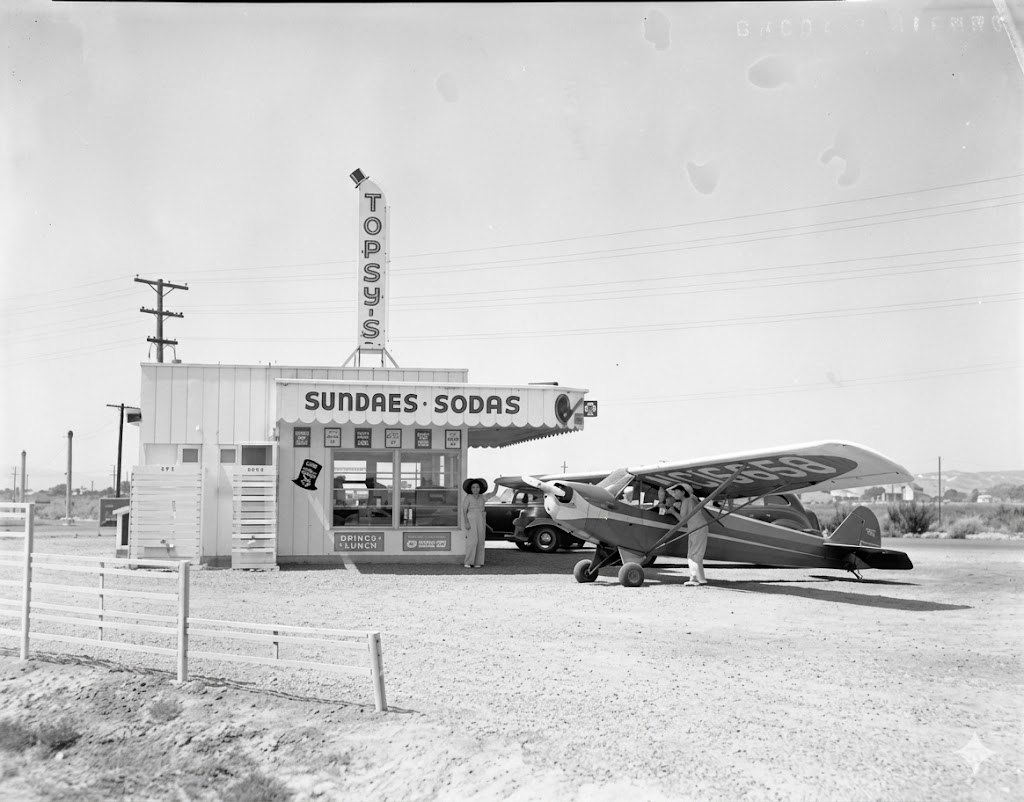
Leucadia’s Noah’s Ark c. 1913. (Photo and caption info courtesy of the San Diego History Center)Other establishments relied on a strong identity tied to name, location, or atmosphere. Restaurants such as Oscar’s, Keith’s, Aztec, Palace Cafe, Topsy’s, Hamburger Spot, and Chinese Garden operated across San Diego’s commercial strips, downtown corridors, and neighborhood districts.
Together, these venues reflected an era when independent restaurants often developed distinct visual identities connected directly to their surroundings.
National City, Keith’s, with a prominent sign, date unknown. (Photo and caption info courtesy of the San Diego History Center)The rise of themed dining
As San Diego expanded after World War II, themed restaurants became increasingly common. Some incorporated coastal or maritime imagery tied to the region, while others drew on international or stylized decorative influences that reflected broader national trends in leisure-oriented dining.
In many cases, the building itself functioned as the advertisement, like Colby’s Rincon Springs with a rooster on the top of its roof in the Pauma Valley.
View of automobiles parked in front of Colby’s Rincon Springs Restaurant in the back country in 1957 rooster on top of the roof to draw attention. (Photo and caption info courtesy of the San Diego History Center)Exterior façades, neon signage, rooflines, and decorative features were designed to be readable from a distance, particularly along major roads where restaurants competed for the attention of motorists.
Dining out, not just eating a drive-in, became associated not only with food, but with atmosphere and visual experience.
Roadside diners and mobility-era design
Right: Hazards’, sometimes referred to as Friedhof’s, at Pacific Highway and Laurel, ca. 1938, and at the left, another view of Hazards’ (sign reads Friedhof’s) in a former train coach that was converted to a restaurant in the 1940s. Location is Pacific Highway and Laurel Street in San Diego. (Photos and captions info courtesy of the San Diego History Center)Alongside themed and independently designed restaurants, San Diego’s dining landscape also included a strong tradition of roadside places shaped by automobile travel and counter-service culture.
Establishments such as Hazard’s, also called Friedhof’s, reflect this layer of everyday dining life. These places emphasized visibility, efficiency, and counter-based service, often featuring interiors defined by chrome finishes, linear seating, and compact service layouts designed for movement and flow.
Rather than theatrical architecture, these spaces represented a different kind of visual culture — one shaped by mobility, accessibility, and the rhythm of roadside travel.
Together, they illustrate how everyday dining was influenced not only by theme or design, but by the practical realities of a car-oriented city.
Gradual decline of architectural individuality
By the later decades of the 20th century, many of these independently designed restaurants began to disappear or change significantly.
Redevelopment, rising land values, and the expansion of standardized chain dining altered commercial corridors across the city. Freestanding themed buildings were remodeled, replaced, or absorbed into larger retail developments.
Distinctive architectural identity gradually gave way to more uniform commercial design focused on efficiency, consistency, and replication rather than visual individuality.
What remains
Although many of these establishments no longer survive in their original form, they remain preserved through photographs, postcards, menus, advertisements, and archival collections.
In some cases, buildings survive in altered form, repurposed beyond easy recognition. In others, only documentation remains.
What endures is a record of a period when restaurants were not only places to eat, but also visual landmarks embedded in the commercial identity of San Diego.
Next up: The lost restaurants of San Diego: Nightlife, cocktail lounges, and entertainment dining Part Four.
Read more history stories here, and do you have a story to tell? Send an email to [email protected].
Sources:
San Diego History Center’s photographic archives documenting restaurant architecture and commercial corridor development. San Diego Public Library Special Collections (restaurant directories, menus, advertisements, and business records).California Digital Newspaper Collection (UC Riverside), historical restaurant advertising and reporting. Regional documentation on Southern California roadside architecture and mid-century themed dining. San Diego Reader’s archival coverage of restaurant and café culture in San Diego.
Hence then, the article about lost restaurants of san diego the rise of themed and roadside dining was published today ( ) and is available on Times of San Diego ( Middle East ) The editorial team at PressBee has edited and verified it, and it may have been modified, fully republished, or quoted. You can read and follow the updates of this news or article from its original source.
Read More Details
Finally We wish PressBee provided you with enough information of ( Lost restaurants of San Diego: The rise of themed and roadside dining )


Also on site :
- PepsiCo Teases a Major Rebrand—Here’s What’s Actually Happening
- 1987 MTV Music Video, Produced by The Monkees’ Mike Nesmith, Helped Bring Iconic Michael Jackson Song to No. 1
- Lady Gaga and Michael Polansky’s Baby Name and Gender Finally Revealed—With a Sweet Musical Connection