
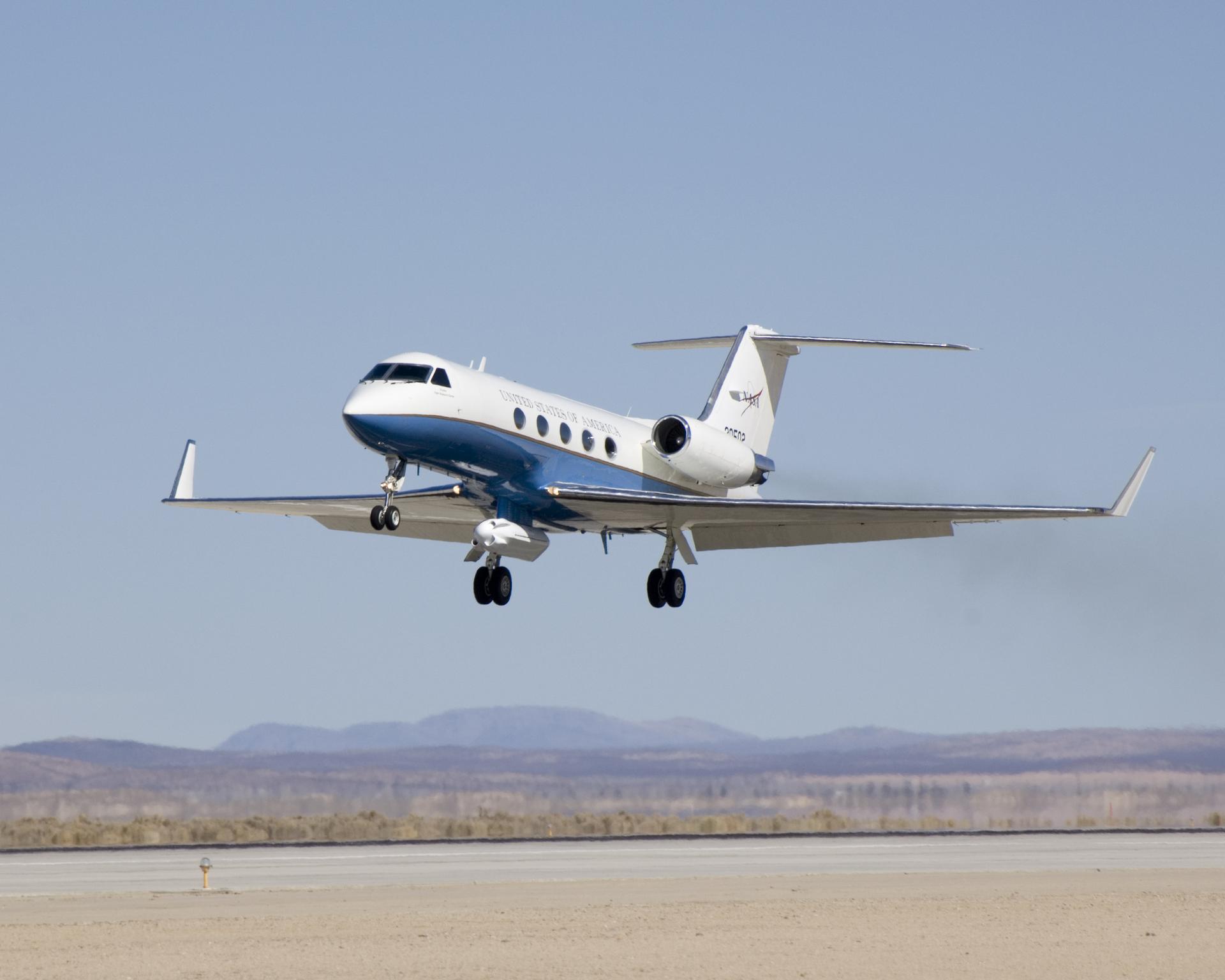
Five research aircraft will support a Student Airborne Research Program (SARP) mission out of Ellington Field in Houston. Flights are expected from Wednesday, June 3 to Saturday, June 13. During the mission, select maneuvers will be conducted at low altitudes over the Houston area.
Pilots will fly remote sensing payloads in raster patterns, or parallel back-and-forth lines. The instruments flown could help researchers map the movement of the gases and particles that make up Earth’s atmosphere, changes to the lowest part of the atmosphere near the coastline, and the natural processes affecting the land and water in that area. The flights will primarily take place in the Houston area, with some extending over the Gulf of America.
While many of the flights will operate at higher altitudes, a WP-3D Orion will conduct maneuvers as low as 1,000 feet above ground level. Owned and operated by the National Oceanic and Atmospheric Administration (NOAA), this aircraft is used as a hurricane hunter and has supported several airborne science missions for NASA. It is equipped with a multitude of scientific instrumentation, radars, and recording systems for both in-flight and remote sensing measurements of the atmosphere, the Earth, and its environment.
The NASA-operated aircraft participating in the mission also are equipped with a variety of remote sensing instruments, including two lidars, a synthetic-aperture radar, an imaging spectrometer, and two spectrometers.
The operations will involve the agency’s Gulfstream V (N95NA), Gulfstream C-20A (N802NA), and Gulfstream III (N520NA), as well as NOAA’s WP-3D Orion (N43RF) and a King Air B200 aircraft (N46L) owned by Dynamic Aviation and contracted by NASA. The flights can be tracked in real time at NASA Airborne Science Program Tracker.
The SARP effort is an eight-week summer internship program that provides undergraduate students with hands-on experience by engaging in field research and data analysis and with access to one or more NASA Airborne Science Program flying science laboratories.
For more information about the NASA Airborne Science program, visit:
airbornescience.nasa.gov
Explore More
4 min readContractor to Civil Servant: NASA Welcomes Kenny Heckle
Article 4 days ago 2 min readGrowing Stem Cells in Space to Improve Cancer and Disease Treatments
Article 4 days ago 4 min readNew Material Could Help NASA Melt Moon Rocks, Harness Lunar Resources
Article 1 week agoHence then, the article about nasa to conduct low altitude flights near houston was published today ( ) and is available on NASA ( Middle East ) The editorial team at PressBee has edited and verified it, and it may have been modified, fully republished, or quoted. You can read and follow the updates of this news or article from its original source.
Read More Details
Finally We wish PressBee provided you with enough information of ( NASA to Conduct Low-Altitude Flights Near Houston )


Also on site :
- The Real Reason Why Josh, Nelson and Leo Got Kicked Off ‘The Challenge’
- How ‘Chévere’: ARIA VEGA ‘Couldn’t Be Happier’ as She Earns First Billboard No. 1 With Ryan Castro Collab
- Fired ‘Shrinking’ Crew Member Accuses Warner Bros TV Of Doing Nothing Over Sexual Harassment By EP; Being Scapegoated After Complaining