
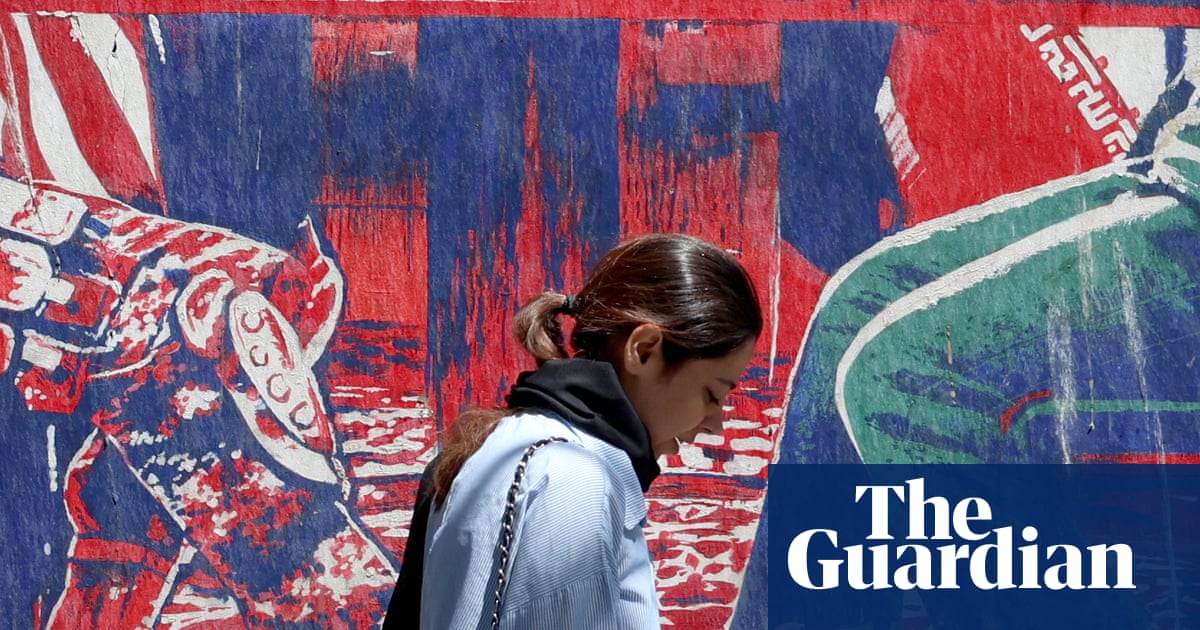
As Donald Trump swung this week between threats of new military action against Iran and predictions that a lasting ceasefire deal was imminent, many Iranians were left exhausted and gripped by uncertainty.
Despite the partial lifting of an internet shutdown that began when the war started on 28 February, fears of worsening repression at home have also fuelled pessimism about the future among some of those to whom the Guardian spoke.
Speaking over the phone from Tehran last weekend, Saeed, who participated in the large protests against the regime earlier this year and, like others, asked to use a pseudonym for security reasons, said he feared what he viewed as the worst possible outcome had now arrived.
“I predicted much earlier that if the US were to attack with promises of coming to our rescue and leaving us without a definitive plan, like this current ceasefire, then it would be the worst outcome. The economy is worse than it was on 28 December [when the protests began] and with the number of raids, arrests and executions daily, we have been left with an emboldened regime. We are truly in a fucked up situation,” he said.
For Saeed, the aftermath has deepened not only political fears but also divisions within families, exposing generational fault lines over how the crisis is understood.
Asked whether his views were widely shared, he described sharp disagreements among friends and relatives. “Some of the elderly members in my family seem to think we [young protesters] are brainwashed and have brought shame to the country,” he said. “They believe everything said on state TV and don’t realise the regime has been executing young people just because they were out protesting. They think they were spies.”
The anti-government protests that began in December and spread across the country were met with a deadly crackdown by security forces, according to rights groups. Thousands were reported killed, more than 50,000 arrested, according to the US-based Human Rights Activists News Agency (HRANA), and at least 226 people have been executed this year, according to the Norway-based Iran Human Rights NGO (IHRNGO).
Meanwhile, the regime has reportedly set up military training booths in the capital to teach civilians how to operate Kalashnikovs, in an effort to prepare them to take up arms if the war resumes. Rallies by pro-government crowds in military Jeeps mounted with machine guns have flooded social media.
A member of the Iranian military shows women how to use a gun at a booth in Hafte Tir Square in Tehran in May. Photograph: AFP/Getty ImagesElnaz, a rights activist based in the capital, said: “Not everyone supports the system or is interested in war. The use of children and teenagers in checkpoint inspections, as well as the broadcast of weapons training on television, has caused widespread concern. Many child rights activists have protested, arguing that war should not be normalised.”
Images showing children holding machine guns had left many Iranians worried, she added. “The fact that children and teenagers have been seen holding machine guns, which the state TV broadcasts, has raised serious concerns.”
Under the shadow of arrests and raids, others say their initial views on foreign intervention have shifted, while fears of what lies ahead increasingly dominate their thoughts.
Amir, a business owner from Mashhad, said he had once desperately hoped for US intervention, believing external pressure might bring political change. But after witnessing the worsening economy and what he described as a deteriorating human rights situation, he now finds himself questioning whether the cost has been too high.
“I feel humiliated,” he said. “This is not a ceasefire. It’s a never-ending auction between the US and the Islamic Republic over our lives and our blood.”
The war has not brought the freedom some Iranians had hoped for. Photograph: Atta Kenare/AFP/Getty ImagesTrump’s comments last month about bombing Iran “back to the stone ages” continued to haunt him. “‘Taking us back to the stone age’ and then treating this war like it’s a business deal while changing his promises every second minute has truly been humiliating to watch,” he added.
“On the other hand, the regime seems to have an infinite length of a noose that’s only getting tighter. I don’t know how to truly express how we feel.”
‘Economic hell’
Soaring prices for groceries and essential medication, alongside the loss of livelihoods caused by the authorities’ nearly 90-day internet blackout, have left many struggling to meet even basic needs.
Noor, 39, a cafe owner from Tehran, said that while her business was not collapsing, she feared the fragile state of affairs meant the “worst is yet to come”.
“It will take years to recover from the emotional and economic devastation caused by January’s massacre and the war,” she said. “Even if this ceasefire holds, in a few months I think we will be in such economic hell that people will come back to the streets simply out of desperation.”
Life has returned to a semblance of normality during the ceasefire but great uncertainty remains. Photograph: NurPhoto/Getty ImagesAs partial connectivity returned this week, many who had not yet fully grasped the scale of devastation wrought by the January protests and the war, both to the economy and to civilian infrastructure, have been confronted with a difficult reality.
Among videos shared widely among Iranians’ accounts is one on Instagram about a Tehran resident, Hamed Mirzaei, who reportedly lost 12 members of his family during the war. The newlywed told local media that he lost his parents, wife, cousins, their children and brother-in-law when his home was struck. He posted videos of himself standing in front of his home, now buried under rubble.
Other videos showed similar scenes of destroyed shops, homes and music schools. Ro, 42, a musician based in Tehran, told the Guardian he was devastated after seeing footage of damaged music schools and civilian spaces.
Iranians were left reeling after January’s bloody protest crackdown and the US-Israeli attacks. Photograph: Abedin Taherkenareh/EPA“Which country has ever achieved freedom through military invasion? Afghanistan, Iraq, Syria?” he asked. “As an Iranian musician, I condemn the military aggression of the United States and Israel against my country. This attack was carried out under the false pretence of bringing democracy and saving the people of Iran, yet it killed many of my fellow citizens and destroyed vital infrastructure.
“They bombed schools, hospitals, research centres, universities, petrochemical facilities and residential homes. They have deepened poverty, inflation, unemployment and shortages of medicine, pushing these crises even further than before.”
Another widely shared video from the past two days features Hamidreza Afarideh, a co-founder of a music academy in east Tehran. He sits amid the rubble of what was once a safe haven for children and adults learning to play musical instruments, after it was destroyed in a strike on a reportedly nearby military base.
A woman who lost two of her children in a school strike on the first day of the war stands by the building’s ruins. Photograph: Majid-Asgaripour/ReutersThe attacks on such infrastructure have left many people jobless, including the staff at Afarideh’s music school, deepening the country’s economic turmoil.
With mounting fears over what a fragile ceasefire might ultimately mean for life inside Iran, many said their attention had shifted to survival.
Amir, the business owner, said: “We are only trying to survive right now. No one can fight on an empty stomach.”
A broken economy and an emboldened regime: Iranians abandoned to endure fallout from war NYT News Today.
Hence then, the article about a broken economy and an emboldened regime iranians abandoned to endure fallout from war was published today ( ) and is available on NY Times News ( Middle East ) The editorial team at PressBee has edited and verified it, and it may have been modified, fully republished, or quoted. You can read and follow the updates of this news or article from its original source.
Read More Details
Finally We wish PressBee provided you with enough information of ( A broken economy and an emboldened regime: Iranians abandoned to endure fallout from war )


Also on site :
- ‘Forgotten Island’ Review: H.E.R. And Dave Franco Give Life To Gorgeously Animated And Frenetic ‘Toon
- Princess Diana’s Brother Reveals What Bombshell Claims About King Charles Won’t ‘Be a Surprise’ to William & Harry
- ‘Survivor 51’ Cast Shares Their Biggest Weaknesses — From Irish Chaos to ‘Pretty Mean Girls’ (Exclusive)