
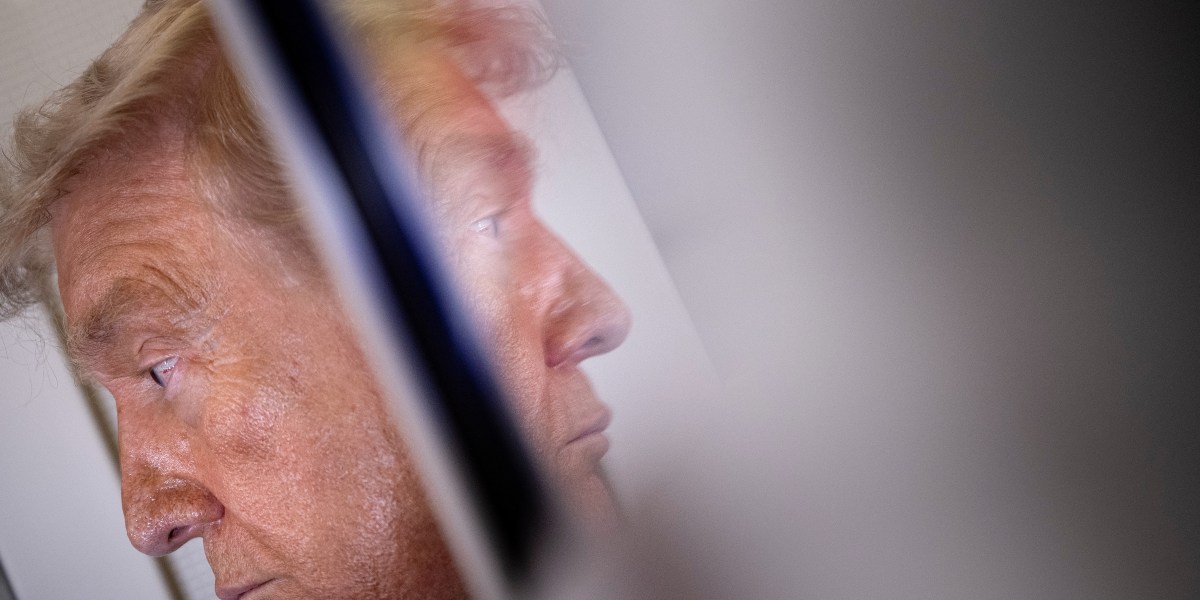
President Donald Trump offered a revealing answer about the limits of centralized leadership in a newly published, wide-ranging interview with Fortune editor-in-chief Alyson Shontell.
Asked how the investment deals, diplomatic leverage, and corporate commitments he has championed could endure beyond his presidency, Trump acknowledged the model may not be transferable. “Can’t answer that question,” he said. “I don’t know. I mean, it’s not going to happen again.”
Trump’s comments illuminate a tension familiar to every boardroom: key-man risk. Corporate America has repeatedly shown that the same leader who creates extraordinary enterprise value can also become the principal constraint on an institution’s durability. Trump’s governing style represents the political extension of the same phenomenon, with influence, relationships, and leverage concentrated in a single figure. Put another way, the more indispensable a leader becomes, the more fragile the institution can appear.
That is why the most valuable companies are not simply those with exceptional leaders, but those capable of outlasting them. It is also why succession planning, once treated as governance housekeeping, has become a central strategic concern for corporate boards.
Apple understood this early. The transition from Steve Jobs to Tim Cook, and now John Ternus, reinforced the idea that the institution could endure beyond any one leader. By contrast, The Walt Disney Company became a cautionary case in succession execution after Bob Iger returned to the CEO role in 2022, forcing the board to restart one of corporate America’s most closely watched succession processes.
Trump’s approach to date reflects a similar dynamic at the geopolitical scale. Much of his dealmaking appears rooted in personal leverage: foreign leaders responding to Trump himself, corporations calibrating around his authority, and counterparties negotiating against his unpredictability. It is a leadership model built for immediacy rather than permanence.
That distinction matters to executives navigating today’s economy. Across sectors, companies are confronting whether they are building enduring institutions or extending the shelf life of singular leaders. The question is especially relevant in the AI boom, where some of the sector’s most valuable companies are closely identified with a handful of executives, including Sam Altman at OpenAI, Jensen Huang at Nvidia, and Dario Amodei at Anthropic.
As for who might carry forward Trump’s political legacy, whether Donald Trump Jr., JD Vance, or Marco Rubio, the president ultimately distilled the issue with characteristic bluntness. “Whoever gets this [job] is going to be very important,” he said. “And if you get the wrong person: disaster.”
That is the succession problem, stripped to its essentials.
Ruth [email protected]
This story was originally featured on Fortune.com
Hence then, the article about trump s leadership model has a succession problem was published today ( ) and is available on Fortune ( Middle East ) The editorial team at PressBee has edited and verified it, and it may have been modified, fully republished, or quoted. You can read and follow the updates of this news or article from its original source.
Read More Details
Finally We wish PressBee provided you with enough information of ( Trump’s leadership model has a succession problem )


Also on site :
- As U.S. Treasury intervened in the bond market, the Netherlands rushed 86 tons of gold out of America because of ‘geopolitical unrest’
- Olympic Figure Skater Joining ‘Dancing With the Stars’ Had Her Best-Ever Performance to This ’80s Classic
- Simon Helberg Celebrates Huge Milestone With ‘Gem’ Jim Parsons in Rare Photo After Shocking ‘Big Bang Theory’ Admission