
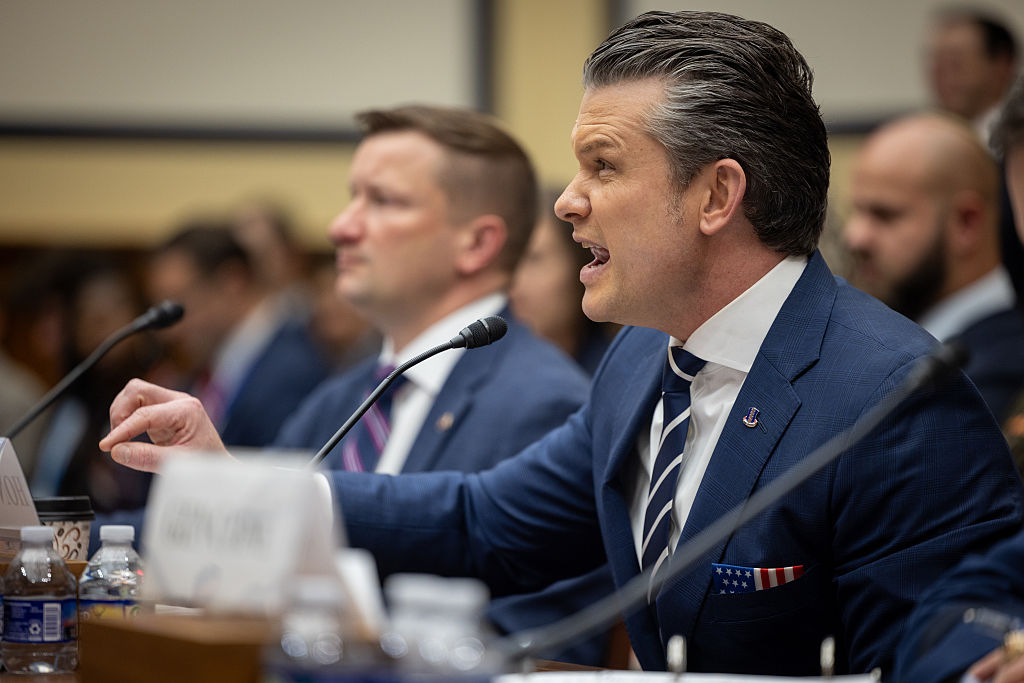
Defense Secretary Pete Hegseth arrived on Capitol Hill on Wednesday facing what was supposed to be a budget hearing. Instead, he confronted something the Trump Administration has largely avoided during two months of war with Iran: direct, sustained questioning over whether it has misled the public about why the United States entered the conflict, what it has achieved, and how or when it will end.
In a combative appearance before the House Armed Services Committee, House Democrats accused Hegseth and President Donald Trump of offering shifting justifications for the war, obscuring its mounting costs, and refusing to level with Americans about a campaign that has already killed 13 U.S. service members and cost at least $25 billion, according to the Pentagon’s first public estimate.
Again and again, lawmakers pressed for a clear definition of victory, a timeline for ending hostilities, and an explanation of why the Administration’s public claims about Iran’s nuclear program have changed over time. Hegseth largely declined to provide specifics, instead denouncing critics as defeatists, questioning their patriotism and insisting the mission had broad public support.
“The biggest challenge, the biggest adversary we face at this point are the reckless, feckless and defeatist words of congressional Democrats and some Republicans,” Hegseth said in prepared remarks before questioning began, setting an unusually hostile tone for a Cabinet secretary appearing before lawmakers who control the Pentagon’s budget.
The confrontation came just ahead of a politically and legally significant moment. This Friday marks 60 days since Trump initiated military operations against Iran without congressional authorization, the threshold under the War Powers Resolution after which presidents are generally required to seek approval from Congress or begin withdrawing forces. TIME has reported that Democrats are having intense discussions over whether they should sue Trump if he continues the war in Iran beyond Friday’s legal deadline without obtaining congressional authorization.
For weeks, many Republicans have largely stood behind Trump’s handling of the war. But as casualties rise, energy markets remain volatile, and U.S. forces deepen their presence in the Middle East, Democrats used the hearing to crystallize a broader charge: that tactical military successes have been substituted for a coherent strategy.
Rep. John Garamendi, Democrat of California, accused the Trump Administration outright of deceiving the country. “Secretary Hegseth, you have been lying to the American public about this war from day one, and so has the President,” Garamendi said. “You have misled the public about why we are at war. You and the President have offered ever-changing reasons for this war.”
Despite some battlefield successes, he said, the broader strategy was “an astounding incompetence” that had left the nation trapped in another Middle East quagmire. Hegseth fired back by questioning the congressman’s motives. “Who are you cheering for?” he demanded. “Your hatred for President Trump blinds you to the truth of the success of this mission.” He added: “I know the American people support that mission, despite your loose talk.”
Read more: These Are the Civilians Who Have Been Killed in the Iran War
Rep. Adam Smith of Washington, the committee’s top Democrat, said the Administration had plunged the country into the very kind of open-ended Middle East conflict Trump once condemned. “Here we are in a full-scale Mideast war, and we’ve seen the costs of that,” Smith said, citing dead and wounded service members, civilian casualties, and instability spreading across Lebanon and Iraq. “One of the big questions that we need to get answered today is, where is this going?”
Iran, Smith said, still possessed a missile program, retained the capacity to disrupt the Strait of Hormuz, and had not relinquished its nuclear ambitions. “We’re not in this for a tactical advantage,” he said. “We’re in this to fundamentally change Iran.”
He then criticized Trump and his top officials for previously saying American strikes last year “obliterated” Iran’s nuclear capabilities, only to later argue that war became necessary because Iran posed an imminent nuclear threat.
“We had to start this war, you just said 60 days ago, because the nuclear weapon was an imminent threat,” Smith told Hegseth. “Now you’re saying that it was completely obliterated?” Hegseth responded that Iran’s nuclear program had been devastated but that Tehran had not abandoned its ambitions. “You’re missing the point,” he told Smith.
Gen. Dan Caine, the chairman of the Joint Chiefs of Staff, testified at the same hearing on Wednesday that Iran was “weaker and less capable than they have been in decades.” Yet outside intelligence assessments have been more cautious, noting that Iran still retains thousands of missiles and attack drones and may recover a significant portion of weapons systems buried in the rubble of U.S. strikes.
Democrats also challenged the Pentagon’s $25 billion cost estimate, saying it excluded broader economic damage from higher fuel and food prices, the deployment of additional naval assets, and the depletion of expensive munitions stockpiles. Rep. Ro Khanna of California said outside experts believed the real burden on American households could be far higher.
“You don’t know what we’re paying in terms of gas. You don’t know what we’re paying in terms of food. Your $25 billion number is totally off. It’s the incompetence,” Khanna said after Hegseth was unable to provide information on the economic cost to the American people. Hegseth countered: “What would you pay to ensure Iran does not get a nuclear bomb?”
Khanna then made an apparent reference to media reports that Vice President J.D. Vance remains privately critical of the Administration's Iran strategy, and specifically of the Defense Department's portrayal of it. "You betrayed a lot of that MAGA base," Khanna told Hegseth. "And you know who knows that? J.D. Vance knows."
Earlier in the conflict, Pentagon officials had suggested costs exceeded $11 billion in just the first six days, and Congress had initially been asked for as much as $200 billion for war-related needs. Wednesday’s lower number suggested either a dramatic slowdown in expenditures or a narrower accounting method than critics expected.
The Trump Administration’s refusal to articulate an end state surfaced repeatedly. Rep. Chrissy Houlahan, a Pennsylvania Democrat, asked Hegseth how long the war would continue. “As you know and as the President has stated, you would never tell your adversary,” Hegseth said, arguing that disclosing timelines would aid Iran, an answer that did little to satisfy lawmakers.
Other Democrats focused on operational controversies. Smith sharply criticized the Pentagon’s handling of a strike on a girls’ school in Iran that killed children, saying the Administration’s lack of transparency around the incident created the impression that “we just don’t care.”
“We made a mistake, and that happens in war,” Smith said. “Yet, two months after it happened, we refused to say anything about it.” Hegseth insisted the strike remained under investigation.
Democratic Reps. Pat Ryan of New York and Chris Deluzio of Pennsylvania pressed Hegseth over force protection failures after a deadly attack against U.S. troops in Kuwait, citing concerns from survivors that the Pentagon was minimizing what happened. Hegseth insisted commanders had done “every conceivable thing” to protect troops and said casualties were a tragic reality of war.
The hearing also widened into scrutiny of Hegseth’s management of the Pentagon. Democrats questioned his dismissal of senior military leaders, including his abrupt dismissal this month of Gen. Randy George, the Army chief of staff. When pressed for a detailed explanation, Hegseth repeatedly said only that “we needed new leadership.” Hegseth also removed Adm. Lisa Franchetti, the Navy’s top uniformed officer, and Gen. Jim Slife, the No. 2 leader at the Air Force. Hegseth has branded the personnel changes as part of his effort to restore a “warrior ethos” to the Pentagon. Rep. Don Bacon of Nebraska, a retiring Republican who supports the Iran war but has occasionally criticized the Administration, told the secretary that while he had the authority to make such firings, “it doesn’t make it right or wise.”
Yet most Republican allies used their time to defend the war and Hegseth. Rep. Nancy Mace of South Carolina, who has been critical of the war, praised his leadership and said he had “surpassed all of my expectations.”
But the larger reality confronting the Trump Administration was unmistakable: two months after the opening strikes, the war’s strategic objectives remain murky, Iran’s nuclear future unresolved, and Congress increasingly restless.
“Simply saying we've already won and boasting and bragging trying to belittle and insult the entire world,” Smith said, “that's not going to get us to the posture that we need.”
Hence then, the article about in hostile hearing democrats accuse hegseth of misleading public on iran war progress was published today ( ) and is available on Time ( Middle East ) The editorial team at PressBee has edited and verified it, and it may have been modified, fully republished, or quoted. You can read and follow the updates of this news or article from its original source.
Read More Details
Finally We wish PressBee provided you with enough information of ( In Hostile Hearing, Democrats Accuse Hegseth of Misleading Public on Iran War Progress )


Also on site :
- Walmart’s ‘Vintage-Style’ $15 Cordless Milk Glass Lamp Has All the Retro Charm of an Antique Store Find
- The Trump Family’s Ireland Trip: From a Bathroom Mirror Selfie with the President to Twinning with Don Jr.
- 1984 Johnny Depp Movie, With a 94% Rotten Tomatoes Score, Ranked Among ‘Best Horror Movies of All Time’