
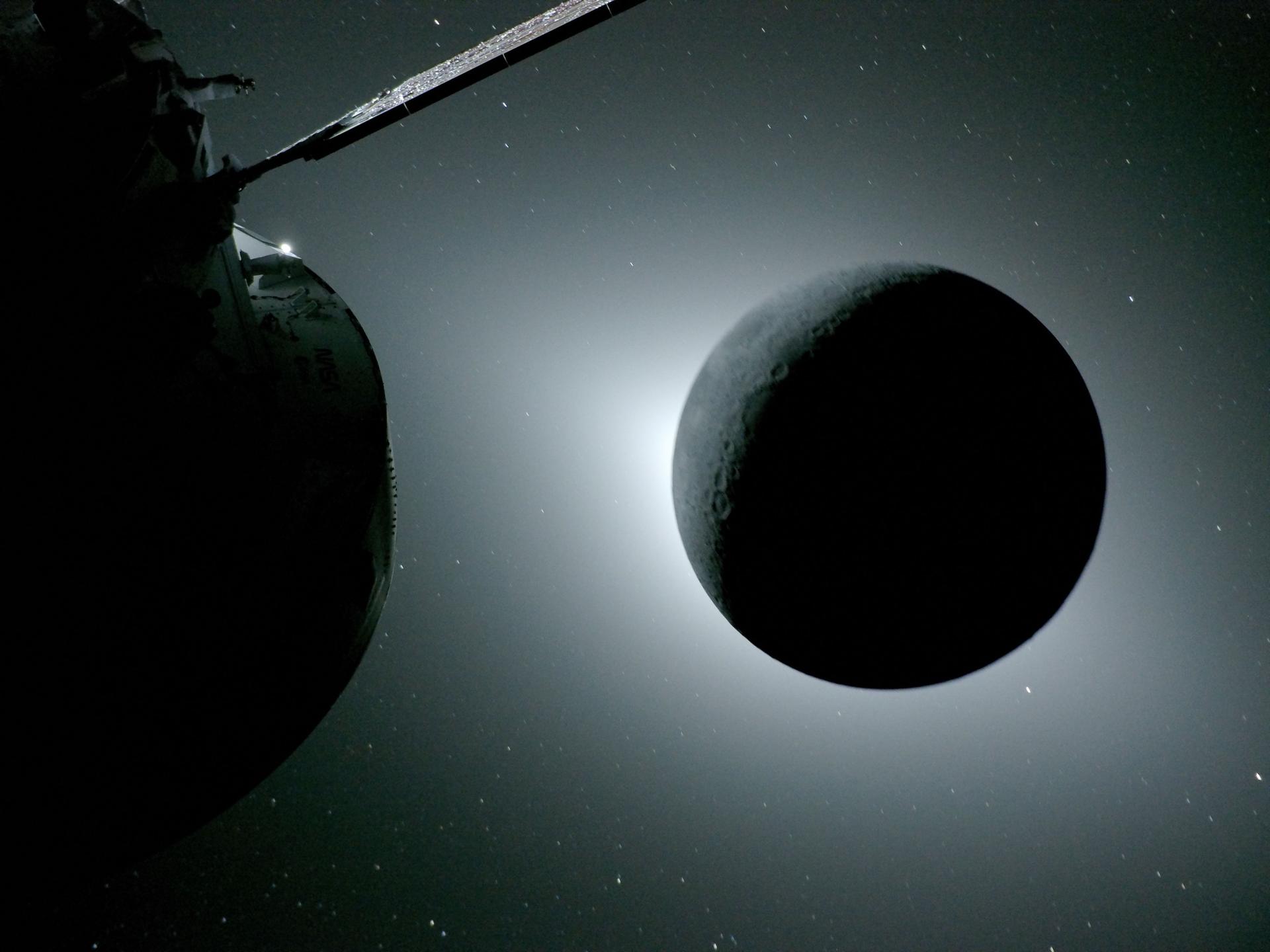
The ocean connects us to the stars.
A small group of space scientists and planetary experts gathered at the Scripps Institution of Oceanography on Thursday one day ahead of the Artemis II splashdown to discuss the connection between the lunar mission and their work back on home soil.
Each of them says that the Artemis II mission has already enriched their understanding of the solar system and humanity’s place in it and in the broader universe. And the data that will return with the astronauts will be extraordinarily precious, enhancing humanity’s understanding not just of the solar system and the moon, but of our own familiar Earth, as well.
The Artemis II mission, NASA’s first crewed lunar fly-by in 50 years, will end when the craft splashes down off the coast of San Diego, or possibly Tijuana, in the early evening Friday, delighting scientists, amateur astronomers and space enthusiasts alike. But once the Orion craft has come and gone, they will all still have a place in San Diego. In fact, they have been here all along.
Local feedback sought
Ben Fernando, a postdoctorate researcher at Johns Hopkins University focusing on seismology and planetary physics, said that he will be leading the campaign to observe the shockwaves that emanate from the Orion capsule when it re-enters the atmosphere and hits the Pacific Ocean.
“Artemis is a perfect calibration,” he said, meaning that they know exactly what its dimensions are supposed to be and how much it is supposed to weigh, giving them a measurement tool for other types of impacts.
Benjamin Fernando, Johns Hopkins scientist. (Photo by Brooke Binkowski/Times of San Diego)This will aid in future planetary research, including on Earth, where the technologies and data developed out of this mission will be useful to study space debris and impacts.
Fernando added that his team is seeking input from San Diegans. “We’re trying to get people to report whether they have heard or felt sonic booms,” he said.
Locals who feel or hear booms, vibrations, shaking, or anything else around the re-entry time are encouraged to put that information into USGS’s “Did You Feel It?” portal, which will have a special section for the Artemis II re-entry.
Earth
A piece of the Zagami meteorite, the largest single Martian meteorite ever found. It fell to Earth in 1962. (Photo by Brooke Binkowski/Times of San Diego)Scripps Institution’s director, Meena Wadhwa, served as director of the School of Earth and Space Exploration at Arizona State University from 2019 to 2025 before joining Scripps. Before that, she worked at the Jet Propulsion Laboratory in Pasadena and as NASA’s principal scientist for the Mars Sample Return Program.
“I see this — the Artemis program — as a way to inspire another generation,” Wadhwa said.
She said she was too young to be part of the cultural phenomenon that was the Apollo moon landing, but she said that Artemis II more than makes up for it.
“This is now a new era. We’re going to be going back — really sample the diversity of materials on the moon.”
Venus
The Moon jaunt also will aid in the study of Venus, the hottest planet in the solar system that mysteriously rotates in opposition to its path around the sun, unlike other planets.
But beneath that, Venus is remarkably similar to our own planet in size and age. It could be thought of as “Earth’s evil twin,” said geophysicist Dave Stegman, a Venus expert whose research interests coalesce around tectonics and magnetics. He said that he is specifically interested in a type of crown-shaped land masses on the Venutian surface known as coronae, a tectonic volcanic feature that does not exist on Earth.
A collection of rocks displayed on the desk of Scripps Institution of Oceanography director Meena Wadhwa, including bits of meteorites and a piece of rock from Mars. (Photo by Brooke Binkowski/Times of San Diego)Stegman said that he is hoping to be able to expand at least some of humanity’s understanding of Venus, and by proxy, Earth. But he said that this could never have happened without human collaboration, cooperation and work that spanned generations.
“The expertise took decades to make this mission happen,” he said. “It’s great to see…. when it splashes down, it’s the culmination of decades.”
Mars
Scripps assistant professor Vashan Wright, whose areas of research include how grains and rocks fracture in response to external pressures, said that Moon data will help expand how Mars is understood, as well.
Varshan Wright, UCSD professor, geophysicist, and Mars researcher. (Photo by Brooke Binkowski/Times of San Diego)“My research can be enriched by Artemis because the moon also has granular materials” similar to those on Mars, he said.
Wright added that his interest in space, like the rest of the scientists there, comes from the same drive to explore that defines the field. “One of the interesting things about space research is, we’ve also developed a lot of tools humanity has used over time,” he said.
That curiosity and human need for exploration and discovery is arguably the most important part of the Artemis II mission, said Scripps director Wadhwa. “We’re going to learn a whole lot about how rocky worlds evolve,” she said. “It’s so inspiring to think about.”
Jupiter
Scripps Oceanography physical oceanographer and assistant professor Lia Siegelman leads research on the similarities between Jupiter’s cyclones and anticyclones, and the ones that occur on our home planet. Siegelman first made the connection between the storms on Earth and Jupiter in 2018, when she noticed similarities between images of Jupiter’s massive storms and the ocean turbulence that she was studying.
A study she co-authored in 2022 shows that a type of convection similar to what is experienced on Earth helps maintain Jupiter’s storms — although those might be years long and thousands of miles wide.
“Whenever you see a natural system like that, there are so many parallels,” Siegelman said. “The same physics, the same metrics.”
Beyond
“The sky is not the limit,” said Venus researcher Stegman. “The infinite is the limit. We have the curiosity.”
Hence then, the article about as san diego prepares for splashdown scientists excited about artemis ii discoveries was published today ( ) and is available on Times of San Diego ( Middle East ) The editorial team at PressBee has edited and verified it, and it may have been modified, fully republished, or quoted. You can read and follow the updates of this news or article from its original source.
Read More Details
Finally We wish PressBee provided you with enough information of ( As San Diego prepares for splashdown, scientists excited about Artemis II discoveries )


Also on site :
- ‘Resident Evil’ Is the Horror Reboot of the Year
- 1968 Beatles Song, Written and Recorded in a Single Night, Was Scheduled Around a Movie the Band Did Not Want to Miss
- Nicole Wallace Joins Josh Heuston In Amazon MGM Romance ‘Throttled’