
I wrote in July 2024 about my fear that, emboldened by unconditional U.S. support, Israel might launch a full-scale war against Hezbollah in Lebanon that could drag in the United States. Clearly, I failed to comprehend the scope of Netanyahu’s and Trump’s barbaric ambitions.
I was right about one thing: Israel did invade Lebanon on October 1, 2024, only four days after assassinating Hezbollah’s Hassan Nasrallah, and 12 days after triggering the pager explosions that killed 42 and maimed almost 3,000. While the two countries agreed to a ceasefire eight weeks later, Israel routinely violated it and faced no consequences. And yet the Israeli invasion and continued bombardment of Lebanon now seem relatively inconsequential when compared to the regional conflagration Israel and the U.S. have ignited by attacking Iran.
Within the first day, the United States and Israel conducted approximately 900 airstrikes, killing hundreds of civilians. The strikes targeted Supreme Leader Ali Khamenei, whose martyrdom sparked riots among Shia communities in Bahrain, Yemen, Iraq, and Pakistan. Iran selected his son, Mojtaba Khamenei, as the country’s new supreme leader. While Khamenei Sr. had issued a fatwa, or religious ruling, in 2003 against the production of nuclear weapons, analysts fear that Mojtaba will impose no such restrictions.
Iran retaliated within hours, launching missiles at Israel and at U.S. military facilities in Bahrain, the UAE, Kuwait, Qatar, and Saudi Arabia. Within the first few days, Iran also hit Oman, the Azerbaijani enclave of Nakhchivan, a British base in Cyprus. Turkey intercepted two Iranian missiles. Although the Houthi movement in Yemen had not yet joined after the first week, Iran-backed militias in Iraq fired missiles and drones at Israel and at U.S. bases in Jordan.
Meanwhile, in addition to launching thousands of airstrikes against Iran, Israel again invaded Lebanon, prompting French President Emmanuel Macron to increase military aid to the Lebanese army, which did nothing to slow Israel’s blitz over Beirut. Israel continued its bombing campaign in Iran, evidently using AI to select such targets as a public park because it was named “Police Park.” No one checked that it had no relation to the police, indicating a lack of human oversight.
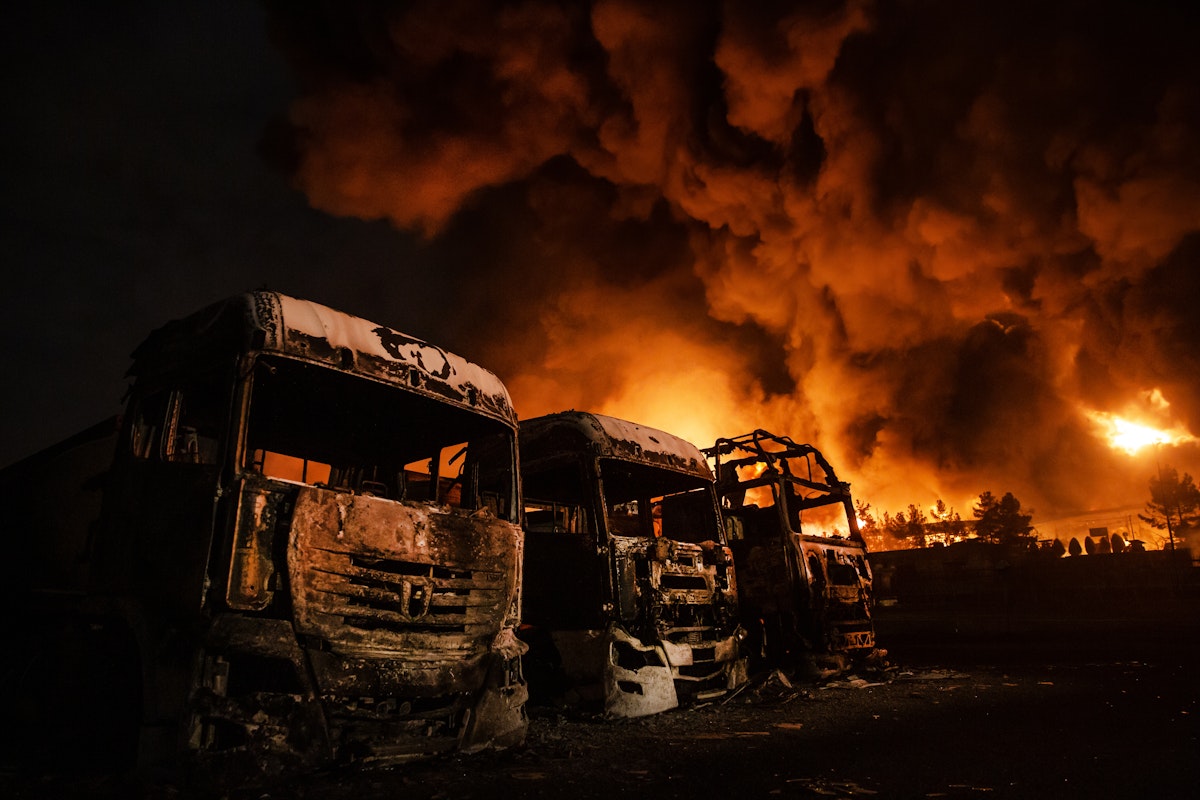
The number of countries actively or potentially involved in hostilities is growing, with no sign of concern from Israel or the U.S. Iranian President Masoud Pezeshkian announced that Iran would stop attacking the Gulf Cooperation Council states unless attacks were launched from their territory. Soon after, Israel attacked a desalination facility and struck 30 oil storage tanks, derailing the possible reduction in hostilities with the GCC. Residents of Tehran captured videos of the apocalyptic aftermath: massive black clouds and fires burning uncontrollably, followed by a black rain of oil. Targeting oil and water facilities marked an escalation that the Gulf states in particular wish to avoid; in the GCC, 100 million people depend on desalinated water.
Although air defenses have deflected most Iranian projectiles, the Gulf countries’ image of peaceful luxury—an image purchased with hundreds of billions of dollars of U.S. weapons—has been shattered. Gulf states are furious with Trump for sacrificing their safety and economic viability for a war that will result either in complete chaos in Iran that could destabilize the entire region or the survival of a regime that is even more hostile, paranoid, and determined to go nuclear.
Emirati billionaire Khalaf Al Habtoor channeled the frustration of many in a post on X aimed at South Carolina Senator Lindsey Graham, a close ally of Netanyahu, who has pushed for years for the U.S. to attack Iran. Habtoor wrote, “I say to him clearly: We know full well why we are under attack, and we also know who dragged the entire region into this dangerous escalation without consulting those he calls his ‘allies’ in the region.” was later removed. Although they previously welcomed Trump’s presidency, the GCC states are learning the wisdom of Henry Kissinger’s observation, “To be an enemy of America is dangerous, but to be a friend is fatal.”
Leaders around the world appear to be struggling to respond to an American administration that is no longer constrained by pretending to care about human lives, the law, or the cost of its hubris. In Europe, only Spain refused to allow the U.S. to use its bases to attack Iran, while France, Switzerland, and Slovenia condemned Trump’s attacks as a violation of international law, as did Russia, China, Chile, Venezuela, and Pakistan. And yet as the price of fuel and food begins to climb, the rest of the world will experience the consequences of failing to hold Israel accountable for its flagrant violations of international law. Israeli impunity, combined with America’s campaign to destroy institutions like the International Criminal Court that could hold Israelis or Americans accountable for war crimes in Palestine or Iran, threaten to destroy the system that prevented a third world war for over eight decades.
Those who are suffering most are the thousands of innocent people inside Iran. The savagery of the American attack became almost immediately apparent when its initial wave of airstrikes targeted a girls’ elementary school. Three separate precision munitions hit the school, indicating that it was attacked intentionally. Given that the school had been a separate civilian facility for a decade, the notion that the missiles were actually intended for the nearby IRGC facility strains credibility.
Instead, this appeared to indicate that the U.S. had adopted Israel’s Dahiyah doctrine, named for a Beirut suburb that Israel completely flattened during the 2006 war. IDF Commander Gadi Eisenkot articulated the doctrine as follows: “We will wield disproportionate power and cause immense damage and destruction.” What he described is antithetical to international law, where the principle of proportionality is foundational. Israel has long demonstrated its contempt for international law.
Now self-styled Secretary of War Pete Hegseth has eagerly followed suit, declaring that the U.S. military would no longer be governed by “stupid rules of engagement.” Hegseth seems to believe that if the U.S. had been willing to kill more civilians in Iraq and Afghanistan, the U.S. might have won. Yet it was the civilian toll of the U.S. War in Afghanistan that drove the population to support the return of the Taliban rather than suffer the violence of ongoing American occupation. America’s toll on the civilian population of Afghanistan and Iraq pales in comparison to Israel’s genocidal assault on Gaza, which Hegseth appears impatient to emulate.
Americans are generally insulated from the tragic human toll of their government’s military interventions abroad; instead, the cost will be felt at the gas pump or perhaps the Republicans’ electoral chances in the upcoming midterms. Not in the loss of a child, a grandparent, a newborn baby to indiscriminate and inescapable violence.
And yet some Americans may pay the ultimate price, as speculation swirls about what was once considered unthinkable: a U.S. ground invasion. The majority of Americans already oppose Trump’s war on Iran; no modern U.S. president has started a war with so little public support. If Trump sends U.S. troops into Iran, the results would be catastrophic—for Iranians, for the region, and for American soldiers.
Many veterans of the so-called “war on terror” have viscerally rejected the possibility of yet another unnecessary war in the Middle East, a sentiment embodied in horrifying footage shot of a protest in a Senate committee hearing. Security officers and a senator drag a uniformed Marine out of the room so violently that they break his arm. Just before you hear his bones snap, he shouts, “No one wants to fight for Israel!”
The fears I expressed 20 months ago now seem almost quaint, in the face of what Trump and Netanyahu have unleashed.
Hence then, the article about the unbelievable madness of our war with iran was published today ( ) and is available on The New Republic ( Middle East ) The editorial team at PressBee has edited and verified it, and it may have been modified, fully republished, or quoted. You can read and follow the updates of this news or article from its original source.
Read More Details
Finally We wish PressBee provided you with enough information of ( The Unbelievable Madness of Our War With Iran )


Also on site :
- Matchbox Twenty Announces Big 30th Anniversary Tour with Several ‘Special’ Guests: See All the Dates!
- Kylie Jenner’s ‘Beauty-From-Within’ Line Expands To This Superstore After Recent Target Launch
- Captain Sandy Drops Major Hint About ‘Below Deck’ Star Joe Bradley and ‘Summer House’ Star Lindsay Hubbard