
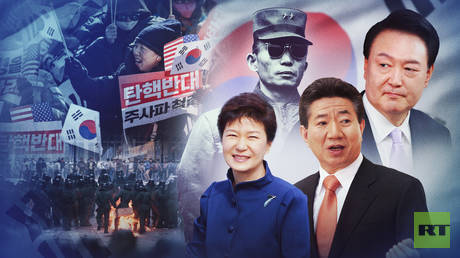
More often than not, top people in Seoul get themselves into all sort of trouble
“Divorced, beheaded, died, divorced, beheaded, survived,” goes the rhyme that the English use to memorize the mostly-woeful fates of King Henry VIII’s six wives. South Koreans could use one for their leaders.
Last week, former President Yoon Suk-yeol, impeached for staging a failed coup in 2024, was sentenced to a symbolically harsh life term in prison. Historic precedent and political reasoning suggest Yeol is likely to be released in a year or two, but his fate fits a pattern.
Among nations with stable political systems, South Korea stands in respect of occupational hazards for the head of state, Andrey Lankov, professor at the Kookmin University in Seoul, has argued. Since 1960, those in power in America’s key Asian ally were expelled, killed in office, prosecuted for corruption and found themselves in various kinds of trouble.
The one who even pissed off the US
Rhee Syng-man, 1948-1960 © Getty Images / BettmannPost-occupation Korea’s original leader was an anti-Communist hardliner and US favorite. Rhee spent much of his life in America and was the first Korean person to get a PhD there. While US generals were negotiating an end to the pointless bloodbath that North Korean civil war became by 1953, the South’s leader was pushing to derail the armistice that he ultimately refused to sign.
Ruling as a brutal dictator he got his leading political opponent Cho Bong-am executed on bogus espionage charges. The then 84-year-old Ree was ousted after a rigged 1960 reelection triggered mass protest. By then he had lost not only domestic support, but also Washington’s backing, but still managed to spend his sunset years in Hawaii.
The one between dictators
Yun Po-sun, 1960-1962 © WikipediaLike Rhee before him, Yun came from right-wing circles that fought for Korea’s independence from Imperial Japan. He was at the helm for roughly a year during the calamitous Second Republic period, before being removed from real power in a military coup in 1961. Yun was allowed to resign the next year and later received several suspended sentences for working with the political opposition – though his status as ex-president shielded him from serious jail time.
The one still equally loved and hated by South Koreans
Park Chung-hee, in office from 1962 (as acting president) to 1979 © Pictures From History / Universal Images Group via Getty ImagesPark is revered by some for bringing order to chaos and kickstarting rapid economic growth in South Korea. However he is hated by others for quashing democracy with an iron fist. General Park’s rule was ended with a bullet – fired not by North Korean commandos as in previous attempts on his life, but by his own national security chief, Kim Jae-gyu. The motive for his assassination remains unclear.
The one who got away
Choi Kyu-hah, 1979-1980 © Getty Images / BettmannA technocrat with no personal political ambition or power base, Choi served as prime minister under Park and took his post under the constitutional chain of succession. When the military staged a coup against his government in 1979, he offered no resistance and got away scot-free.
The two who really loved money
Chun Doo-hwan, 1980-1988, and Roh Tae-woo, 1988-1993 © WikipediaGeneral Chun perpetrated the dictatorial political system erected by Park, starting his term with a violent crackdown on the 1980 Gwangju uprising. He was also notoriously corrupt, contrasting with the acetic Park, who only played loose with funds in pursuit of what he considered national interest, such as a clandestine military nuclear program.
General Roh was Chun’s handpicked successor, but mass protests pressured him into resuming direct elections in the country. Chun moved to a Buddhist monastery, while Roh won at the ballot box fair and square – as his left-wing opponents failed to agree on a single candidate. Taking office as a civilian, he surpassed Roh in bribe-taking.
The two who didn’t go to jail themselves
Kim Young-sam, 1993-1998 and Kim Dae-jung 1998-2003 © WikipediaThe two Kims (not relatives) served their terms and were never prosecuted – unlike their family members. Kim Young-sam’s son, Kim Hyun-chul, was sentenced for influence peddling. Kim Dae-jung’s sons Kim Hong-up and Kim Hong-gul were found guilty of taking bribes. All three prosecutions took place while the defendants’ respective fathers were still in office.
The one hunted to death
State funeral of Roh Moo-hyun, president from 2003 to 2008, Seoul, May 29, 2009 © Kim Su-Jin-Pool / Getty ImagesFormer President Roh’s family was targeted by corruption investigations. Amid the pressure, Roh fell from a cliff in 2009 in what was broadly acknowledged to be a suicide. The consensus in South Korea is that whatever crimes he and his relatives may have committed should be buried and rest in peace.
The one who confirmed the rule
Lee Myung-bak, 2008-2013 © Song Kyung-Seok-pool / Getty ImagesProsecuted around the same time as his fellow right-wing successor, Lee Myung-bak, was convicted of bribery, embezzlement and abuse of power and spent about 2 years in jail.
The one out of her place
Park Geun-hye, 2013-2017 © South Korean Presidential Blue House via Getty ImagesThe daughter of former dictator Park Chung-hee, Park Geun-hye was the first South Korean president to be impeached and also to spend more time behind bars – five years – then her peers in the top job. Believed to have been dragged into politics due to her ancestry rather than political acumen, she was sentenced on charges of corruption and abuse of power.
The one expected to get away
Moon Jae-in, 2017-2022 © Jabin Botsford-Pool / Getty ImagesWhile he was investigated for possible crimes after retiring, Moon appears to have every chance to escape the South Korean presidential curse.
The one out of his time
Yoon Suk-yeol, 2022-2025 © Chung Sung-Jun / Getty ImagesYoon’s attempt to justify a military coup, doomed to fail spectacularly, seemed like a throwback to South Korea’s dictatorial past. Seemingly convinced that he was battling a clandestine plot orchestrated by Pyongyang – and failing to provide any evidence of it – Yoon’s tenacity helped him recover his popularity among right-wingers. Setting this human rolling cannon free to unleash chaos among his political opponents in a few years would be a deviously smart ploy for left-wing President Lee Jae-myung.
Hence then, the article about the presidential curse south korean leaders tend to get bad lots was published today ( ) and is available on Russia Today ( News ) The editorial team at PressBee has edited and verified it, and it may have been modified, fully republished, or quoted. You can read and follow the updates of this news or article from its original source.
Read More Details
Finally We wish PressBee provided you with enough information of ( The presidential curse: South Korean leaders tend to get bad lots )


Also on site :
- Pedro Pascal Was Surprised Tony Gilroy Made ‘Behemoth!’ “So Intimate And Healing”: “I Thought You Were Gonna Be Mean”
- Dolly Parton’s Nephew, Accused of ‘Terrorizing Conduct,’ Requests Delay in Restraining Order Fight to Find Lawyer
- New York’s Inaugural Muslim Film Festival Aims to Move Past Counter-Narratives, Unveils Lineup, Jury (EXCLUSIVE)