
Gulf countries are accelerating their geopolitical and economic diversification across Africa, with renewable energy emerging as a central pillar of this strategy.
This push responds in part to the structural infrastructure and capacity deficits facing North African states, underscored in Egypt in 2024, when declining domestic production and rising demand forced more than USD 1 billion in additional LNG imports and triggered widespread power cuts.
Within this broader regional dynamic, the United Arab Emirates has emerged as a leading, though not exclusive, investor in Egypt’s energy sector.
Egypt at the heart of a broader Gulf investment dynamic
Abu Dhabi has methodically projected its economic power across North Africa, where Egypt stands out as a key partner. In 2024, the country attracted nearly USD 46.6 billion in foreign direct investment, with a significant share originating from Gulf countries. While the United Arab Emirates has played a leading role, it is far from being the only actor shaping Egypt’s energy landscape.
Saudi Arabia has expanded its footprint through ACWA Power, which is developing multi gigawatt wind projects along the Red Sea and in the Gulf of Suez. Qatar has also strengthened its position, notably through QatarEnergy’s acquisition of stakes in offshore gas exploration blocks in the eastern Mediterranean. These investments highlight a shared Gulf interest in Egypt’s strategic location, energy potential, and access to European and African markets.
That said, the UAE’s engagement benefits from a particularly dense political and economic relationship with Cairo. Since 1971, both countries have maintained close diplomatic ties. Emirati support during key political transitions has translated into sustained investment flows, with more than USD 60 billion committed between 2020 and 2025. Bilateral trade surged by 71 percent in 2025, and more than 1,600 Emirati companies now operate in Egypt.
Energy projects reshaping Egypt’s regional role
Energy cooperation lies at the centre of this relationship. In October 2025, K and K Investment partnered with the Egyptian Electricity Transmission Company to advance the Egypt Europe electricity interconnection via Italy. The project aims to export up to 3,000 MW of surplus renewable energy to Europe, positioning Egypt as a critical bridge between African generation capacity and European demand.
Wind energy development illustrates the scale of Gulf involvement in Egypt. Alcazar Energy’s 2,000 MW wind project, reviewed in September 2025 with Egyptian authorities, ranks among the largest in the country. In parallel, Saudi backed developers are advancing comparable capacities along the Red Sea corridor, underlining the strategic importance of this zone for Gulf investors.
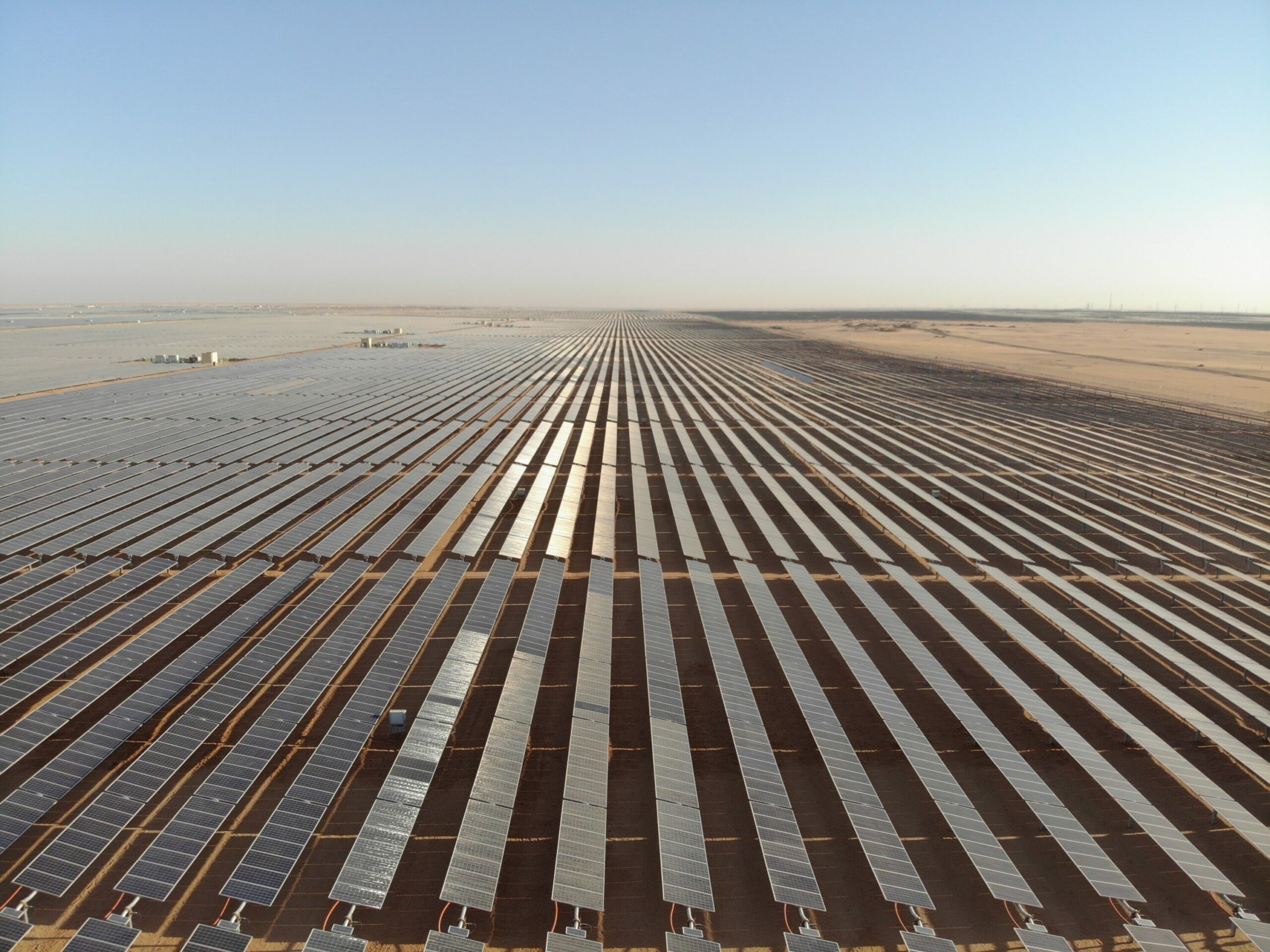
Solar energy is another focal point. Masdar, Abu Dhabi’s renewable energy flagship, is developing two major projects: a 5 GW floating solar plant on Lake Nasser and a 2.8 GW facility in Nagaa Hammadi. Earlier agreements also include a 10 GW onshore wind farm. Together, these initiatives place Egypt among the largest renewable energy markets in the Global South and could reduce its annual carbon emissions by nearly nine percent. Strategically, they also help Egypt attract much-needed Gulf investment to meet rising energy demand and ease fiscal pressures, while advancing its ambition to position itself as a regional energy hub linking Africa, Europe, and Asia.
Emirati companies within a wider Gulf ecosystem
Emirati firms remain among the most active players. Masdar (through Infinity Power), ADQ, AMEA Power, and IRH are deeply involved as Egypt accelerates its energy transition.
AMEA Power already operates a 500 MW solar plant in Aswan and is developing a second 1,000 MW facility combining solar generation with battery storage, set to become Africa’s largest integrated solar and storage project once completed. Masdar, via Infinity Power, continues to expand its footprint in Egypt and remains active in major energy tenders. Beyond strengthening Egypt’s power supply, reducing dependence on gas imports, and improving grid resilience, these investments reflect a broader Gulf strategy that views Egypt as a gateway for energy expansion into Africa and the eastern Mediterranean.
Egypt’s natural advantages, including abundant sunlight, vast land availability, and a well developed power grid, attract investors from across the Gulf. Emirati companies have moved particularly quickly in deploying integrated projects.
The Cairo-Abu Dhabi partnership reflects deliberate strategic choices made by Egypt to anchor its energy transition in long-term regional alliances.
By prioritising Gulf capital and expertise, Cairo aims to consolidate its position as a regional energy hub and a key power broker between Africa, Europe, and the eastern Mediterranean.
For Gulf states, Egypt offers scale, infrastructure, and geographic leverage; for Egypt, they provide financing, technology, and speed, making them well-suited partners in advancing a shared vision of regional energy leadership.
Gulf Energy Investment Surges in Egypt, Led by the UAE first appeared on Egyptian Streets.
Hence then, the article about gulf energy investment surges in egypt led by the uae was published today ( ) and is available on Egyptian Streets ( Egypt ) The editorial team at PressBee has edited and verified it, and it may have been modified, fully republished, or quoted. You can read and follow the updates of this news or article from its original source.
Read More Details
Finally We wish PressBee provided you with enough information of ( Gulf Energy Investment Surges in Egypt, Led by the UAE )


Also on site :
- In 2008, Celine Dion bought a lot on Florida’s Jupiter Island for $7 million; her water park mansion there sold 9 years later for $28 million
- Dwayne Johnson and Oprah Winfrey gave $10 million to launch the People’s Fund of Maui for wildfire survivors
- In 2017, Jack Daniel’s named Nathan “Nearest” Green its first master distiller for teaching the brand’s founder to distill whiskey over a century earlier