
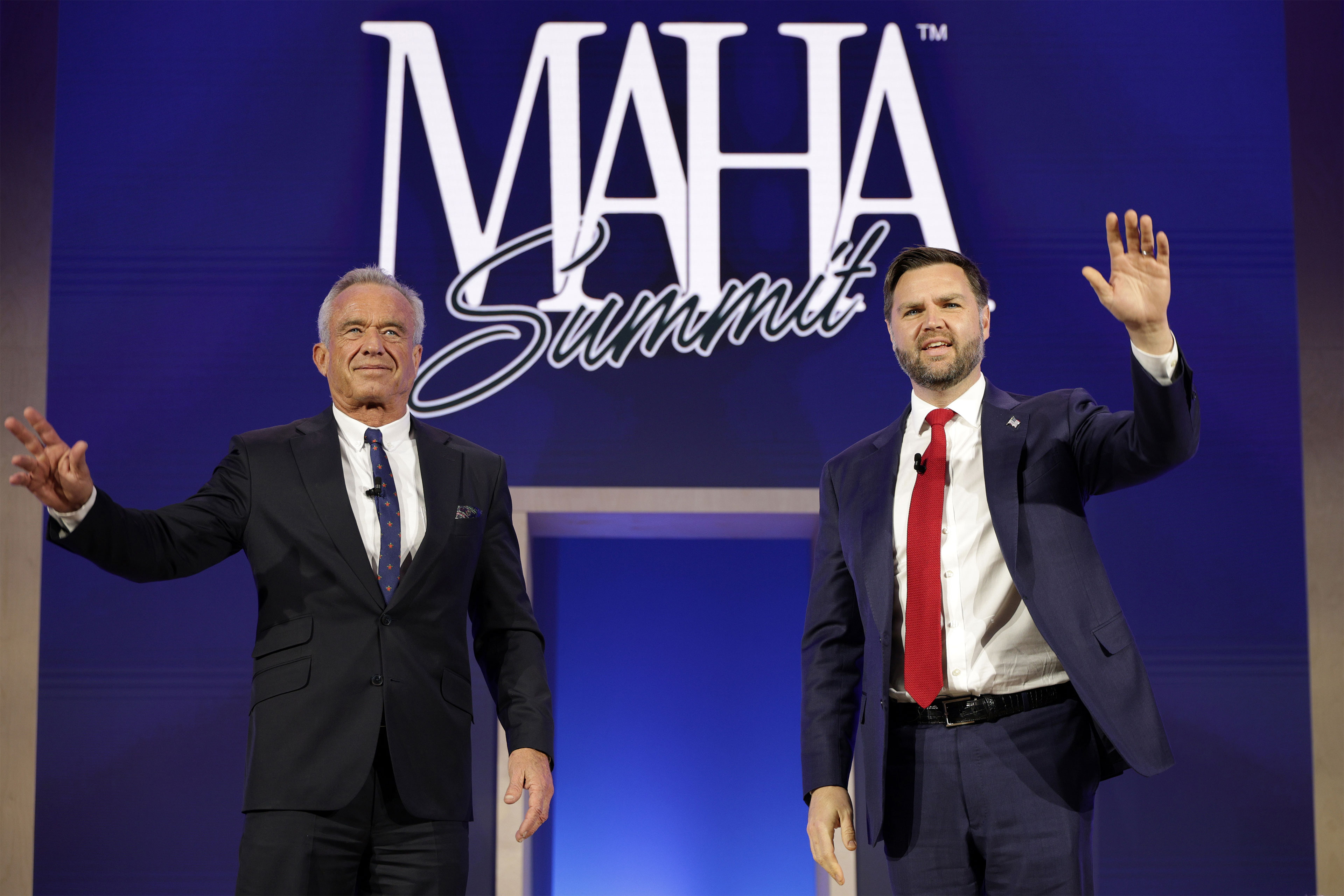
When a “Make America Healthy Again” summit was held at the posh Waldorf Astoria in Washington, the line of attendees stretched down the block.
The daylong, invitation-only event in November featured a who’s who of MAHA luminaries. Vice President JD Vance attended, as did Health and Human Services Secretary Robert F. Kennedy Jr., the leader of the ad hoc movement whose members rail against vaccines, Big Pharma, and ultraprocessed food.
During a fireside chat that organizers broadcasted online, Vance extolled MAHA’s impact on the Trump administration, calling it “a critical part of our success in Washington.”
The summit underscored just how closely Republicans have hitched themselves to the MAHA campaign, banking on its popularity to give them an electoral bounce in the midterms. But the strategy carries risks, because support for Kennedy is cratering and polls show voters care more about reducing health care costs than MAHA priorities such as ending vaccine mandates and promoting raw milk.
“Polls show clearly MAHA issues are not the top issues for people,” said Robert Blendon, a professor emeritus of health policy and political analysis at Harvard University. “The top health care voting issue is cost, and costs are actually rising.”
The disconnect was on display Nov. 12, the day of the MAHA summit, where attendees picked up swag bags and mingled amid the hotel’s blue-velvet couches and crystal chandeliers.
A few blocks away at the White House, President Donald Trump that day signed legislation to reopen the federal government. The 43-day shutdown centered on disagreement over expiring Affordable Care Act subsidies, which Democrats wanted to extend and GOP congressional leadership declined to take up. The government went back to business and, in the midst of a political and legislative push and pull, those subsidies expired at the end of 2025. That has fueled the national affordability debate, as many of the roughly 24 million people who buy coverage on the health law’s marketplaces are now facing premium payments more than double what they faced last year. In January, Congress continues to wrestle with what has emerged as a key kitchen table issue.
Said Blendon: “MAHA is not lowering the cost.”
MAHA was mainstreamed as part of the political platform embraced by Kennedy, an environmental lawyer and anti-vaccine activist who ran for president in 2023 and 2024. When he suspended his campaign and endorsed Trump, Kennedy united MAHA with conservatives, marrying the “health freedom” movement with MAGA.
But the movement took root before then, during the covid pandemic, grounded in the idea that the U.S. is in the throes of a chronic disease epidemic caused by corruption in the food, medical, and pharmaceutical industries, as well as federal agencies. Some adherents also are skeptical of or opposed to vaccines.
“Covid was really eye-opening for people,” said Andrea Nazarenko, a psychologist and MAHA supporter who co-authored a book on food as medicine. “They realized, ‘Wait a minute — the systems I trusted may not be as trustworthy as I thought.’ At its core, people are noticing the systems they relied on are failing them.”
MAHA has since emerged as an influential force for the GOP, gaining significant clout in a short time. Case in point: Early this month, Kennedy announced new dietary guidelines and updated childhood vaccine recommendations, which were both part of the movement’s wish list and departures from existing frameworks.
In addition, members of Congress have founded a MAHA caucus. Lawmakers in Republican-led states are introducing or passing legislation to advance the MAHA agenda, including laws to restrict mRNA vaccines or ban certain additives in food. And food manufacturers including Nestle, General Mills, and Kraft Heinz have pledged to remove artificial dyes or additives.
Republicans see the MAHA constituency as critical in the 2026 midterm elections and beyond. Its supporters include desirable voting demographics — independents and some Democrats, many of whom are women, younger voters, or suburbanites. About 21% of independent voters and 8% of Democratic voters held a favorable or somewhat favorable view of MAHA as of early fall, according to a poll by Change Research.
“I think one reason I won reelection was that I advocated for the covid-vaccine-injured and was an ally of Bobby Kennedy back then when he was being vilified,” Sen. Ron Johnson (R-Wis.) said. “People appreciated that. It’s about basic health.”
Republicans are counting on a MAHA bounce, and political analysts say they may need it. The party took a drubbing in November’s statewide races, and Trump’s approval rating has slumped from 47% in early 2025 to 36% by December, according to Gallup polls. Those are ominous trends for the GOP, since the party with the presidency has lost ground in 20 of the past 22 midterm House elections.
Meanwhile, cracks are starting to threaten the Make America Great Again coalition and the lockstep support Trump has enjoyed from Capitol Hill Republicans. While MAGA shows signs of weakening, MAHA is flourishing.
“Kennedy has ratified the Republican agenda around health and food,” said David Mansdoerfer, who served in HHS leadership during the first Trump administration. “We sound very much like the issues Democrats were into in the 1990s and 2000s. We’ve almost done a 180 and co-opted a topic under a Republican agenda.”
Kennedy is expected to soon check another item off MAHA’s list by pressing states to remove fluoride from the water supply, according to a source who asked to remain anonymous because he isn’t authorized to speak to the media.
But Republicans’ embrace of MAHA in the run-up to the November midterm elections could also cost them, political strategists say.
Polling shows popular support for MAHA initiatives such as ridding food of synthetic dyes, but voters are far less enthusiastic about Kennedy and his denouncements of vaccines and efforts to limit access to them. Almost 60% of adults disapprove of his work as head of HHS, according to polling released in October by KFF, a health information nonprofit that includes KFF Health News.
And only 26% of registered voters support defunding mRNA vaccine research, according to a September survey by left-leaning pollster Navigator Research. In the same poll, 3 in 4 reported feeling positively toward the measles vaccine.
Still, the Trump administration has broadened and accelerated its attack on vaccines. The Food and Drug Administration’s top vaccine official in November said in a memo that the agency would overhaul vaccine regulation, asserting without evidence that at least 10 children had died from covid shots.
In December, a federal vaccine advisory panel handpicked by Kennedy voted to stop recommending routine vaccination of newborns against hepatitis B. Medical groups denounced the panel’s actions, saying the vaccine is safe and that the recommendation would lead to more infections with the virus, which causes serious liver damage.
Democrats see an opening. The Democratic Doctors Caucus, a group of medical doctors in Congress, issued a statement condemning the federal advisory panel’s changed recommendation on the hepatitis B vaccine, calling it an attack on basic science. And Democratic Reps. Frank Pallone of New Jersey, Diana DeGette of Colorado, and Yvette Clarke of New York wrote to the FDA commissioner demanding data from the agency on the covid death claims.
Highlighting the risks of the Trump administration’s anti-vaccine initiatives is only part of Democrats’ game plan to counter Republicans’ alliance with MAHA.
Strategists describe three aims: Expose GOP policies that run counter to MAHA priorities; trumpet Democrats’ efforts to tackle health care costs; and highlight their own party’s work on such MAHA goals as cracking down on pesticide-makers.
“If people want to be healthier, they need affordable health care, and Democrats are the only ones pushing for affordable health care,” said C.J. Warnke, communications director for the House Majority PAC, a fundraising group that works to elect more Democrats.
Most notably, the strategy so far hasn’t really involved attacks on Kennedy or MAHA itself.
“If Democrats focus on attacking Kennedy, saying he’s crazy and he has a brain worm, some voters hear that as reinforcing the notion that Democrats are wedded to Big Pharma and Big Ag,” said Justin Zorn, a senior adviser at the Center for Economic and Policy Research, a progressive nonprofit focused on economic policy.
So Democrats will talk about their continuing fight to address health care costs, such as with a possible retroactive fix to the now-expired ACA subsidies, or a bill by Sen. Cory Booker (D-N.J.) to prevent pesticide manufacturers from getting legal immunity against health claims. And they plan to discuss Trump administration actions that seemingly run counter to the MAHA agenda, such as a decision by the Environmental Protection Agency to relax the health assessments of the carcinogen formaldehyde.
“Everything they’re doing actually makes people sicker with higher bills, dirtier air, and fewer people covered with insurance,” said Jesse Ferguson, a Democratic strategist. “Democrats do need to take MAHA seriously and can’t brush it off. The core is to show Democrats are focused on health and health care and exposing what the Republican agenda means.”
For Republicans, the next batch of MAHA events and summits is already scheduled. After taking a political back seat in recent years, health care may dominate the 2026 election races.
KFF Health News is a national newsroom that produces in-depth journalism about health issues and is one of the core operating programs at KFF—an independent source of health policy research, polling, and journalism. Learn more about KFF.
USE OUR CONTENT
This story can be republished for free (details).
Hence then, the article about gop promotes maha agenda in bid to avert midterm losses dems point to contradictions was published today ( ) and is available on KHN ( Middle East ) The editorial team at PressBee has edited and verified it, and it may have been modified, fully republished, or quoted. You can read and follow the updates of this news or article from its original source.
Read More Details
Finally We wish PressBee provided you with enough information of ( GOP Promotes MAHA Agenda in Bid To Avert Midterm Losses. Dems Point to Contradictions. )


Also on site :
- EU open to reversing Brexit after Burnham speech – but at a price
- Crumbl Drops ‘Country Week’ Menu With New Cookies, but Fans Say 2 Flavors Should Have Been Included
- Romania’s political crisis intensifies as Parliament rejects pro-EU PM