
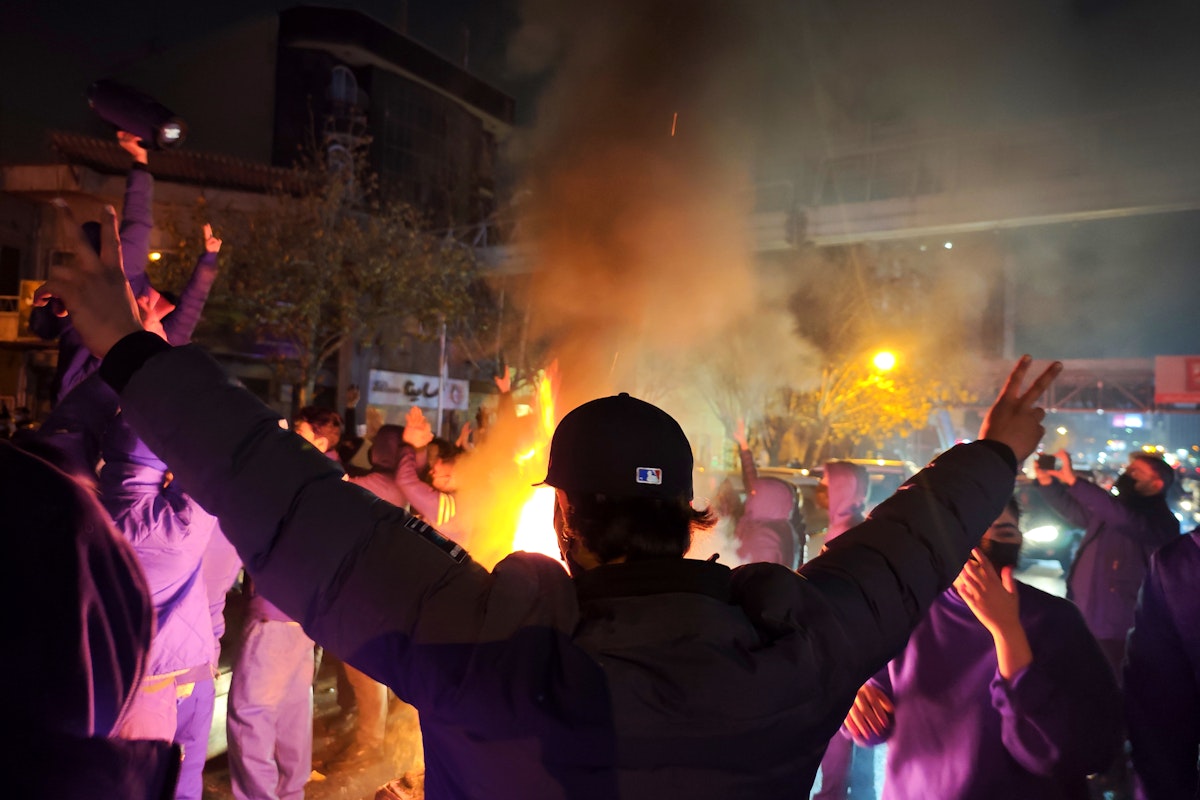
Iran is once again at the center of a familiar and dangerous dynamic: mass protests met with lethal state repression at home, and escalating threats of U.S. military action from abroad. As security forces crack down on demonstrators across major cities, President Donald Trump has openly signaled his readiness to attack Iran, claiming the United States “stands ready to help” as Iran “looks toward FREEDOM.” The political imagination has been narrowed to two grim choices: a state killing its own people, or a foreign military intervention that would worsen the crisis and entangle the United States in another open-ended war.
In a functioning international order—one that took international law seriously and treated civilian protection as more than rhetoric—we would not be trapped in today’s absurd and dangerous choice between a government killing its citizens and U.S. military action that would further endanger civilians and distort any path toward democratic change. This false binary reflects a deeper credibility gap in U.S. foreign policy—a pattern in which the language of human rights and democratic solidarity is invoked selectively, embraced when it aligns with geopolitical aims and quietly abandoned when it becomes inconvenient.
Over the past decade, most starkly in the context of Israel’s war on Gaza, the United States has hollowed out the very institutions meant to offer a universal alternative to this selective enforcement. By sidelining the United Nations, undermining international humanitarian law, and even sanctioning the International Criminal Court for seeking accountability, Washington has helped erode the norms that once constrained both state violence and foreign intervention. The result is a world where civilian protection is treated as conditional, diplomacy as disposable, and military force as the default. This leaves societies like Iran trapped between repression at home and a form of “help” from abroad that has repeatedly proven conditional, fleeting, and ultimately unreliable.
This collapse of guardrails is now acutely visible in Iran, along with the mistrust in diplomatic solutions.
Iran’s current upheaval is the result of years of economic decline, political exclusion, and repeated protest cycles that the state has answered with repression rather than reform. These dynamics follow domestic misrule, exacerbated by a long-running confrontation with the United States marked by draconian sanctions, isolation, and repeated diplomatic breakdowns. The latest wave of protests, sparked by sharp currency depreciation but rooted in deeper grievances, represent not a sudden rupture but a tipping point. The state’s response has followed a familiar authoritarian script: lethal force, mass arrests, internet blackouts, and the insistence that unrest is foreign-orchestrated rather than domestically rooted.
The scale, persistence, and geographic spread of these protests mark a qualitative shift. According to data compiled by the Human Rights Activists News Agency, or HRANA, at least 544 people have been killed in the course of the protests so far, with hundreds of additional deaths still under investigation. More than 10,600 people have been arrested, and demonstrations have been recorded in over 180 cities across all 31 provinces. These figures have emerged despite a near-total internet shutdown since the evening of January 8, which severely hinders independent verification. They point to a sweeping campaign of repression aimed at extinguishing dissent rather than addressing its causes.
Yet the scale of repression cannot restore the previous, already volatile balance between state and society. The protesters’ message to the ruling elite is unmistakable: coercion can no longer compel consent. Iranians breached the fear barrier, and are risking bullets en masse to demand change. The Islamic Republic may succeed in suppressing this round of protests, but without meaningful political and economic transformation, the conditions that produced this upheaval will persist, and the regime will merely limp forward—more brittle, more unstable, and increasingly vulnerable to the next eruption of public anger.
This dynamic is not without precedent. One of us witnessed it firsthand in Egypt in 2011, while working alongside civil society actors during the uprising against Hosni Mubarak. The regime responded with killings, internet shutdowns, and claims of foreign conspiracy, believing repression would restore order. Instead, it accelerated Mubarak’s downfall by alienating a broader spectrum of society and destroying what remained of the regime’s legitimacy. While the Iranian and Egyptian systems are profoundly different, once a regime crosses a certain threshold of violence and denial, coercion alone cannot reconstitute the political order it seeks to preserve.
Egypt also illustrates a second, equally important lesson. Toppling a ruler is not the same as building a stable political order. In Egypt’s case, external intervention and foreign support, particularly by the United States and key regional allies, prioritized military rule over a genuine democratic transition. The military establishment manipulated elites after Hosni Mubarak’s fall, further distorting the transition and contributing to the emergence of a new authoritarian equilibrium. Outside interventions for regime change, witnessed in the region and elsewhere most recently in Venezuela—all point to this same dismal outcome.
That is why calls for U.S. military intervention in Iran are profoundly misguided. Political change cannot be engineered or forced from the outside without warping its outcome. Societies do not reach stability through the triumph of one faction imposed by foreign backers, but through internal rebalancing shaped by their own social forces, pressures, and conflicts.
Rejecting war is not indifference to state violence. It means pursuing accountability through international mechanisms, calibrating sanctions to reduce civilian harm, protecting information flows and internet access, and sustaining diplomacy rather than substituting military force for politics. For Washington to place its weight on the scale militarily would not protect civilians or advance accountability. It would freeze Iran’s crisis in a distorted form, strengthen the most coercive actors, help delegitimize indigenous demands for change, and leave the United States owning the consequences—regional escalation, civilian harm, and prolonged instability—without any credible pathway to a durable or just outcome.
What is already clear is that the Islamic Republic cannot simply repress its way back to the political status quo ante. How this reckoning unfolds remains uncertain and contested, but it will be shaped primarily inside Iran, and not by foreign military force.
In a world where international law has been weakened and civilian protection treated as conditional, Trump offers war as a substitute for politics. U.S. military intervention in Iran would accelerate that erosion, reinforcing the lesson that when institutions fail and diplomacy collapses, military force fills the vacuum. That message is likely to empower the most coercive actors worldwide, exacerbate instability, and further hollow out an international order that once aspired to constrain both domestic repression and war.
Hence then, the article about military intervention will not liberate the iranian people was published today ( ) and is available on The New Republic ( Middle East ) The editorial team at PressBee has edited and verified it, and it may have been modified, fully republished, or quoted. You can read and follow the updates of this news or article from its original source.
Read More Details
Finally We wish PressBee provided you with enough information of ( Military Intervention Will Not Liberate the Iranian People )


Also on site :
- Anthropic Sued for Using Elvis Presley Music to Train AI Models
- Trump: US could strike Iran on Sunday
- Cynthia Erivo Plays Glinda in ‘Nigerian Wicked’ Sketch on ‘SNL U.K.’: ‘She Wants a BBL That Defies Gravity’