
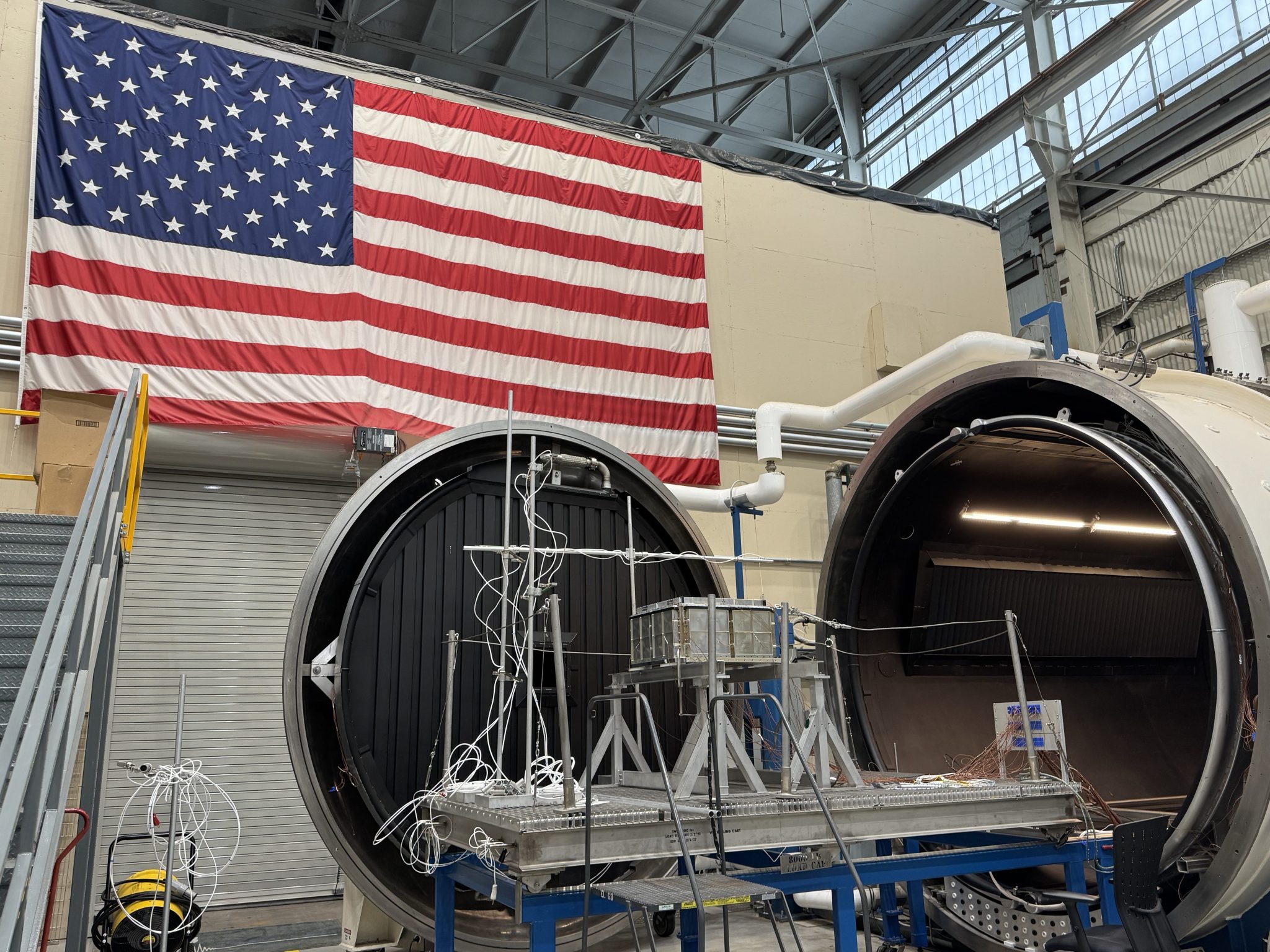
Heated, cooled, shaken, and settled – NASA’s StarBurst instrument is several steps closer to being ready for launch. The small satellite is now awaiting instrument calibration following a successful integration in Canada and rigorous testing by engineers at the agency’s Marshall Space Flight Center in Huntsville, Alabama.
StarBurst is designed to detect the initial emission of short gamma-ray bursts, some of the most powerful explosions in the universe and a key indicator of neutron star mergers. This would provide valuable insight into such events, which are also detected through gravitational waves by observatories on Earth. These events are where most of the heavy metals in the universe, such as gold and platinum, are formed. To date, only one such event has been observed simultaneously in gravitational waves and gamma-rays; StarBurst is expected to find up to 10 per year.
StarBurst arrived at NASA Marshall in March 2025. During its time at the center, the instrument underwent thermal testing in a vacuum chamber and flight vibration testing.
The team held StarBurst’s nonstop thermal testing in a vacuum chamber, 24 hours a day for 18 days. Technicians placed radioactive material into the vacuum chamber, giving StarBurst the ability to detect gamma-ray signals during the tests.
NASA Marshall test engineers fit test the multi-layer insulation blanket in early August at Marshall’s Stray Light Facility. The thermal blanket will insulate the crystal detector units. NASA/Michael AllenTest teams conducted thermal balance testing to simulate the hottest and coldest situations the instrument will operate under in space. Data from these tests improves thermal models used by NASA engineers, while also ensuring the satellite can handle these temperatures in orbit.
NASA engineers also completed a 24-hour “bake-out,” a process that removes unwanted gas or vapor from the instrument using extreme heat in a vacuum.
“NASA’s StarBurst mission is ready for its next stage of assembly and is one step closer to flight,” said Daniel Kocevski, principal investigator at NASA Marshall. “Testing at NASA Marshall has verified engineering models, adding our understanding of how StarBurst will operate in space as it observes gamma ray emission from merging neutron stars to help us better understand the building blocks of Earth—and the universe.”
Outside of the vacuum chamber, a “vibe test” bolted the instrument to a special “shaker table” to simulate the vibrations and turbulence StarBurst will experience during launch.
While at NASA Marshall, StarBurst underwent a series of tests in a vacuum chamberNASAThe Marshall team shipped the StarBurst instrument to Space Flight Laboratory at the University of Toronto, which manufactured the spacecraft bus, in August.
Prior to shipment, teams at Marshall’s Stray Light Facility fit-tested the multi-layer insulation blanket needed to insulate the crystal detector units from the harsh space environment. StarBurst is equipped with 12 of these detectors, which serve as the main gamma-ray detection system on the spacecraft.
Marshall team members traveled to Toronto and were on hand to help integrate the instrument with the spacecraft bus in early September. Testing at Marshall set the stage for planned post-integration testing, which included functional testing and electromagnetic compatibility testing. StarBurst is scheduled to undergo additional calibration, vibration, and thermal vacuum testing in the spring.
Integration teams intend to have StarBurst launch-ready by June 2026. NASA plans to launch the satellite as early as 2027 during the next run of the Laser-Interferometer Gravitational Wave Observatory to maximize the chance of detecting gamma-ray bursts that coincide with gravitational wave events. To date, such a joint gamma-ray and gravitational-wave detection has been observed only once.
StarBurst was successfully integrated with the spacecraft bus Marshall team members were on hand to help integrate the instrument with the spacecraft bus at the Space Flight Laboratory at the University of Toronto in early September. NASAStarBurst is a collaborative effort led by NASA’s Marshall Space Flight Center, with partnerships with the U.S. Naval Research Laboratory, the University of Alabama Huntsville, the Universities Space Research Association, and the University of Toronto Institute for Aerospace Studies Space Flight Laboratory. StarBurst was selected for development as part of the NASA Astrophysics Pioneers program, which supports lower-cost, smaller hardware missions to conduct compelling astrophysics science.
To learn more about StarBurst visit:
science.nasa.gov/mission/starburst/
Share
Details
Last Updated Jan 09, 2026 EditorLee MohonContactCorinne M. [email protected] [email protected] Space Flight CenterRelated Terms
GeneralAstrophysicsGamma RaysGamma-Ray BurstsHence then, the article about shaken not stirred nasa s starburst aces extreme temperature tests was published today ( ) and is available on NASA ( Middle East ) The editorial team at PressBee has edited and verified it, and it may have been modified, fully republished, or quoted. You can read and follow the updates of this news or article from its original source.
Read More Details
Finally We wish PressBee provided you with enough information of ( Shaken, Not Stirred: NASA’s StarBurst Aces Extreme Temperature Tests )


Also on site :
- ‘Harry Potter’ Producer David Barron Backs AI Adaptation Of ‘The Call Of The Wild’
- Truecaller takes its scam intelligence to the open web as it looks beyond caller ID
- Oil prices surge after Trump rejects Iran’s plan to reopen Strait of Hormuz