
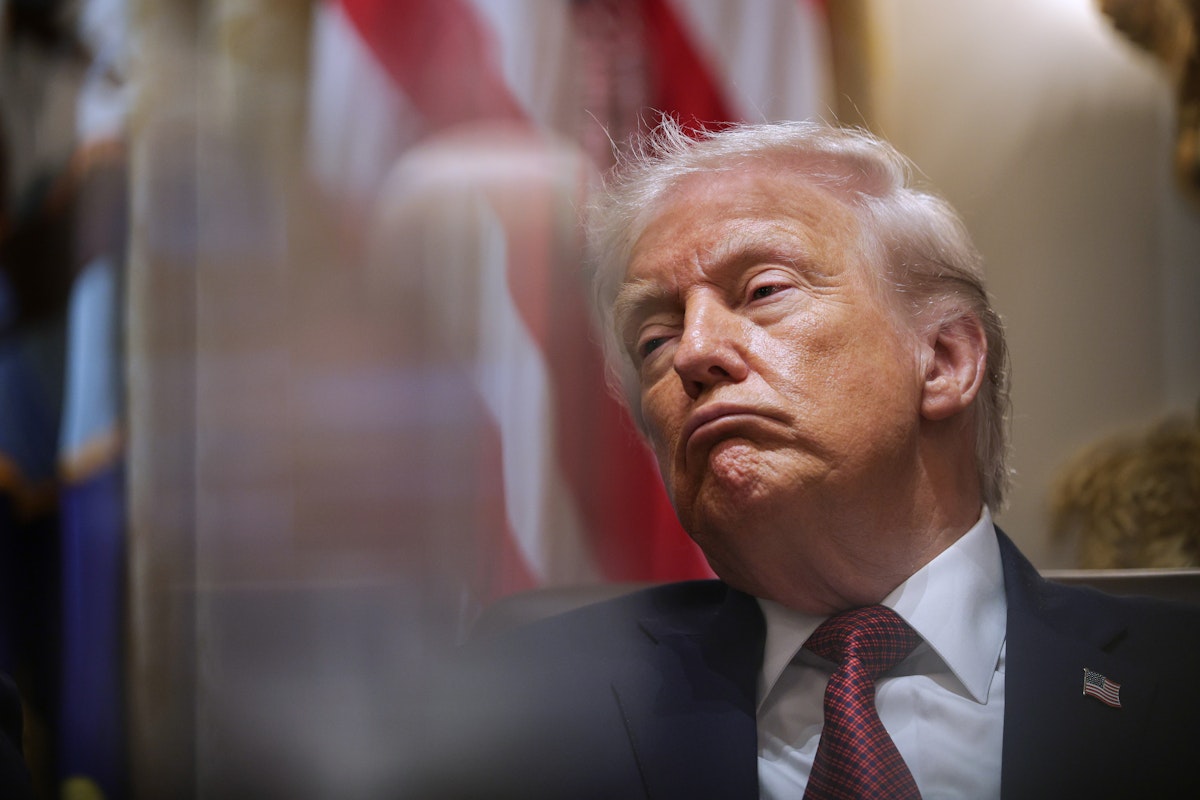
Not long ago, President Trump seemed simply to be following the Joe Biden playbook on the affordability crisis: Deny Americans’ lived experience. Despite poll after poll, and a mountain of bad economic indicators, he’s called the affordability problem a “hoax” and a “con job” by Democrats, even mocking the concept in a speech in Mount Pocono, Pennsylvania, in early December—just days after yet another poll showed that his own voters were fed up and struggling to pay their bills.
Still, Trump has begun to address the issue a bit more—rhetorically, that is. He’s never fully acknowledged that the affordability problem has continued into his administration, nor how his own policies—from tariffs raising prices on myriad goods to the chaotic interruptions in crucial benefits like food stamps—have contributed to Americans’ economic sufferings. But he has been making more claims about what he’s supposedly doing to bring down the cost of living, a tacit nod to the polling.
He says inflation has “stopped.” He says his policies will cut drug prices by “400, 500, even 600 percent.” He says he has brought down the price of food and gas. He says that electricity costs “will fall dramatically.” He says that wages are up and that manufacturing jobs are flooding back to the United States.
Trouble is, none of that is true.
Inflation has not “stopped.” Grocery prices are up even from the Biden era. His claims about drug prices are not only false but, as CNN points out, “mathematically impossible.” Wage growth for workers without college degrees slowed, from January to September, and within the same time frame, workers lost 361,000 jobs. From April—the month Trump announced his “liberation day” tariffs—to September, manufacturing in the U.S. fell by 58,000 jobs. On gas, his claims are exaggerated, as are his claims on egg prices. Electricity has spiked by 9 percent during his administration, and while it’s impossible to predict the future, there’s certainly no reason to believe his claim that he’s just about to bring it down.
But an equally big problem is that Americans’ struggles just don’t interest him. That’s why he can’t stay focused on them. That’s why he rolls his eyes when he says the word “affordability.” It’s also why in every recent speech, when he’s not lying about the affordability problem, he’s changing the subject. Trump raises the issue only to pivot to his preferred topics: tariffs (which he said recently was his “favorite word”), immigration, his personal beefs, himself, Ilhan Omar, Somalians in Minnesota, and so on. In his December 17 speech on the economy, he opened with three sentences on the cost of living, and immediately after saying the word “affordability,” he launched a rant about immigrants, as if to wake himself up. Two days later, in a speech in Rocky Mount, North Carolina, he shifted from affordability to his weird obsession with immigrants coming from insane asylums (presumably he is equating those seeking “asylum” with mental patients, a long-standing Trumpian muddle) without even the pretense of a logical transition, just because he couldn’t wait to get there.
Hardship bores Trump. And why wouldn’t it? He’s a rich guy who likes to hang out at Mar-a-Lago with other rich guys. He doesn’t have any answers to the affordability crisis because he doesn’t care—he really should borrow his wife’s infamous jacket—and because some of the easiest and most obvious solutions to the crisis involve rolling back his own policies, not to mention alienating Republican donors. No wonder he’d rather rant about Somalis in Minnesota—or reminisce about the good old days of his attempted assassination.
Trump’s utter disengagement and mendacity on the affordability crisis create a huge opportunity for Democrats, and some have been running with it. On Thursday, democratic socialist Zohran Mamdani was sworn in as the new mayor of New York City. He campaigned on making New York more affordable through universal childcare, free buses, a rent freeze for rent-stabilized buildings, as well as increasing the supply of housing for poor, working-class, and middle-class New Yorkers. He is backed by a grassroots campaign to tax the rich to make all this possible. On January 20, Mikie Sherill, the Democratic governor-elect of New Jersey, will also be sworn in. She too campaigned on lowering costs while also strongly opposing the construction of new data centers, which will increase energy bills, line tech billionaires’ pockets, and only flood the world with more slop.
In a sense, they will face the same challenge that Trump is facing: how to deliver on their campaign promises to address the affordability crisis. The difference is that they have actual policies they plan to advance in their respective legislative bodies. All Trump ever had was his favorite word, and every respected economist knew back in 2024 that astronomical tariffs were certain to accomplish one thing: higher prices on American consumers. But the president is not one to acknowledge his mistakes, let alone learn from them. So it’s a safe bet that he’s not going to suddenly find any solutions to the affordability crisis, not when he can barely bring himself to say those words.
Hence then, the article about trump is bored to death by the affordability crisis was published today ( ) and is available on The New Republic ( Middle East ) The editorial team at PressBee has edited and verified it, and it may have been modified, fully republished, or quoted. You can read and follow the updates of this news or article from its original source.
Read More Details
Finally We wish PressBee provided you with enough information of ( Trump Is Bored to Death by the Affordability Crisis )


Also on site :
- Dow Jones Futures: S&P 500, Nasdaq Break Key Levels As CoreWeave, Dell Dive; Tesla, SpaceX, Meta Loom
- The Hollywood Reporter, Animation Is Film Festival Partner on Live Animation Roundtable With Bill Hader, Travis Knight, More
- ServiceNow CFO says leaders working 14 hours and getting 4 hours of sleep set a ‘terrible example’ for their employees