
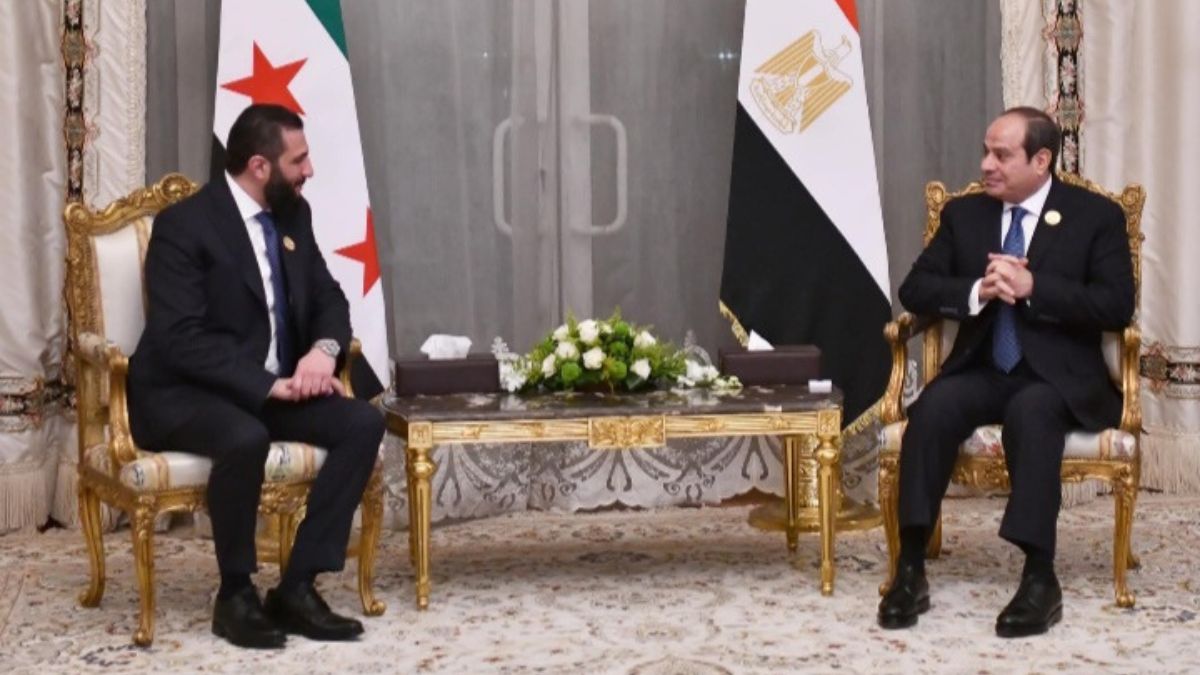
Following the Gaza truce and the “Sharm el-Sheikh Peace Summit,” Egypt has intensified its diplomatic moves to contain the escalating tension between Lebanon and Israel amid renewed Israeli strikes inside Lebanese territory.
Within this context, a series of meetings and visits took shape. Egyptian Prime Minister Mostafa Madbouly met his Lebanese counterpart, Nawaf Salam, in Cairo on November 2, followed by a joint press conference after the tenth session of the Egyptian-Lebanese committee concluded, its first since a six-year hiatus.
At the press conference, Madbouly stressed the need to end the crisis between Lebanon and Israel and for Israeli forces to withdraw from southern Lebanon.
This coincided with a visit by Egypt’s intelligence chief, Hassan Rashad, to Beirut, where he met Lebanese President Joseph Aoun and several senior officials. Discussions covered the situation in southern Lebanon and the possibility of expanding the “Sharm el-Sheikh” agreement to include Lebanon.
According to a statement from the Lebanese presidency, Rashad announced Egypt’s readiness to help stabilize the south and end the ongoing insecurity there.
These developments raise questions about how Egypt’s new initiative on the Lebanese file could affect Cairo’s relations with the government in Damascus. Observers say that if Egyptian mediation between Israel and Lebanon succeeds, which would require coordination with Syria, Egypt’s role will grow in the coming phase.
The contours of the Egyptian initiative
During these meetings, Cairo floated what has become known as the “Egyptian initiative” to resolve the Lebanese-Israeli crisis, with the participation of parties from the United States, Israel, and Lebanon. Motivated by fears of a full-scale Israeli war on Lebanon, the plan seeks a comprehensive settlement to the crisis and the consolidation of a ceasefire, including the withdrawal of Israeli forces from five points in southern Lebanon, according to BBC reporting from Egyptian diplomatic sources.
A key feature of the initiative is “a complete halt to any Israeli attacks or incursions into Lebanese territory by land or air as soon as the agreement takes effect,” coupled with “a full withdrawal of Israeli forces following an official announcement from Beirut that Hezbollah’s weapons have been relinquished and a full redeployment of the Lebanese army in the south.”
Lebanese journalist and political analyst Dr. Ziyad Alloush told Enab Baladi that traditional Egyptian diplomacy never ceased in Lebanon, despite Cairo’s significantly diminished leverage in Beirut.
Questions multiplied around the visit of Egypt’s General Intelligence chief, Lt. Gen. Hassan Rashad, to Lebanon at the head of a large security delegation after his October 21 meeting with Israeli Prime Minister Benjamin Netanyahu, Alloush said, against the backdrop of the cool ties between Cairo and Damascus and their impact on Lebanese-Syrian relations. The Egyptian delegation’s trip coincided with the postponement of Saudi Prince Yazid bin Farhan’s visit to Beirut.
Mediation or warning messages
Publicly, Egypt’s mission looks like moral support for Lebanon, yet in reality it conveys an Israeli warning to Lebanon under U.S. auspices, Alloush argued. Similar warning messages have been relayed by several regional and international actors, including Germany, known for its quiet intelligence mediation in matters involving Lebanon’s Hezbollah and Israel, especially after U.S. envoy to Syria Thomas Barrack described the Lebanese state as “failed.”
He added that Tel Aviv’s patience may run out, pushing it to widen its assault on Lebanon by year’s end unless the Lebanese government disarms Hezbollah in line with UN Security Council Resolution 1701 and the ceasefire terms between Lebanon and Israel that Israel violates daily.
To avert a new Israeli war on Lebanon, Cairo is exploring mediation between Tel Aviv and Beirut similar to what it has pursued between Gaza and Israel. Lebanon, Alloush said, appears to have “handed Egypt the thread” with Lebanese President Joseph Aoun’s declaration that he accepts direct negotiations with Israel as a unifying Lebanese position.
Alloush believes the Lebanese-Syrian file remains thorny despite clear Saudi efforts to steward it. Riyadh carries weight in Beirut, and some results have been achieved, including reduced border tensions, joint committees, and reciprocal visits. Still, a clear breakthrough in Lebanese-Syrian relations has yet to emerge.
He added that Syria’s transitional president, Ahmad al-Sharaa, insists on official state-to-state dealings, while in Beirut there are clashing visions over defense and foreign policy, evident governmental paralysis on sovereign questions in favor of Iranian influence, and a musical-chairs struggle among the three presidencies, each seeking to leverage regional and international cross-currents to buttress its position.
Damascus lacks a Lebanese “partner”
An observer of Lebanese-Syrian relations under Syria’s new leadership would conclude that Damascus has settled its identity and Arab choice alongside Saudi Arabia, distancing itself from the “Shiite crescent” and the “Talmudic David corridor,” and opening up to the West and the United States. Yet, according to analyst Ziad Alloush, Damascus lacks an effective Lebanese partner, “especially among Sunnis,” and has not yet received the regional and international green light concerning its relationship with Lebanon.
Alloush expects greater clarity by year’s end following the Washington meeting between Presidents Donald Trump and Ahmad al-Sharaa and subsequent consolidation through an anticipated meeting between Prince Mohammed bin Salman and President Trump, developments that are not far removed from Turkish and Qatari roles.
He noted that what transpires in Beirut through the end of the year will significantly shape these files amid new local and regional alignments.
If Egyptian mediation in the Lebanon-Israel track succeeds, Egypt will likely gain a larger role and stronger influence over other files, Alloush said. For now, Lebanese-Syrian relations lie under Saudi Arabia’s umbrella, with Riyadh holding the greatest sway in Lebanon and likely to have the decisive say on many issues. Syria’s role could grow if Egypt falters.
Egypt’s regional role and a “cautious approach”
On Egypt’s activity in Lebanon without coordination with Syria, Egyptian writer and political analyst Ezzat Elnemer said Egyptian-Syrian relations suffer from hesitation and oscillation, governed by mutual anxieties. Realities on the ground nonetheless impose a minimum threshold that prevents a complete rupture, while falling short of the normal ties, let alone the special ties, the moment requires.
Elnemer attributed Cairo’s cool and hesitant posture toward relations with Syria to several factors, including that Egypt views the new Syria under Ahmad al-Sharaa, who has an Islamist background, which presents complications for the Sisi government, whose rule rests on hostility to Islamists and casting them as a “bogeyman.”
Despite its reservations toward Syria, or rather toward its new political system and path of change, Egypt will seek serious steps toward Damascus to retain some regional files in its hands and preserve a vital role, he argued. Egypt’s new role in Lebanon will be a real test of the government’s seriousness there.
In his view, the Egyptian intelligence chief’s visit to Beirut is a concerted attempt to position Cairo as the lead player on the Israel-Lebanon track.
Elnemer expects Egypt’s role to be largely confined to transmitting messages, aligning with the Israeli agenda, and showcasing Egypt as a vital actor to the United States and Israel. Cairo may leverage local actors inside Lebanon to exert pressure and notch progress, consistent with a governing mindset that favors concentrating arms and power in official state institutions, namely the army. Still, Egypt’s direct influence is limited because it lacks channels to Hezbollah, while its role in maritime boundary demarcation would remain diplomatic given the file’s complex security and political dimensions.
According to Elnemer, the U.S. “umbrella” is necessarily invested in the disarmament of Hezbollah, an Israeli priority. American support for an Egyptian role will therefore hinge in part on this specific task in Lebanon, or at best on calming between Israel and Lebanon. The United States has no need to apply pressure regarding Egyptian-Syrian relations.
Consequently, Cairo will likely pursue a cautious approach with Damascus, seeking a presence in emerging alliances, maintaining as much of its regional role as possible, and avoiding absence from the evolving equation, the analyst concluded.
Is Egypt seeking a role in Lebanon apart from Syria? Enab Baladi.
Hence then, the article about is egypt seeking a role in lebanon apart from syria was published today ( ) and is available on ُEnabbaladi ( Syria ) The editorial team at PressBee has edited and verified it, and it may have been modified, fully republished, or quoted. You can read and follow the updates of this news or article from its original source.
Read More Details
Finally We wish PressBee provided you with enough information of ( Is Egypt seeking a role in Lebanon apart from Syria? )


Also on site :
- Disney Teams Up With Golden Goose for the Ultimate Theme Park Sneaker Collab
- Sylvester Stallone Calls Himself an ‘Idiot’ After Years Performing His Own Stunts and Countless Surgeries
- ‘Chicago Fire’ Sets Up Trouble for Stellaride as Severide Feels the Heat — And Probies Continue to Cause Problems