
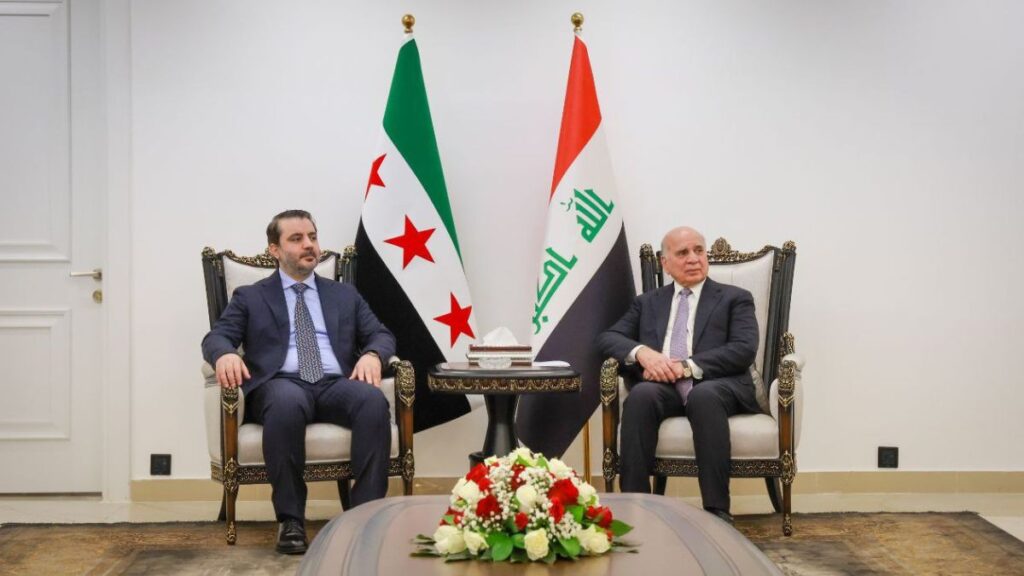
Syria and Iraq are currently discussing the need to bolster security cooperation following the fall of the Assad regime, driven by shared challenges topped by confronting the Islamic State group (ISIS). Despite its territorial losses, the organization still poses a serious threat, particularly in the desert regions stretching between the two countries.
This threat is pushing Baghdad and Damascus to study joint security strategies, especially as the role of the international coalition in Iraq wanes, according to a report by the Washington Institute for Near East Policy published on Friday, November 7.
The report said the meetings that have taken place between the two countries since the fall of the Assad regime reflect a mutual recognition that security cooperation is essential to ensure internal stability.
Iraqi officials stress the need for direct coordination with Damascus and intensified counterterrorism efforts to contain the threat and build trust between the two sides.
Concerns on both sides
Baghdad fears that the security vacuum created by the fall of the Assad regime could be exploited by thousands of the organization’s fighters and their families currently residing in al-Hol camp (al-Hasakah, northeastern Syria), the report said.
It added that Baghdad is keen to cooperate in monitoring vast desert areas that have become a main corridor for drug and weapons smuggling between the two countries. Reports point to large quantities of captagon pills and light weapons being smuggled between Deir ez Zor (eastern Syria) and Iraq’s al-Anbar province, according to the report.
Damascus, for its part, is cautious, fearing that any security agreement with Baghdad could renew the influence of Iraqi “militias” inside Syria through support for Syrian “Shia” groups along the coast. Since 2013, Iraqi factions, most prominently Kataib Hezbollah and Harakat al-Nujaba, have fought alongside the Syrian government under the pretext of protecting religious shrines.
In coordination with the Islamic Revolutionary Guard Corps’ Quds Force, these factions contributed to expanding Iranian influence in areas such as Deir ez Zor (eastern Syria), al-Bukamal (Deir ez Zor, eastern Syria), and al-Qusayr (Homs, central-western Syria near the Lebanese border), as part of securing the “Shia Crescent,” a land corridor running from Tehran to Beirut via Baghdad and Damascus, the report explained.
A window opened by a coalition withdrawal
The report argues that the imminent withdrawal of international coalition forces from Iraq, including American forces, marks a significant turning point. As a result, cooperation with Damascus is no longer a mere diplomatic or political option, but a security necessity to pre-empt “terrorist attacks.”
The coalition’s departure offers Iraq an opportunity to recalibrate its regional alignments. In the absence of direct Western presence, outreach to Syria’s new leadership could give Baghdad a way out of its current geopolitical isolation, especially if it manages to balance competing power blocs in the region.
Some Iraqi political factions view the coalition’s exit as a chance to rebuild a regional security framework between Baghdad and Damascus, free from external dictates. However appealing, this vision faces major obstacles, notably deep-rooted mistrust between the countries’ security institutions, differing priorities, and clashing regional alliances.
Regional influence network: Turkey, the Gulf, and Iran
The report shows that Iraqi-Syrian rapprochement cannot be read in isolation from the regional scene, especially Turkey, Gulf states, and Iran. Turkey is watching any coordination between Baghdad and Damascus with caution, seeing the resumption of ties as an opportunity for Iran to restore its sway in Syria. Ankara also fears that reviving the Kirkuk–Baniyas pipeline could threaten the Kirkuk–Ceyhan line, a strategic pillar of Iraq–Turkey economic relations. Baniyas (Tartus, coastal Syria).
Meanwhile, Gulf states have stepped in. Qatar, Saudi Arabia, and the UAE are trying to push Syria toward an Arab track independent of Tehran. Doha has floated economic initiatives to supply Syria with energy and reduce its dependence on Iraqi oil, while Riyadh and Abu Dhabi are working to reintegrate Damascus into the Arab fold on terms that curb Iranian influence.
Iran, which lost a substantial part of its influence in Syria after the fall of the Assad regime, has begun repositioning itself through a trilateral coordination mechanism with Tehran, Baghdad, and Damascus under the banner of “counterterrorism.” According to Iraqi sources, Tehran is leveraging its political influence in Baghdad to secure a central role in any forthcoming security arrangements with Damascus.
A domestic split in Baghdad
Regional struggles are directly reflected in Iraq’s political landscape. While some Iraqi politicians call for normalizing relations with the new Damascus leadership based on security interests, others flatly reject any engagement with a “regime that emerged from the ruins of a strategic ally of Iran,” the report noted.
This split came into sharp focus when former Prime Minister Nouri al-Maliki refused to invite Syria’s transitional president, Ahmad al-Sharaa, to the Arab League summit in Baghdad, claiming that al-Sharaa is “involved in supporting terrorism,” a claim other Iraqi officials denied, affirming there are no arrest warrants or judicial rulings against him.
Iraqi Prime Minister Mohammed Shia al-Sudani, for his part, emphasized the importance of Syria’s participation in the summit “to present a vision for the new Syria,” considering that moving past the Syrian crisis serves regional and Arab security.
Likely scenarios
According to the report, several scenarios could shape future Iraqi-Syrian relations:
• The first scenario depends on Baghdad’s ability to overcome regional pressures and internal divisions. If successful, this could pave the way to expand the partnership between Baghdad and Damascus, including joint border coordination centers, security campaigns against the organization, rehabilitation of the Kirkuk–Baniyas pipeline, and other economic projects. This would require a strong, politically cohesive Iraqi umbrella able to balance international relations. • Given regional complexities, the second and more likely short-term scenario is continued limited security cooperation, including intelligence sharing and covert field operations that fall short of formal partnership or full normalization. If relations sour, both sides could relapse into the border crises that characterized the pre-2014 period, with attendant security turmoil and economic risks.
Caveats in the Syria–Iraq relationship
In the post-Assad phase, the Syria–Iraq relationship is a complex overlap of a legacy of grievances and security anxieties on one side, and opportunities for economic cooperation alongside geopolitical challenges on the other.
Syria, after the downfall of the deposed Assad regime, is concerned about Iraq’s growing ties with Iran, which it sees as a threat to its new governance.
Iraq’s cautious stance toward Syria is shaped by external geopolitical pressures. Baghdad must balance relations with Iran, maintain positive ties with the United States, and avoid becoming a battleground for proxy conflicts among regional powers such as Iran, the United States, and Israel.
This dynamic has led both neighbors to proceed cautiously in restoring political relations, moving slowly toward limited security and economic understandings, according to a study by the Harmoon Center for Studies.
Syria and Iraq are building a “security framework” after Assad Enab Baladi.
Hence then, the article about syria and iraq are building a security framework after assad was published today ( ) and is available on ُEnabbaladi ( Syria ) The editorial team at PressBee has edited and verified it, and it may have been modified, fully republished, or quoted. You can read and follow the updates of this news or article from its original source.
Read More Details
Finally We wish PressBee provided you with enough information of ( Syria and Iraq are building a “security framework” after Assad )


Also on site :
- In 1930, 3 Entrepreneurs Started a Toy Company During the Great Depression; Today, It’s a Household Name
- Karen Hale’s mother has lived with breast cancer for nearly 30 years; now the Hales have given $50 million — the largest single gift ever to breast cancer research
- Steve Madden Started His Shoe Business in 1990 With Just $1,100; 30 Years Later, His Brand Was Selling More Than $1 Billion in Merchandise Annually