
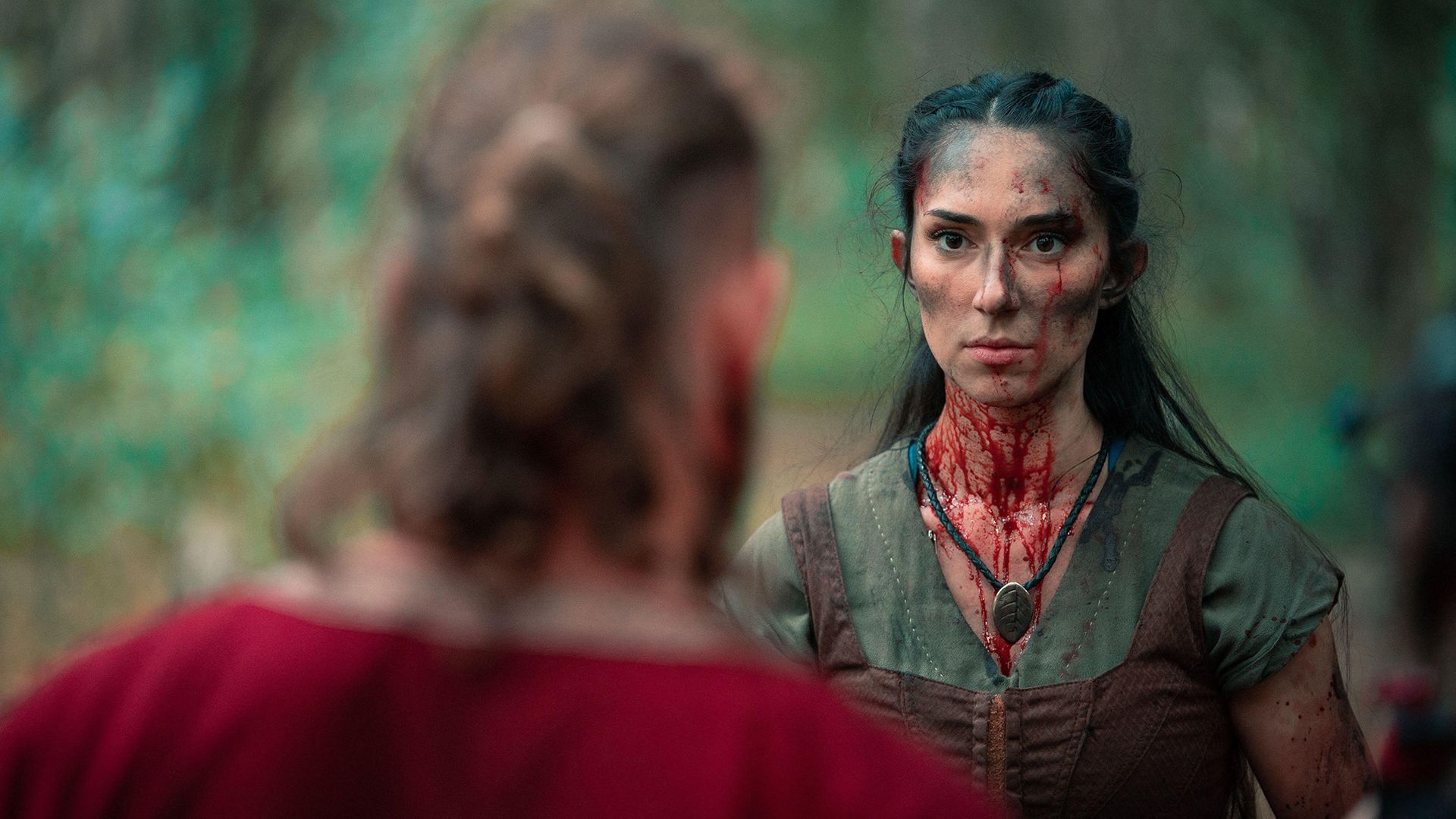
The Vikings were explorers, farmers, merchants and, most famously, warriors who launched raids across large parts of Europe.
Stereotypes of Vikings usually conjure up images of muscular men. But over the past few decades, researchers have turned their attention to women of the Viking Age (roughly A.D. 793 to 1066) and the roles they held. For instance, there are stories of "shield maidens" who fought alongside men, and some of these texts mention Viking women who fought in battle. The archaeological record also holds evidence, including graves of Viking Age women who were buried with war-grade weapons and shields.
It's still a matter of debate whether women who lived during the Viking Age could be warriors, but this discussion raises another question: It's one thing to have texts describing female fighters and archaeological records of women buried with weapons, but what can the evidence tell us about how frequently Viking women fought in battle?
The answer, experts told Live Science, largely depends on our interpretation of texts, artifacts, and burials of Viking Age women, which often face higher scrutiny than burials of men who were buried with similar (or even fewer) weapons.
The Vikings used a runic system of writing, but they left precious few texts behind. Instead, much of what we know about the Vikings was written about them by people from other cultures or by their Norse descendants.
One of the most evocative texts was written in the 12th century by the Danish historian and theologian Saxo Grammaticus. In "Gesta Danorum" (Latin for "History of the Danes" and translated by Jenny Jochens), he wrote that "there were once women in Denmark who dressed themselves to look like men and spent almost every minute cultivating [combat] skills." As "if they were forgetful of their true selves they put toughness before allure, aimed at conflicts instead of kisses, tasted blood, not lips, sought the clash of arms rather than the arm's embrace, fitted to weapons hands what should have been weaving, desired not the couch but the kill, and those they could have appeased with looks they attacked with lances."
Another text about the Vikings, the medieval Irish "Cogadh Gaedhelre Gallaibh" ("War of the Irish with the Foreigners"), refers to a woman known as the "Red Lady" leading a Viking fleet in a raid on Belfast in the 10th century.
There's a lot of uncertainty, said Neil Price, an archaeology professor at Uppsala University in Sweden who has written extensively about the Vikings. The text in the "Cogadh Gaedhel re Gallaibh" that refers to the Red Lady is of debatable accuracy, Price told Live Science in an email.
He suspects that Viking women fought in battle but not frequently. In addition, "female warriors were probably a very small minority," Price said.
A modern-day reenactment depicting Viking warriors. (Image credit: Yuriy Seleznev via Alamy)The account written by Saxo Grammaticus is also contentious. Thomas Kristian Heebøll-Holm, a history professor at the University of Southern Denmark, said Saxo Grammaticus is not a reliable source.
"Saxo Grammaticus does write about female warriors, but only in the parts of his work concerned [with] the legendary past of Denmark," Heebøll-Holm told Live Science in an email. "Furthermore, these writings are not accurate, but moral and fictitious," Heebøll-Holm said, noting that, in some instances, Saxo Grammaticus seemed to be drawing on the stories of the Amazons, a group of legendary female warriors whom the ancient Greeks believed in with stories about them dating back more than 2,500 years.
Turning to archaeology
Archaeological evidence can also be challenging to interpret. Archaeologists know of about 30 Viking Age female burials containing weapons, including three with swords in Scandinavia. Even more Viking Age women's graves have items that could have been used as weapons — including spears, axes and knives — although these tools also could have been used for hunting or tending to farms. Either way, we can't be sure if these women fought in battle.
"The first concern is that the weapons were really used by the deceased and were not merely included as signs of special status or social rank acquired through inheritance," Deborah Shepherd, an independent researcher who holds a doctorate in archaeology and has studied the Vikings extensively, told Live Science in an email. She noted that graves are often not well preserved, making it difficult to gather information.
This 1889 illustration shows a grave at Birka in Sweden. It is now known that the person buried with war-grade weapons and riding gear is a woman. (Image credit: Evald Hansen/American Journal of Physical Anthropology)There were likely "some few female warriors, but they were probably only found in the highest ranking families, and their warrior career was probably short-lived," Shepherd said. "They wouldn't have fought in the great armies of later centuries but possibly did fight in pre-Christian skirmishes." (The Vikings began gradually converting to Christianity between the ninth and 12th centuries.)
There is at least one known case of a Viking woman found with what may be combat-related injuries. A Viking woman found in Solør, Norway, had a head injury consistent with a sword strike. She was 18 or 19 at the time she died, was buried with weapons and lived around 900.
Ole Kastholm, a curator and senior researcher at the Roskilde Museum in Denmark, said there is a lot of uncertainty regarding how frequently Viking Age women fought in battle.
Weapons "do occur as a grave good in a handful of graves with female human remains," Kastholm told Live Science in an email. "Often it is just a single weapon [such] as a spear or [a] battle axe. But we know of at least one example of a female grave with a full set of weapons as well as riding equipment," which is located in Birka, Sweden.
Related mysteriesDid the Vikings really shoot fiery arrows at funeral boats?Did the Vikings reach Maine?Did Celtic women fight in battle?
"If this was a man's grave, researchers would have no doubt that it was a warrior grave, and this explanation must necessarily also apply when the interred is a woman," Kastholm said.
That said, there were female warriors in other cultures. "One can also note in passing that female warriors were an almost common feature of central Asian societies for at least a millennium before the Viking Age," Price wrote in his book, "The Sea-King and the Sorceress: Life and Death in the Viking Age" (Basic Books, 2026).
For instance the Scythians are a people who flourished in eastern Europe and Asia and Scythian women have been found buried with horses and weapons. In some cases, the Scythian women suffered combat wounds such as arrowheads and it's been speculated that they may have been an inspiration for stories of the Amazons.
See how much you know about ancient norsemen with our Viking quiz!
Hence then, the article about how frequently did viking women fight in battle was published today ( ) and is available on Live Science ( Middle East ) The editorial team at PressBee has edited and verified it, and it may have been modified, fully republished, or quoted. You can read and follow the updates of this news or article from its original source.
Read More Details
Finally We wish PressBee provided you with enough information of ( How frequently did Viking women fight in battle? )


Also on site :
- Highly Anticipated Sarah J. Maas Novel Is the Most Read Book of the Week According to Goodreads
- In 1980, John Hughes Wrote a Short Story Called “Christmas ’59” for National Lampoon Magazine; Nine Years Later it Became ‘National Lampoon’s Christmas Vacation’
- Angelina Jolie’s Daughter Vivienne, 18, Breaks Her Silence on Eating Disorder Battle and Hospitalization