
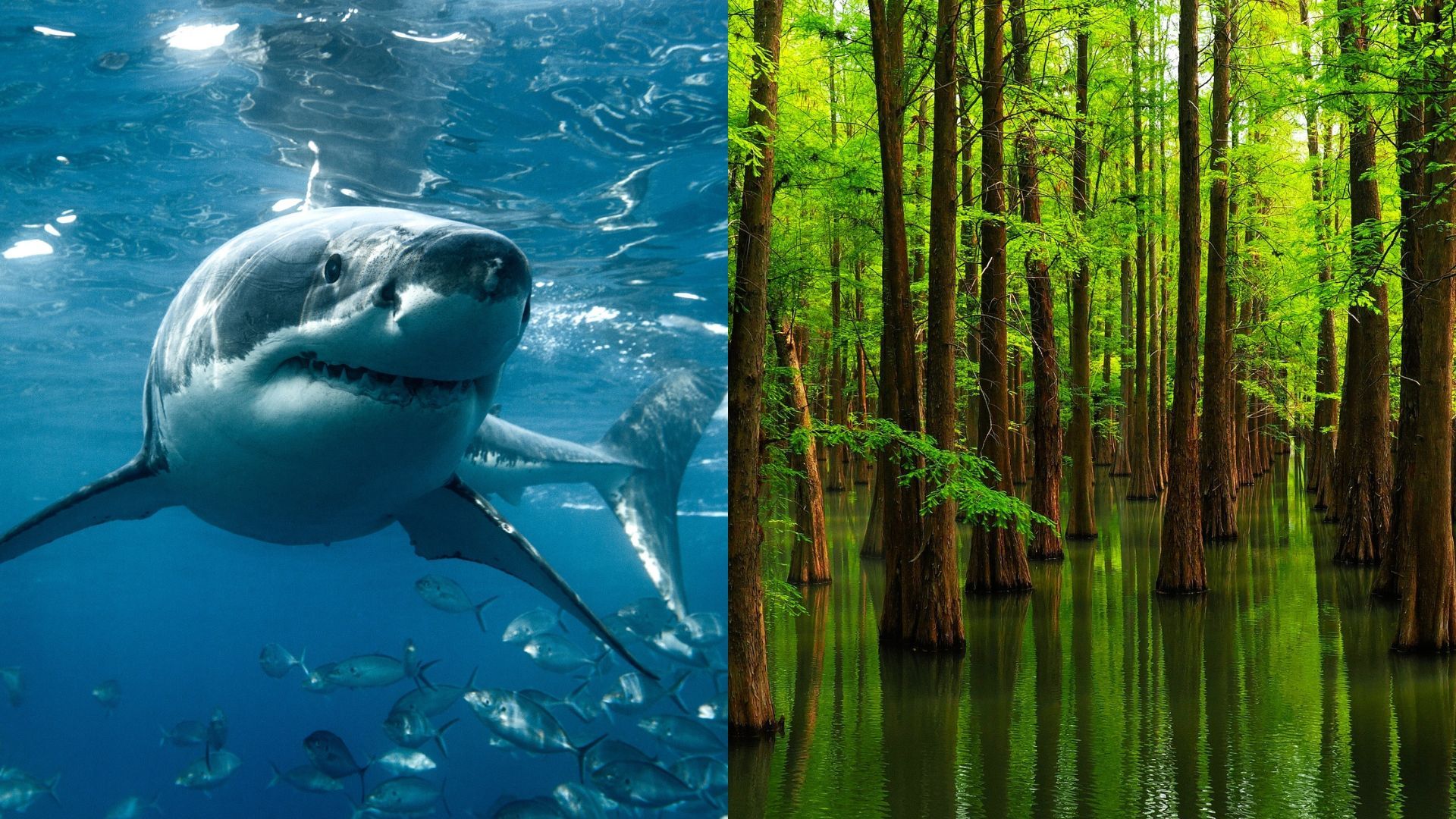
You may have heard that sharks are older than trees. And yes, sharks are truly ancient, with an evolutionary lineage dating back hundreds of millions of years.
But are they really older than trees? Experts told Live Science that the answer depends on what we classify as a shark.
"It's all in the fine print," John Maisey, the curator-in-charge emeritus of fossil fish at the American Museum of Natural History in New York, told Live Science. "The takeaway is that the shark lineage within the fishes generally does go back further than trees. But it really depends on how you define what we mean by shark."
The modern sharks we see today first emerged around 195 million years ago, during the Jurassic period. Fossils of ancient sharks from this time can be traced to living lineages, namely Hexanchiformes, an order of sharks identified by their six or seven gills and single dorsal fin.
This means that modern sharks, at least, are not older than trees. Experts generally agree that trees first evolved in the Middle Devonian epoch, around 380 million to 390 million years ago. "I think it's not very controversial, when we had the first trees," Cindy Looy, a paleobotanist at the University of California, Berkeley, told Live Science.
For instance, the first true tree in the evolutionary record is considered to be Archaeopteris, an extinct genus discovered in a 385 million-year-old fossil forest near Cairo, New York. Looking at these fossils, Archaeopteris has many characteristics of trees we have today, including a tall, woody trunk; leaves; and a deep root system. Other early trees — such as Eospermatopteris found in ancient forests near Gilboa, New York, and Calamophyton in southwest England — also appeared in the fossil record 390 million and 393 million years ago, respectively.
But when we look at the extinct relatives of modern sharks, "that's where it gets a bit wobbly," Maisey said. There are fossils from the sister groups of modern sharks that can be traced back through the Permian period and into the Devonian period (around 359 million to 420 million years ago). The most abundant group are hybodonts, an extinct group of spiny fish that have a unique calcification pattern in their cartilage that is similar to that of modern sharks.
A microscopic image of skin cells from the dogfish shark. (Image credit: Mohammed Al Ali via Getty Images)"It’s called tessellated calcified cartilage, and that's a very important hallmark of most of the shark-like fishes and their ancestors," said Maisey, who has studied a spiny fish fossil called Doliodus problematicus from the early Devonian. If this definition is used, these sharks first appeared around 400 million years ago, before trees emerged.
Sharks' rough skin can be traced even further back, with the dermal denticles — the tooth-like scales that roughen a shark's skin — first appearing in the fossil record around 450 million years ago.
These transition fossils, where fish were evolving into sharks and gaining shark-like traits, introduce a gray area in the definition of sharks. "When you get back into the ancient past, when you're not dealing with things that we have living examples to compare with anymore, then it becomes a bit more tricky [to figure out what they are]," Maisey said.
Related mysteriesSharks are older than the dinosaurs. What's the secret to their success?What is the oldest shark?Do trees exist (scientifically speaking)?
Fossils also present a very limited picture. Many contain only fragments of an animal, like a fallen tooth, so scientists are still piecing together the clues of exactly how and when sharks arose. That means every fish fossil discovery often leads to more questions about what other transition fossils could be out there, Maisey said.
There is also much to be discovered about trees, Looy added. Terrestrial fossils, especially ones that clearly show parts of a tree, are quite rare. Finding a fossil forest requires a lot of luck, she said, although there is little indication that trees were present before the Middle Devonian.
"That's why I think the fossil record is so intriguing," Maisey said. "Because it may not give us all the answers, but it certainly raises questions."
How much of a shark fan are you? Find out with our shark quiz!
Hence then, the article about are sharks really older than trees was published today ( ) and is available on Live Science ( Middle East ) The editorial team at PressBee has edited and verified it, and it may have been modified, fully republished, or quoted. You can read and follow the updates of this news or article from its original source.
Read More Details
Finally We wish PressBee provided you with enough information of ( Are sharks really older than trees? )


Also on site :
- Ollie, a privacy-focused AI assistant, is shutting down
- ‘Obsession’ Director Curry Barker Pitched Nathan Fielder a Collaboration After Watching ‘You Can See Everything’: ‘I Put It Out in the Water’
- Nvidia weighs playing the cosigner for Nscale’s AI data center in West Virginia