
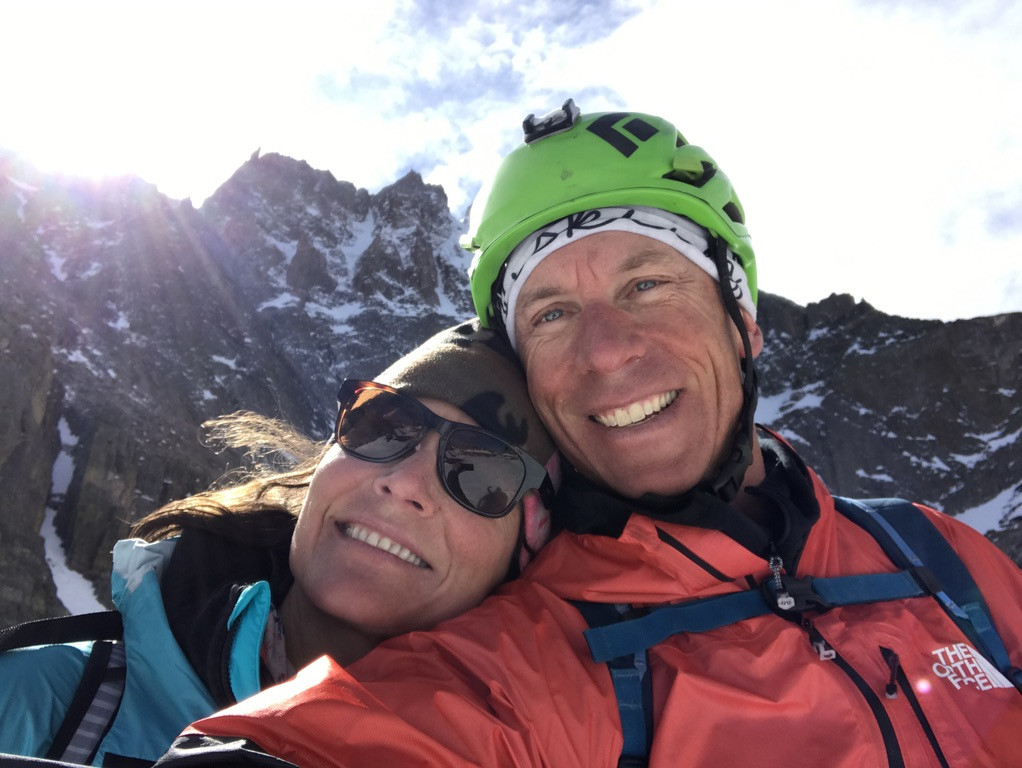
Mount Everest is the largest mountain in the world. It’s estimated that more than 7,500 people have stood on its peak, reaching an astonishing 29,031 feet above sea level in Nepal, typically climbing up the mountain’s south side. But Elizabeth Chai Vasarhelyi and Jimmy Chin’s documentary Everest: The Other Side shifts focus to the mountain’s north face. It is here that two people, ski mountaineers Jim Morrison and Hilaree Nelson, attempted to do something that no human being had done before.
Morrison and Nelson met in 2015 on an expedition to Makalu, the world’s fifth-highest mountain, in the Mahalangur Himalayas. The pair developed a friendship before beginning a romantic relationship in 2017, bonding over their shared sense of adventure. “There’s a connection I don’t feel anywhere else…I love how it makes me feel alive,” Nelson says about ski mountaineering in the new film, which hit theaters on Oct. 30 following its premiere at the Venice Film Festival. Together, Morrison and Nelson conceived a plan: They would climb to the top of Everest’s north face, and once they’d reached the summit, become the first to ski down it. It was the ultimate proposal for a pair of adventurous thrill-seekers, but one wrong move could result in disaster. They never got the chance to take the risk together, though: Disaster struck before they embarked on the journey, a tragedy the directors capture in devastating detail in the new film.
Vasarhelyi and Chin are drawn to stories of people who accomplish extraordinary things, and they set out to capture them in a manner that fully captures their feats, like in Free Solo, Meru, and The Rescue. Everest: The Other Side is playing in both regular format and IMAX cinemas, the latter of which takes particular advantage of the breathtaking shots the filmmakers were able to capture, offering a sense of how epic Everest is, and how dangerous.
Though most people don’t participate in extreme sports, Vasarhelyi believes there’s something inherently relatable about these feats. “I think it’s fundamental to the human paradox, which is this ability to dream audaciously, and then the mentality, psychology, mania—whatever you want to call it—to actually have the grit, determination, and diligence to get it done. I think everyone can identify with that,” she tells TIME.
Hilaree Nelson, a National Geographic Explorer and the 2018 National Geographic Adventurer of the Year —Cavan Images / Alamy Stock Photo
Vasarhelyi and Chin intended for Everest: The Other Side to capture Morrison and Nelson’s historic feat. But on Sept. 26, 2022, tragedy struck. Nelson and Morrison were climbing nearby Mount Manaslu in Nepal when an avalanche swept down the slope, killing Nelson. It was a devastating moment captured on camera, one that had both the filmmakers and Morrison questioning whether they should continue with their journey, and the film, at all.“We always knew we were making a film about Jim and Hilaree and their attempt to ski and climb the direct north face, but these films for us always had to have something deeper. The part that stayed true throughout was this extraordinary love story,” says Chin.
Morrison had experienced tragic loss before. In 2011, he lost his wife Katie and their two children in a plane crash. “I knew about Jim’s history and the loss that he’d been through, and how he had moved through that loss and found the strength and courage to fall in love again with Hilaree. That was extremely moving to me,” says Chin. “When we lost Hilaree, we saw that again in real time. We were living it with him.”
Together, they decided that Chin, a longtime friend of the couple and an experienced climber, would step in as Morrison’s climbing partner, replacing Nelson.
“Jimmy and I fundamentally see this differently," says Vasarhelyi of whether they would continue making the film. “It was such a tragedy when Hilaree passed, and real life has to be lived in that moment. With the decision of Jimmy stepping in as Jim’s only climbing partner, my professional interest came into direct conflict with my personal responsibilities.” At the time of filming, Vasarhelyi and Chin were married with two children. The couple divorced in 2025.
“The question was, ‘Do you want to make that film?’ It was going to be heavier. It had to be very candid, which all our films are, but this was requiring us to go one step further in this investigation. There was also the reality of, how do you wrangle the story that was conceived one way into something that could both honor her legacy as well as honor this incredible journey that Jim would go on?” says Vasarhelyi.
Ultimately, it was Morrison who made the decision to continue filming. “In the beginning, I didn’t want to keep going to the mountains. I was devastated by the loss of Hilaree,” he says. Initially, it looked like the quest to ski mountaineer the north face of Everest was over, and there was a seven-month break in filming. “Over time,” Morrison explains, “the inner fire and the passion for this project Hilaree and I shared together became a driving force in my life. I began to call [Chai and Jimmy] to say, ‘I’m going to go back into the mountains. I’m going to go on another expedition and push myself to complete this goal for us and for her legacy and her story.”
With Chin as his climbing partner and Vasarhelyi and Chin continuing to document the adventure, Everest: The Other Side would go on. Instead of a story of a couple facing this incredible physical feat together, it became a story of processing grief and overcoming tragedy.
The two expeditions
World-renowned ski mountaineer Jim Morrison, left, and filmmaker and climber Jimmy Chin —Savannah CumminsThe expedition on Everest’s north face occurred in 2024. Chin explains why the north side of Everest, the more challenging route up the mountain and an extremely steep, 9,000-ft. face, holds such appeal. “In terms of pure technical difficulty, it’s really challenging. Because of those challenges and because it’s a direct line, it’s really appealing to climbers.” He continues: “When you’ve spent a lifetime in the mountains, you build experience to take on more and more difficult climbs, and as a ski mountaineer, more challenging ski descents. This is the ultimate line on the tallest mountain on Earth that literally splits the biggest face on Everest.”
The 2024 expedition involved dozens of people, including climbers, camp managers, cooks, and cinematographers. The set-up involved three different camps. The climb would start at 20,000 ft. and go up 9,000 ft. to the top of the mountain. An advanced basecamp would be established at 18,100 ft., as well as three additional camps, with one right below the entrance of the Hornbein Couloir, the most challenging and steepest part of the climb.
To accomplish such a challenging climb, the climbers would do rotations, going up the mountain and back down, in an effort to build up red blood cells and acclimatize themselves to the changes in altitude as well as to bring equipment up the mountain. The process involves pushing the body to its limits, over and over again, before returning to base camp and going again. “It’s hard to sleep at 18,000 ft., so it becomes this game of acclimatizing and getting all your equipment, the rope and all the oxygen cylinders and the sherpa up the mountain,” says Morrison.
Jim Morrison, Jimmy Chin, Mark Fisher, and Erich Roepke depart from Camp One, officially beginning their summit push —Savannah CumminsUnfortunately, one of the climbers on the expedition, Yukta Gurung, broke his leg on the journey up Everest. With that injury and the uneasy weather conditions, the decision was made to call the expedition off. “It felt like we were walking away, and we weren’t coming back,” recalls Morrisson. Chin didn’t see it that way. “Walking through the airport terminal with Jimmy, he was like, ‘Of course you’re going to go back.’”Chin was right. In September 2025, Morrison, Chin, and a team of 12 climbers, including a healed Gurung, returned to Everest. The expedition took seven weeks, and this time there were no injuries or unforeseen weather circumstances. On Oct. 15, 2025, they arrived at the peak. Jim Morrison, Jimmy Chin, and their team of climbers—Carla Perez, Esteban Mena Yanez, Pasang Sona Sherpa, Pemba Sherpa, Roberto Morales, Erich Reopke, Nigma Tenjing Sherpa, Pemba Gelje Sherpa, Pur Bahadur “Yukta” Gurung, and Tenging Gyaljen Sherpa—reached the summit. It wasn’t over yet: Morrison still intended to be the first person to ski down Everest’s north face.
“We got to the summit about 2 p.m.,” recalls Morrison. “We spent about 45 minutes on top. I connected with Hilaree and spread some of her ashes. There were a lot of hugs and a lot of tears. Then I started transitioning to skiing, which might take five to 10 minutes normally, but takes a lot longer on top of a mountain. Just buckling your boots at 29,000 ft. Every couple of buckles, you have to stand up and take a break to get hold of your breath. Everything becomes laborious. Then I looked over at Jimmy and my other teammates on the summit and said ‘OK, here we go.’” Any mistake, Morrison reminded his teammates, and himself, could prove catastrophic.
The epic descent
Jim Morrison climbs the north face of Everest —Jimmy ChinThen came what Morrison describes as “the greatest run of my life—the hardest, longest, deepest, scariest, most dramatic ski run.” It took four hours and five minutes to ski down the north face of Everest. “It wasn’t four hours straight skiing,” says Morrison. “You take it one step at a time, one turn at a time, and there’s a lot of stopping.” He compares it to running to the end of the street as fast as you can, over and over. Going down at least means more access to oxygen. “As I went further down the mountain, I was able to recover a lot quicker, and as my physical endurance wore away, I got into a more oxygen-rich environment, which helped keep me going and able to achieve this.”
Morrison explains his feelings as he reached safety as “a tidal wave of emotions.” He recalls: “I just totally broke down. I’m crying and yelling at the sky. I’m all by myself in this glacier, and it was just a tremendous overwhelming feeling that we did it,” referring to himself and Hilaree. “I felt like we did it together, and we accomplished it. It starts with Hilaree and I, but it reverberates to the other 11 people that were on the summit with me, everyone that’s below me in base camp or in camp one, and everyone across the planet pushing their energy for us to accomplish and achieve it.”
He looks back on the scale and scope of what they all accomplished together. “I felt like it was a tremendous team effort and something that humanity helped me do.”
Hence then, the article about the true story of tragedy and perseverance behind everest the other side was published today ( ) and is available on Time ( Middle East ) The editorial team at PressBee has edited and verified it, and it may have been modified, fully republished, or quoted. You can read and follow the updates of this news or article from its original source.
Read More Details
Finally We wish PressBee provided you with enough information of ( The True Story of Tragedy and Perseverance Behind Everest: The Other Side )


Also on site :
- Noah Wyle Says Eddie Murphy Told Him to ‘F— Off’ When He Was 9 Years Old, So ‘The Pitt’ Star Always Signs Autographs for Kids Now
- Nelly Recalls Taylor Swift Flying Him Out to Perform at Her Houston Show for $50,000: ‘I Would’ve Did It for Free’
- Influencer Bryce Hall Beaten Bloody by Group of Men on the Street 1 Month After Domestic Violence Arrest