
Long before California became known for its cultural diversity, two immigrant communities were forging a unique bond in the state's agricultural heartland: first the Imperial Valley in Southern California and later in Sutter County in Northern California.
In the early 1900s, Punjabi men immigrating to California in search of new opportunities began building lives and families with Mexican women. Their unions helped create a distinctive Punjabi-Mexican culture, with roots deeply planted in Yuba City.
Today, Northern California artist Sarabjit Singh is working to preserve that often-overlooked chapter of California history, using her artwork to bring the stories of those early families back to life.
Art of Sarabjit Singh"A picture is worth a thousand words, as they say. Our children may not read the books, but if they see the story painted when they go to a museum or any place, at least they will be curious to know what happened, why it happened," Singh reflected.
In her home studio, Singh transforms historical research into detailed illustrations depicting the people, families and experiences that shaped this blended community.
"The strength that they had within themselves to push through all this negativity and stay focused on what they wanted, a better life for themselves and their families here. And not only that, they also wanted to contribute," said Singh.
Her collection explores a time when Punjabi men arrived in California from the Punjab region of South Asia, now divided between India and Pakistan, many from farming castes and looking to find work in agriculture.
Immigration restrictions and discriminatory laws of the time shaped the relationships they formed. At the time, U.S. laws made it difficult for Asian men to bring women and family members from their homeland, while California's anti-miscegenation laws prohibited marriages between white people and people of other races.
Against that backdrop, Punjabi men and Mexican women found each other. Hundreds of these families were built, birthing new communities of their own.
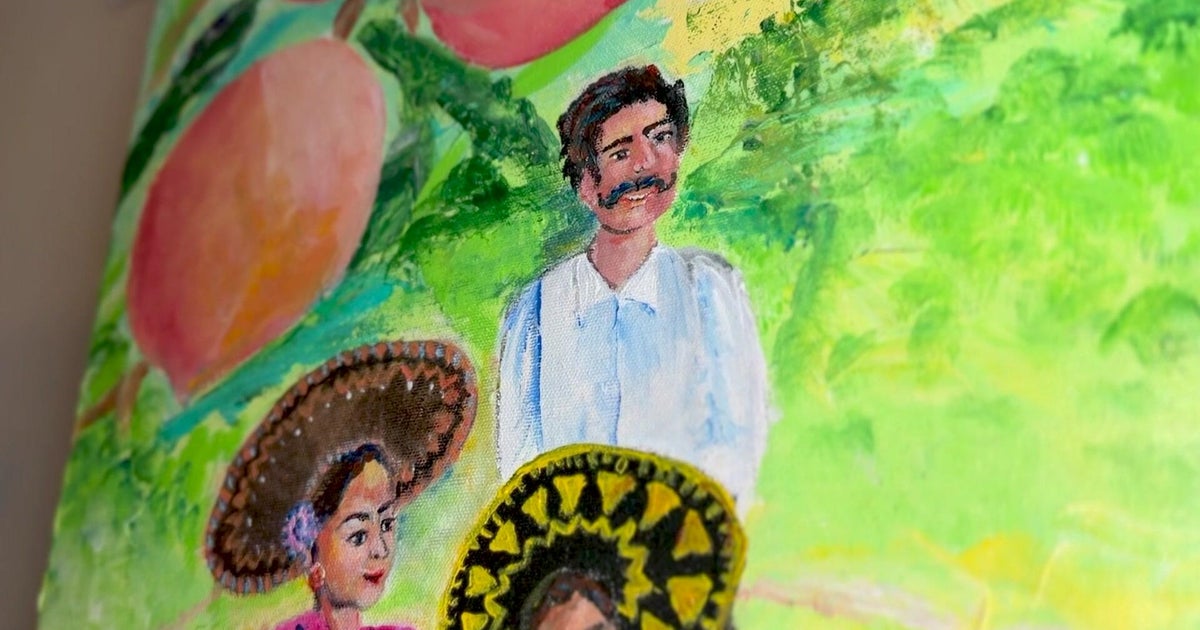
One of Singh's illustrations depicts Mexican women dancing in traditional Mexican dresses alongside their Punjabi husbands and fathers on a Yuba City peach farm. The men are shown without their traditional turbans, reflecting the way some families navigated and blended their cultural identities.
Art of Sarabjit SinghAnother piece, titled 'Binding Laws and Blending Cultures,' captures the complicated circumstances that brought these communities together.
Art of Sarabjit Singh"The hardships they are going through shows on their faces," Singh says of the people depicted in her artwork. "Still, there is joy in their eyes."
Despite the challenges, the two communities shared multiple characteristics. Both had immigrant roots, both worked in agriculture, and both were building new lives in California.
For Singh, the story is not simply about discrimination or struggle. It is also about perseverance, connection and the ability to create something new.
"Not focusing on the hardship only, but pushing through, moving ahead and forging new pathways, freedom," she says.
The history behind Singh's collection is informed in part by the research of author Karen Leonard, whose book 'Making Ethnic Choices' documents the Punjabi-Mexican community and its place in California history.
Leonard says the community's legacy remains.
"There isn't really a third or fourth generation, but there's a memory," Leonard says.
For Leonard, the story offers a glimpse into how shared experiences helped bridge cultural divisions. Her research centered on the flexibility of ethnic identities.
"In the early days, the commonalities bridged divisions," she says.
Leonard says based on her research, the Punjabi immigrants did not come to America solely for land. In fact, under discriminatory laws of the time the foreign-born men could not own land. It was their American-born children who would become landowners of their family farms.
"They worked to get landownership finally, through the solution found by the Japanese immigrants. Their children born here were American citizens," said Leonard. "They were really good farmers and the system worked."
The contributions of Punjabi-Mexican families can still be seen throughout Yuba City and the surrounding region.
Members of the community worked California's farms and helped establish some of the state's earliest Sikh temples. At one local gurdwara, the list of founders includes a Sikh man who took the surname "Kasagrande," reflecting the influence of his Punjabi-Mexican family.
That cultural connection also found its way into the local food scene.
The now-closed Rasul's El Ranchero restaurant was founded in 1953 in Yuba City by Gulam and Inez Rasul. The couple brought their backgrounds together through both their marriage and their restaurant, serving a fusion of Indian and Mexican dishes.
For Singh, those stories offer a reminder that cultural differences do not have to stand in the way of connection.
"They got to know each other and they moved forward. Why can't we do that now?" she says.
She hopes her artwork will ensure the stories of these families are not lost over the years.
"My artwork might be like a capsule in time," Singh says. "I'm showing these stories and they will be preserved even when I'm gone."
That mission is also finding a home at the Sutter County History Museum, where one of Singh's latest works will soon become a permanent part of the collection.
Commissioned for the museum, the artwork depicts the parade celebrating Punjabi culture and traditions in Yuba City. It also incorporates familiar details of the community, from local peach orchards to the free-roaming chickens and roosters often spotted around town.
Mural soon to be added to Sutter County History Museum permanent collection Art of Sarabjit SinghThe piece celebrates the cultural traditions that continue to shape Yuba City while recognizing the intertwined histories that helped build the community.
More than a century after those first families came together, their story remains part of California's history — a reminder of the connections forged through shared experiences, resilience and the search for a place to call home.
Hence then, the article about history of punjabi mexican culture brought to life by northern california artist was published today ( ) and is available on CBS sacramento ( Middle East ) The editorial team at PressBee has edited and verified it, and it may have been modified, fully republished, or quoted. You can read and follow the updates of this news or article from its original source.
Read More Details
Finally We wish PressBee provided you with enough information of ( History of Punjabi-Mexican culture brought to life by Northern California artist )


Also on site :
- Ollie, a privacy-focused AI assistant, is shutting down
- Cracks are emerging in the AI spending boom
- Noah Wyle Says Eddie Murphy Told Him to ‘F— Off’ When He Was 9 Years Old, So ‘The Pitt’ Star Always Signs Autographs for Kids Now