
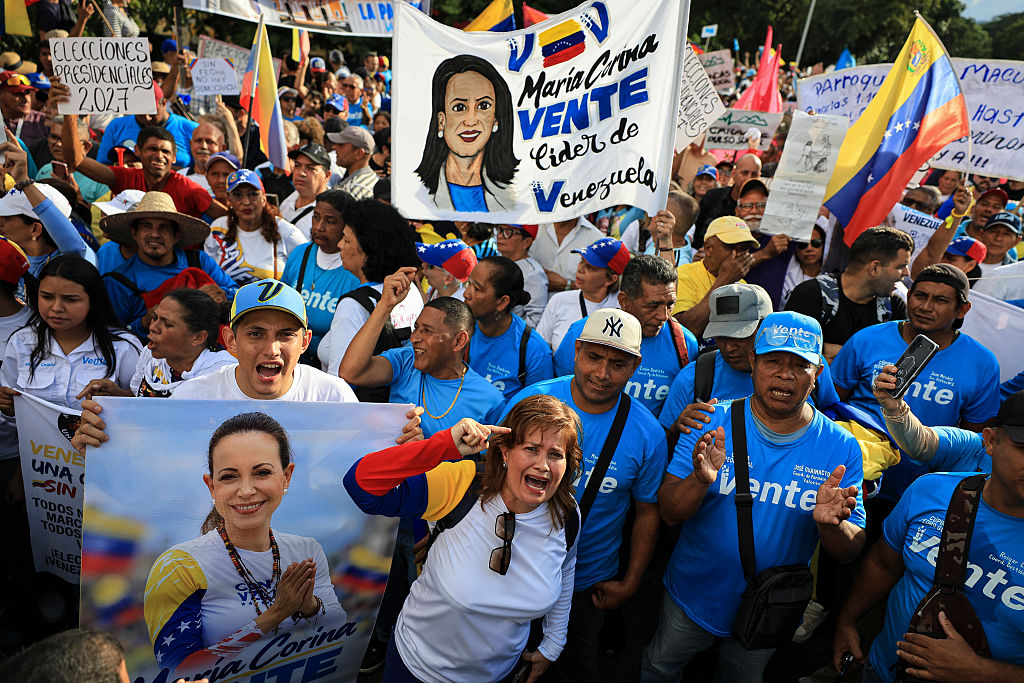
Thousands of protesters took to the streets in Venezuela on Thursday afternoon to demand presidential elections and call for the return of exiled Nobel Prize-winning opposition leader María Corina Machado.
In the capital, Caracas, protesters gathered in Plaza Venezuela and called for presidential elections to be scheduled as early as 2027, as well as the release of all political prisoners in the country.
“We will have presidential elections very soon with María Corina as president,” said former congressman Piero Maroun, who attended the protests, according to independent local news organization Efecto Cocuyo. The Machado-led activist group Vente Venezuela spearheaded the protests, which led to the closure of some streets in Caracas. Others also staged protests in the states of Nueva Esparta, Táchira, and Zulia.
The ruling party that acting President Delcy Rodríguez belongs to, the United Socialist Party of Venezuela, also staged a gathering near the opposition demonstrators in Caracas, though for a women’s march for Breast Cancer Awareness Month.
Protesting has become common for disgruntled Venezuelans since the forced end of Nicolás Maduro’s presidency. Maduro and his predecessor Hugo Chávez heavily cracked down on political dissent. But since Maduro’s removal in January by U.S. forces, protesters have taken to the streets “with increasing frequency,” according to the international civil society alliance CIVICUS, citing data from the Venezuelan Observatory of Social Conflict, which recorded 1,101 protests during just the month of September, or about 37 demonstrations per day. These protests, however, have not necessarily been large.
Until this week. The Thursday protests, which Reuters described as “the first nationwide opposition protest in nearly two years,” coincided with the third anniversary of the opposition’s presidential primary elections, in which Machado emerged victorious.
Machado is still the opposition’s most prominent figurehead in the transition toward a democratic government: in an AtlasIntel survey conducted for Bloomberg News, Machado received 52% support, compared with 19% for Rodríguez. But Machado has her work cut out for her.
The protests also happened as Rodríguez met with Dinorah Figuera, the opposition representative backed by the U.S. State Department in negotiations for a political transition, inside the Venezuelan presidential palace. The three rounds of U.S.-backed talks between the Venezuelan government and Figuera’s faction have yet to yield an agreement on elections.
In a statement reported by El País after the meeting, Rodríguez appeared to reference the opposition protests, saying in Spanish: “There are still very, very small groups that resist and believe that trying to set the country ablaze and block streets is the way for Venezuela to move forward. I recognize the good Venezuelans who, through this dialogue, are promoting necessary changes.”
Since arresting Maduro in an extraordinary military operation in January, the U.S. has been working with an interim government led by Rodríguez, Maduro’s former deputy. Rodríguez and U.S. President Donald Trump both have said elections will eventually be held in the country, though Trump told TIME in late September: “It’s so raw now, you know that I just think it’s too soon.”
Why has an election not yet been scheduled?
-Maduro government opened talks in August with the opposition faction led by Figuera, the president of Venezuela’s 2015 National Assembly, to help the country achieve a democratic transition. But the changes are expected to take time.
Domestic opposition and international observers have long slammed Maduro’s 2018 and 2024 re-elections for lacking transparency and fairness, disputing the results and arguing that Machado’s proxy, Edmundo González Urrutia, actually won in the latter. This raised questions about the independence of the Supreme Court and Venezuela’s National Electoral Council, which have been packed with loyalists of the regime.
For the transition, the establishment and the opposition are trying to iron out details of reforming the court and the council. Even if this happens, experts told Reuters that authorities will still need to update voter rolls and ensure that parties can reach a consensus on how subsequent elections would work.
The twin earthquakes that struck Venezuela in June and caused extensive damage also complicated efforts toward stability in the country.
But the U.S. has also set certain prerequisites that could affect how soon elections could happen. President Trump and Secretary of State Marco Rubio outlined that they seek stabilization, economic recovery, and national reconciliation in Venezuela, on top of a political transition. Axios reported that it’s a multi-step process: change the court makeup, reform the electoral commission, and then announce an election date. Rubio also announced other requirements, including a truly free press.
“What would threaten an enduring republic in Venezuela would be that someone is elected and they inherit a complete catastrophe, economic and social, and then the whole project is endangered because now anything can happen,” Rubio said on Sept. 23, following Trump’s meeting with Rodríguez in New York. “We want to do two things at the same time.”
Critics argue that the Trump Administration’s position sidelines the opposition faction led by Machado and instead prioritizes oil agreements and economic stabilization over Venezuela’s democratic transition. In August, Trump announced that Washington agreed to a deal with Caracas, saying it would give the U.S. majority control over more than 65 billion barrels or about a fifth of Venezuela’s oil reserves.
Dhayana Fernández-Matos, a professor of political science at the Federal University of Pelotas in Brazil, told Spain’s broadcaster RTVE last month that an election in Venezuela is not a priority for Trump, as his “primary interest lies in oil and the geopolitical power of controlling the world’s largest proven crude oil reserves.”
TIME’s September interview with Trump hinted at the U.S.’s potential financial bias for a delayed election: after saying that it would be too soon for Venezuela to hold an election, the President said, “A lot of money is being made by us, but a lot of money is also being made by Venezuela, and we have complete control of all of them.”
Hence then, the article about venezuelans take to the streets to demand democracy was published today ( ) and is available on Time ( Middle East ) The editorial team at PressBee has edited and verified it, and it may have been modified, fully republished, or quoted. You can read and follow the updates of this news or article from its original source.
Read More Details
Finally We wish PressBee provided you with enough information of ( Venezuelans Take to the Streets to Demand Democracy )


Also on site :
- In 2008, Celine Dion bought a lot on Florida’s Jupiter Island for $7 million; her water park mansion there sold 9 years later for $28 million
- Dwayne Johnson and Oprah Winfrey gave $10 million to launch the People’s Fund of Maui for wildfire survivors
- In 2017, Jack Daniel’s named Nathan “Nearest” Green its first master distiller for teaching the brand’s founder to distill whiskey over a century earlier