
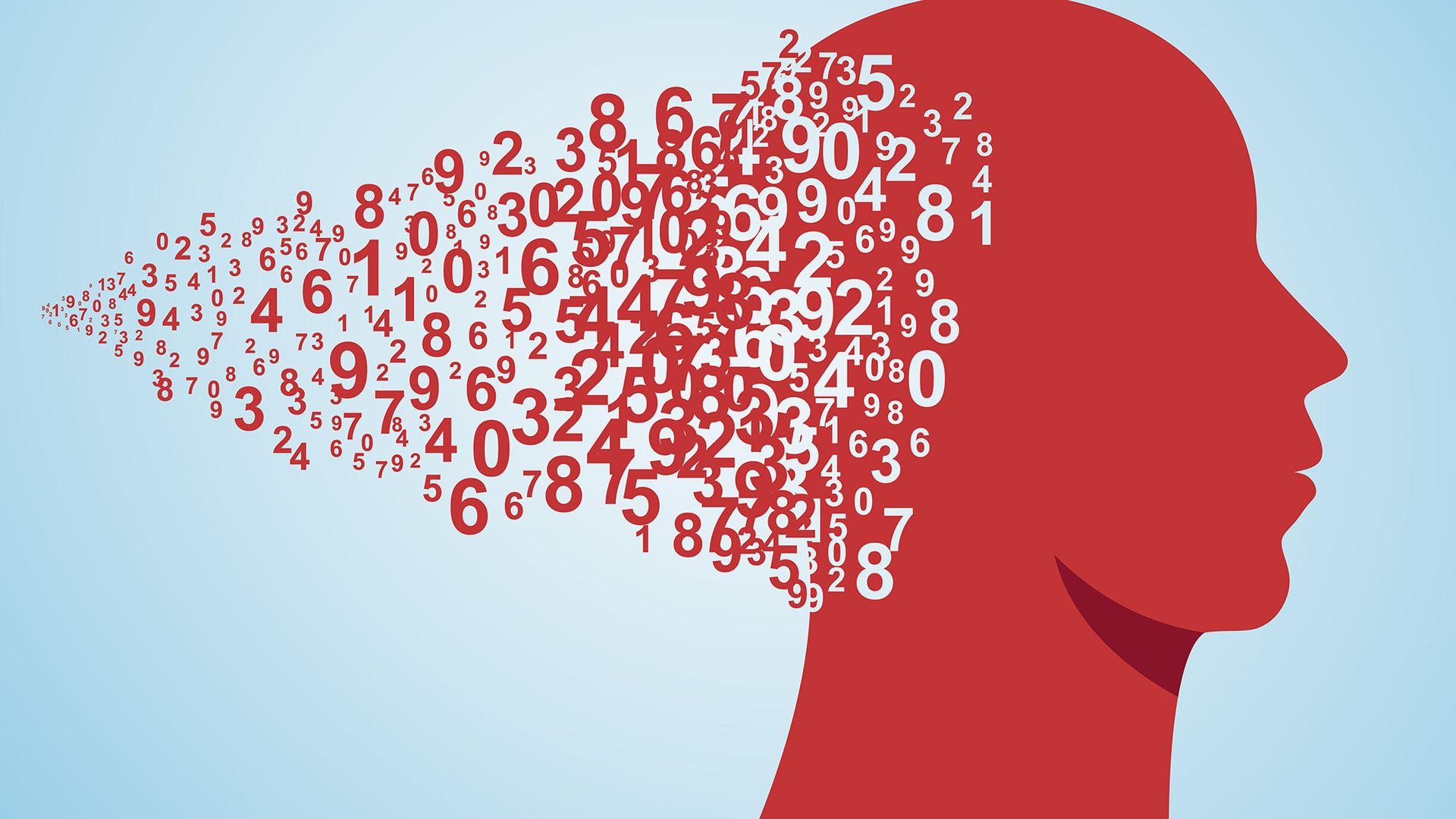
Picture a number line, with the values running from the smallest to the largest. New research shows that the human brain uses a similar system when comparing numbers; in the study, scientists uncovered a "mental map" in which numbers have unique coordinates in the brain, which may help us place them in order of magnitude.
"Numbers are abstract concepts, but our brains have ways of organizing them that allow us to compare and reason about their values," said study co-authors Daniela Valério, a postdoctoral researcher in the INSERM-CEA Cognitive Neuroimaging Unit (UNICOG) in France, and Stanislas Dehaene, the director of UNICOG.
"What is fascinating is that the brain can bring together numbers that look very different, such as integers [whole numbers] and fractions, within a common system," they told Live Science in a joint statement.
That system is a map for both sets of numerical values within the brain, they reported Thursday (Oct. 22) in the journal PLOS Biology.
To investigate how the brain represents different types of numbers, Valério, Dehaene and their colleagues used a high-resolution functional magnetic resonance imaging (fMRI) scanner, which tracks blood flow through the brain as an indirect measure of activity. They measured brain activity in 20 adults while they worked through a simple task of comparing numbers — a mix of fractions and whole numbers — and determining whether each number was bigger or smaller than the previous one shown.
The brain scans revealed distinct activity patterns in the anterior inferior parietal cortex — part of the brain that's known to be key for processing numbers. As participants compared numerical values, the brain region lit up in an organized pattern resembling a number line. The whole numbers and fractions were represented along this shared line according to their size, rather than being mapped in separate systems.
fMRI scans performed during the study revealed similar patterns of brain activity when participants compared integers and fractions. Smaller numbers are represented in reddish hues and larger numbers in bluish hues; these activity patterns represent an average across the study participants. (Image credit: Valério D, et al., 2026, PLOS Biology, CC-BY 4.0 )The brain's shared map brings different number formats into a common system based on the quantities they represent, the researchers concluded.
"For me, it is how the brain gets from a symbol to its meaning," said Abiot Derbie, a cognitive neuroscientist and founder of the company LifeByLogic, which makes psychology assessments.
The fraction "¼" contains the digit "4," but the fraction's value is much closer to zero, he noted. "The activity patterns reflected that numerical relationship, going beyond the digits themselves," Derbie, who was not involved in the research, told Live Science in an email.
The idea that the brain represents numerical magnitude in the parietal lobe is not novel. However, scientists mostly understood how the brain dealt with whole numbers, while its strategy for fractions was not well understood. The new work builds on that existing research by exploring how both numerical magnitude and number type are processed together.
"To the best of our knowledge, this is the first study to investigate the geometry of neural representations in a task involving both integers and fractions," the researchers wrote in their report. "In the future, it might be interesting to expand the present work to decimal numbers."
From previous work, "scientists already knew that fractions and whole numbers engage overlapping parts of the brain's number-processing network," Derbie said. "This study gives us a clearer picture of how their values are organized."
In the future, the team could examine how this neural representation varies across people of different ages, educational levels and mathematical backgrounds, Derbie suggested. The study also included only native French speakers, so may not reflect differences across language or culture.
Related storiesMap of 600,000 brain cells rewrites the textbook on how the brain makes decisionsSuper-detailed map of brain cells that keep us awake could improve our understanding of consciousnessFirst-of-its-kind map of the mouse nose reveals surprises about the sense of smell
"I would want to see how this organization develops as people learn," Derbie said. For instance, the team could follow children before and after they learn about fractions, to see whether changes in brain activity accompany better understanding.
In the current study, the participants found it more difficult to compare fractions than to compare whole numbers, the researchers noted; they were slower and made more errors while working with fractions, which was expected. But the study's results don't offer hints as to why.
"Our study was not designed to explain why fractions are harder to learn or understand," Valério and Dehaene told Live Science. "What is new in our study is that we show that these different types of numbers are organized within a shared map in the brain."
See how much you know about the most complex organ in the human body with our brain quiz!
Hence then, the article about brain scans reveal number line that s used to mentally compare values was published today ( ) and is available on Live Science ( Middle East ) The editorial team at PressBee has edited and verified it, and it may have been modified, fully republished, or quoted. You can read and follow the updates of this news or article from its original source.
Read More Details
Finally We wish PressBee provided you with enough information of ( Brain scans reveal 'number line' that's used to mentally compare values )


Also on site :
- Bournemouth vs AC Milan: Kick-Off Time, TV Channels, and Live Streaming
- Payment Processor Nears Buy Point Amid Accelerating Earnings Growth
- Macy’s ‘Beautiful’ Cardinal Comforter Set Is a Dream Find for Bird Lovers This Christmas, Now 73% Off