
Content warning: this article contains mention of sexual assault and details some readers may find disturbing.
On Thursday, both the State of North Carolina and defense attorneys for Miguel Salguero-Olivares laid out their closing arguments as to whether the 33-year-old is guilty of the 2012 murder and rape of UNC student Faith Hedgepeth.
Defense Attorney James Rainsford and the rest of the defense surprised prosecutors on Wednesday when it said it would not be presenting any evidence of its own. This was despite the fact that two witnesses for the defense had been called and were present at the Durham County Courthouse. Because the defense did not present any evidence that was seen by the jury, it was given the right of last argument, meaning it could deliver its closing arguments after the state.
As a result of the defense resting their case, Judge Keith Gregory released the jury early on Wednesday and court proceedings resumed Thursday with closing arguments. Here are some highlights from both the prosecution and the defense’s final words to the jury.
Prosecutors Say DNA Evidence Makes Salguero-Olivares’ Guilt Clear
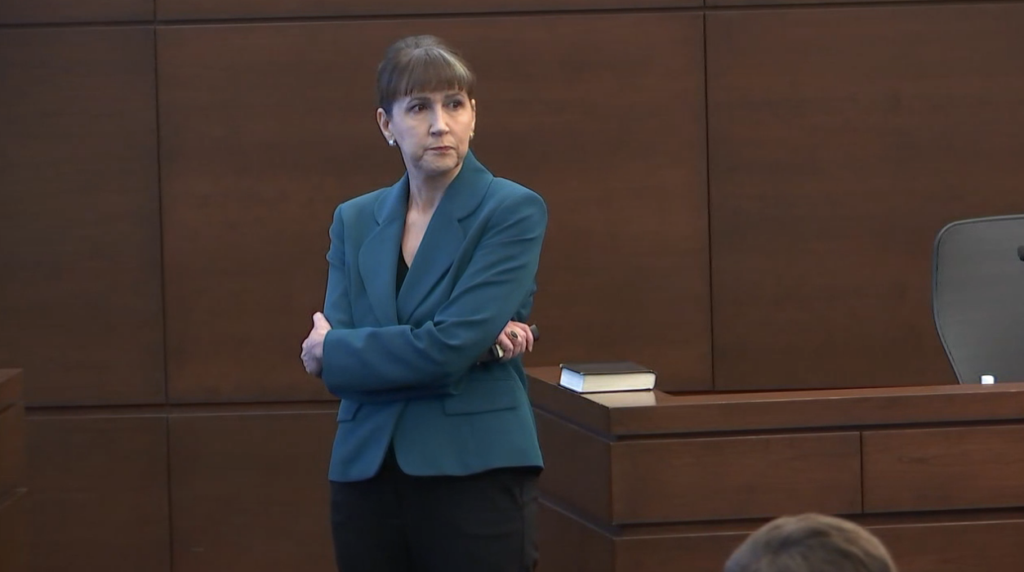
Homicide and Arson Resource Prosecutor Lisa Coltrain delivers the state’s closing arguments to the jury. (Image via pool footage.)
The state’s closing arguments were delivered by Assistant District Attorney Angela Garcia-Lamarca and Homicide and Arson Resource Prosecutor Lisa Coltrain. They provided the jury with a potential narrative of what happened in the early morning hours of Sep. 7, 2012. They told the jury Salguero-Olivares was attending a cookout with other Guatemalan men at the Hawthorne at the View apartment complex, and that he was drunk. They said when Hedgepeth and her roommate Karena Rosario returned from their night out at The Thrill in Chapel Hill, Rosario was quite drunk, and was being cared for by the victim. They theorized that Salguero-Olivares approached the two women and some form of verbal altercation took place. After Rosario was later picked up by Jordan McCrary, they said the defendant entered the apartment, enraged at having been either rejected, insulted or both. They said he then killed Hedgepeth with a Bacardi rum bottle and raped her, with the order of these two events not having any bearing over his guilt in either offense.
“He was the jury, he was the judge, and he was the executioner,” said Garcia-Lamarca. “He sentenced her to death. He sentenced everyone else who loved her to life.”
During the presentation of its case, the centerpiece of the state’s evidence was DNA evidence left both on and inside Hedgepeth’s body, as well as on the Bacardi bottle, a blue riesling bottle found by the bed where she died, and a takeout bag with a vulgar message written on it. Garcia-Lamarca went through each of the charges against Salguero-Olivares, highlighting how the state believes DNA evidence points towards his guilt on each count.
“The law in North Carolina says, ‘DNA evidence tending to show that the defendant’s sperm was found on an anal swab from the victim was unequivocal evidence of penetration.’ That’s it,” she told the jury. “The law says if you’ve got sperm inside someone’s anus, that’s penetration. The likelihood ratio when the defendant is included [in DNA] is 170 septillion. You remember the seesaw analogy. And y’all, to be clear, it’s not just an ant on one side and the defendant’s DNA over here, the size of an elephant. It’s not just one elephant. It’s a universe of elephants.”
Attorney Lisa Coltrain picked up the baton by reviewing the state’s presented evidence with the jury. She also did her best to anticipate some of the points that would be raised by the defense in its closing statements, namely that there is enough circumstantial evidence pointing towards Rosario potentially being involved to create reasonable doubt in the state’s case. She refuted the idea that investigators had overlooked evidence potentially pointing towards Rosario, and took aim at Rainsford’s earlier assertion that it was suspicious that she did not brush her teeth or wash her hands after vomiting and before leaving the apartment. She questioned why more of Rosario’s DNA wasn’t found on key items at the crime scene, and why Salguero-Olivares’ DNA would be so prevalent at the scene if he truly wasn’t involved. She said any attempts on the defense’s part to question Rosario’s involvement or the methods of investigators was an attempt on its part to distract the jury with “red herrings.”
Coltrain concluded by emphasizing how Hedgepeth’s life has been unduly picked apart and examined as a result of the murder, the years without a lead and now the evidence presented at trial.
“[Hedgepeth] had [Salguero-Olivares’] penis rammed inside of her, and now her life has had to be dissected for you to find out about her sexual partners, about the fact that she doesn’t like to have sex when she’s on her period, about who she was sleeping with,” she said. “You’ve had to have pictures of her vagina splayed across this courtroom because of this man’s selfish actions, because he couldn’t be made to feel stupid.”
Ultimately the state asked the jury to return a verdict of guilty on charges of first degree murder in perpetration of a felony; first degree murder on the basis of malice, premeditation or deliberation; first degree rape; first degree sexual offense; and first degree burglary.
Defense Says The State Has Not Met Its Burden in Proving Defendant’s Guilt
Defense Attorney James Rainsford delivers the defense’s closing arguments to the jury. (Image via pool footage.)
Because the defense decided against presenting any of its own evidence, it put a lot of weight on its closing statement, which was the final thing heard by jurors before being sent to deliberation. Attorney Jason Murphy spoke to the jury first, claiming that the state gained “tunnel vision” after identifying Salguero-Olivares as a suspect. He also said that his client had not been afforded the same considerations of youthful naivety as the victim and some of the state’s witnesses, despite the fact he was the same age as Hedgepeth at the time of the crime. He also took issue with the state’s characterization of potential holes in its case as “red herrings” and “noise,” specifically in regards to Rosario. Jordan McCrary, who picked her up from the apartment the night of the murder, told investigators that Rosario had pointed out red stains on her hands and questioned why she had blood on them. She claimed she didn’t remember saying this. The state claims the stains likely resulted from her red vomit as a result of having drank red slushies at The Thrill. The defense has insinuated it was blood.
“The state has put a lot of emphasis on everyone believing that it makes sense that Ms. Rosario doesn’t remember a conversation the next day when she was sober about having blood on her hands with Jordan McCrary.” Murphy said. “She said, ‘I wish I did.’”
Other potential holes in the case highlighted by Murphy and Rainsford included places for DNA analysis which weren’t tested, such as the apartment’s light switch or the door handle. Rainsford mentioned multiple yellow placards placed at the scene in photos reviewed by the jury which showed where investigators thought they might find evidence, not all of which were ultimately tested for DNA. He reminded the jury that their job is to test the evidence, and said the state did not provide enough to eliminate reasonable doubt.
“Some people call it a red herring,” he said. “Other people might call it reasonable doubt. And if it hasn’t been ruled out by the state, you can’t test it. And that thing in your mind that says, ‘this just doesn’t feel quite right,’ that’s a doubt based on some of the evidence. If you’re going to take away anything from this defense argument, please take that away because that encapsulates everything. That’s everything that’s wrong with this. They have not proved their case. Hold them to their burden. He’s not guilty.”
Judge Keith Gregory Provides Instructions, Jury Enters Deliberation
Miguel Salguero-Olivares confers with his defense team during the state’s closing arguments. (Image via pool footage.)
Once the defense wrapped up its closing arguments, Judge Keith Gregory provided the jury with instructions on how to consider the charges and factor in evidence. He laid out the parameters of each charge, explained different degree levels of offenses like murder, and made sure the jury understood the level of certainty they needed to have as to the defendant’s level of culpability in each.
Afterwards, the jury left the courtroom to begin deliberations. How long this process will take is highly variable, as it is possible they will return a verdict as soon as Friday, or it could take much longer. The jury returned home at 5 p.m. Thursday, and will return Friday morning at 9:30 a.m. to continue deliberating.
Featured image via courthouse press pool.
Chapelboro.com does not charge subscription fees, and you can directly support our efforts in local journalism here. Want more of what you see on Chapelboro? Let us bring free local news and community information to you by signing up for our newsletter.
State And Defense Present Closing Arguments, Jury Enters Deliberations in Faith Hedgepeth Murder Trial Chapelboro.com.
Hence then, the article about state and defense present closing arguments jury enters deliberations in faith hedgepeth murder trial was published today ( ) and is available on chapelboro ( Middle East ) The editorial team at PressBee has edited and verified it, and it may have been modified, fully republished, or quoted. You can read and follow the updates of this news or article from its original source.
Read More Details
Finally We wish PressBee provided you with enough information of ( State And Defense Present Closing Arguments, Jury Enters Deliberations in Faith Hedgepeth Murder Trial )


Also on site :
- Payment Processor Nears Buy Point Amid Accelerating Earnings Growth
- Former Penfield school employee charged with rape, district sends message to families
- Penn Yan schools on lockdown and lockout due to possible report of weapon at high school