
For the past week, President Donald Trump and his aides have traded accusations with Elon Musk, the CEO of SpaceX, over who restricted Ukraine’s access to a military-grade version of Starlink, SpaceX’s satellite network product that Ukrainian forces depend on to intercept incoming Russian projectiles and target Russian launchers.
Musk blamed Trump and the U.S. military for the decision, writing on X, “Any limits on speed or usage are decided by the US military and ultimately POTUS.” Trump insisted that his administration did not disrupt Ukraine’s access to the network. Secretary of State Marco Rubio argued that decisions about Ukraine’s access to the network were in the hands of SpaceX and Musk and not the White House. The Wall Street Journal and CBS News reported that the decision had been Musk’s.
On Mar. 9, 2025, Musk had promised that, whatever his disagreements with U.S. policy toward Ukraine, “Starlink will never turn off its terminals. We would never do such a thing or use it as a bargaining chip.” Critics have raced to blame Musk alone, casting him as the puppeteer behind the throne, the first business titan to achieve what William Randolph Hearst, Marcus Alonzo Hanna, and J.P. Morgan only aspired to: a latter-day Cornelius Vanderbilt, who is reputed to have scoffed, “Law? What do I care about the law? Hain’t I got the power?”
That gets the story backward. Musk’s businesses are uniquely dependent on the blessings of Washington: a fifth of SpaceX’s revenue comes directly from federal agencies, its satellites require federal authorization to launch and operate, and the possible merger of Tesla and SpaceX will live or die by the decisions of federal regulators.
Confronted with a White House that appeared determined to squeeze Ukraine, whatever its public denials, Musk faced a familiar choice for anyone dependent on political patronage: capitulate, resist, or retreat into ambiguity. He chose ambiguity, revealing the limits of his power. The wealthiest man in the world still answers to someone else.
The finger-pointing creates a haze of ambiguity, giving both men plausible deniability. The apparent aim is to force Ukraine into a settlement by depriving it of the means to resist: a way to secure a quick, short-term peace and lower oil prices at the expense of Ukrainian sovereignty and international law.
But that calculation mistakes capitulation for stability. Rewarding President Vladimir Putin of Russia could encourage him to test NATO’s resolve in the Baltic states, Poland, Finland, or Sweden, raising the risk of a direct confrontation with the alliance. It would also signal to other U.S. adversaries that sufficient pressure can fold Washington’s commitments.
For now, Trump could claim to have brokered peace between Russia and Ukraine, even if the peace he delivers is the silence of a defeated country. Musk can evade responsibility by presenting himself as merely one supplier among many across the defense industry whose failures have weakened Ukraine’s defenses. He could point to weapons manufacturer RTX, whose Patriot interceptors are so scarce that Ukraine reportedly ran out of them this month, or to delays in delivering F-16s manufactured by Lockheed Martin that were promised two years earlier.
Beneath the public quarrel lies a familiar pattern: surrender political independence and retain the freedom to accumulate extraordinary wealth. The historians who have studied Putin’s Russia most closely would recognize the pattern instantly. Timothy Snyder has written that Russia’s oligarchs “were tamed, but not by a neutral state.” Rather, “Putin himself became the head oligarch, the boss of bosses.” Anne Applebaum echoed the insight and described Putin as making himself “godfather to all of the other oligarchs.”
Putin laid out the terms of that bargain on Jul. 28, 2000, when he met with 21 of Russia's richest men in the Kremlin, less than three months after his inauguration. The message was simple. The fortunes they had amassed in the chaos of the 1990s were theirs to keep, as long as they stayed out of politics entirely. Keep your distance from power, and the state would leave you alone.
Those who refused the deal faced immediate reprisals. Boris Berezovsky and Vladimir Gusinsky, whose television networks refused to bend the knee, were driven into exile within the year. Gusinsky’s NTV was seized by state-controlled Gazprom. Mikhail Khodorkovsky, then Russia’s richest man, funded opposition parties and lectured the Kremlin on corruption. In Oct. 2003 he was pulled off his plane at a Siberian airport and arrested. He spent a decade in prison and watched his oil company, Yukos, dismantled and its assets transferred to state-controlled companies.
Those who accepted the deal are the ones who got rich, and they have never been richer. Forbes counted a record 155 Russian billionaires this year, the fourth straight year that number has grown, with a combined fortune of $696.5 billion—up 11% from the previous year, even as Putin’s war against Ukraine entered its fifth year. Their collective wealth reportedly now exceeds the bank term deposits of the rest of Russia’s population: 155 oligarchs with fortunes greater than the savings of roughly 146 million ordinary Russians.
“Oligarchies are unstable,” Snyder has observed. “Members disappear.” For those who might have forgotten the terms of Putin’s bargain, an instructive reminder came in 2023, when Yevgeny Prigozhin, the head of the Wagner Group, did the one thing the bargain forbade: he challenged the Kremlin’s authority. Prigozhin seized a military headquarters in Rostov-on-Don and sent his forces toward Moscow. His column advanced to within 125 miles of the capital before he agreed to stand down under a deal brokered by Aleksandr Lukashenko, the Belarusian dictator.
Putin publicly called the mutiny treason, then appeared to forgive him. Two months later, on Aug. 23, 2023, Prigozhin’s private jet crashed north of Moscow, killing everyone aboard. The Kremlin denied involvement, the U.S. intelligence concluded that the plane had been blown up, and The Wall Street Journal later reported that the operation had been ordered by Putin’s Security Council chief. Putin’s eulogy, delivered the next day, described Prigozhin as a man who had “made serious mistakes in life.” No oligarch in Russia needed the rest of the sentence spelled out.
Prigozhin’s fate is only the most spectacular entry on a longer, murkier list. Since the invasion of Ukraine began in 2022, at least 85 Russian businessmen and officials have reportedly died in unexplained or violent circumstances, many of them figures in the energy industry. Among the dead are three Lukoil executives: board member Alexander Subbotin, who died in May 2022 after a visit to a “shaman” outside Moscow; chairman Ravil Maganov, who fell from a sixth-floor window that September; and vice president Vitaly Robertus, who was found dead in his office in March 2024.
In April 2022, two former energy and banking executives were found dead alongside their families. Vladislav Avayev, a former Gazprombank vice president, was found shot dead in his Moscow apartment with his wife and 13-year-old daughter. Sergei Protosenya, a former Novatek executive, was found hanged at a rented villa in Lloret de Mar, Spain, with his wife and daughter stabbed to death inside. Catalan police concluded that Protosenya had killed his family, then himself. His son rejected that finding, insisting that his father had been in good spirits and had no reasons to kill them and himself.
Transneft vice president Andrei Badalov fell from a 17th-floor window in July 2025. The Moscow Times has counted 18 such fatal falls from windows since 2002. Three days later, Russia’s transport minister, Roman Starovoit, was found shot dead in his car hours after Putin fired him. Another transport official died of supposedly acute heart failure the same day.
A shadow over America
Putin’s Russia offers an extreme and grotesque example of the bargain. Yet some critics see an emerging American version, in a far less violent form. Snyder and Applebaum have warned that Western billionaires risk repeating the mistakes of Russia’s oligarchs under Boris Yeltsin, believing they can manage a strongman for profit, only to discover that he is managing them.
Musk spent more than $277 million to help elect Donald Trump, took a desk in the West Wing, and ran the Department of Government Efficiency like a man who believed he was co-president. When that arrangement flamed out in May 2025, he tried to exercise independent political power by turning against Trump, calling his signature legislation, the Big Beautiful Bill, a “disgusting abomination.” Musk threatened to form a third political party and then briefly launched one. He even taunted Trump about Jeffrey Epstein, posting that the president “is in the Epstein files.”
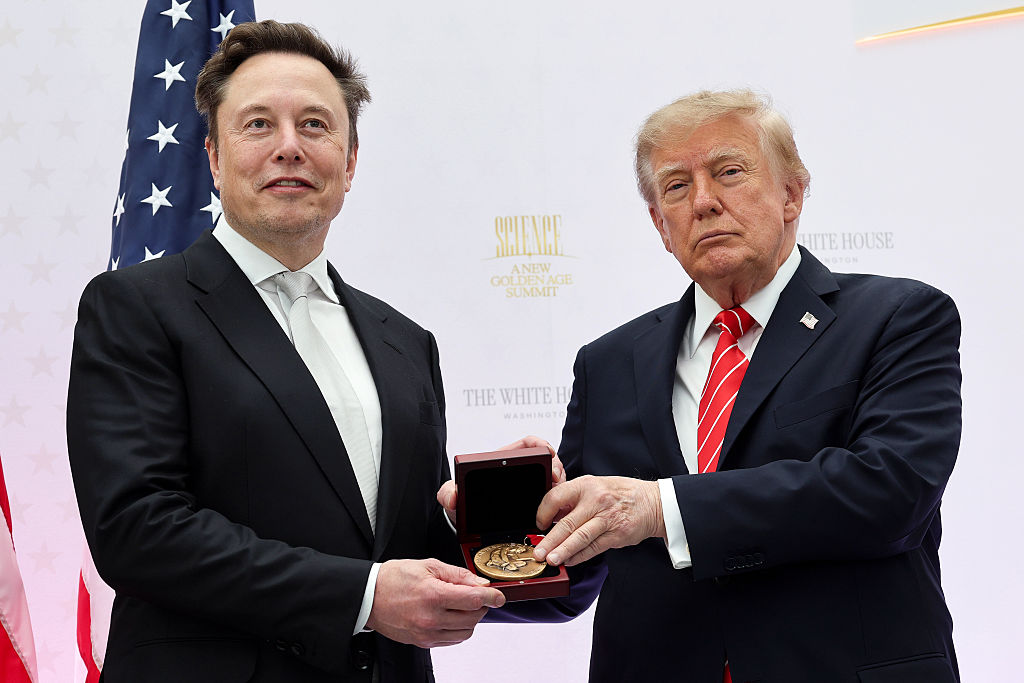
After Trump publicly mused about terminating his contracts, Musk quickly retreated. He deleted the posts, and conceded that they “went too far.” He returned to the fold, shook Trump’s hand at Charlie Kirk’s memorial, accepted the National Medal of Science from him this month, and became the biggest known donor of the 2026 midterms, giving at least $366 million to Republican groups. He has grown vastly richer in the process: SpaceX’s June IPO made him the world’s first trillionaire, while the company remains the U.S. government’s dominant launch provider, with competitors such as Blue Origin winning only a fraction of the contracts.
Musk’s retreat illustrates the bargain: surrender the freedom to oppose the president and preserve the ability to enrich yourself. By that measure, Musk’s political defeat has come with an extraordinary financial windfall. He won by losing. The throttling of Starlink in Ukraine appears to fit this pattern. Last week, after Trump demanded that Ukraine stop striking Russian refineries and Kyiv did not comply, its access to a military-grade version of Starlink was restricted and responsibility disappeared into a haze of accusation and denial.
The costs of such Faustian bargains fall on everyone excluded from them. In Russia, soldiers die at the front by the hundreds of thousands while politically compliant billionaires accumulate obscene fortunes. In Ukraine, drone operators lost contact with their interceptors in mid-flight last week while Russian missiles were in the air; the consequences of a disrupted connection are immediate and potentially fatal. Other customers face the question: can a contract with Starlink be relied upon?
In America, democratic government rests on the principle that neither political office nor private places anyone above the law. Businesses must be free to challenge a president without fearing retaliation, and their owners must remain accountable for their conduct. Those protections help distinguish America from an authoritarian dictatorship like Putin’s Russia.
The Starlink saga does not suggest that America has become Russia. But it raises a troubling question: is political obedience becoming the price of commercial success in America? Putin’s oligarchs struck that bargain in 2000 and have been collecting on it ever since. Whether Americans accept a version of it will depend on how forcefully our institutions and business leaders defend our freedom to say no.
Hence then, the article about the price of faustian bargains with trump was published today ( ) and is available on Time ( Middle East ) The editorial team at PressBee has edited and verified it, and it may have been modified, fully republished, or quoted. You can read and follow the updates of this news or article from its original source.
Read More Details
Finally We wish PressBee provided you with enough information of ( The Price of Faustian Bargains with Trump )


Also on site :
- Bournemouth vs AC Milan: Kick-Off Time, TV Channels, and Live Streaming
- AuraQuantic positioned as a Leader in the SPARK Matrix™: Intelligent Process Orchestration (IPO), 2026 by QKS Group
- Payment Processor Nears Buy Point Amid Accelerating Earnings Growth