
Crystal Hendricks-Kretzer was spending the winter months out of state with her husband when she felt horrible pain in her armpit.
When it didn’t go away after a week, she went to an urgent care for help.
“The doctor did a breast exam, checked my lymph nodes, she said there’s nothing untoward. You likely have fiber cystic breasts.”
Because the doctor didn’t seem concerned, Hendricks-Kretzer postponed a mammogram.
But by the time she got back home to Chicago, the pain only got worse.
“When I went into my gynecologist, I saw her face when she did the breast exam. I knew right then something was not right,” she said.
Following a diagnostic mammogram, ultrasound, and biopsy a week later, Hendricks-Kretzer received devastating news.
“I was diagnosed with Stage 2B triple — positive breast cancer,” she said.
Doctors found a tumor that had grown to the size of a grapefruit, and diagnosed her with the fast-growing, aggressive form of cancer that had already spread to her lymph nodes.
At the advice of her surgeon, she enrolled in a clinical trial at UChicago Medicine aimed at developing targeted, personalized breast cancer treatments. The study uses gene expression data to identify biomarkers that can predict specific treatments tumors are most likely to respond to.
“The goal with treating breast cancer is about trying to ‘right size’ treatment. We try to get as much treatment as a patient needs, no more, no less,” said Dr. Frederick Howard, Hendricks-Kretzer’s oncologist and an assistant professor at the university.
She received a novel antibody drug conjugate that helped shrink her tumor enough to avoid a potent form of chemotherapy known as “the red devil” because of its harsh side effects. She instead opted for a lower toxicity combination of chemo for another 12 weeks.
After 21 weeks of treatment, she was officially cancer free.
“The only reason ‘standard of care’ is ‘standard of care’ today is because of the women and men who participated in clinical trials 10, 20, 30 years ago. That is why I’m alive because of those women,” said Hendricks-Kretzer. “I signed up on the spot because I knew being a part of research would give me a sense of purpose and help me find the silver lining in a rather tumultuous time.”
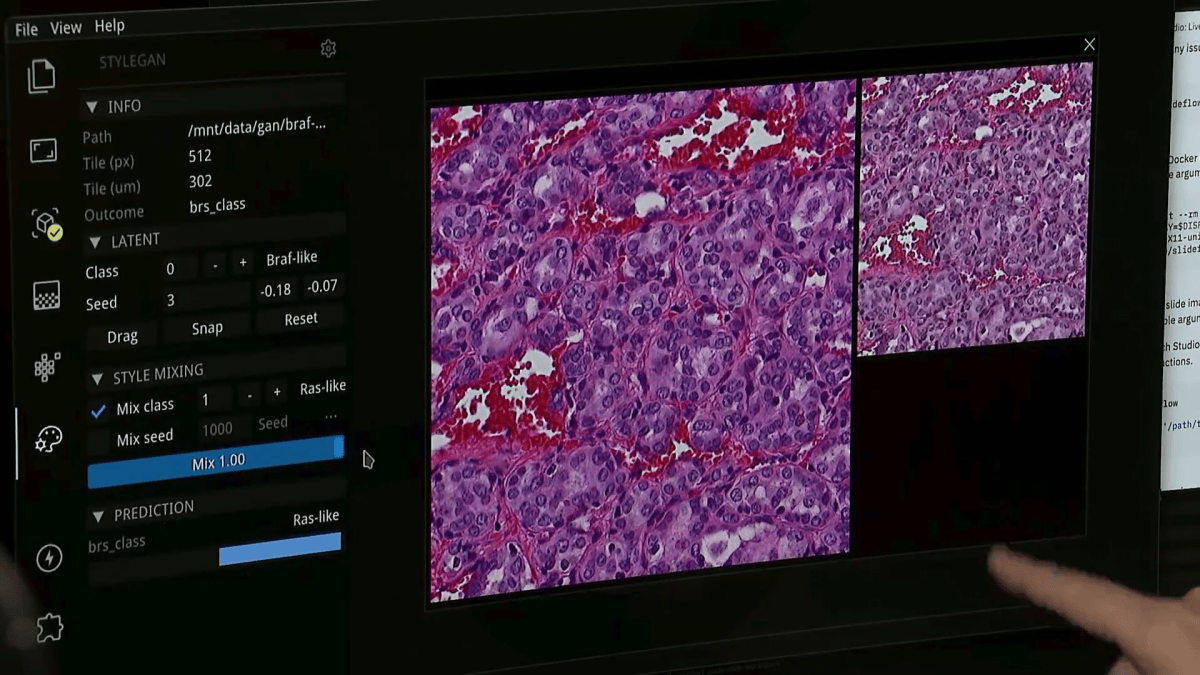
Dr. Howard’s team of researchers is using samples from the same study Hendricks-Kretzer participated in to input digital pathology images into artificial intelligence software to, similarly to the trial, better predict how tumors will respond to different treatments.
“The power of A.I. is the idea that if we can get enough data of characterization of individual cancers and then how those patients then respond to the treatment, we can then understand what are the patterns that are present in individual tumors that might suggest response to one therapy versus another?” said Howard.
Through the trial, Hendricks-Kretzer was able to get personalized treatment and avoid the most toxic chemotherapy.
AI wasn’t used in Hendricks-Kretzer’s treatment plan; however, Howard hopes A.I. programs will advance enough to also predict how patients will respond to specific treatment, making care faster and less expensive.
“I hope that AI will be used to augment the care, to make sure we are doing the right thing for every patient, and providing safer care as well,” said Howard.
AI has been used for decades in diagnosing breast cancer, helping doctors interpret mammograms. The future, according to Howard, is in using it as a tool for personalized treatment plans.
“There is a lot of excitement about AI,” said Howard. “Perhaps right now, the hype over A.I. might, sort of, exceed the reality of what it is actually doing.”
He says in the future, “no doubt it will be used to help guide treatment.”
“We need to understand if the added value of these tests and the appropriate way they can be used and continued study before we start rushing to have that done on every case,” said Howard. “There’s still some need to study these before adoption.”
Hence then, the article about how a uchicago clinical trial using ai aims to personalize breast cancer treatment was published today ( ) and is available on NBC Chicago ( Middle East ) The editorial team at PressBee has edited and verified it, and it may have been modified, fully republished, or quoted. You can read and follow the updates of this news or article from its original source.
Read More Details
Finally We wish PressBee provided you with enough information of ( How a UChicago clinical trial using AI aims to personalize breast cancer treatment )


Also on site :
- Sophia Bush Reveals She’s Now Friends With Women Chad Michael Murray Allegedly Cheated With: ‘You Did Have Kind of Great Taste’
- Gypsy-Rose Blanchard served years in prison for her mother’s 2015 murder; her memoir is now a No. 1 bestseller
- Monroe County approved a full tax break for 100% disabled veterans, but many local towns still have not decided