
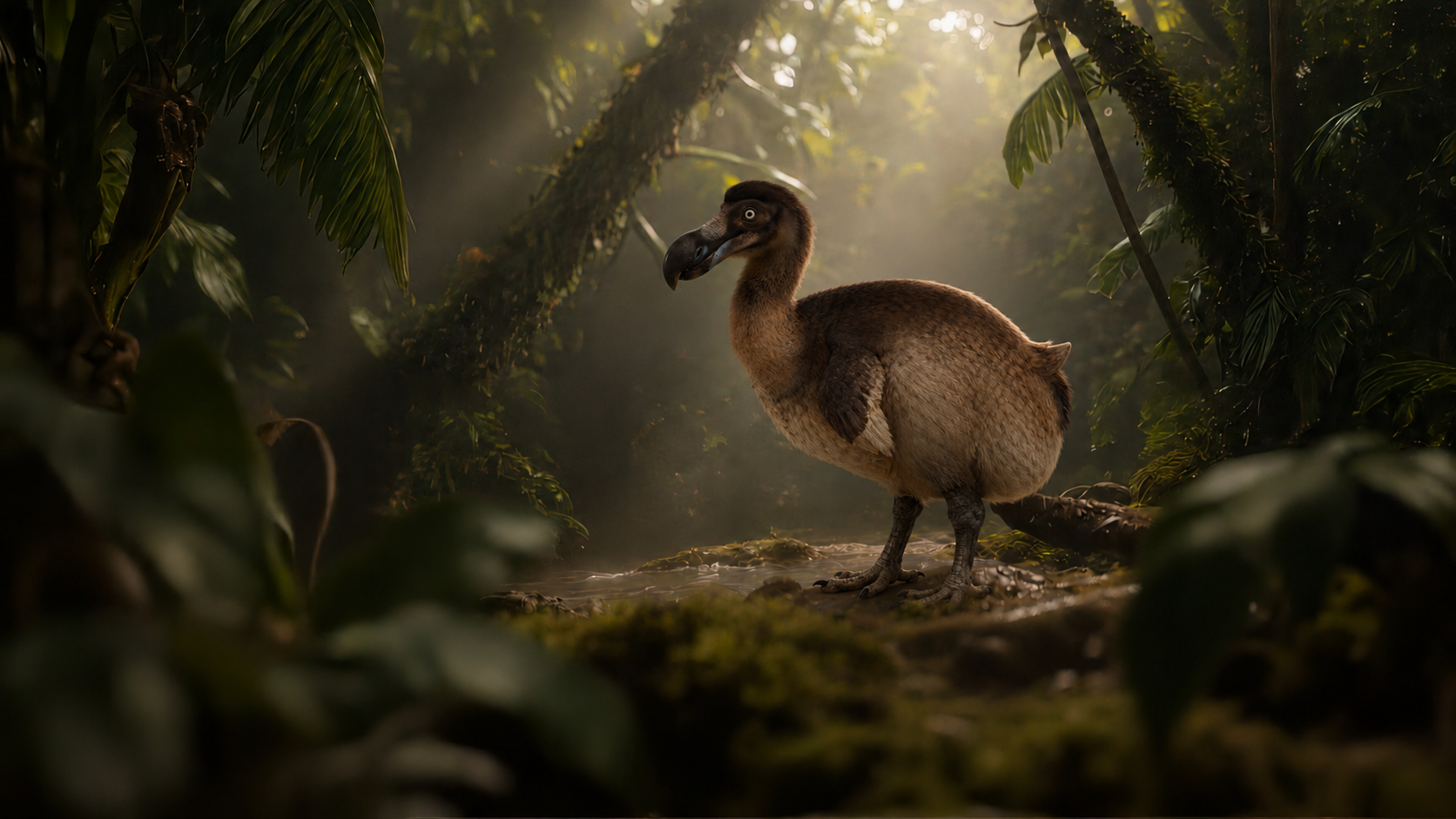
There are a whole lot of reasons to have a whole lot of concerns about the harm artificial intelligence can cause, which explains why the technology has so many detractors. But even the harshest critics might smile at the news coming out of Dallas-based Colossal Biosciences. There, researchers have just announced that AI may help hasten the return of the extinct dodo, with the flightless bird, which vanished from the world more than 350 years ago, likely walking among us again sometime in the early 2030s. With so few ancient samples of dodo DNA surviving—and that which does exist having degraded over the centuries—the analytic and number-crunching power of AI is just what’s needed to fill in the genetic blanks.
“De-extinction is as much a data problem as a biology problem,” said Colossal CEO and co-founder Ben Lamm in a statement. “[AI] learns how regulatory DNA shapes living birds, then identifies the genetic switches that may have contributed to the dodo’s distinctive anatomy.”
Colossal established its de-extinction bona fides in 2025, when it announced that it had sequenced ancient DNA from the long-extinct dire wolf, used that to rewrite the genome of the extant gray wolf, and brought the Ice Age dire wolf back to life, more than 10,000 years after it vanished. Animals that are also on the company’s de-extinction to-do list include the woolly mammoth, the Tasmanian tiger, the ostrich-like moa, and the antelope-like quagga. The dodo, with its waddling gait, its stubby wings, its goggly eyes, and its preposterous beak, has none of the power, grace, or charisma of those other animals—but that’s part of its charm.
“The dodo never had a chance,” wrote New York Herald Tribune writer Will Cuppy, in his 1941 book How to Become Extinct. “He seems to have been invented for the sole purpose of becoming extinct and that was all he was good for. I’m not blaming the dodo, but he was just a mess. The Portuguese called the birds doudos, or fools, because they would associate with the Portuguese on friendly terms and allow themselves to be hit on the head with clubs.”
But what inspires mockery inspires love too—and it will take plenty of that to bring the dodo back. De-extincting a placental mammal like a dire wolf is a comparatively straightforward process. Colossal researchers first harvested cells from a living gray wolf and made 20 edits to 14 genes, coding for the dire wolf’s white coat, larger size, more powerful jaws, cold weather metabolism, and more. They then extracted the nucleus of that rewritten cell and inserted it into a gray wolf ovum whose own nucleus had been removed. Next, the fertilized egg was allowed to develop into an embryo and was implanted in the womb of a large domestic hound. Just over 60 days later, that mama dog gave birth to a puppy wolf.
De-extincting a bird, which does its gestating outside of any womb, will be harder. For the dodo, the researchers will first harvest primordial germ cells (PGCs)—nascent cells that give rise to eggs and sperm—from the nicobar pigeon, the dodo’s closest living relative. The PGCs will then be rewritten to add dodo traits, in the same way the gray wolf was edited. Those cells will then be injected through the shell of a domestic chicken egg into a microscopic chick embryo. The PGC’s will migrate to the embryonic gonads of the chick-to-be, taking up residence there. When the edited female chick hatches and grows and mates with an edited male, she will lay eggs that will produce not a chicken like her, but a dodo.
—Lon Tweeten for TIME“In an ideal world, if we had hundreds of nicobar pigeon [eggs] we would use the pigeon as the surrogate,” says Anna Keyte, Colossal’s avian species director. “But nicobars are seasonal breeders. They only lay for a couple of months out of the year and they usually lay just two eggs in a clutch. Chicken eggs are super easy to get. Some chickens will lay an egg a day. You can just get vastly more surrogate eggs from a chicken than you can from a nicobar.”
But editing the PGCs in the first place will be no small thing, simply because there are so many sites on the dodo genome that code for the species’s traits—especially its ice-cream-scoop-shaped beak. It’s not precisely the genes that the researchers are reading in their work, but the regulatory elements—or the parts of the genome that determine which genes get switched on and off. And for the beak alone, that’s a heavy lift. There are more than 650 regulatory elements associated with beak size and nearly 1,700 with beak thickness and breadth. Worse, the fragmentation of DNA in the ancient samples gives an imperfect record of which of those regulatory switches are to be flipped which way. A new AI platform the company calls GenoMorph can fill in those gaps.
To develop GenoMorph, Colossal scientists built an atlas showing how the genetic switches that control facial development turn on and off as embryos grow in chickens, quail, ducks, and pigeons. They then compared genomes and skull shapes from more than 70 bird species, including the dodo’s closest living relative, the Nicobar pigeon. The result is the list of about 2,350 genetic switches that may help explain the dodo’s unusual beak, which the team is now testing one by one. That work builds on a separate achievement: a remarkably complete dodo genome, assembled from a single well-preserved specimen using software Colossal originally developed for its dire wolf project.
“For an ancient genome, this one is extraordinary,” says Beth Shapiro, Colossal’s chief science officer. “There are a few small holes, but far fewer than we usually see with ancient DNA. We’re really not missing much of the dodo genome.”
The beak might be the most dramatic dodo feature, but there are plenty of others, written in the two billion letters that make up the dodo genome—which is why Colossal scientists urge patience for the five or so years it will take to bring a dodo back into the world.
In the same way that some of the work Colossal did to read and analyze the dire wolf genome helped in the later work developing GenoMorph to read the dodo genome, the dodo work can similarly pay itself forward to reading and editing the genomes of other species to be de-extincted.
“It’s been rewarding to see that an approach developed for the dire wolf is now producing value across another species program,” said Shapiro in a statement. “Every scientific breakthrough becomes part of a scalable technology platform that can accelerate the programs that follow.” For now, the dodo remains biological vaporware—but it’s vaporware that could, before too long, take shape in the 21st century.
Hence then, the article about ai is helping bring back the dodo was published today ( ) and is available on Time ( Middle East ) The editorial team at PressBee has edited and verified it, and it may have been modified, fully republished, or quoted. You can read and follow the updates of this news or article from its original source.
Read More Details
Finally We wish PressBee provided you with enough information of ( AI Is Helping Bring Back the Dodo )


Also on site :
- Sylvester Stallone Calls Himself an ‘Idiot’ After Years Performing His Own Stunts and Countless Surgeries
- ‘Chicago Fire’ Sets Up Trouble for Stellaride as Severide Feels the Heat — And Probies Continue to Cause Problems
- Carole Radziwill Responds to Explosive ‘RHONY’ Questions About Ghislaine Maxwell With Lengthy Statement